Best Oscillating Multi-Tools for Paint Prep
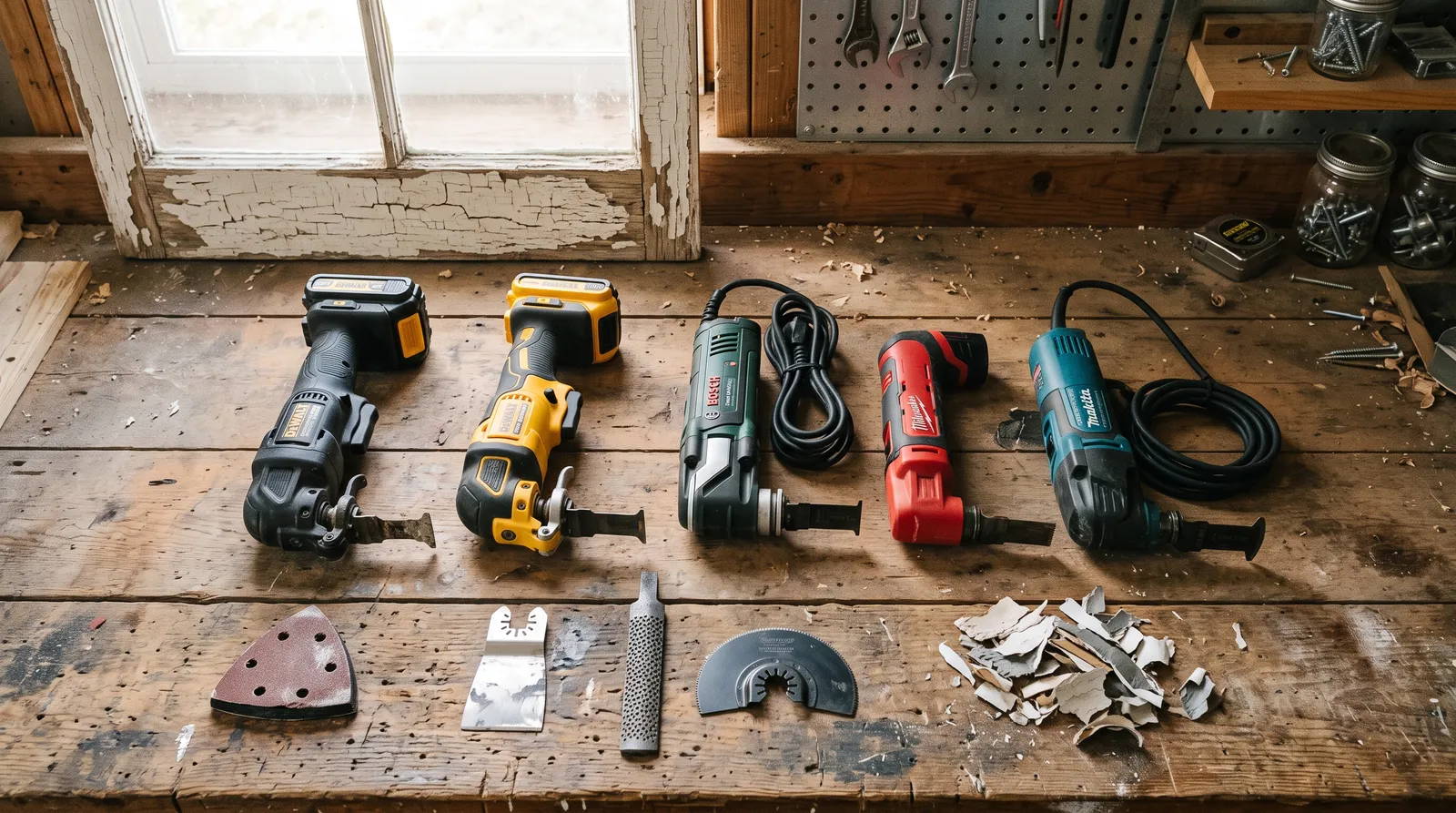
Five oscillating multi-tools tested on peeling siding, window sash, painted casing, and old caulk. Top pick: DeWalt DCS356B for oscillating tool paint removal that holds speed under load.

Disclosure: Some links below are affiliate links. We earn a commission if you buy through them, at no extra cost to you.
Top pick: the DeWalt DCS356B. Around $150 for the bare tool, 20V brushless, three fixed speeds sitting under a variable trigger, and a blade mount you change with your thumb. It wins on the two things paint prep actually asks for. The motor holds speed when you lean a rigid scraper into a painted sash, and the QUICK-CHANGE head takes universal-fit accessories, so the $14 carbide rasp on the home-center peg hook fits without an adapter. It falls short on amplitude. If you’re stripping fifty feet of porch column back to bare wood, the Fein MultiMaster AMM 700 Max Top removes more paint per minute than anything else in this test, and it costs three to four times as much. The Milwaukee M18 FUEL 2836-20 is the runner-up for all-day exterior work. The compact M12 FUEL 2526-20 fits inside a divided-light sash where nothing else will. On a budget, the corded Dremel Multi-Max MM50 does most of the job for under $130.
The category has a hard limit, and it’s worth knowing up front.
An oscillating multi-tool is a detail stripper. It will not take the paint off a house. It takes the paint off the parts of a house that a scraper and a random-orbit sander cannot reach, and it does that better than any other tool made.
Where This Tool Earns Its Money on a Paint Job
Run through the last exterior repaint you did. The broad clapboard came off fine with a pull scraper and a 5-inch random-orbit sander. Then you hit the window.
Sash muntins. The rabbet where glass meets wood. The inside corner of a casing return. The underside of a sill nose. The bead on a porch column. Every one of those is a profile a flat scraper skates over and a sanding disc cannot touch, and every one of those is where paint fails first because water sits there.
That’s the oscillating tool’s job. A rigid scraper blade oscillating a few degrees at 12,000 strokes a minute gets under the failed film and lifts it off in chips. Swap to a carbide rasp and you feather the hard ridge where sound paint stops and bare wood begins, which is the step almost everyone skips and the reason repainted trim reads lumpy in low sun. Swap to a delta sanding pad and you clean out the inside corner.
Four other paint-prep jobs it does well, in rough order of how often we used it during testing:
Old glazing putty. A rigid scraper under a wood sash pops hardened putty out of the rabbet without gouging the muntin. This is the job Fein built the MultiMaster for in the first place.
Dead caulk. A flexible scraper or a grout blade takes a bead of hardened silicone-latex out of a tub surround or a trim joint faster than a utility knife and without slicing the substrate. Recaulking over failed caulk is the most common prep shortcut we see, and it always telegraphs.
Wallpaper adhesive. After steaming, the residue that stays glued to the drywall paper comes off with a flexible scraper at low speed. Go slow. High speed burnishes the paste into the paper. There’s more on that in the guide to wallpaper glue residue.
Cutting out rot. A segment blade plunges into a soft window sill or a rotted casing return and takes out the punky wood cleanly so you can fill it. No other portable tool makes that cut in a corner.
What it doesn’t do: broad flat area. Anything over about two square feet, put down the multi-tool and pick up a random-orbit sander.
How We Ran These Five
Six weeks, four jobs, five tools, same accessories wherever the mount allowed it.
The exterior job was a 1962 clapboard house with failing oil-based paint on the south elevation, roughly 180 square feet of scraping and feathering back to sound paint. Four double-hung wood sash came off the same house and got stripped on a bench, glazing putty included. Interior work was a 1980s kitchen with fourteen painted cabinet boxes that needed inside-corner sanding, and a bathroom with about thirty feet of hardened caulk to remove before recoating.
Every tool ran a rigid scraper blade, a carbide rasp, and a hook-and-loop delta pad with 80-grit and 120-grit paper. Five scoring axes: paint removed per minute of scraping on the same paint system, speed holding under load, grip vibration after a continuous twenty-minute session, head clearance inside a divided-light sash, and accessory cost per hour.
Battery tools ran a single mid-size pack. Nobody sent us anything; all five came off retail shelves.
The results split cleanly. The Fein removed the most paint per minute and cost the most per hour to feed. The M18 was the calmest in the hand. The M12 was the only tool that worked comfortably inside a nine-light sash. The DeWalt finished second or third on every axis and first on the one that matters to most buyers, which is what you get for the money. The Dremel took twice as long on the exterior scraping and never once needed a battery.
Side by Side
| Tool | Power | Speed range | Blade mount | Best for | Price tier |
|---|---|---|---|---|---|
| DeWalt DCS356B | 20V brushless, 3-speed | Variable to 20,000 opm | QUICK-CHANGE, universal fit | All-round paint prep, best value | $$ |
| Fein MultiMaster AMM 700 Max Top | 18V brushless | 10,000-19,500 opm | StarlockMax | Heavy stripping, glazing putty | $$$$ |
| Milwaukee M18 FUEL 2836-20 | M18 brushless | 10,000-20,000 opm | OPEN-LOK, universal fit | Long exterior sessions | $$$ |
| Milwaukee M12 FUEL 2526-20 | M12 brushless | 10,000-20,000 opm | OPEN-LOK, universal fit | Sash, muntins, cabinet corners | $$ |
| Dremel Multi-Max MM50-01 | 5.0 amp corded | 10,000-23,000 opm | Wrench-free, universal fit | Interior trim, budget kit | $ |
1. DeWalt DCS356B, Top Pick
The three-speed selector is why this one wins, and it’s the feature buyers overlook on the shelf.
Most oscillating tools give you a dial and a trigger, and the dial creeps under a gloved thumb. The DCS356B has three detented speed settings and a variable trigger under them. You set speed two for scraping soft interior latex, and the trigger still gives you a soft start so the blade doesn’t jump off the line. On the exterior clapboard we ran it at speed three with the rigid scraper and it did not once stall when we pushed, which is exactly where the brushed Dremel gave up.
Accessory fit is the other half of the argument. The QUICK-CHANGE mount takes universal-fit blades, pads, and rasps. Over a full sash-stripping job we burned through four scraper blades and two rasps, and every one of them came off a home-center peg hook for a third of what a Starlock equivalent costs. Over a year of prep work that difference is larger than the price gap between this tool and the Fein.
On paper it has less amplitude than the MultiMaster, and in practice you feel it on thick alkyd. Where the Fein pulled paint off in curls, the DeWalt took chips and needed a second pass on the heaviest build-up. The head is also bulky. Inside a six-light sash it clears the muntins but you’re working at an awkward angle, and the M12 is simply better in there.
| Spec | Value |
|---|---|
| Power | 20V MAX XR brushless, bare tool |
| Speed | 3-speed selector plus variable-speed trigger, to 20,000 opm |
| Mount | DeWalt QUICK-CHANGE, accepts universal-fit accessories |
| Best for | Mixed interior and exterior paint prep on one battery platform |
| Approx. price | $145-$170 bare, $200-$230 kitted |
Buy it if: you want one oscillating tool for scraping, feathering, and corner sanding, and you’d rather spend the savings on consumables. Skip this if: every job you do is a divided-light window, or you strip paint professionally and amplitude pays your bills.
2. Fein MultiMaster AMM 700 Max Top, Best for Heavy Stripping
Fein invented this tool category, and the amplitude spec is where that shows.
The AMM 700 Max runs 2 x 2.0 degrees of oscillation, the widest stroke of the five. In hand that translates to a rigid scraper that gets under paint and keeps going instead of chattering on the surface. On the south elevation clapboard, the MultiMaster was the only tool that consistently lifted the old oil film in strips rather than flakes. On glazing putty it wasn’t close. Hardened putty that took the M12 several minutes per light came out of the rabbet in one pass.
The low end of the speed range matters as much as the top. It dials down to 10,000 opm with real control, and low speed is where scrapers do their best work. Fast blades skate. Slow blades bite.
Two hard cons. The Top set costs three to four times the DeWalt, which is a lot of money for a tool most homeowners use four weekends a year. And StarlockMax accessories are both expensive and exclusive; the universal blades in your existing bag will not mount. Budget accordingly, because the running cost is the real story here, not the sticker.
Third con, smaller: it’s heavy. Working fascia overhead for an hour, my forearm knew it.
| Spec | Value |
|---|---|
| Power | 18V brushless, AMPShare compatible |
| Speed | 10,000-19,500 opm |
| Amplitude | 2 x 2.0 degrees |
| Mount | StarlockMax, roughly 180 Fein accessories |
| Best for | Sash restoration, glazing putty, heavy multi-layer stripping |
Buy it if: you restore old windows, or you’re stripping a whole pre-war house and the tool will pay for itself in labor hours. Skip this if: this is a one-house project. The DeWalt gets you eighty percent of the removal rate for a quarter of the money.
3. Milwaukee M18 FUEL 2836-20, Best for All-Day Exterior Work
Vibration is the spec nobody shops for and everybody regrets ignoring.
Paint prep is not measured in cuts. It’s measured in hours of continuous scraping, and after two of those your hands decide whether the wall gets finished today. The 2836-20 has real vibration dampening built into the head, and across our twenty-minute continuous-session test it left the least hand buzz of anything here. Not marginally. Noticeably. On the second day of exterior scraping I picked it up over the DeWalt without thinking about it.
The rest is what you’d expect from M18 FUEL. Brushless, 10,000 to 20,000 opm, strong low-end control, an OPEN-LOK mount that swallows both Milwaukee and universal-fit accessories. If you already own M18 batteries, this is the least friction of any pick on the list.
It costs more than the DeWalt for very similar paint output, and the nose is long. Inside a cabinet box it was the most awkward of the five. The dust port is an extra purchase and a nuisance to fit.
Verdict: the tool for the guy scraping fascia and soffit all week. If you already run M18, this is the runner-up that quietly becomes the top pick.
4. Milwaukee M12 FUEL 2526-20, Best Compact for Sash and Cabinets
Small wins jobs that power can’t reach.
A nine-light double-hung sash has muntins about seven-eighths of an inch wide. Get a full-size oscillating head in there with a scraper blade and you spend the whole time worrying about the glass and the adjacent profile. The M12 FUEL is short enough and light enough to work that space one-handed, at an angle, with the blade doing what you told it to. Across four sash it was the tool I finished the detail work with every time.
Same 10,000 to 20,000 opm range as its big brother, same OPEN-LOK mount, a fraction of the mass.
Where it gives up is torque. On thick alkyd build-up it scrapes fine and rasps slowly, and pushing harder just stalls it. The M12 packs are small, so a full day of prep means two batteries and a charger running. If exterior siding is the main event, this is the wrong tool.
Buy it if: you’re restoring windows, repainting cabinets, or doing detail trim, and you want a tool that doesn’t fight the geometry. Around $150 bare.
5. Dremel Multi-Max MM50-01, Best Budget Corded
The tool I’d hand someone prepping their first room.
A 5.0 amp corded motor, a speed dial that runs 10,000 to 23,000 opm, a compact angled head, and a 30-piece kit in the box for around $120. For interior trim prep, caulk removal, and corner sanding, it does the work. Hour four is where corded pays off: no battery swap, no runtime math, no charger on the floor.
The head deserves specific credit. Dremel angled the body and shortened the front end, and it reaches into a window rabbet better than either full-size cordless tool in this test. On the cabinet job it got into inside corners the M18 couldn’t approach.
The motor is brushed and it acts like it. Lean a rigid scraper into hardened oil paint and the speed drops audibly. You learn to reduce pressure and let the blade work, which is slower but produces a cleaner result on softwood anyway. The bundled sanding sheets are thin and load up with soft latex within a few square feet, so buy real hook-and-loop delta paper before you start. And it’s corded, which means an extension cord on a ladder for any exterior work. Don’t.
Verdict: the right buy for interior prep and occasional use. Wrong buy if a ladder is involved.
What Actually Matters When You Choose One
Skip the marketing copy on the box. Five specs decide whether a tool is good at paint.
Amplitude. The oscillation angle, usually printed as a total degree figure or as 2 x something. Wider stroke, more material per pass. The Fein’s 2 x 2.0 degrees is the reason it strips faster than tools with more watts. Most tools land between 3.0 and 3.4 degrees total.
Usable low speed. Soft latex gums a scraper blade at 20,000 opm. Hardened alkyd wants speed. A tool that only goes fast is half a tool. Look for real control below 12,000 opm, and prefer a detented selector over a friction dial you’ll knock with your thumb.
Mount and accessory cost. Universal-fit mounts (DeWalt QUICK-CHANGE, Milwaukee OPEN-LOK, Dremel’s quick-fit) accept cheap generic blades. Starlock and StarlockMax accept better scrapers at a premium and won’t take generics. Over a year of prep work, consumables cost more than the tool. Do that math before you buy.
Vibration. After the first hour it’s the only spec you feel. Dampened heads (Milwaukee M18 FUEL, Fein) are worth the upcharge if you scrape for a living.
Head size. Divided-light sash, cabinet corners, stair balusters. Measure the tightest thing you’ll work on before you buy the most powerful tool on the shelf.
One more thing that isn’t a spec: dust. Every one of these makes chips or dust, and the delta sanding pad makes fine dust in volume. Wear a real respirator, not a paper mask. Our respirator round-up covers what filters what.
Lead Paint Changes the Rules
Any house built before 1978 gets treated as lead until a test says otherwise, and paint prep is the exact activity that releases it.
Oscillating scraper blades are the better power option here because they produce chips instead of airborne dust. Chips fall. Dust travels. But chips in soil and chips in carpet are still contamination, so contain the work zone with plastic, mist the surface before you scrape, collect everything, and wear a P100.
Never put a sanding pad on suspect lead paint without HEPA extraction. That is the single most dangerous thing in this whole article.
Heat guns have their own lead problem: above roughly 1,100°F, lead paint fumes. That’s why the oscillating tool is often the safer first move on pre-1978 trim, and why the heat gun round-up spends so long on temperature control. If you’re hiring the work out on a pre-1978 house, federal RRP rules require an EPA-certified firm.
Tools We Looked At and Passed On
- Bosch StarlockPlus GOP18V-34. Genuinely good, very close to the DeWalt on paint work, and the Starlock accessory tax pushed it out. If you already own Bosch 18V, buy it without guilt.
- Ryobi ONE+ HP brushless multi-tool. Fine for caulk and light sanding. Stalled repeatedly under scraper pressure on exterior alkyd, which is the job we care about.
- Corded DeWalt DWE315K. A solid kit and cheaper than the cordless, but the Dremel’s angled head reaches more of the places paint prep sends you.
- Sub-$40 no-name oscillating tools. Two of them shed their blade clamp mid-test. The clamp is the whole tool. Don’t.
Mistakes That Cost You the Trim
- Scraping at full speed. High opm burnishes soft paint into a glaze instead of lifting it, and it heats the blade until the edge rolls. Start at the middle of the dial and only go up if the paint is hard.
- Skipping the feather. Scraped trim has a ridge where old paint stops. Prime and paint over that ridge and it shows in raking light forever. Carbide rasp, then 120-grit on the delta pad, then check it with your palm.
- Using a flexible scraper on paint. Flex blades are for caulk and adhesive. On paint they bow away from the surface at the exact moment you apply pressure.
- Buying the tool and cheaping out on blades. A soft-steel scraper rolls its edge in twenty minutes and then it’s a burnishing tool. Four good blades will outlast twenty bad ones.
- Digging into softwood. Old pine and cedar are softer than the paint on them. Hold the blade at a low angle and let the oscillation do the work. Gouges need filler, and filler needs its own prep and its own primer coat. The primer explainer covers which one goes over bare patched wood.
- Prepping bare wood and leaving it. Bare exterior wood should be primed the same day it’s exposed. Overnight moisture into open grain is how the next coat fails, and the peeling exterior paint guide is mostly a list of people who waited.
What I’d Actually Buy
One house, mixed interior and exterior, no existing battery platform: the DeWalt DCS356B kit at around $220, plus four rigid scraper blades, two carbide rasps, and a pack of hook-and-loop delta paper in 80 and 120. Call it $290 and you’re set for years.
Already on M18: buy the 2836-20 bare and spend the savings on blades.
Restoring old wood windows, or stripping a pre-war house room by room: the Fein. It costs what it costs, and after the second sash you stop thinking about the price.
Interior trim, one room, working on a budget: the Dremel MM50 kit and a better set of sanding sheets than the ones it ships with.
And whichever one you buy, spend the extra $30 on real scraper blades. The tool is not the thing that removes paint. The edge is.
Ask a Question