What Is PVA Primer? The New-Drywall Sealer, Explained
PVA primer is a cheap polyvinyl acetate sealer built for one job — bare drywall. Here is the chemistry behind it, why it works there, and the four places it will let you down.

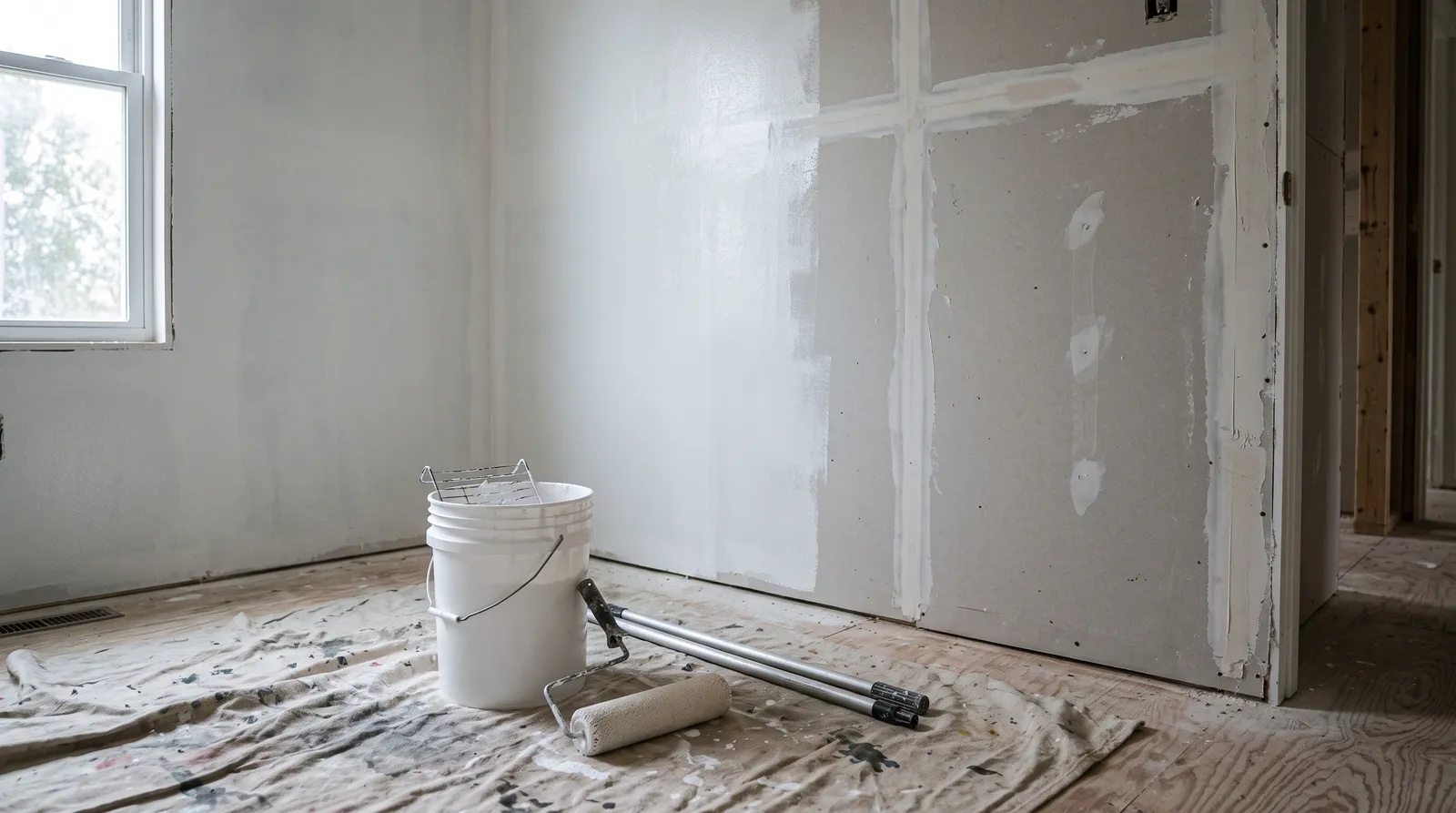
Most people meet PVA primer as the cheap bucket at the end of the primer shelf, half the price of everything beside it, and reasonably assume cheap means worse. It is not worse. It is narrower. PVA primer is polyvinyl acetate resin in water, and it is engineered for exactly one substrate — new, bare, taped and sanded drywall — where it does a better job per dollar than anything else on the shelf.
The trouble starts when people take that bucket home and use it everywhere else.
What PVA Actually Is
Polyvinyl acetate is a thermoplastic vinyl polymer. If that means nothing to you, here is the analogy that does: it is the same resin family as white wood glue. The bottle of Elmer’s in your drawer is a PVA emulsion. So is the binder in the cheapest flat ceiling paint on the shelf.
That tells you most of what you need to know about how it behaves.
A PVA film forms by pure coalescence. Water evaporates, the resin particles crowd together, and they fuse into a continuous film. There is no chemical cross-linking, no second reaction that hardens the film over the following weeks the way an alkyd or a modern acrylic keeps developing. What you get at the end of drying is what you get forever.
That has two consequences worth holding onto.
The first is that PVA dries fast and cheap. There is no cure chemistry to wait on. Water leaves, the film is done, and you can topcoat in about an hour. The resin itself is inexpensive to make, which is why a gallon runs roughly $12 to $20 while acrylic primers start closer to $25 and climb.
The second is that a PVA film stays soft and stays water-sensitive. Un-cross-linked vinyl acetate softens when it gets damp and softens further when it gets warm. This is not a defect — it is the trade you make for the price. It is also the reason the list of places PVA does not belong is as long as it is.
Why New Drywall Needs a Sealer at All
Look closely at a wall that has just been hung and finished. You are not looking at one surface. You are looking at two, side by side, with wildly different appetites.
The field of the board is paper — a facing sheet designed to be absorbent so the joint compound sticks to it. The seams, the corner beads and every screw dimple are joint compound, sanded smooth. Compound is essentially a chalky filler with a small amount of binder in it. Its porosity is much higher than the paper’s, and the sanded surface is more open still because sanding opens the pores rather than closing them.
Now roll unprimed finish paint across that.
Where the roller crosses joint compound, the substrate pulls water out of the wet film fast. The binder particles do not get the time they need to coalesce properly, so the film that forms there is thinner, less continuous, and optically duller. Where the roller crosses paper, water leaves more slowly, the binder coalesces properly, and the film comes out normal.
Step back and you can read every seam in the room as a band of slightly different sheen. Painters call it joint banding or photographing; in general terms it is flashing. It has nothing to do with paint quality. It is a substrate story, and once the first coat has dried that way, a second coat does not reliably erase it — the second coat sinks unevenly too, just less.
PVA primer’s whole purpose is to remove the difference before the finish paint ever arrives. It is loaded with cheap filler pigment, it wets porous surfaces readily, and it dries to a film with uniform, mild absorbency across both paper and compound. The topcoat then meets one surface instead of two. Everything above it forms evenly.
That is also why the finish coat covers so much better afterward. Unsealed drywall drinks paint. Sealed drywall does not. The same gallon that gets you 250 square feet on raw board gets you 380 over primer.
Where PVA Primer Should Not Go
This is where most of the disappointment comes from, so it is worth being blunt about each one.
It does not block stains. PVA is water-based and permeable. A water stain on a ceiling, nicotine film, marker, or an old grease shadow will dissolve into the wet primer, dry with it, and dissolve again into the next wet coat. You get the stain back every time. Stain-blocking is a barrier chemistry job and requires shellac or a stain-blocking oil primer. The BIN vs 1-2-3 comparison walks through what actually holds a stain down.
It does not block tannin, so it does not belong on wood. Knots in pine, and the extractives in cedar and redwood, migrate through a permeable film and stain the topcoat amber. PVA is one of the most permeable primers there is. Bare wood wants shellac or an oil-based primer, every time.
It bonds poorly to slick surfaces. PVA works by soaking into porosity. Give it a glossy oil-painted door, melamine, laminate, tile or a factory finish and there is nothing to soak into. The film sits on top and lets go. This is bonding-primer territory — a urethane-modified acrylic like Insl-X Stix.
It is the wrong choice where things get wet. Because polyvinyl acetate softens with sustained moisture, a bathroom that steams daily or a laundry room with condensation issues will find the softest layer in your paint stack and work on it. Use an acrylic drywall primer or a purpose-built moisture-resistant sealer instead.
It is interior only. Sun, freeze-thaw cycles and rain all attack a soft, un-cross-linked film. There is no exterior PVA primer worth using and most manufacturers do not label one.
Be careful on fresh masonry and lime plaster. Vinyl acetate hydrolyses in alkaline conditions. Fresh concrete, stucco and traditional lime plaster carry a high pH for months. A PVA film over a high-alkali substrate can slowly break down from underneath. Use an alkali-resistant masonry primer.
There is no point using it on already-painted walls. The sealing job is already done by the old paint film. You would be inserting a soft, weakly bonded layer between two harder ones for no benefit.
PVA vs Acrylic Drywall Primer
Both are sold for the same shelf position, and the difference is real but narrow.
| PVA drywall primer | Acrylic drywall primer | |
|---|---|---|
| Resin | Polyvinyl acetate | Acrylic or vinyl-acrylic copolymer |
| Typical price per gallon | About $12–$20 | About $25–$40 |
| Seals new drywall | Yes, very well | Yes, very well |
| Bonds to glossy surfaces | No | Some, with prep |
| Blocks light water stains | No | Light ones only |
| Moisture tolerance | Low | Moderate |
| Recoat time | About 1 hour | About 1 hour |
| Best use | Whole-house new construction | Mixed-substrate repaint work |
The honest summary: on genuinely new drywall with no stains and no surprises, PVA and acrylic will look identical under the finish coat, and PVA costs half as much. On any wall with a history — a repair, a stain, an old glossy finish, a suspect surface — the acrylic earns its extra money by being useful in more situations. Reference products in each camp include Glidden PVA Drywall Primer and KILZ PVA Drywall Primer at Home Depot, Valspar PVA Drywall Primer at Lowe’s, Sherwin-Williams PVA Drywall Primer and Sealer at Sherwin-Williams stores, and on the acrylic side Zinsser Bulls Eye 1-2-3. We break the whole category down in the primer round-up, and the general chemistry lives in what is primer.
The Cheap Insurance Argument
Run the numbers on an average 12 by 14 foot bedroom with 8-foot ceilings. That is roughly 400 square feet of wall.
Unprimed, the first coat of finish paint disappears into the board — you are spending a gallon of $50 paint doing sealer work, and you will still see the seams. Primed, one gallon of $15 PVA seals the room, and two finish coats cover cleanly on about a gallon and a half.
So the primer is not an extra step you paid for. It replaced a coat of finish paint that cost three times as much and would have done the job worse. In a whole new-construction house the gap is hundreds of dollars, which is why every production painter in the country primes new board with PVA and none of them agonise over it.
The insurance framing is the right one. You are spending fifteen dollars so that a two-thousand-dollar paint job does not read as banded seams in afternoon light.
Using It Properly
- Vacuum and wipe the sanding dust first. Primer bonds to whatever is on the surface. If that is a film of joint-compound dust, the primer bonds to the dust. A shop vac with a brush head, then a dry microfiber pass.
- One full wet coat, not two thin ones. The sealing comes from having enough film to close the pores. Starving it defeats the purpose. Use a 3/8-inch nap on level 5 finishes, 1/2-inch on ordinary texture.
- Do not sand the primer smooth. Light scuffing to knock down raised paper fuzz is fine. Sanding through it puts you back to bare board in patches, which is worse than not priming.
- Tint it toward a deep topcoat. Half-strength grey under a saturated navy or a deep green routinely saves a whole finish coat.
- Give it real time in a cold house. New construction is often unheated. At 50°F the one-hour recoat becomes three or four. The room needs to be above 50°F for the film to coalesce at all.
- Spot-prime any surprise with the right product. Found a water stain behind the drywall dust? Hit it with shellac first, then PVA over the whole wall.
The full sequence for a new room is in our new drywall guide.
Common Mistakes
- Buying PVA for a repaint job. It is a new-drywall product. On previously painted walls it is a soft layer nobody asked for.
- Expecting it to hide anything. PVA is a sealer, not a blocker and not a hider. A dark wall under white PVA is still a dark wall.
- Priming over dust. The single most common cause of a primer that peels off new drywall in sheets.
- Using it on the trim while the bucket is open. The seam between good drywall practice and bad trim practice is exactly here. Trim gets handled; PVA stays soft.
- Skipping it because the paint says self-priming. Self-priming finish paint is finish paint. It seals unevenly on drywall because it was never designed to do that. The paint and primer in one piece has the longer version.
The short way to hold all of this: PVA primer is a specialist, and the specialty is porosity. Give it bare drywall and it is the best fifteen dollars in the room. Give it a stain, a knot, a gloss or a shower and it will politely fail, because none of those problems are the one it was built to solve.
Ask a Question