How to Spray Masonry Paint
Spray masonry paint with an airless gun, a 0.021-inch to 0.025-inch tip, and a back-roll behind every pass. Tip size, pressure, and the mistakes that peel.

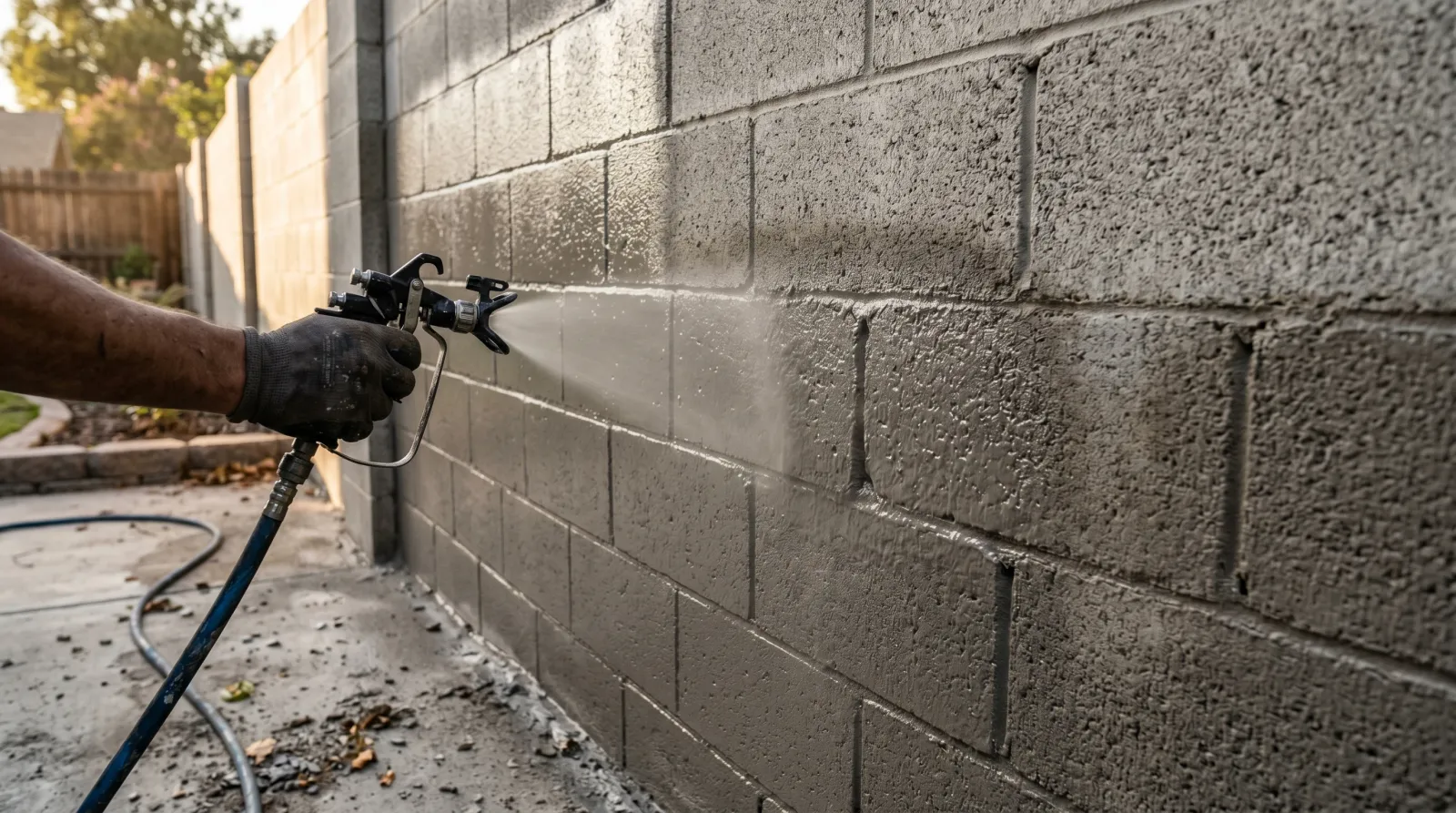
Spraying masonry paint means atomizing a thick acrylic or elastomeric coating through an airless gun and laying it onto block, brick, or stucco fast. An airless rated for 0.5 gallons per minute and up, fitted with a 0.021-inch to 0.025-inch reversible tip, will cover a wall four to six times faster than a roller. On porous masonry, the gun alone isn’t enough. The fan lays paint on the high points and skips the pores, so you back-roll every pass to push the wet film into the surface. Spray, roll, spray, roll, two coats, 8 to 10 dry mils.
That’s the whole job. Everything below is the why.
When to Spray Masonry Paint
Spray it for:
- Big exterior block, CMU, or split-face walls. Warehouses, foundations, garden walls, retaining walls.
- Stucco, traditional or synthetic, where the texture eats a roller and takes all day.
- Rough brick and parging where speed matters and the surface is too coarse to roll cleanly.
- High-build coatings like elastomeric and block filler that you want to lay on thick and even.
- Any job where you can mask the surroundings and there’s no overspray drift onto cars, neighbors, or glass.
If the wall is big, rough, and out in the open, the gun pays for itself by lunch.
When NOT to Spray Masonry Paint
- Windy days. Anything over 10 mph and the overspray walks. You’ll fog a neighbor’s truck two lots over and lose half your paint to the air.
- Tight, cluttered sites. Spraying near windows, downspouts, AC units, and parked cars means more time masking than painting. Roll it.
- Damp or chalky masonry. Fresh efflorescence or a chalky old coat has to come off first. Spray over it and the new film peels with the old. See the fix for efflorescence on brick and chalking on exterior walls before you load the gun.
- One small wall. Setup, masking, and cleanout on an airless eat 45 minutes. For a single 8-foot block wall, a 3/4-inch nap roller is done before the sprayer’s primed.
- Below 50°F or above 90°F. Masonry coatings flash wrong outside their window. Cold and the film won’t form; hot and it skins before you back-roll.
How Spraying Compares to Rolling and Brushing
| Spray + back-roll | Roll only | Brush only | |
|---|---|---|---|
| Speed on rough block | fastest | slow | slowest |
| Film bite in pores | strong | strong | strong |
| Overspray cleanup | high | none | none |
| Crew needed | 2 ideal, 1 works | 1 | 1 |
| Best for | big open walls | small or tight jobs | cut-in and detail |
The gun wins on speed and on driving even film into deep texture. It loses on cleanup and on any site where overspray is a problem. For the surface-prep walkthrough, see the masonry painting guide.
How to Actually Do It
This is the part that decides whether you sealed the wall or just fogged it.
Step 1 — Match the tip to the coating. A 0.021-inch to 0.025-inch reversible tip for standard acrylic masonry paint. Elastomeric and block filler want 0.027-inch to 0.035-inch. Run the biggest tip the coating needs and the gun can push.
Step 2 — Set the pressure. Crank the airless until the fan stops “tailing” (heavy edges, thin middle). Masonry coatings need 2,800 to 3,300 PSI to atomize clean. Too low and you get fingers; too high and you blow paint into the air and wear the tip out fast.
Step 3 — Spray a 4- to 6-foot section. Keep the gun 12 inches off the wall, perpendicular, moving at a steady walking pace. Overlap each pass 50 percent. Don’t spray a whole wall and walk back. The film flashes before you can roll it.
Step 4 — Back-roll into the wet. Grab a 3/4-inch or 1-inch nap on rough block and stucco, 1 1/4-inch on heavy texture. Run the roller across the sprayed strip in two crossing passes. You’re not adding paint. You’re pushing the sprayed film into the pores so the whole surface seals, not just the peaks. This is the step that keeps the warranty. The full rundown is in what back-rolling does.
Step 5 — Move to the next strip, then second-coat the whole sequence. Roll into the previous wet edge, no stopping mid-wall. Then spray and roll the second coat the same way. Two coats, both back-rolled, every time.
Common Mistakes
- Spraying without back-rolling. The single biggest one. A sprayed-only coat sits on the high points of porous block and skins off in two years. Every masonry coating’s data sheet says back-roll. They mean it.
- Tip too small for the coating. Run a 0.017-inch tip on thick elastomeric and the gun stalls, spits, and tails. You fight the gun all day and the film comes out streaky. Step up to 0.027-inch and the same paint flows.
- Over-thinning to “make it spray.” Watering down a thick masonry paint past the label limit thins the film below the dry mils it needs to seal. Step up the tip instead. If you must thin, stay inside the label, and read thinning paint first.
- Holding the gun at an angle or wrong distance. Tilt the gun and you get a heavy edge and a light edge. Drift past 14 inches and the fan dries before it lands, leaving dry overspray fuzz on the wall.
- Spraying chalky or wet masonry. New film bonds to the loose old film, not the wall. The whole stack peels. Pressure-wash, let it dry two days, then spray.
What It Looks Like
A clean masonry spray pass reads as an even, slightly stippled film with paint sitting full in the mortar joints and the pores, not just on the face of the block. Hold a raking light across it after back-rolling and you should see no dry pinholes, no bare valleys, no glossy high points next to dull low points. If the joints look starved while the block face looks coated, the gun skipped and the roller didn’t chase it. That wall fails first at the joints.
Where to Buy / What to Look For
You need an airless rated for at least 0.5 GPM to push masonry coatings. Graco and Titan stand-mount or cart units are the workhorses. Pair it with a 50-foot 3/8-inch hose (thick coatings choke a 1/4-inch line), a reversible tip in your coating’s range, and a 9-inch frame with 3/4-inch to 1-inch lambswool covers for the back-roll. For the gun itself, see the best airless sprayers. For which coatings the makers list as spray-and-back-roll, see the best masonry paint picks.
FAQ
can you spray masonry paint with an airless sprayer?
Yes, and it’s the fastest way to coat block, stucco, or brick. Use an airless rated for at least 0.5 GPM, a reversible 0.021-inch to 0.025-inch tip, and a 50-foot 3/8-inch hose for thick coatings. On porous surfaces, back-roll behind every pass or the paint peels.
do you have to thin masonry paint to spray it?
Most acrylic masonry paint sprays straight from the can through a 0.021-inch or larger tip. Thin only if the gun stalls or spits, and only by the label amount, usually up to 10 percent water. Elastomeric is too thick to thin much. Step up the tip size instead.
how many coats of masonry paint when spraying?
Two coats, and back-roll both. One sprayed coat leaves thin film in the pores even when the peaks look covered. Two coats with a roller chasing the gun get you the 8 to 10 dry mils most masonry coatings need to seal the wall.
what tip size for spraying masonry paint?
A 0.021-inch to 0.025-inch reversible tip for standard acrylic masonry paint. Elastomeric and high-build block filler want 0.027-inch to 0.035-inch. Too small and the gun stalls; too big and you flood the wall and get runs.
Related
One last thing that’ll bite you in two years: a sprayed-only masonry wall looks perfect the day you finish. Give it one freeze-thaw cycle. The first hard winter, the unbonded film on the high points checks, then the next year water gets behind it through the bare pores and the coating sheets off the block. There’s no patch for it. You strip and start over. Spray it, then roll it, every coat. Always.
Ask a Question