What Is Back-Rolling? And When You Actually Need It
Back-rolling pushes sprayed paint into the surface. Required on stucco, raw drywall, and porous masonry. Optional on smooth pre-primed siding. Here's the rule.

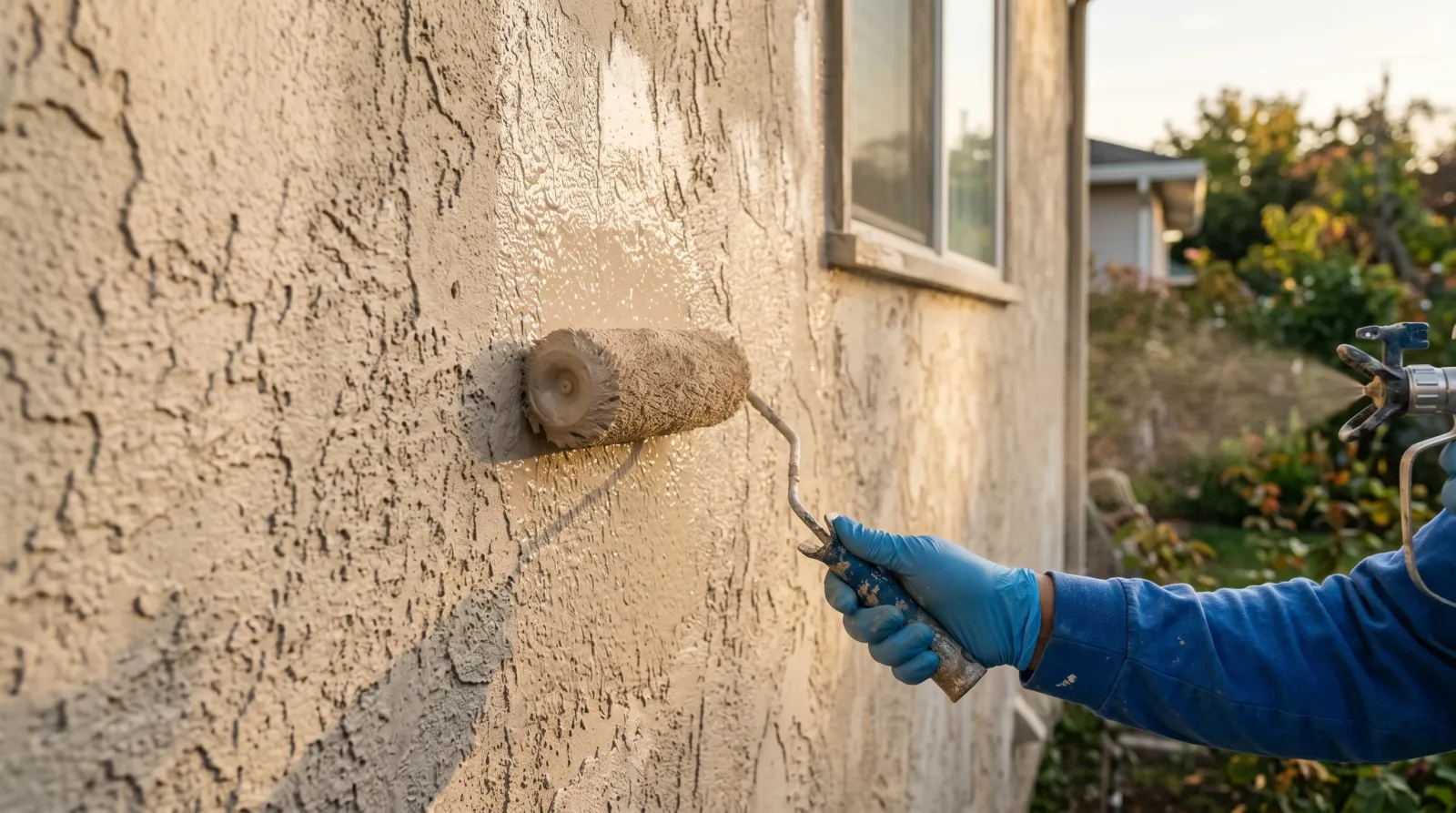
Back-rolling is what it sounds like. You spray the paint on, then immediately run a roller over the wet film to push it into the surface. It’s a pro technique that takes a 4-8 wet mil sprayed film and forces it into every pore, crack, and texture valley the spray tip skipped. On porous substrates — stucco, raw drywall, concrete block, rough masonry — back-rolling isn’t a finishing flourish. It’s how the paint actually bonds. Skip it and the coating sits on the high points, peels in two years, and warranty doesn’t cover spray-only application on any of these surfaces.
That’s the whole rule. Everything below is the why.
When You Have to Back-Roll
Required on:
- Stucco — traditional, synthetic, EIFS topcoat. Every one.
- Raw drywall, primer coat. The first coat into porous gypsum paper.
- Concrete block, CMU, split-face block.
- Brick, rough or sandblasted.
- Rough-sawn cedar, fresh fiber cement before the factory primer is sealed.
- Any surface where the manufacturer’s TDS says “back-roll” — Sherwin Loxon, BM Aura Exterior, every elastomeric on the market.
If the surface has texture you can feel with your hand, the roller goes on after the spray. Not optional.
When You Don’t Have to (but it Won’t Hurt)
- Smooth pre-primed Hardie or LP SmartSide siding. Factory primer already sealed the substrate. Spray-only holds up.
- Already-painted smooth interior walls on a repaint. The old film is the bond. New paint just sits and levels.
- Vinyl siding, smooth metal, cabinets. Spraying gives the best lay-down. Roller would wreck it.
- Trim, doors, and any project where the lay-down matters more than the bond. Spray and tip. Don’t roll a door.
The rule: smooth and already-sealed, spray-only is fine. Porous and unsealed, roller chases the gun. Always.
How Back-Rolling Compares to Spray-Only and Roll-Only
| Back-roll | Spray-only | Roll-only | |
|---|---|---|---|
| Speed on stucco | medium | fastest | slow |
| Film bite on porous | strong | weak | strong |
| Hides texture skips | yes | no | yes |
| Crew needed | 2 ideal, 1 works | 1 | 1 |
| Warranty coverage on stucco/block | yes | no | yes |
For the sprayer side of the job, see the best airless sprayers. For the stucco-specific walkthrough, see the stucco paint guide.
How to Actually Do It
This is the part that decides whether back-rolling helps or just smears the film.
Step 1 — Set the spray pattern. A 12- to 14-inch fan, vertical or horizontal depending on which way you’re walking the wall. Tip size 515 to 519 for masonry coatings. Keep the gun 12 inches off the wall and move at a steady walking pace. You’re laying down 4-8 wet mils.
Step 2 — Spray a 4- to 6-foot section. Don’t spray a whole wall and walk back. The film flashes too fast. One strip per back-roll cycle.
Step 3 — Back-roll into the wet. 3/4-inch nap for stucco, 1-inch for heavy texture, 3/8-inch for smooth drywall. Run the roller from dry into wet, then back across the strip in opposite directions. Two crossing passes per section. You’re not adding paint. You’re pushing the sprayed paint into the surface.
Step 4 — Move to the next strip. Roll into the previous wet edge. No stopping mid-wall. Stopping mid-wall on stucco is how you get lap marks the size of dinner plates.
Step 5 — Second coat repeats the whole sequence. Spray, roll, spray, roll. Skipping the back-roll on coat two is the most common warranty-killer on the job.
Common Mistakes
- Waiting too long between spray and roll. Five minutes on a 90-degree day and the film has skinned. Now the roller drags and pulls the skin off. Two-person crew solves it. Solo, work shorter sections.
- Wrong nap. A 3/8-inch nap on heavy stucco rides the peaks and never touches the pores. You sprayed for nothing.
- Pressing too hard. Back-rolling is wrist weight, not body weight. You’re working the paint in, not squeezing it out. Heavy pressure smears the film into runs.
- Back-rolling a wall already touched by morning sun. The substrate is too hot, the film flashes before the roller hits, the texture grabs the half-dry paint and rips fuzz off the nap. Chase the shade.
- Cheap roller cover. A bargain 3/4-inch nap sheds fibers into wet stucco coating and you find them all summer. Wooster or Purdy 3/4-inch lambswool blend. Pay the $9.
Where to Buy the Right Roller
For porous masonry and stucco, 3/4-inch and 1-inch napped lambswool covers in a 9-inch frame. Pair it with a sturdy extension pole so you can ride the roller into the spray pattern without ducking under it. The deeper breakdown is in the paint rollers round-up and the masonry paint picks cover which coatings the manufacturer specifically lists as back-roll-required.
Related
One last thing that’ll bite you in two years: if you sprayed stucco without back-rolling and the job looks fine right now, give it through one freeze-thaw cycle. The first February after install, the unbonded film on the high points starts checking — tiny hairline cracks running with the texture lines. By the second winter the cracks open and water gets behind the coating. There’s no fix short of stripping and starting over. Back-roll the first time. Always.
Ask a Question