German Smear vs Limewash vs Whitewash
German smear vs limewash vs whitewash, explained plainly. How each finish looks on brick, how thick it goes, how long it lasts, and which one to pick.

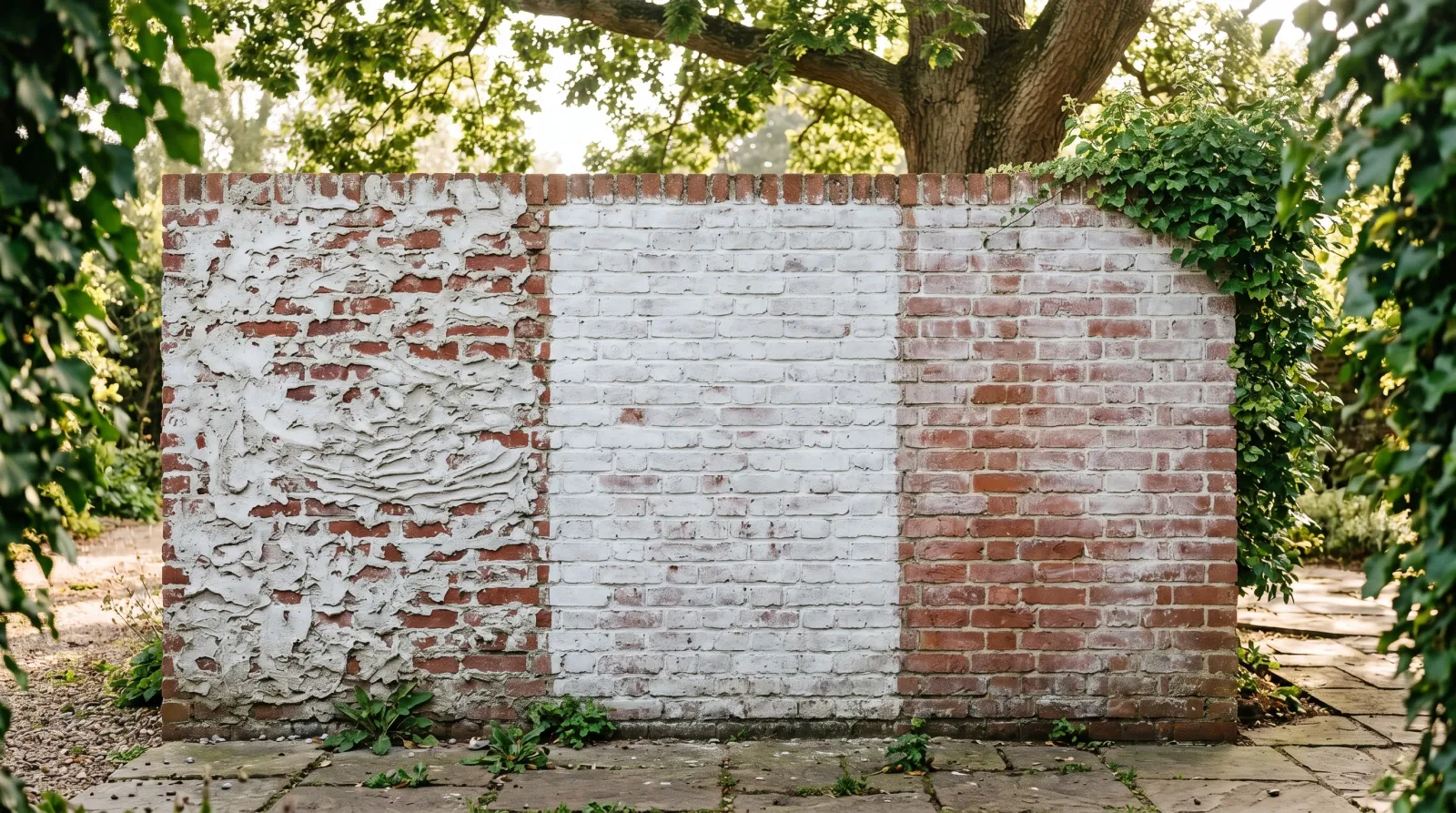
German smear, limewash, and whitewash are three ways to soften red brick toward white without hiding it. German smear is the thickest: wet mortar troweled over the brick and wiped back, so it sits raised and grouted, often 1/8 to 1/4 inch thick where it catches, with bare brick peeking through. Limewash is a thin slaked-lime paint brushed on flat; it soaks in, reads chalky and matte, and lasts about 5 to 7 years before a refresh. Whitewash is the lightest touch, watered-down paint or lime brushed translucent so the brick color still glows underneath. Same goal, three textures.
The quickest way to keep them straight: German smear changes what you feel on the wall. Limewash and whitewash mostly change what you see. One is masonry work. The other two are a kind of painting.
How They Differ at a Glance
| German smear | Limewash | Whitewash | |
|---|---|---|---|
| What it is | Mortar troweled over brick | Slaked-lime paint, thin | Diluted paint or lime, thin |
| Texture | Raised, grouted, rough | Flat, chalky, matte | Flat, smooth, sheer |
| Brick showing through | Yes, in patches | Faintly, as a soft veil | Yes, color glows under |
| Coverage feel | Heavy, mortared | Soft, washed | Sheerest, most see-through |
| Lasts | Permanent | 5–7 years, then refresh | Longest of the painted looks |
| Reversible | Very hard | Easy to soften | Easiest to strip |
| Best for | Old-world, cottage, Tudor | European farmhouse, soft modern | Cottage, light brightening |
For the full single-finish breakdown, see what limewash actually is and how it sits against brick over time.
When to Use Each One
Pick by how much of the brick you want to keep, and how much texture you want to add.
Reach for German smear when:
- You want an old-world, weathered, slightly European look with real dimension.
- The brick underneath is plain or unremarkable and you want to mute it heavily.
- You like the idea of a permanent finish you never repaint.
- The architecture leans cottage, Tudor, or French country.
Reach for limewash when:
- You want the brick softened to a chalky, washed white but still readable as brick.
- You like a matte, lived-in finish that ages by fading rather than peeling.
- You want a breathable, lime-based coat that lets old masonry move moisture.
- You may want to lighten or refresh the tone again in a few years without stripping anything.
Reach for whitewash when:
- You want the lightest touch — brick that reads brighter but keeps most of its color and warmth.
- You want the brick’s character to lead and the white to whisper.
- You are brightening a dim fireplace or interior wall, not transforming a whole facade.
When NOT to Use These Finishes
None of the three belongs on every brick wall, and the surface decides more than the style does.
Skip all three when:
- The brick is already painted or sealed. Limewash and mortar need bare, porous masonry to grab. Over a sealed or glossy painted surface, nothing bonds and it flakes off in a season.
- The wall is in deep shade and stays damp. A constantly wet wall fights any lime finish setting properly.
- You love the brick as it is. These are one-way changes, and German smear especially is close to permanent.
Skip German smear specifically when you might change your mind. It is real mortar bonded to brick; removing it means grinding, which scars the face. If you are unsure, limewash a back corner first and live with it for a month.
Skip true limewash when the wall shows active efflorescence — those chalky white salt deposits. Solve the moisture and salts first, because a lime coat over an actively-salting wall will keep blooming through.
How German Smear vs Limewash Compares to Painting
It helps to see where these sit next to ordinary masonry paint and the related lime products. They are not the same job.
| German smear / limewash | Masonry paint | Mineral paint | |
|---|---|---|---|
| Look | Translucent, brick reads through | Solid, opaque | Solid, matte, mineral |
| Breathable | Yes | Some are | Yes, very |
| Reversible | Smear no, limewash yes | No | No |
| Brick texture kept | Smear adds it; limewash keeps it | Hidden | Mostly kept |
If you decide you actually want full, even, solid coverage instead of a softened veil, you are no longer choosing between these three. You want the best masonry paint round-up, or a breathable mineral paint if you like the matte lime family but want full opacity. Limewash itself is its own product, sorted by tone and durability in the best limewash picks.
Common Mistakes
- Going over sealed or painted brick. This is the number-one failure. Limewash and mortar grab porous masonry, not film. Test a splash of water on the brick first. If it beads instead of soaking in, the wall is sealed and none of these will bond.
- Mixing German smear too dry or too wet. Too dry and it crumbles off as it cures. Too wet and it slides and smears flat with no texture. Mix to a thick peanut-butter body and work small sections so it stays workable.
- Skipping the test patch. All three read completely different wet versus dry, and different again across morning and evening light, the same way any white shifts with its undertone and the hour. Do a 3-by-3-foot patch and look at it across a full day before committing the wall.
- Wiping German smear too clean. People panic and wipe off most of the mortar, ending up with a thin whitewash look they could have gotten for a fraction of the labor. The point of smear is the raised, grouted texture. Leave it.
- Using straight latex paint and calling it limewash. Watered-down latex is a whitewash, not a limewash. It sits on top, it is not breathable, and it can peel. Real limewash is slaked lime and soaks in. Know which one you are buying.
What Each Finish Looks Like
On a wall, the three read as a progression from heavy to sheer. German smear is the most dramatic: mortar dragged across the faces, dropping into the joints, raised where it catches, with red brick winking through the gaps. It looks centuries old on day one.
Limewash sits flatter and quieter. It veils the brick in a soft, chalky white, so the wall reads as one calm tone with the texture of the brick still faintly visible underneath. It has the matte, powdery depth that flat latex can never fake.
Whitewash is the sheerest. The brick’s color still glows through a thin milky layer, so a red wall goes rosy-white rather than white, and the warmth stays. In a dim room, a whitewashed fireplace lifts the light without erasing the brick’s character.
Where to Buy and What to Look For
For German smear, you want bagged type N or type S mortar from any masonry or home center, mixed with water on site. That is most of the cost. For limewash, buy a true slaked-lime product (Romabio Classico is the name most people land on) rather than a latex labeled “limewash look.” For whitewash, you can dilute a quality masonry or breathable mineral paint yourself, roughly one part paint to one part water, and adjust from there.
Whatever you choose, do the water-bead test on the brick first, and prep the surface the way you would for any coating. The exterior brick guide covers cleaning, repointing loose joints, and the breathability rules that keep an old wall healthy under any finish.
If you want soft and washed but reversible, limewash. If you want sheer and warm, whitewash. If you want old-world texture and you are sure, German smear. Test a corner, look at it at the hour you see the wall most, then commit.
Ask a Question