What Is Mineral Paint?
Mineral paint uses a potassium silicate binder that chemically fuses to masonry, lasts 50+ years, and never needs biocide. Here's the chemistry and where it wins.

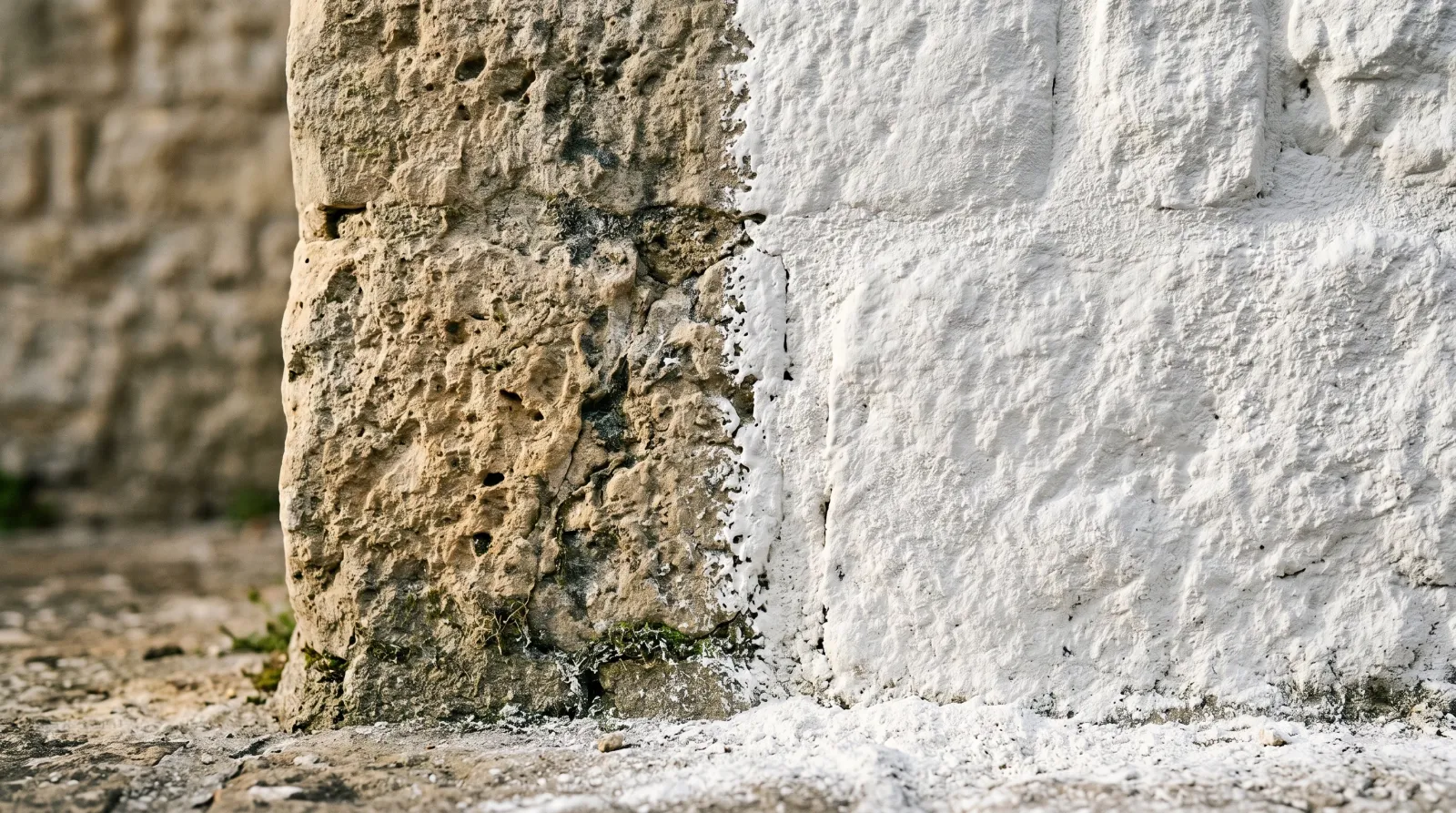
Most exterior paint failures on brick start the same way. A homeowner rolls premium 100% acrylic over a fifty-year-old brick facade in spring, and by the third winter the coating is bubbling along the mortar joints and peeling in sheets. The paint is fine. The brick is fine. A film-forming polymer on a vapor-permeable substrate is a long argument the substrate eventually wins.
Mineral paint solves that argument by refusing to form a film at all. The binder is potassium silicate, also called water glass. Instead of drying into a polymer skin on top of the wall, it reacts chemically with calcium and silica in the masonry to form an interlocking matrix of insoluble silicates. The pigment gets locked into that matrix. The coating doesn’t sit on the substrate. It becomes the substrate. That’s why Keim has documented projects in Europe with the original paint still serviceable at the 100-year mark, why Romabio markets a 20-year warranty as conservative, and why mineral paint never needs biocide. There’s no organic polymer for mold to eat.
How the Silicification Reaction Works
Potassium silicate in water exists as a soluble alkaline solution. Long polysilicate chains float in solution with potassium ions balancing the charge. When the solution contacts a calcium-rich or silica-rich substrate, water carries the silicate molecules into the surface pores. Potassium ions exchange with calcium in the substrate, and the silicate chains polymerize into a three-dimensional gel of calcium silicate hydrate. That’s the same family of bonds that hold concrete together. As the gel dehydrates over 24 to 48 hours, it crystallizes into a hard, insoluble mineral matrix bonded to the substrate at the molecular level.
The mineral pigment in the paint (iron oxide, titanium dioxide, chromium oxide, or other inorganic oxides) gets caught inside that matrix as it forms. The pigment becomes part of the crystal structure, not a particle suspended in a polymer film. That’s why mineral paint colors don’t fade. Iron oxide red has been used in cave paintings for forty thousand years. Embedded in a silicate matrix on a brick wall, it’ll outlast every owner of the house.
The reason the reaction needs a mineral substrate is straightforward. There’s no calcium or silica in an acrylic film to exchange with. Roll mineral paint over latex and the silicate has nothing to bond to. It dries as a chalky residue you can wipe off with a wet rag.
Why It Beats Acrylic on Masonry
Three things separate mineral paint from premium acrylic on brick, stone, and stucco.
Vapor permeability without water uptake. Masonry breathes. Brick walls, lime mortar, and old plaster all transmit water vapor from inside outward, and any seasonal moisture in the wall has to be able to leave. A 100% acrylic film blocks vapor on the way out (perm ratings under 1.0 are typical) and traps moisture against the substrate. That trapped water is what drives the blister-and-peel cycle on painted brick. Mineral paint runs perm ratings of 50 to 100, basically unrestricted vapor transmission, while still shedding bulk liquid water.
No film to peel. A polymer coating fails by losing adhesion. The film stays intact while it lifts off the substrate, which is why you can pull a sheet of failed acrylic paint off a brick wall in one continuous piece. Mineral paint has no film. The failure mode is mechanical abrasion (you can scratch it off with a stiff wire brush) but it cannot peel because there’s no discrete coating to peel. When it eventually wears, it wears as a slow chalking on the surface, and a maintenance recoat handles it in an afternoon.
No biocide needed. Acrylic and alkyd binders are organic polymers. Mold and algae will eat them given moisture and the right temperature. Every exterior latex on the market includes a biocide package (zinc oxide, isothiazolinones, sometimes carbendazim) to slow that growth, and the biocides leach out over years until the coating is defenseless. A silicate matrix is inorganic. There’s nothing for biology to consume. Mineral paint on a north-facing wall in a damp climate stays clean for decades without antimicrobial additives.
The trade-off is rigidity. The mineral matrix is hard and it doesn’t flex. If the masonry itself moves, the coating cracks with it because it is the surface now, not a flexible skin on top.
When NOT to Use Mineral Paint
Mineral paint only works on substrates that can react with the binder. Outside that envelope, it fails fast.
- Over existing acrylic or latex paint. No bond. Strip back to bare masonry or use a sol-silicate hybrid (Beeck Sol-Silicate, Keim Soldalit) that includes enough acrylic emulsion to grip aged paint.
- On wood, steel, vinyl, or fiber cement. No calcium or silica to react with. Use the right system for the substrate.
- On gypsum drywall. Interior drywall has too little surface silica to silicify properly. Mineral paints intended for interior use are formulated with extra fixative for this case (Keim Innostar, Romabio Calce CL Interno).
- On sealed or polished concrete. The reactive surface is buried under a sealer. Grind the sealer off or pick a different coating.
- In freezing temperatures during cure. The silicification reaction stalls below 8°C / 46°F. Apply in spring or fall.
How It Compares to Other Masonry Coatings
| Mineral Paint | Limewash | 100% Acrylic Masonry | Elastomeric | |
|---|---|---|---|---|
| Binder | Potassium silicate | Slaked lime | Acrylic resin | Acrylic with added flex |
| Bonds by | Chemical reaction | CO2 carbonation | Film formation | Film formation |
| Service life | 40–60 years | 5–10 years | 8–15 years | 10–20 years |
| Vapor perms | 50–100 | 50+ | Under 1 | Under 0.5 |
| Needs biocide | No | No | Yes | Yes |
| Price per gallon | $90–180 | $35–70 | $50–80 | $60–100 |
For the deeper read on the acrylic options, see the masonry paint round-up.
The Brands That Matter
The mineral paint market is small and the serious manufacturers are European. Three names cover almost all of it.
Keim is the original. Adolf Wilhelm Keim patented potassium silicate paint in Munich in 1878, and the company has been making it continuously since. Reference projects include painted exteriors of historic Swiss and German buildings still serviceable at the century mark. Keim Royalan is the standard two-component mineral system. Keim Soldalit is a sol-silicate hybrid for application over aged or partially coated substrates. Pricing runs $120 to $180 per gallon, mostly sold through architectural specifiers.
Romabio is the Italian alternative that brought mineral paint into the American DIY market via Lowe’s. Their Classico Limewash gets the most coverage, but the actual mineral paint line (Bianco Calce, Avorio, Masonry Flat) uses a sol-silicate binder formulated for new American masonry. Pricing is friendlier at $90 to $130 per gallon and the product is more forgiving of imperfect substrate prep.
Beeck is the Bavarian competitor to Keim. Smaller US distribution but technically excellent. Beeck Renosil is widely used in European historic restoration.
A handful of American brands sell “mineral-effect” paints that are actually acrylic with mineral fillers. If the binder is listed as acrylic resin, it’s not a silicate paint.
What to Look For When You’re Buying
Read the technical data sheet, not the front of the can. The phrase you want to see in the binder line is “potassium silicate” or “water glass,” ideally with a percentage (true two-component mineral paints are usually 15–25% silicate by weight). For hybrids, “sol-silicate” or “silicate dispersion with acrylic emulsion” is honest labeling. If the spec sheet lists “acrylic resin with mineral fillers,” the binder is acrylic and the silicate is decoration.
The other tell is the application instructions. A real mineral paint will require a silicate fixative as a primer, will specify a minimum substrate pH (usually 9 or above), and will warn you not to apply over latex. If the can says “self-priming on any surface,” it’s not a silicate paint.
For a brick or stone facade you want to paint once and never paint again, the price difference between $50 acrylic and $130 mineral disappears across a fifty-year service interval. For a wood-sided house or an interior drywall room, mineral paint is the wrong tool. Match the chemistry to the substrate, and the coating will outlast everyone in the house.
Ask a Question