Flex Additives for Painting Plastic and Vinyl, Explained
Flex additive, explained for painting plastic and vinyl. What it does to the cured film, how much to add per quart, and when bonding primer beats it.

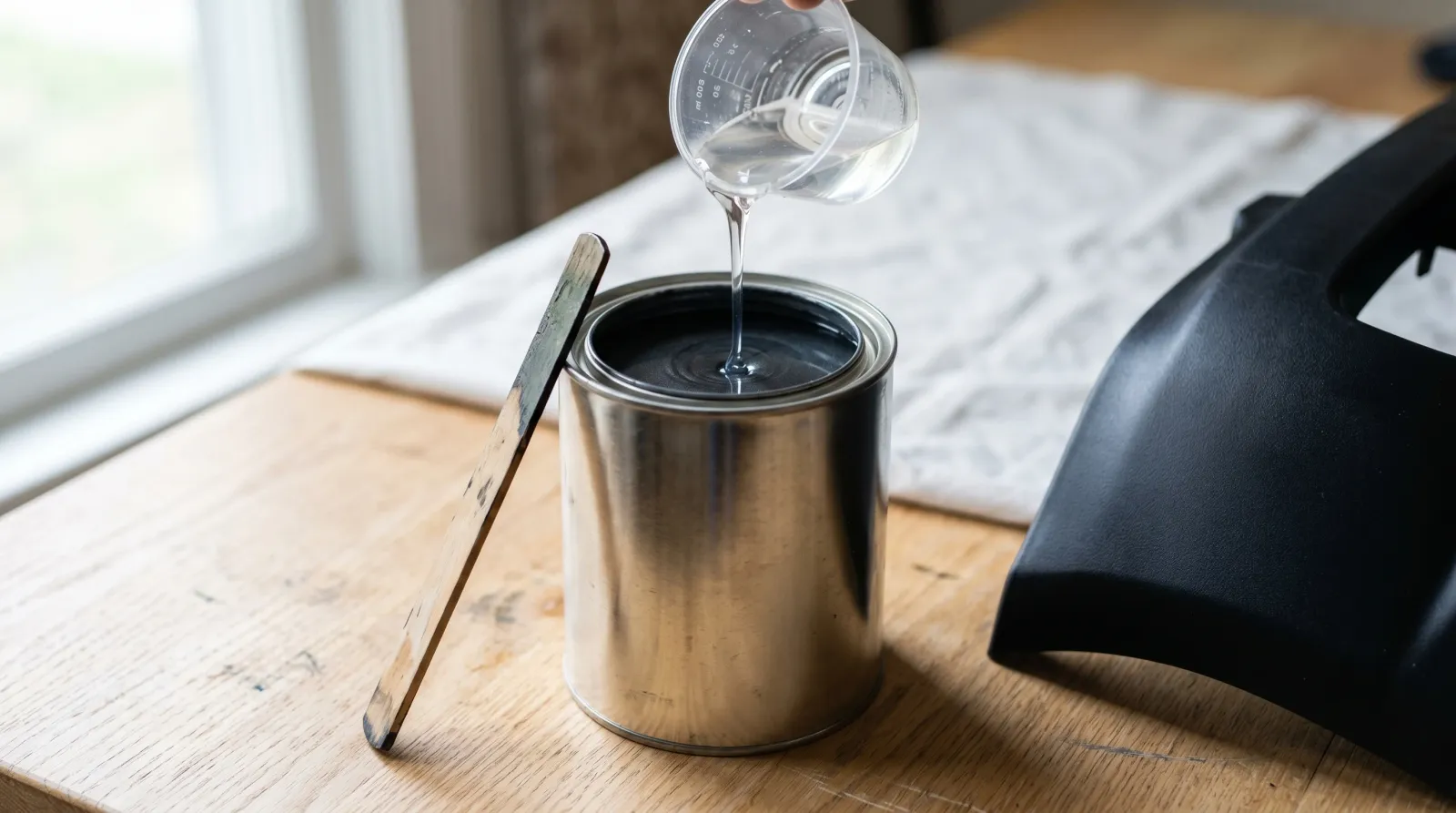
A flex additive is a clear liquid plasticizer you stir into paint so the cured film can bend with a flexible surface instead of cracking off it. On automotive basecoat and 2K urethane the standard dose is 10–20% by volume of the sprayable paint, roughly 3 to 7 ounces per quart. Chemically it works by lowering the film’s glass transition temperature, the point where a polymer shifts from a hard glassy state to a soft rubbery one. Drop that temperature below room temperature on the flexing part and the paint stretches and rebounds when a bumper cover or a vinyl seat deforms, rather than fracturing the way a rigid film would.
You’ve probably seen what happens without it. A repainted bumper looks fine in the shop, then six months later a network of fine cracks spreads across the corners where the cover flexes against the body. That’s the film telling you it was too hard for the substrate. The paint never failed on adhesion. It failed on flex.
Here’s the chemistry behind that. A cured paint film is a polymer network, and every polymer has a glass transition temperature, written Tg. Above its Tg the network is rubbery and elastic; below it, glassy and brittle. A normal automotive clearcoat is tuned for hardness, gloss, and scratch resistance, so its Tg sits well above the temperatures the panel will see. That’s the right call on a steel fender, which doesn’t move. On a polypropylene bumper cover that flexes every time someone leans on it, a high-Tg film has no give. The substrate stretches, the film can’t follow, and the bond between binder and pigment tears at the surface. Flex additive drops the Tg of that specific film so it stays in the rubbery range and moves with the part.
When to Use Flex Additive
Use it for:
- Flexible plastic auto body parts: bumper covers, fascias, ground effects, flexible spoilers, mirror housings.
- Vinyl and soft trim that bends in normal use: vinyl seats, dashboards, door cards, RV and boat vinyl.
- Rubber-modified or TPO panels that deform under hand pressure.
- Any solvent-borne automotive paint sprayed over a substrate that visibly flexes when you push on it.
Don’t use it for:
- Steel, aluminum, fiberglass, or any panel that holds its shape under pressure. Adding flex here just softens the film for nothing.
- Rigid plastics. More on those below.
When NOT to Use Flex Additive
Most surfaces people think need flex additive actually don’t, and adding it costs you film hardness for no benefit.
Skip it on:
- Rigid plastic like hard ABS, polystyrene, acrylic, and PVC pipe or trim. These don’t deflect enough to crack a normal film. What they need is adhesion, and that comes from a plastic-bonding primer, not a flex agent.
- Waterborne and latex paints, including wall paint and most spray cans. Flex agents are built for solvent-borne automotive systems. Stirred into an acrylic emulsion they tend to do nothing or break the dispersion. For flexible plastic you’re brushing or rolling with latex, an elastomeric coating is the right tool.
- High-wear horizontal surfaces like floors and steps. A flexed film is a softer film, so it scuffs, prints, and holds dirt more readily. Don’t trade abrasion resistance away unless the part actually moves.
- Over-thinned or already-soft paint. Stacking flex additive on top of a film that’s slow to harden anyway can leave it permanently tacky and printing.
How Flex Additive Compares
It’s easy to confuse three different ways of getting paint to stay on bendable plastic. They solve different problems.
| Flex additive | Bonding primer | Elastomeric paint | |
|---|---|---|---|
| What it fixes | Film cracking on flexing parts | Paint not sticking to slick plastic | Hairline cracks bridging on masonry/stucco |
| Where it goes | Mixed into the topcoat | First coat under the paint | The paint itself, brushed/rolled |
| Substrate | Flexible auto plastic, vinyl | Slick or low-energy plastics | Concrete, brick, stucco, some siding |
| Film result | Softer, more elastic | Normal hardness, better grip | Thick, rubbery, very high elongation |
| Typical chemistry | Solvent-borne automotive | Acrylic or solvent adhesion promoter | Acrylic at very high build |
The two often pair up. On a slick bumper cover you adhesion-promote or bonding-prime first so the paint grips, then run flex additive in the topcoat so the gripping film can bend. For the deep version of the adhesion side, see the bonding primer explainer, and for the high-build masonry cousin, the elastomeric paint guide.
Common Mistakes
- Adding it to rigid plastic to be safe. It’s not insurance. On hard ABS or PVC you’ve just softened the film and gained nothing, because the part never flexes enough to crack a normal coating. Use a bonding primer for grip instead.
- Guessing the dose instead of reading the ratio. Flex agents run 10–20% by volume on most systems, but the right number is on the product. Overshoot past roughly 25% and the film never hardens fully, so it prints fingerprints and holds dirt for the life of the job.
- Mixing it into the wrong stage. Flex additive goes into the activated, reduced paint, after the hardener and reducer, not into the raw base. Add it at the wrong point and the mix ratio of the 2K system is off and the cure suffers.
- Forgetting it goes in the clear too. On a basecoat-clearcoat job the clear is the film that cracks first because it carries the gloss and the stress. Flex the clearcoat, not only the base, or the cracks show up in the top layer anyway.
- Using it as a substitute for adhesion. Flex doesn’t make paint stick. A flexible film that was never bonded still peels in sheets. Solve adhesion first, then solve flex.
What It Looks Like
A bench flex test tells you whether you got it right. Spray a scrap of the same flexible plastic, let it cure, then bend the panel sharply over a 1-inch radius at room temperature. A correctly flexed film follows the bend and shows no cracking. An under-flexed or unflexed film spider-cracks along the fold line, the same pattern you’d otherwise discover on the car months later. A side-by-side of the two folded scraps, cracked versus clean, is the clearest picture of what the additive buys you.
Where to Buy and What to Look For
Flex additive is sold as “flex agent,” “flex additive,” or “elastomeric additive” by the automotive refinish brands: SEM, Bulldog, U-POL, and the major paint lines. Match it to your paint system. A flex agent meant for a 2K urethane clear is not interchangeable with a basecoat additive, and the mix ratio printed on the can is the one that matters. Check that the technical data sheet lists your topcoat type and gives a percent-by-volume add rate.
For the substrate-by-substrate product picks, see the best paint for plastic round-up and the best paint for vinyl guide. If your real problem is paint already lifting off slick plastic or laminate, the fix is adhesion, not flex, and that’s covered in why paint peels off laminate and plastic.
Ask a Question