What Is Elastomeric Paint? High-Build, Crack-Bridging Coatings, Explained
Elastomeric paint is a 10–20 mil flexible acrylic coating engineered to bridge hairline cracks in masonry. Where it wins, where it's overkill, and what ASTM crack-bridging spec actually means.

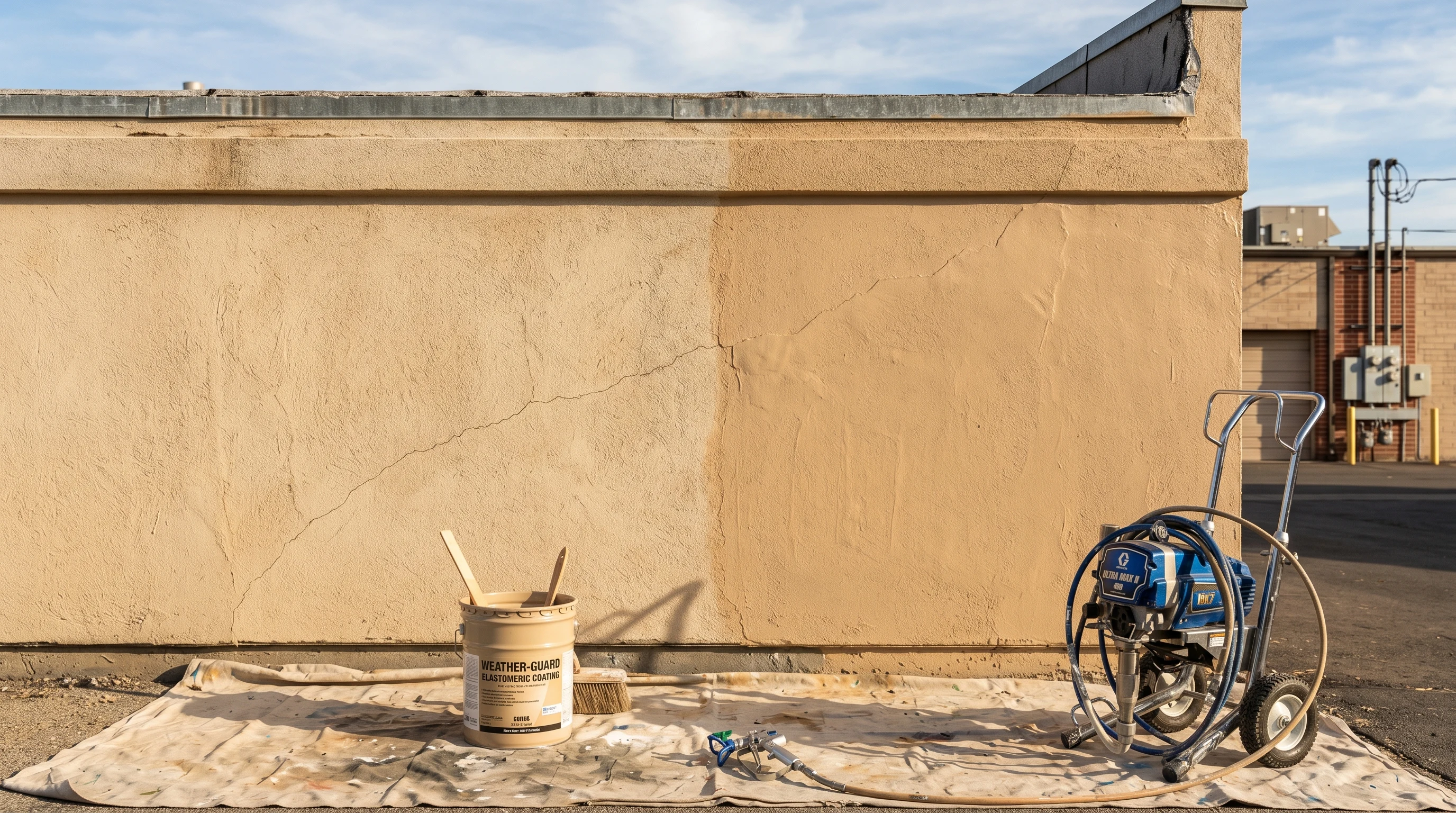
Walk past a 30-year-old stucco wall on a commercial building and look closely at the surface. You’ll often see a slightly thicker, slightly rubbery-looking finish bridging hairline cracks that the surrounding parging is starting to show. That coating is almost always elastomeric paint, and the reason it’s there is that ordinary exterior latex would have re-cracked through every one of those fissures by the second summer.
Elastomeric paint is a high-build flexible coating engineered for masonry substrates that move. Two coats apply at 10 to 20 mils dry film thickness — about five times the build of a standard exterior paint, which targets 2.5 to 4 mils dry. The binder is 100% acrylic, the same resin family used in premium exterior latex, but the formulation runs a higher acrylic-to-pigment ratio and a softer, more elastic monomer blend. The cured film stretches 200 to 600% before tearing, measured by ASTM D2370 tensile elongation. Standard 100% acrylic exterior paint elongates closer to 30 to 80%. That stretch budget is what lets the film follow a moving substrate without splitting.
What “crack Bridging” Actually Means As a Spec
The marketing word for what elastomeric does is “crack bridging.” The technical spec behind that word is ASTM C836, originally written for elastomeric waterproofing membranes and now widely cited on architectural elastomeric paint data sheets. C836 puts a coated specimen through repeated thermal cycles between -15°F and 120°F over a substrate with a controlled crack opening, then checks whether the film failed. Pass means the coating bridged the crack through the cycle count without splitting; fail means it cracked through. ASTM D2370 measures the underlying tensile elongation that makes the bridging possible. A real elastomeric paint publishes both numbers on its data sheet. Hairline cracks under 1/16 inch are inside the bridging window; anything wider needs to be repaired before the coating ever goes on.
Where Elastomeric Is the Right Tool
Elastomeric pays off on substrates that crack but don’t structurally fail. Stucco walls with the typical pattern of hairline shrinkage cracking. CMU block on parking-garage walls, retaining walls, and commercial foundations, where the porosity and the joint movement together defeat normal paint. Concrete tilt-up panels on warehouse and light-industrial buildings. EIFS recoats, where the original synthetic-stucco finish has chalked and the building owner wants another 10-year cycle without a full system replacement.
Across those substrates the failure mode of standard exterior paint is the same. The 2.5-mil acrylic film tracks a hairline crack on day one of installation, telegraphs the crack pattern by season two, and starts releasing along the crack lines by year five. The elastomeric film at 12 mils dry has enough thickness and enough stretch to hold the crack closed for a decade.
Where It’s the Wrong Tool
Standard wood siding is the most common misuse. Cedar and pine clapboard move with humidity but not in a way that needs a 10-mil flexible bridge — they need a 2.5-mil breathable acrylic film that lets moisture out from behind. A thick elastomeric coating on wood traps water vapor, and what you get back two years later is blistering and adhesion loss, not cracked paint.
Interior walls are the other consistent overkill. Drywall doesn’t move, doesn’t crack thermally, and a 12-mil-thick coating reads as physically heavy on the wall, with rougher texture and a longer cure profile. Spend the money on a quality interior latex instead.
The third wrong-tool case is structural cracking. Any crack wider than 1/16 inch, or any crack that’s actively growing, is outside the C836 bridging window. Coating over it just hides the diagnostic. Repair the crack with an elastomeric patching compound or a polyurethane sealant rated for the substrate, let the repair cure, then put the elastomeric on top.
What’s Actually on the Shelf
Four lines reliably publish their crack-bridging numbers and meet C836: Sherwin-Williams ConFlex XL (the workhorse spec on commercial stucco repaints), Behr Elastomeric Masonry, Stucco & Brick Paint (the volume product at Home Depot), Rust-Oleum Cool Coat (a reflective elastomeric for low-slope concrete and metal roofs), and Benjamin Moore MoorLastic. Each one gives you the elongation percentage and the ASTM cycle count on the data sheet. If a “100% elastomeric” can on a big-box shelf doesn’t list its bridging spec, it’s marketing the word, not the chemistry.
Application Reality
Coverage runs 80 to 150 sq ft per gallon at spec film build, versus 350 for standard exterior paint. Application is two coats minimum to hit the rated dry-film thickness. Spray with an airless and a 517 to 525 tip, then back-roll each pass to push the coating into the substrate texture. On a CMU block wall, the first coat may need to be thinned slightly per manufacturer instructions and applied as a fill coat into the open block face, with two finish coats on top. Cure to full elasticity takes 14 to 30 days; foot traffic and wash cycles before that point can dent the soft film.
The Cost Math, Honestly
Elastomeric runs $50 to $90 per gallon. Standard premium exterior latex runs $40 to $60. With coverage cut by 60 to 75%, the coated cost per square foot lands roughly 3 to 4 times higher than a normal repaint. That math works on stucco, CMU, EIFS, and tilt-up. It does not work on wood lap siding, fiber cement, or aluminum, where the substrate doesn’t ask for the performance you’re paying for. The decision rule is upstream of the paint: if the substrate cracks and cycles, elastomeric is the chemistry built for it. If the substrate doesn’t, standard 100% acrylic exterior is the right film, at the right thickness, for the right cost.
Ask a Question