Mildew vs Mold — How to Tell What's on Your Wall
Mildew is flat, gray-black, and wipes off. Mold is colonial, deeper, and ranges black to green to red. The diagnosis tells you whether you can treat it Saturday or need a remediator.

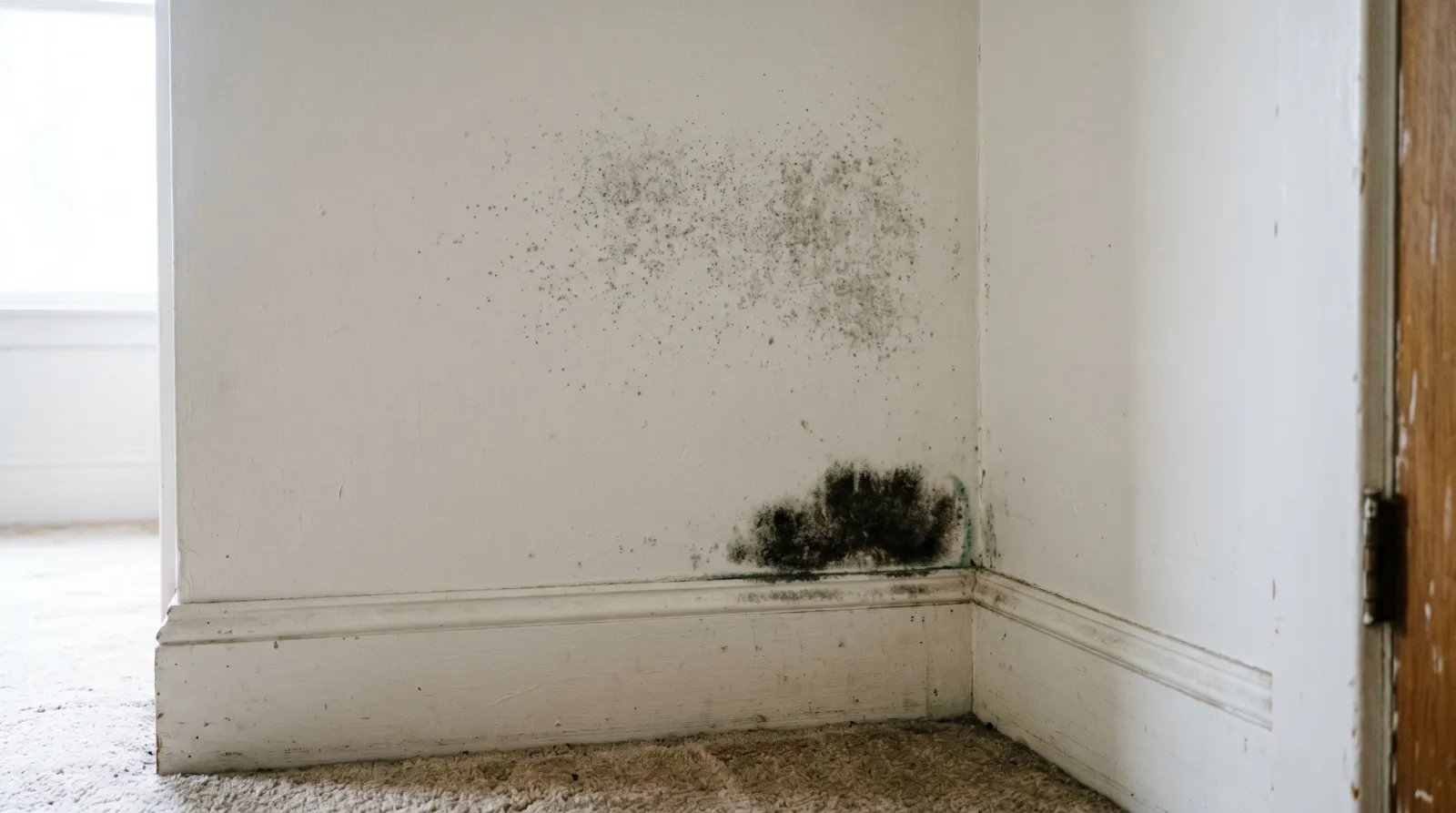
Spots on the wall. You walk up close, you can’t tell if it’s a Saturday job with a spray bottle or a call to a remediator. The names get used interchangeably and they shouldn’t. Mildew lives on the surface. Mold sets up a colony and goes in. The diagnosis takes about ninety seconds if you know what you’re looking at, and the wrong diagnosis sells you the wrong fix.
Does This Match What You’re Seeing?
Four common look-alikes. Walk up to the wall and check.
- Surface mildew. Flat dusty speckle, gray to black, often in a soft spray pattern rather than a defined patch. Sits on top of the paint film. Wipes off onto a white cloth with a smudge. Common spots: upper corners of bathrooms, behind toilets, north-facing window frames in winter, behind a sofa parked against an exterior wall.
- Mold colony. A defined patch with texture. Fuzzy, raised, sometimes slimy. Black, green-black, olive, dark red, or rust. Doesn’t wipe clean. Leaves a shadow even after you scrub. Often growing out of grout, drywall paper seams, or around a plumbing penetration.
- Efflorescence. White or chalky powder on brick, block, or basement concrete. Not biological. Mineral salt pushed out by moisture moving through the masonry. Different fix entirely. See the efflorescence on brick page.
- Soap scum, dust, or nicotine staining. Stripes that follow water flow under a shower head, gray fuzz in textured ceiling corners, uniform yellowing on an old white wall. None of these are fungal. Wipes off with regular cleaner or needs a different primer entirely.
If you’re still unsure, do the wipe test. A clean white cotton cloth, slightly damp, one firm pass across the spot. Mildew smudges onto the cloth in a gray streak and the wall behind it looks like fresh paint. Mold smears, leaves the colony texture mostly intact, and the wall stays stained.
Mildew vs Mold at a Glance
| Tell | Mildew | Mold |
|---|---|---|
| Where it lives | On top of the paint film | Into the paint film and substrate |
| Texture | Flat, dusty, powdery | Raised, fuzzy, sometimes slimy |
| Color | Gray, light black | Black, green, olive, red, rust |
| Wipe test | Smudges onto a damp cloth | Stays stuck, leaves shadow |
| Smell | Faint or none | Musty, earthy |
| DIY fix | 🟢 Saturday job | 🟡 If under 10 sq ft and dry |
| Pro call | 🔴 Rare | 🟢 Over 10 sq ft or wet drywall |
Five columns. That’s the diagnosis. Below is what to do with it.
How Serious Is This?
Surface mildew in a working bathroom or on a window frame is a same-weekend fix with a spray bottle and a fresh coat. A real mold colony bigger than ten square feet is not a DIY job. That’s the EPA threshold, not a number I made up. Above it, the spore load you kick up during removal becomes a respiratory problem for anyone in the house and a containment problem for anyone next door.
Two other triggers send the job to a pro regardless of size. Visibly wet, soft, or sagging drywall means water is sitting in the cavity, and no paint film closes that loop. Mold that returned through fresh paint inside 90 days of a good treatment means the moisture source is still active and is feeding spores below where a topcoat can reach.
Why the Distinction Matters
The treatments are different, and the wrong one looks like it worked for about two weeks.
Mildew is a thin film of fungal growth riding on the paint surface. The biocide doesn’t need to penetrate. A spray, a dwell, a wipe, and a fresh prime-and-topcoat seals the surface against the next round. Cheap, fast, and the fix usually holds for years if the ventilation is decent.
Mold has hyphae (root-like fibers) pushing into the substrate. Drywall paper and the porous binder in flat paint are food. Spray-and-wipe handles the visible top layer; the colony below feeds back through within a season. Mold needs a deeper biocide (Concrobium, RMR-86, or a contractor-grade product), a 24 to 48 hour dry-down, a stain-blocking primer that carries biocide chemistry, and a warranted topcoat. Skip any one of those four and you’ll repaint the same spot next spring.
And the underlying water source needs fixing in both cases. Mildew is telling you the room runs above 60% relative humidity too often. Mold is telling you the room runs above 70% or there’s a leak you haven’t found.
The Fix — Mildew (surface, Saturday Job)
Three steps. Don’t paint over live spores.
Step 1 — Treat the Surface
Spray the affected area with Concrobium Mold Control for painted drywall or a 1:10 bleach-and-water solution for tile, grout, and other non-porous surfaces. Dwell ten minutes. Wipe with a clean white cloth, working from the top of the patch down so you don’t drag spores into clean wall below. Ventilate hard. Window open, fan on.
Safety rule. Never mix bleach with vinegar, ammonia, or hydrogen peroxide. Produces chlorine or chloramine gas, toxic in any closed room. N95 mask, nitrile gloves, eye protection, and use bleach alone or skip to Concrobium.
Step 2 — Dry the Wall
24 hours minimum. A fan blowing across the treated wall speeds it up. Damp substrate is what got you here; sealing wet drywall under fresh paint just resets the clock.
Step 3 — Prime and Topcoat
Zinsser Mold Killing Primer in one coat, brushed in the corners, rolled on the field. Recoat per the label, typically one hour. Topcoat with a bathroom- or kitchen-rated film. Two coats. If the room is high-humidity and you want a warranty number on the can, Zinsser Perma-White in satin carries five years against mold and mildew growth on the film itself.
The Fix — Mold (colony, Bigger Job)
Same shape, more steps, harder products.
- Confirm size. Patch under 10 sq ft, you can DIY. Over, stop and call a remediator. Measure honestly. A 3-foot by 4-foot patch is already past the threshold.
- Treat. Concrobium on porous painted drywall or Concrobium-grade biocide. RMR-86 on grout and tile. Heavy ventilation, N95, gloves, eye pro. Dwell per label, usually ten minutes, then wipe.
- Dry hard. 24 to 48 hours of forced air or a dehumidifier on the wall. The substrate has to be bone dry to the touch before primer goes on. This is the step most people skip.
- Prime with biocide-loaded stain-block. Zinsser Mold Killing Primer for the biocide; if the mold left a dark ghost in the drywall paper that’s still bleeding through, hit it first with Zinsser BIN shellac primer to lock the stain, then a coat of Mold Killing Primer for the biocide layer.
- Topcoat with a warranted film. Zinsser Perma-White in the appropriate sheen. Two coats. Recoat at two hours, full cure at seven days, no scrubbing for a week.
For the deep round-up on which warranty paints actually hold up in a steamy bathroom, see the best mold-resistant paint guide. For the bathroom-specific walkthrough, the bathroom mold walls fix covers the fan-sizing math.
Recommended Product
Concrobium Mold Control. EPA-registered, no-rinse biocide for porous surfaces. Handles surface mildew on painted drywall and small mold colonies under 10 sq ft. The pro-grade option I reach for first on residential calls. For grout and tile, swap in RMR-86.
Buy Concrobium on Amazon · Best mold-resistant paint round-up
Prevention
The can isn’t the lever. Water is.
- Run the bathroom or laundry exhaust fan during use and for 20 minutes after. A timer switch costs $25 and pays for itself the first season.
- Hold indoor RH below 60% year-round. A $25 hygrometer tells you the truth. A dehumidifier in the basement during cooling season usually does it.
- Pull furniture an inch off exterior walls. Mildew behind the sofa is the dew point picking your trouble spot for you. Air circulation kills it.
- Fix the leak. A slow drip behind a vanity, a failed shower-pan corner, a clogged gutter dumping water against the foundation. Recurring growth in the same spot means the water is still arriving.
When to Call a Pro
- Affected area larger than 10 square feet (EPA threshold).
- Visibly wet, soft, or sagging drywall.
- Mold returned through fresh paint inside 90 days of a good treatment.
- Suspected black mold near a known plumbing leak, slimy texture, strong musty smell.
- Pre-1978 home with peeling paint near the growth. Test for lead before sanding (RRP rule).
- Severe asthma, immune compromise, or pregnancy in the household.
What’s going to bite you in two years if you guess wrong. You treat a mold colony like surface mildew with a wipe and a fresh coat, the film looks perfect through Christmas, and by the next humid summer the same patch is back through the new paint because the hyphae were never killed and the moisture source was never fixed. Diagnose first. Then treat. The can does its job when the wall is ready for it.
Ask a Question