Wagner FLEXiO 3000 vs 5000
FLEXiO 3000 vs 5000, tested by job size. Handheld turbine against stationary base on weight, finish, reach, cleanup, and what the extra 80 dollars buys.

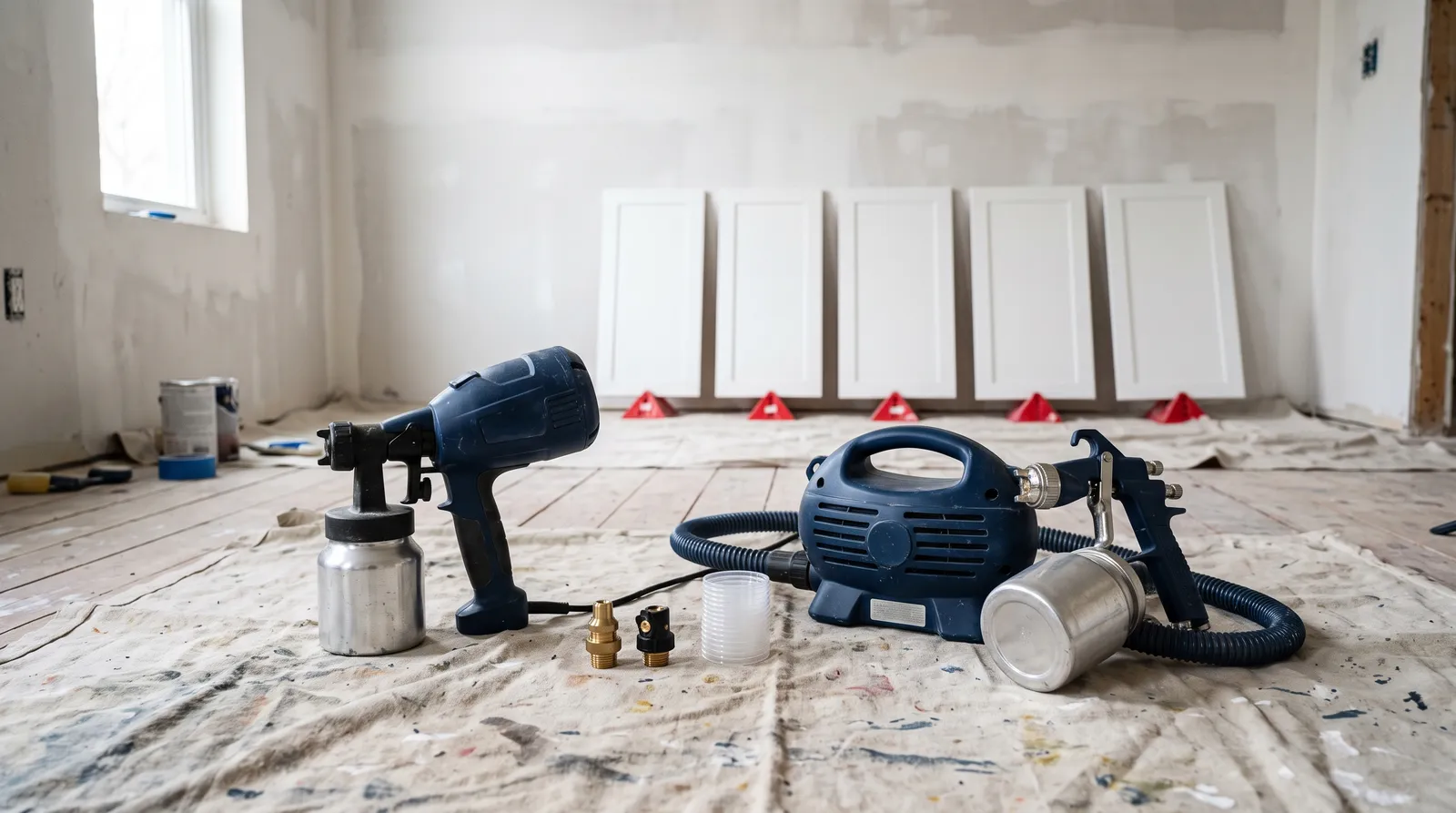
The 30-Second Answer
Top pick for most buyers: the FLEXiO 3000. It’s the handheld, roughly $150 to $180, with the turbine, cup, and gun in one body, and you’re spraying about four minutes after the box is open. A room, a dresser, a set of shutters, a fence section. Done.
Buy the FLEXiO 5000 if the job is a whole kitchen’s worth of cabinet doors or an entire exterior. The turbine sits on the floor and an 11.5-foot hose feeds a gun that weighs a fraction of the 3000 loaded. The extra $80 buys endurance, not a finer finish.
At a Glance
| FLEXiO 3000 | FLEXiO 5000 | |
|---|---|---|
| Format | Handheld all-in-one | Stationary base plus 11.5-foot hose |
| Street price | $150–180 | $220–250 |
| Turbine | X-Boost, variable speed | X-Boost, variable speed |
| Nozzles included | iSpray + Detail Finish | iSpray + Detail Finish |
| Cup | 1.5 qt, gun-mounted | 1.5 qt, gun-mounted |
| Weight carried in hand | ~7 lb loaded | ~3.5 lb loaded (gun only) |
| Unthinned latex | 🟢 Yes | 🟢 Yes |
| 8-by-10 wall | Under 5 min | Under 5 min |
| Ladder and soffit work | 🟢 No hose to manage | 🟡 Hose snags on rungs |
| 14-door kitchen | 🟡 Wrist quits first | 🟢 Built for it |
| Setup to first spray | ~4 min | ~7 min |
| Cleanup | ~6 min | ~9 min |
| Storage footprint | 🟢 Case on a shelf | 🟡 Case plus hose coil |
Where These Two Sit in the FLEXiO Line
Wagner ladders the FLEXiO family by format first, price second. The 1500 and 2500 are the entry handhelds, and the 2500 ships with the iSpray nozzle only; Detail Finish is a $45 add-on. The 3000 and 3500 are the handhelds that come with both nozzles in the box, which makes them the first models that can do a wall on Saturday and a cabinet door on Sunday. Above them, the 4000, 4300, and 5000 move the turbine off your hand and onto the floor. The 5000 tops that corded stationary tier at $250 MSRP with the 11.5-foot hose, both nozzles, five cup liners, and a case. The cordless 3550 sits alongside at $359 for anyone without a convenient outlet, covered in our cordless sprayers round-up.
Both machines spray the same materials: latex and oil-based paint, wood stain, semi-transparent and solid stain, paint-and-primer, urethanes. The material spec isn’t the deciding factor here. Weight is.
Weight in Your Hand
This is the whole comparison and everything else is detail.
The 3000 carries its turbine motor in the grip. Loaded with a 1.5-quart cup of latex, you’re holding around seven pounds at the end of an extended arm, and the mass sits forward of your wrist. For a bedroom wall it’s a non-issue. For the eighth cabinet door, it’s the reason your spray distance drifts from eight inches to twelve without you deciding to move.
The 5000 moves the motor to a base unit on the floor. The gun in your hand is a plastic body, a cup, and an air fitting. Call it three and a half pounds loaded. You can hold that at a consistent distance through a full run of doors, which is the actual skill that produces an even finish.
I have tendonitis in my right wrist from a decade of holding test equipment. The 3000 tells me about it by door six. The 5000 doesn’t.
Winner: FLEXiO 5000. Decisively, and it’s the reason the model exists.
Reach, Setup, and Ladder Work
The 3000 wins this back.
Nothing tethers a handheld. You climb a ladder with it, spray a soffit, come down, move the ladder, climb again. Adding an 11.5-foot hose and a floor-mounted base to that sequence means either dragging the turbine along the ground each move or accepting that the hose catches on rungs and on the ladder feet. Neither is dangerous exactly, but it’s a nuisance that costs real minutes on an exterior with a lot of repositioning.
Setup runs the same way. The 3000 is nozzle on, cup filled, trigger. About four minutes. The 5000 asks you to place the base, connect and uncoil the hose, then fill the cup, and you’re closer to seven before the first pass. On a job with three spray sessions of ten minutes each, that setup delta is the entire difference in your afternoon.
Where the hose earns its keep is horizontal reach. On a 12-foot run of fence or a long stretch of siding, you set the base once and walk the run. The 3000 makes you carry a seven-pound unit down the same run.
Winner: FLEXiO 3000 on vertical and ladder work. FLEXiO 5000 on long horizontal runs.
Atomization and Finish Quality
On paper, a tie. In practice, a tie for the first twenty minutes.
Same X-Boost turbine architecture, same two nozzles, same adjustable flow, pattern, width, and air-speed controls. We sprayed matched pairs of shaker doors in a waterborne semi-gloss, one machine each, through the Detail Finish nozzle at the same settings. At 24 hours the panels were indistinguishable under raking LED. Both showed the faint stipple that every consumer turbine in this price tier leaves on a solid color at six inches, and 600-grit closed it on both.
The gap opens over time, and it’s an operator gap rather than a machine gap. Film consistency on a sprayed panel is mostly a function of holding a constant distance and a constant sweep speed. Fatigue kills both. By the tenth door the 3000 panels ran heavier at the bottom rail, because a tired arm drops.
If your projects are short, the 3000 gives you the same finish for $80 less. If your projects are long, the 5000’s finish is better for a reason that has nothing to do with atomization.
Winner: Tie on the first panel. FLEXiO 5000 on panel ten.
Sustained Output Per Session
Both machines empty a 1.5-quart cup in roughly the same time, which means both interrupt themselves at the same interval. On a 14-door kitchen at two coats, that’s five or six refills either way.
The difference is what happens between refills. With the 5000, a refill is a pause. With the 3000, a refill is relief, and you start taking longer ones. That shows up as a session that stretches from three hours to four and a half.
Neither of these is a production tool. If you’re spraying eight hours a day, you want a real four-stage turbine or an airless, and the airless vs HVLP breakdown is the decision to make before you shop models at all. Within the FLEXiO family, the 5000 is the one that survives a full weekend.
Winner: FLEXiO 5000.
Cleanup and Consumables
The 3000 is simpler and it’s simpler by one component.
Lock-N-Go pulls the nozzle off both machines the same way. Dump the cup, fill with warm water, spray clear into a waste bucket, soak the air cap, reassemble. Six minutes on the 3000 if you start inside ten minutes of the last pass. The 5000 adds the hose and quick-connect to the same routine, and you want air run through the line before it goes back in the case. Call it nine minutes.
Three minutes doesn’t sound like a verdict. It is one, because the tool that gets cleaned is the tool that survives. Consumer turbines in this tier live 200 to 500 hours of trigger time with disciplined cleanup and about six months without it. Every minute you add to the cleanup routine is a minute somebody skips at 9pm on a Sunday. The tool care economics piece runs the replacement math on exactly that habit.
Both use the same iSpray and Detail Finish nozzles and the same cup liners. Order the nozzles in pairs.
Winner: FLEXiO 3000.
Price and What the Gap Buys
Street price puts the 3000 around $150 to $180 and the 5000 around $220 to $250. Call the gap $80.
That $80 buys a hose and moves a motor off your hand. It doesn’t buy a finer nozzle, a different material spec, a bigger cup, or a longer warranty; Wagner extends the warranty six months on registration for both. Under about 300 square feet of sprayed surface per session, the 3000 is the better buy and the $80 belongs in a respirator and a spray shelter instead. Above that, or on anything involving a stack of doors, the 5000 is the cheaper machine because it’s the one you finish with.
Winner: FLEXiO 3000 on pure dollars. FLEXiO 5000 on dollars per finished door.
Where Each One Falls Short
The 3000 falls short on anything that runs past two hours. It also stores paint weight in the worst possible place for anyone with wrist or elbow trouble, and no technique fixes that. Skip this if your first project is a kitchen.
The 5000 falls short on quick jobs. Seven minutes of setup and nine of cleanup around a four-minute spray of one closet door is a bad trade, and in practice people stop reaching for it on small work. It also takes real shelf space with the hose coiled. Skip this if the sprayer’s job is touch-ups and single pieces of furniture.
Neither one is the right tool for a full-house exterior in one weekend. That’s airless territory, and the airless sprayer round-up covers the tier where a FLEXiO stops making sense.
The Verdict by Use Case
- Pick the FLEXiO 3000 if: the project list is one or two rooms at a time, a dresser or a bookcase, shutters, a shed, or a fence section; the work involves ladders and soffits where a hose is a snag hazard; you want the shortest path from box to first pass; or the budget is hard at $180.
- Pick the FLEXiO 5000 if: you’re spraying a full kitchen’s worth of cabinet doors, whole-house interior walls, or exterior siding; your sessions run past two hours; you have wrist, elbow, or shoulder trouble; or you want consistent film build on door number fourteen.
- It’s basically a tie when: the job is a single room of walls and ceiling. Both cover an 8-by-10 wall in under five minutes with the iSpray nozzle, both spray unthinned latex, and the finish is identical. Buy the 3000 and keep the $80.
Top Picks by Side
Going with a handheld? The HVLP sprayer round-up puts the FLEXiO handhelds against the HomeRight Finish Max and the Earlex 5500 on cabinet flatness and noise, which is where consumer turbines separate. For furniture-scale work specifically, the furniture sprayer picks are the shorter list.
Going stationary? Before you spend $250 on a FLEXiO 5000 for a kitchen, read the cabinet refinishing kit round-up to check whether your job wants a sprayer at all. If it does, the Wagner brand hub maps the rest of the lineup, including where the Control Pro airless models take over.
And if you haven’t settled the spray-versus-roll question for your particular room, roller vs sprayer is the first read. Half the people shopping FLEXiO models are buying a sprayer for a job a roller finishes faster.
Related
- Best HVLP sprayers: every turbine tier, budget through Fuji
- Wagner brand hub: the full sprayer lineup and where each model fits
- Airless vs HVLP: the atomization decision under the model decision
- Best furniture sprayers: the short list for doors, dressers, and cabinet fronts
- Paint tool care economics: what ten minutes of cleanup is actually worth
Frequently asked questions
Is the FLEXiO 5000 finish actually better than the 3000?+
Can I spray unthinned latex through the FLEXiO 3000?+
Which one is better for a deck or a fence?+
Do the 3000 and 5000 use the same nozzles and cup parts?+
I already own the 3000. Is the 5000 worth adding?+
- Best HVLP sprayers: every turbine tier tested, budget to Fuji
- Wagner brand hub: the full sprayer lineup and where each model fits
- Airless vs HVLP: the atomization decision under the model decision
- Best sprayers for furniture and cabinet doors
- Paint tool care economics: what cleanup discipline is actually worth