Airless vs HVLP Sprayer — Which Fits Your Job?
Airless wins on whole-house exterior and big square footage. HVLP wins on cabinets, trim, and fine furniture. A jobsite breakdown with picks per use case.

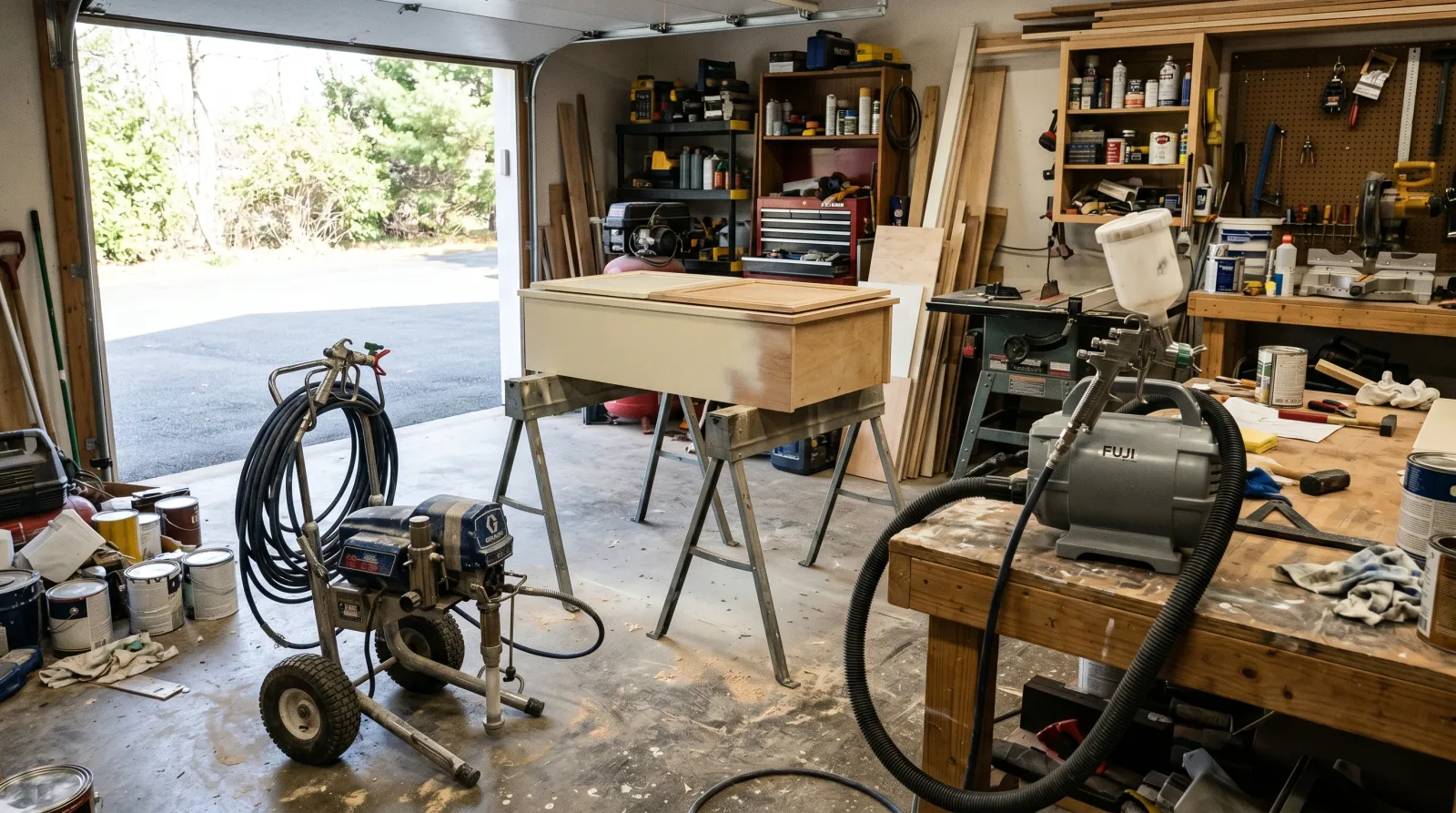
The 30-Second Answer
Pick airless for big square footage. Pick HVLP for finish quality on small surfaces. That’s the whole rule.
Airless atomizes paint by forcing it through a .011 to .021 tip at 1,500 to 3,000 PSI. It moves a gallon a minute on exterior siding. Overspray is heavy, the finish is good-enough, and cleanup is real work. HVLP atomizes with a turbine at low pressure through a 1.0 to 1.5mm needle. It lays glass on cabinet doors. Overspray is minimal, finish is the best of any sprayer, and it’s painfully slow on a wall. For whole-house exterior, get a Graco Magnum X5. For cabinets and trim, get a Fuji Q4.
At a Glance
| Airless | HVLP | |
|---|---|---|
| Volume per hour (siding) | 🟢 ~150 sq ft/min | 🔴 ~25 sq ft/min |
| Finish on cabinet doors | 🟡 good with FFLP tip | 🟢 glass |
| Overspray and waste | 🔴 30–50% outdoors | 🟢 65–80% transfer |
| Reach on tall siding | 🟢 long whip, 25-ft hose | 🔴 short cup, hauling turbine |
| Cleanup time | 🔴 30–45 min | 🟡 15–20 min |
| Entry cost | 🟡 $300–600 | 🟡 $300–1,200 |
How to Tell Which Job You’re Actually On
Stand in front of the work and ask one question: am I covering area, or am I laying finish?
A 2,500 sq ft house with weatherboard siding is area. A fence run, a garage interior, a barn, masonry — area. The eye reads it at twenty feet and stipple from a sprayed coat looks identical to a roller at that distance. Airless wins because volume is the whole game.
A set of kitchen cabinet doors on sawhorses is finish. The eye reads it at eighteen inches under a vanity light and any flaw shows. HVLP wins because the atomization is finer and the overspray cone is narrower. Same call for interior doors taken off the hinge, furniture refinishing, and built-in shelves pulled apart.
Mid-size interior jobs almost never justify either. A bedroom takes an hour with a roller. Spray prep takes two.
Volume per Hour
This is what airless is built for. With a .017 tip at 2,000 PSI, a Graco Magnum X5 lays paint at roughly 150 square feet per minute on bare siding. A two-person crew shoots a 2,500 sq ft house in a single day where rolling takes three. Same math on a 200-foot fence: half a day with the gun, two days with a roller.
HVLP with a 1.3mm tip moves at about 25 square feet per minute on flat panel work. That’s fast enough for a kitchen’s worth of cabinet doors in an afternoon. It’s nowhere near enough for a house. The turbine just doesn’t push the volume.
Winner: Airless, by 5 to 6x on large surfaces.
Finish Quality
HVLP wins on cabinet doors. The tight overspray cone and the low atomization pressure lay an even film with no stipple. A 1.3mm tip in a self-leveling waterborne alkyd (Advance, Emerald Urethane) produces a finish you can read your watch in. Every cabinet shop owns an HVLP. There’s a reason.
Airless on siding produces a finish that’s indistinguishable from a roller at three feet, which is the only distance anyone will ever look at it. Run a .017 tip, hold the gun 12 inches off the wall, overlap each pass 50 percent, and the lap edges feather clean. Airless on cabinet doors with a standard tip leaves a coarse texture. The fix is a FFLP (fine finish low pressure) tip at .011 — Graco RAC X FFLP 210 or similar — running at 800 to 1,200 PSI. That gets you close to HVLP on a flat panel, not equal.
A brush leaves marks. A roller leaves stipple. Both are visible on a flat cabinet door. HVLP is the only method that lays a true glass surface on a flat panel without spending the day sanding between coats.
Winner: HVLP on cabinets and trim. Airless on siding. Airless with a FFLP tip closes the gap but doesn’t beat HVLP.
Overspray and Transfer Efficiency
Transfer efficiency is paint that lands on the surface versus paint that becomes fog. Outdoors with an airless, you land 30 to 50 percent. The rest blows away. Indoors with the same gun, 50 to 65. HVLP runs 65 to 80 because the air stream is gentler and you work closer to the surface.
That math hits hardest with expensive paint. Spraying $95-a-gallon Emerald Urethane through an airless at 50 percent transfer is half your gallon on the floor. Through HVLP at 75 percent, you save a quarter of every can. Across a kitchen of cabinet doors, that’s real money.
Outdoors with an airless, the overspray also lands on cars two driveways down. Mask aggressively, watch the wind, and stop spraying when the breeze picks up over 8 mph. I see people miss this every spring and end up paying for someone’s neighbor’s paint job.
Winner: HVLP, by a clean 20 to 30 percentage points.
Tip and Pattern Control
Airless is tip-driven. Swap a .017 for a .011 and the same gun goes from siding to trim. Pattern width comes from the tip number (the second digit times two, in inches at 12 inches off the surface). A 517 tip throws a 10-inch fan at 12 inches. Pressure controls atomization, not pattern. You learn to read the lap edge in a week and you’ve got it for life.
HVLP is needle-and-air-cap driven. A 1.0mm needle with a small air cap gives a 4-inch pattern at 6 inches off the panel. A 1.5mm needle in a larger cap gives 8 inches at 8 inches. You swap needles for the job. Fluid control, pattern width, and air volume are three separate dials on the gun. There’s more to learn, but once you have the pattern set for cabinet doors, it stays set.
For tight detail on profiled trim, an HVLP gun with a 1.0mm needle beats airless at any tip size. The pattern is narrower and the overspray doesn’t fog the wall behind it.
Winner: HVLP for fine pattern control. Airless for fast tip swaps across job types.
Tool Cost and Maintenance
A Graco Magnum X5 runs $300 to 400. The X7 with a longer hose is $500 to 700. Tip kits are $25 to 60 each. Maintenance is real: flush after every job, lubricate the packings monthly, run pump-saver before storage. Skip any of it and the pump seizes in a week.
A Fuji Q4 Platinum is $800 to 900. The Q5 is $1,000 to 1,200. Wagner FlexiO consumer HVLPs run $150 to 300 but finish quality drops with the price. Turbines are nearly maintenance-free. The gun cleans in 15 minutes after a job. The turbine motor runs for years untouched.
Once a year on a shed, neither is justified. One whole-house exterior, rent an airless for $80 a day. Refinishing cabinets every weekend, a Fuji Q4 pays for itself in three jobs.
Winner: Airless on entry cost. HVLP on long-term maintenance.
Verdict by Use Case
- Pick airless if: whole-house exterior over 1,500 sq ft, fences, garages, masonry walls, anywhere masking is minimal because nothing nearby needs protection. Graco Magnum X5 is the entry pick.
- Pick HVLP if: cabinet doors off the hinge, interior doors disassembled, trim taken off and laid flat, fine furniture, anything where the eye gets within two feet of the surface. Fuji Q4 Platinum is the cabinet-shop standard.
- Pick airless with a FFLP tip if: you’ll spray cabinets twice a year and a whole house every five. One gun, two tips, accept the finish-quality compromise.
- It’s a tie when: interior doors stay installed and you’re spraying them in place. Both fog the room. Brush and roll instead.
Top Picks by Side
Going airless? See best paint sprayers for the Graco shortlist. For the exterior paint that earns the sprayer, the best exterior paint round-up has the topcoat call.
Going HVLP? See best paint sprayers for the Fuji and Wagner shortlists. For the cabinet topcoat that earns the HVLP, the kitchen cabinet paint round-up names Emerald Urethane and Advance.
What’ll Bite You in Two Years
Two failure modes show up after a few seasons.
A sprayed exterior with thin lap edges because the operator didn’t back-roll. Sprayed paint sits on the surface. Back-rolling forces it in. By year two on a south-facing wall, the un-backrolled film has chalked and the lap shadows show through every morning. Back-roll the siding, every pass, no exceptions.
A sprayer left dirty for a week. The pump’s check valves gum up, the packings dry out, and the next job starts with a $200 repair kit. Same story on an HVLP cup. If you don’t have time to clean the gun the day you used it, you don’t have time to own one.