Best Paint Sprayers for Furniture Refinishing
Five paint sprayers tested on dressers, chairs, and cabinet doors. Top pick: Wagner FLEXiO 3500 for the best sprayer for furniture that handles paint and stain.

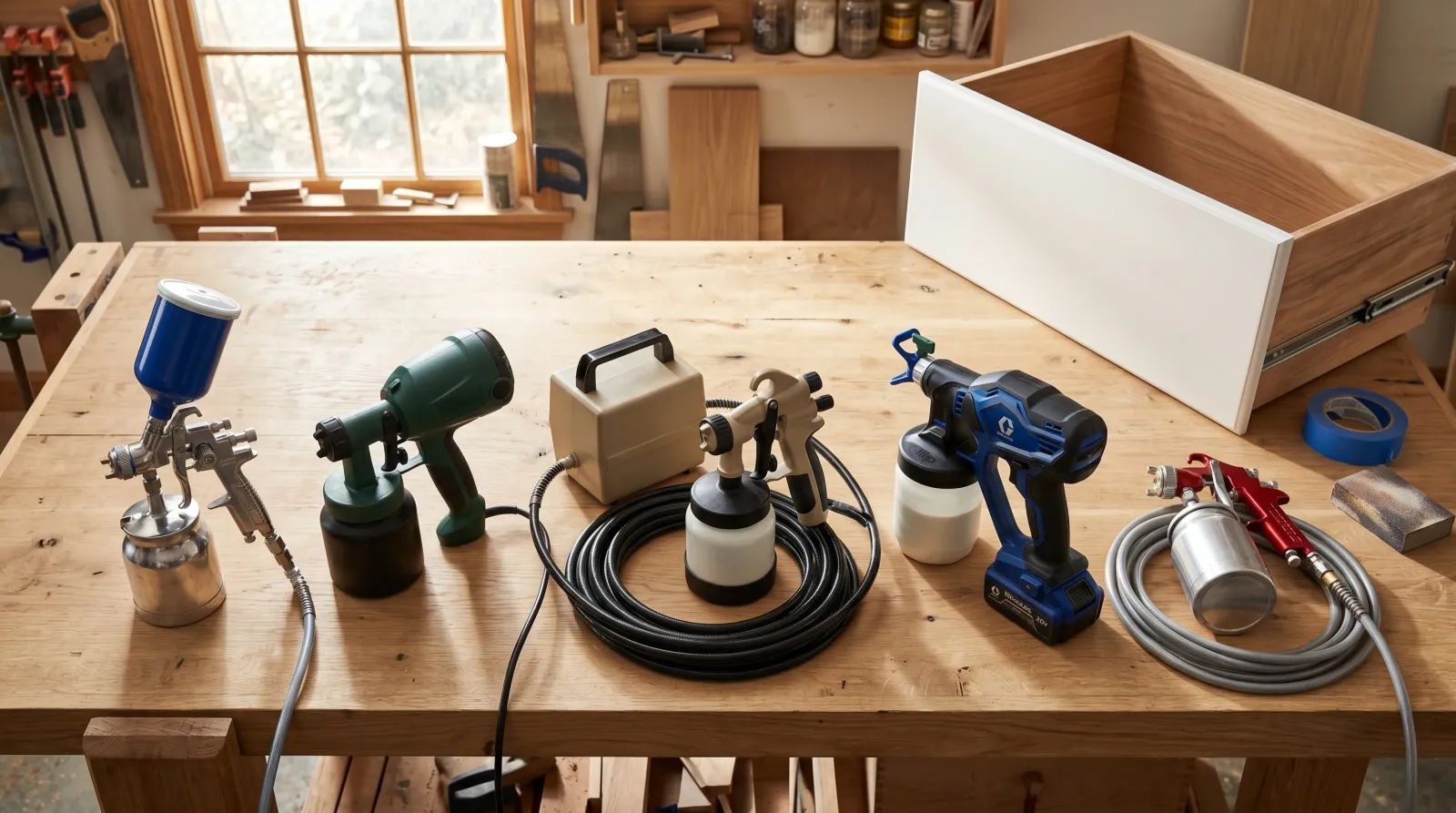
Disclosure: Some links below are affiliate links. We earn a commission if you buy through them, at no extra cost to you.
Top pick: Wagner FLEXiO 3500. Its X-Boost turbine sprays unthinned paint and stain straight from the can, and the Detail Finish nozzle lays a near-spray finish on a dresser without the thinning math that trips up first-time sprayers. It wins on versatility and on the cleanest result you can get from a one-piece handheld. It falls short on weight, because the turbine rides in the handle, and on the iSpray nozzle, which is too coarse for furniture. For the flattest budget finish, the HomeRight Super Finish Max under $90 is the smarter pick. For thick paint and speed on a carcass, the Graco TrueCoat 360 DS airless covers fastest. For stain, lacquer, and poly where atomization has to be glass-fine, the Wagner Control Spray Max is built for it. And if you refinish furniture often enough to want pro results, the Fuji Mini-Mite 4 PLATINUM lays the flattest coat in the test.
There is no single right sprayer for furniture.
Most people refinishing one or two pieces a year do fine with the FLEXiO 3500, or the Super Finish Max if budget is the constraint.
The Shortlist and Why These Five
I bought five sprayers off the shelf, the same channels a homeowner would use, and ran them through three real furniture projects across six weeks. A solid-oak dresser in Benjamin Moore Advance satin. Eight maple dining chairs in waterborne enamel. A pine console table sealed with polyurethane. Each sprayer ran a full piece from primer to final coat, the way you’d actually use it.
Furniture is a harder test than walls. A wall stipple invisible at arm’s length is a furniture failure, because a tabletop gets judged at six inches under a window’s raking light. The finish has to settle flat, the overspray has to stay controllable on small pieces with spindles and corners, and the gun has to atomize whatever you load, from thin stain to unthinned enamel.
Three axes anchored the picks: finish flatness under raking light, atomization against coating thickness, and overspray and control. The role each sprayer earns comes from where it lands on those three.
How the Testing Actually Ran
Same protocol per piece, per sprayer. Dresser top: two coats of Advance satin, sanded between with 320, photographed under raking LED at 30 minutes wet and at 24 hours cured. Chairs: waterborne enamel on spindles and seats, judged on how clean the pattern stayed on narrow parts and how much overspray landed past the masked line. Console: polyurethane, judged on flatness and on whether the gun spat at low flow.
Overspray got measured against a masked white control panel set 18 inches from the spray line. Cleanup time ran on a stopwatch, from the last pass to a flushed, reassembled gun.
I tested the sprayers that come up over and over again in furniture-flipping groups, on refinishing forums, and on the shelves at real paint stores.
How to Choose a Furniture Sprayer
HVLP or Airless
This is the first fork. HVLP (high volume, low pressure) pushes a high volume of air at low pressure through the paint, atomizing it into a soft, controllable mist. That softness lays a flat finish, wastes less paint, and stays controllable on a chair leg. For most furniture, HVLP is the right call.
Airless skips the air. It forces paint through a tiny tip under high pressure, so it atomizes thick unthinned latex that chokes a homeowner HVLP, and it covers fast. The trade is overspray: airless throws more mist, demands more masking, and reads slightly coarser on a tabletop. For a dresser carcass you’ll topcoat, or for thick paint, airless earns its slot. For the visible top, HVLP wins.
There’s a third split inside HVLP. A one-piece handheld puts the turbine in the gun (the FLEXiO 3500, the Super Finish Max), which is convenient but heavy in the hand. A turbine-box system runs a hose to a light metal gun (the Control Spray Max, the Mini-Mite 4), which is more setup but easier on the wrist and finer in the finish.
Tip Size and What You’re Spraying
Match the tip to the coating’s thickness. Thin stain, lacquer, and sealer spray through a small tip (around 1.5mm on an HVLP). Latex, enamel, and primer need a medium tip (2.0mm). Thick chalk and milk paints want the largest tip (4.0mm) or they clog.
The Super Finish Max ships with all three brass tips, which is most of why it punches above its price on furniture. A sprayer locked to one tip size limits what you can load. If you spray a range of coatings, multiple tips matter more than raw power.
Control: Flow, Pattern, and Power
A sprayer you can turn down is a sprayer you can use on furniture. Three controls matter: material flow (how much paint comes out per trigger pull), spray pattern (round for spindles, flat horizontal or vertical for panels), and air or power (how hard it atomizes). The FLEXiO 3500 and the Mini-Mite both give you all three. A bare sprayer with one fixed pattern fights you on detail work and floods small parts.
At-a-Glance Comparison
| Brand / Model | Type | Best paint | Best for | Price tier |
|---|---|---|---|---|
| Wagner FLEXiO 3500 | Handheld turbine HVLP | Unthinned latex, enamel, stain | All-round furniture | Mid |
| HomeRight Super Finish Max | Corded handheld HVLP | Chalk, milk, enamel, stain | Budget fine finish | Budget |
| Graco TrueCoat 360 DS | Electric airless handheld | Thick unthinned latex, primer | Fast carcass coats | Mid |
| Wagner Control Spray Max | Two-stage turbine HVLP | Stain, lacquer, poly, thinned latex | Stain and clear coats | Mid |
| Fuji Mini-Mite 4 PLATINUM | Four-stage turbine HVLP | Lacquer, enamel, poly, latex | Pro-grade finish | Premium |
1. Wagner FLEXiO 3500, Best Overall
The FLEXiO 3500 is the sprayer I’d hand someone refinishing their first dresser who doesn’t want to learn the thinning math first. The X-Boost turbine has enough push to atomize unthinned Advance satin straight from the can, and the Detail Finish nozzle laid it flat on the dresser top with no orange peel once I’d dialed the flow back. Three controls, the flow, the pattern, and the power dial, let you tune the gun to the part you’re spraying instead of fighting a fixed spray.
The two-nozzle setup is the reason it wins. The iSpray nozzle moves fast across the dresser sides and the back panel. Then you swap to the Detail Finish nozzle for the top and the drawer fronts, where flatness gets judged up close. One tool covers both the production parts and the show parts.
It’s heavier in the hand than a hose-fed gun, because the turbine lives in the handle. On the eight-chair job my wrist felt it by the sixth chair. And if you leave the iSpray nozzle on for a tabletop, the finish reads coarser than it should; that nozzle is built for walls, not show surfaces. Use the Detail nozzle on anything you’ll look at closely.
| Spec | Value |
|---|---|
| Type | Handheld turbine HVLP, X-Boost |
| Nozzles | iSpray (coverage) + Detail Finish (furniture) |
| Best for | Unthinned latex, enamel, stain on most furniture |
| Approx. price | $130–$160 |
Buy it if: you want one sprayer that handles a whole piece, from fast sides to a show-grade top, without thinning. Skip it if: every project you do is a fine clear coat. Pay up for a turbine-box system like the Control Spray Max or the Mini-Mite.
2. HomeRight Super Finish Max, Best for Fine Finishes on a Budget
The Super Finish Max is the sprayer that proves you don’t need to spend $150 for a flat furniture finish. Under $90, and on the dresser top it laid the smoothest coat of any budget handheld I ran. The three brass tips are the trick: the 1.5mm for thin stain and sealer, the 2.0mm for enamel and latex, the 4.0mm for thick chalk and milk paints that a single-tip sprayer can’t handle. Three spray patterns and a flow dial give you real control on chair spindles.
For furniture flippers running chalk paint, this is the obvious pick. The 4.0mm tip sprays chalk and milk paint with little to no thinning, which is exactly the use case that sells the most of these.
It’s corded and one-piece, so the whole unit sits in your hand. On a hutch or a long dresser run, your wrist tires before the paint does. The cup is small, too, which means frequent refills on a big piece. Those are real limits. For the money, no other sprayer matched its finish on furniture.
Buy it if: you refinish furniture on a budget, especially with chalk or milk paint. About $79–$90.
3. Graco TrueCoat 360 DS, Best Cordless Airless
Different tool, different rules. The TrueCoat 360 is a true airless, not an HVLP, and that changes what it’s for. It atomizes thick unthinned latex and primer that a homeowner HVLP can only spray after thinning, and it covers fast. On the dresser carcass, the sides and back, it laid two coats quicker than any turbine in the test. The any-direction spray is the underrated feature: you can turn the gun upside down to hit the underside of a chair seat without it losing prime.
Airless throws more overspray than HVLP. You mask more, you ventilate harder, and you wear a respirator without exception. The finish on the tabletop read a touch coarser than a tuned HVLP under raking light, fine for a piece you’ll topcoat or for a painted-not-precious look, less ideal for a glass-flat show surface.
The 360 also sprays whole rooms and doors, so if you bought it for cabinets or trim it doubles as a furniture sprayer. For furniture alone, an HVLP gives the cleaner result.
Buy it if: you spray thick paint, want speed on a carcass, or already own it for cabinets and trim. About $180–$220.
4. Wagner Control Spray Max, Best for Stain and Clear Coats
Stain and clear coats are where the Control Spray Max earns its slot. It’s a two-stage turbine with a 20-foot hose, so only the lightweight metal gun is in your hand and the turbine box sits on the floor. On the pine console’s polyurethane, it atomized the poly finer than any handheld in the test, which is exactly what a clear coat needs. Stain, lacquer, and sealer spray straight through it with no fuss.
The metal gun and the two cups, a 1-quart metal and a 1.5-quart plastic, hold up to a long day. The hose-and-box format is the trade. There’s more to set up and more to flush at the end than a one-piece handheld.
Thick unthinned wall latex is where it struggles. The two-stage turbine wants thinner coatings, so latex needs about 10 percent water to spray clean. For furniture stain, poly, and lacquer, that’s not a problem. For thick enamel, the FLEXiO out-muscles it.
Buy it if: most of your furniture work is stain, lacquer, or polyurethane. About $90–$120.
5. Fuji Mini-Mite 4 PLATINUM, Best Premium Finish
The Mini-Mite 4 is the sprayer you buy when you’ve decided furniture refinishing is a real hobby, not a one-off. Four-stage turbine, the T-70 metal gun, roughly 9 PSI of clean atomization. On the dresser top it laid the flattest coat in the test, the kind of finish that needs no sanding and no apology under raking light. The Pattern Control Knob adjusts the fan from a tiny dot for a spindle to a full pass for a panel without swapping parts.
This is a buy-once tool. The turbine and the metal gun outlive the cheap handhelds by years, and Fuji’s heat-dissipation design keeps the turbine alive longer than a bargain unit’s.
It costs four to six times a handheld HVLP, which makes it overkill for one dresser. And the turbine box plus hose plus gun is the most setup of anything here. For someone refinishing a piece a year, that’s too much sprayer. For someone doing it most weekends, it’s the one that stops you wanting a better sprayer.
Buy it if: you refinish furniture often and want pro-grade flatness. About $400–$500.
Sprayers I Tried and Dropped
- Wagner Control Spray Double Duty. The smaller sibling of the Control Spray Max. Fine for stain on a fence, underpowered for furniture enamel. The Max is worth the small step up.
- Cheap no-name HVLP guns under $50. Single fixed tip, no pattern control, and the finish proves it. The Super Finish Max is the floor I’d buy.
- Full-size airless on a cart (Graco Magnum X5). Built for whole houses, not a dresser. Overspray and cleanup are out of proportion for furniture. Right tool, wrong job.
- Aerosol spray cans. Acceptable for one small chair, expensive and inconsistent past that. A real sprayer pays for itself by the third piece.
Care, Cleanup, Longevity
Sprayers don’t die of old age. They die of dried paint left in the tip. The cleanup routine matters more than the brand on the gun.
Waterborne paint and enamel. Empty the cup back into the can. Fill the cup with clean warm water, spray it through until the gun runs clear, then break down the tip, needle, and air cap and brush every passage with the kit brush. Reassemble wet, store dry. Eight to ten minutes. Skip the teardown and paint dries in the needle channel, where it hardens and ruins the pattern.
Stain, lacquer, and oil. Flush with the matching solvent (mineral spirits for oil, lacquer thinner for lacquer) instead of water, same teardown. On waterborne-safe units, finish with a short water rinse. Catch the dirty solvent in a labeled jar; paint settles to the bottom over a week and you pour the clean solvent off the top to reuse.
Turbine-box units (Control Spray Max, Mini-Mite). The turbine itself stays clean since paint never touches it. Flush the gun and hose, and keep the turbine’s air filter clear so it pulls full air.
A flushed handheld HVLP lasts years of weekend furniture work. A neglected one is a paperweight by the third project. The brass-tipped units (Super Finish Max) survive more cleanups than soft-tipped bargains.
Mistakes I Still See
- Spraying indoors in a finished room. Even a controlled HVLP fogs fine mist that settles on everything nearby. Spray in a garage, a tent, or outdoors on a calm day. Mask, ventilate, wear a respirator.
- Not straining the paint. Skins and clumps clog the tip mid-pass and leave a run you have to sand out. Strain every batch through a paper cone filter. It takes 30 seconds.
- Loading the wrong tip. Thick chalk paint through a 1.5mm tip spits and spatters. Match the tip to the coating: small for stain, medium for enamel, large for chalk and milk paint.
- Spraying one heavy coat. A wet heavy pass runs and sags on a vertical drawer front. Two or three light coats, each flashed off before the next, lay flatter and don’t drip.
- Holding the gun at an angle or pivoting your wrist. Arcing the gun makes the ends of the pass thin and the middle heavy. Keep the gun parallel to the surface and move your whole arm, 6 to 10 inches off the piece.
- Skipping the cleanup flush. Dried paint in the tip is the number-one sprayer killer. Flush the minute you finish, not after lunch.
A Furniture Sprayer Kit That Earns Its Keep
For someone refinishing a piece or two a year: HomeRight Super Finish Max ($85), a box of paper cone strainers ($8), a respirator rated for paint ($30), a roll of masking film and tape ($12), and a collapsible spray tent if you’re working in a garage ($60). About $195, and the sprayer is the part that lasts.
For someone doing it most weekends, step up to the FLEXiO 3500 or the Mini-Mite 4 and keep the rest of the kit. The strainers, the respirator, and the tent matter on every sprayer, no matter what you spend on the gun.
The sprayer is half the result. Bad prep and a skipped strainer waste a good sprayer. Sand, clean, strain, and spray light coats.
FAQ
Do I need to thin paint to spray furniture? Depends on the sprayer. A turbine HVLP like the FLEXiO 3500 or an airless TrueCoat 360 sprays unthinned latex straight from the can. A two-stage turbine like the Control Spray Max wants wall latex thinned about 10 percent. If the gun spits or leaves orange peel, thin 5 percent at a time until the pattern smooths.
Is HVLP or airless better for furniture? HVLP for most furniture. The soft, controllable spray lays a flatter finish and wastes less paint on detailed pieces. Airless wins on thick paint and speed but throws more overspray and reads slightly coarser on a show surface.
Can I spray chalk and milk paint? Yes, with the largest tip. The Super Finish Max’s 4.0mm tip sprays them with little to no thinning. Strain the paint first and spray light coats so a clog doesn’t leave a run.
What’s the cheapest sprayer that gives a good furniture finish? The HomeRight Super Finish Max, usually under $90. It laid the flattest budget finish in the test, and the three tips cover stain through chalk paint.
Ask a Question