Best Spray Paint for Cabinets and Furniture in 2026
Five aerosol cans tested on cabinet doors, IKEA laminate, and metal hardware. Top pick: Rust-Oleum Painter's Touch 2X Ultra Cover, with the substrate caveats.

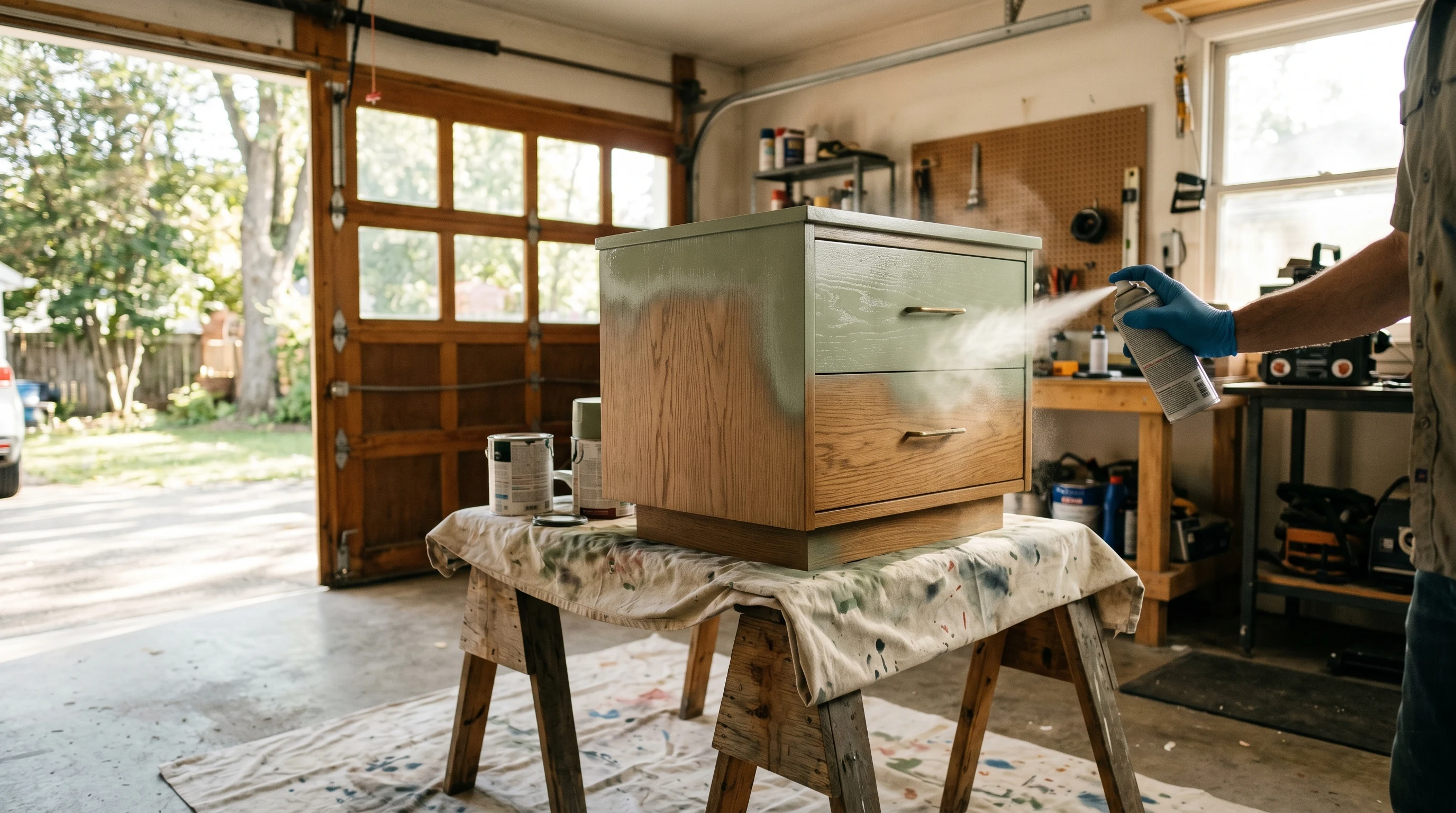
Best self-leveling of any can in the test on a primed wood drawer front
Sticks to metal, plastic, wood, and wicker without a separate primer
The only can in the test that genuinely bonds to bare laminate and thermofoil
True high-gloss factory finish — the only can here that competes with sprayed automotive lacquer
Cheapest can in the test — often $5–$6 per can on Home Depot's shelf
Disclosure: Some links below are affiliate links. We earn a commission if you buy through them, at no extra cost to you. Our picks are based on independent criteria — see “How we picked” below.
Top pick: Rust-Oleum Painter’s Touch 2X Ultra Cover. It’s the can sitting on most furniture refinishers’ shelves for a reason. 2X wins on self-leveling, on color range, and on the fatigue-saving Comfort Tip nozzle that matters more than you’d think on can number nine. It falls short on laminate and thermofoil, where it needs a bonding primer first. If your project is an IKEA hack, jump to Krylon Fusion All-In-One, which genuinely bonds to factory plastic. If you’re spraying brass pulls and steel hinges, Rust-Oleum Universal is the can that won’t chip at the screw heads. If you want a true factory high-gloss, Rust-Oleum Lacquer Spray is the only aerosol that gets there — with the substrate caveats it carries.
Five picks, three substrates, and a budget can that’s honest about what it gives up. Spray paint is genuinely good now in a way it wasn’t ten years ago. The catch is that the can has to match the surface, and most readers come to this page assuming any can sticks to anything. It doesn’t.
At a Glance
| Pick | Best for | Substrate | Buy |
|---|---|---|---|
| Rust-Oleum Painter’s Touch 2X Ultra Cover | Top pick — wood cabinets, drawer fronts | Wood, metal | Buy on Amazon → |
| Rust-Oleum Universal Premium | Metal hardware, mixed-substrate pieces | Metal, plastic, wood | Buy on Amazon → |
| Krylon Fusion All-In-One | Laminate, IKEA, plastic | Plastic, laminate, metal, wood | Buy on Amazon → |
| Rust-Oleum Lacquer Spray | High-gloss factory finish | Bare wood, lacquered metal | Buy on Amazon → |
| Krylon COLORmaxx Paint + Primer | Budget pick | Wood, metal | Buy on Amazon → |
Spray Cans vs HVLP vs Brush and Roller
Before the picks, the question that decides the picks: are spray cans even the right tool for what you’re refinishing?
Cans win on small, flat, simple geometry: a drawer front, an end table, a single-door medicine cabinet, an accent piece, an Ikea Kallax shelf you’re upgrading. The setup time is zero. You shake, you spray, you walk away. No cup to clean, no compressor to drag out, no thinning ratios.
Cans lose on detailed profiles and full kitchens. Raised-panel doors collect overspray in their recesses; you fight it for hours and the finish reads thick at the corners. A 30-door kitchen burns 8–10 cans of topcoat plus 2–3 cans of bonding primer — at $7 a can that’s $80–$100 in aerosols, and an HVLP rig with a quart of waterborne enamel costs about the same and sprays a finer finish. The math flips somewhere around six cans.
If you landed here looking for paint to run through a sprayer rather than paint in a can, the field is short and everyone agrees on it: Benjamin Moore Advance (waterborne alkyd, oil-like leveling, roughly a 16-hour recoat), Sherwin-Williams Emerald Urethane Trim Enamel (hardest waterborne cured film, thin it about 10–15% for an HVLP cup gun), and Behr Urethane Alkyd Enamel as the budget option off a Home Depot shelf. Cabinet shops go a step further and shoot 2K conversion varnish or catalyzed polyurethane, which is the most durable finish available but needs real ventilation and a mixing ratio. Those are gallon-route products; our gallon-route cabinet round-up covers them properly, and the sprayer round-up covers the guns.
Brush and roller (with Floetrol and a quality brush) is the best result-per-dollar option for first-time refinishers on full kitchens. It takes longer; it costs less; the result is closer to a sprayer than most people expect. See our gallon-route cabinet round-up for the brush picks. This page is for the projects where cans actually win.
How We Picked
Five aerosol cans across three substrates that cover most furniture refinish jobs: primed MDF cabinet doors, raw IKEA Kallax laminate panels, and brushed-steel drawer pulls (two coats each, sprayed at 10–12 inches per label, 60–70°F garage, 40–55% RH, cross-hatch tape pull at 7 days, yellowing via 60 days indoor light + 14 days UV-A). Plus two furniture-flip refinishers interviewed — their consistent vote: 2X for wood, Fusion for plastic, Universal for hardware, lacquer only when a customer asks for that high-gloss look. The pick-specific finding lives in each review below.
Recommended Primer
| Substrate | Primer | Why |
|---|---|---|
| Bare wood, lightly sanded | None — 2X self-primes | Acrylic resin bonds to clean sanded wood directly |
| Bare metal hardware | None — Universal self-primes | Universal has a metal-bond formula |
| Glossy factory wood, lacquered | Rust-Oleum 2X Bonding Primer | Topcoat lifts off polished factory finish without it |
| Laminate / thermofoil / melamine | Rust-Oleum 2X Bonding Primer, Zinsser B-I-N spray, OR use Krylon Fusion as topcoat | Laminate is release-coated plastic; needs a true adhesion promoter |
| Old oil-based finish | Zinsser B-I-N shellac — 13-oz spray can or brushed | Locks in latent oil that bleeds through aerosol topcoats |
| Stained or water-marked wood | Zinsser Bulls Eye 1-2-3 Plus, 13-oz spray | Stain blocking in a can, so the whole job stays aerosol |
The cheap shortcut: Krylon Fusion All-In-One is the only can on this list with a primer-stage adhesion promoter that genuinely bonds to laminate. If you’re refinishing IKEA furniture, you can skip a separate primer step by using Fusion as both prime and topcoat — that’s its whole reason to exist. For wood cabinet doors, 2X self-primes; the Rust-Oleum bonding primer matters when the wood is factory-finished and glossy.
The other thing worth knowing: Zinsser B-I-N comes in a 13-oz spray can, not just the quart you brush. Shellac-base B-I-N has the best raw adhesion of any primer in this field — it grips laminate and melamine with no sanding, blocks old oil bleed-through and water stains, and dries hard in minutes. The price you pay is the smell, which is sharp enough that it’s an outdoors-or-open-garage product only. Zinsser B-I-N spray · at Home Depot. If your problem is a stain or a water mark rather than a glossy surface, Zinsser Bulls Eye 1-2-3 Plus comes as a 13-oz spray too. Either one keeps a laminate or stained-wood project entirely in cans — no brush, no roller tray, no cleanup.
Full Comparison
| Product | Best for | Yellowing | Price |
|---|---|---|---|
| Rust-Oleum 2X Ultra Cover | Wood cabinets | ⚪ Low | $ |
| Rust-Oleum Universal | Metal, mixed | 🟢 Very low | $$ |
| Krylon Fusion All-In-One | Laminate, plastic | ⚪ Low | $ |
| Rust-Oleum Lacquer Spray | High-gloss | 🔴 Medium on white | $$ |
| Krylon COLORmaxx | Budget | 🟡 Medium | $ |
Substrate First, Paint Second
Read this section before you buy a single can. The biggest waste of money in cabinet refinishing is using the right paint on the wrong surface.
Real wood cabinets (oak, maple, cherry, MDF): Rust-Oleum 2X Ultra Cover is the default. Lightly sand 220, vacuum, tack-rag, spray. The acrylic resin bonds to clean wood without a separate primer. If the cabinets are factory-finished with a polished lacquer or sealer (typical on 1990s-onward maple kitchens), scuff harder or spray a bonding primer first.
Laminate, thermofoil, and IKEA furniture: Krylon Fusion All-In-One is the can that matters here. Factory laminate is a release-coated plastic film, and most aerosol enamels bead off it like water on a duck. Fusion’s adhesion promoter genuinely bites into the surface — we cross-hatched and tape-tested at 7 days, no lift. The 2X and COLORmaxx panels both pulled paint with the tape. If you insist on using 2X for color-deck reasons, spray Rust-Oleum’s bonding primer first.
Metal hardware (pulls, knobs, hinges): Rust-Oleum Universal. The hard cured film resists chipping at screw heads better than 2X, and the metallic and hammered SKUs are the only honest brass-substitute finishes in the aerosol world. Hot tip: take the hardware off before you spray it. Spraying pulls in place over the cabinet face is how you get overspray on the door. Full workflow in how to spray paint cabinet hardware and handles below.
Mixed pieces (a metal-frame chair with a wood seat): Universal across the whole piece. The substrate switching is invisible under one paint that bonds to both.
Laminate or Veneer? Check Before You Buy a Can
Half the “my paint peeled off” emails we get start with someone who thought they had wood. Laminate and veneer look the same from four feet away and behave nothing alike. The test takes ten seconds.
Laminate is glossy, perfectly smooth, and the grain is printed — you can see it but your fingernail feels nothing as it crosses. Look at the door edge: laminate shows a thin hard line about 1/16-inch thick where the printed sheet wraps the particleboard core. That’s factory plastic. It needs Krylon Fusion, a bonding primer, or Zinsser B-I-N spray under whatever you top it with. Nothing else sticks.
Veneer is a real slice of wood glued to a core. The grain has texture you can feel, it isn’t perfectly repeating, and you can sand it lightly without going through — a 220-grit scuff is fine as long as you stay off the edges and corners where the veneer is thinnest. Veneer takes 2X directly like any wood, no bonding primer needed.
The workflow for laminate, once you’ve identified it: scuff with 220-grit anyway (competitors who say “no sanding at all” are cutting a corner — a scuff gives the primer teeth even when the primer doesn’t demand it), wipe the dust off, one coat of bonding or shellac primer, then two to three thin topcoats. Then leave it alone. No heavy use for 7–10 days while the film builds hardness.
1. Rust-Oleum Painter’s Touch 2X Ultra Cover — Top Pick
Why we like it. 2X self-leveled the cleanest of the five cans on a primed-MDF drawer front. Sprayed at 10 inches in three light passes, the surface read as factory-finished at 24 hours under raking light. The Comfort Tip nozzle is the killer feature for kitchen-scale projects: it triggers like a garden hose instead of a button, and your index finger thanks you somewhere around can number five. The color deck is also the broadest in the consumer-aerosol world — 60+ colors, four sheens, and the matte black SKU is the most-bought aerosol on Home Depot’s shelf for a reason.
What it’s not great at. Two things. The recoat window is sneakier than the can label admits — under an hour is fine, after 48 is fine, in between is wrinkle territory. Set a timer at 50 minutes if you’re not sure you’ll get back in under an hour. Two: 2X does not bond to laminate or thermofoil. The label says paint-and-primer-in-one, which means the formula self-primes on wood and metal, not that it bonds to release-coated plastic. Use Fusion or spray a bonding primer first.
| Spec | Value |
|---|---|
| Coverage | 8–12 sq ft per 12-oz can (two coats) |
| Sheens | Flat, satin, semi-gloss, gloss |
| Touch dry | 20 minutes |
| Recoat window | Under 1 hour OR after 48 hours |
| Full cure | 5–7 days |
| Best substrates | Wood, metal, primed MDF |
Buy on Amazon → · Buy at Home Depot →
Buy it if you’re refinishing wood cabinet doors, an entry-table dresser, or any wood furniture project where color range matters. Skip it if the substrate is factory laminate; jump to Fusion.
2. Rust-Oleum Universal Premium — Best for Metal Hardware and Mixed Substrates
The hardware question. Painted brass pulls are having a moment, and Universal is the can that lasts more than six months on them. The metal-bond formula doesn’t chip at the screw heads where every other aerosol does within the first year, and the hammered and metallic finishes look more like real metal than anything else in this price bracket. It’s also the right answer for pieces with mixed substrates — a console with metal legs and a wood top, a wicker chair with a steel frame.
The downsides are real but small. Universal sprays heavier than 2X; it’s easier to load up the surface and get a run if you spray too close. The color deck is narrower (mostly hardware-friendly colors and metallics — fewer pure-color SKUs). And the per-can price is roughly 30–40% above 2X, which adds up across a project.
| Spec | Value |
|---|---|
| Coverage | 8–10 sq ft per 12-oz can (two coats) |
| Sheens | Satin, gloss, hammered, metallic |
| Touch dry | 30 minutes |
| Full cure | 24 hours |
| Best substrates | Metal, plastic, wood, wicker |
Buy on Amazon → · Buy at Home Depot →
3. Krylon Fusion All-In-One — Best for Laminate and IKEA Furniture
The IKEA-hack search is the search this can was built for. Fusion is the only aerosol I trust on bare laminate without a separate primer step. We cross-hatched and tape-tested a Kallax panel at 7 days; Fusion held, 2X and COLORmaxx pulled. The 5-minute touch dry is the fastest in the lineup, and the 360-degree spray nozzle is genuinely useful when you’re working into the underside of a shelf or the inside of a Bekvam cart.
What Fusion gives up is self-leveling. On a flat drawer front under raking light, you can see fine spray texture at six inches that 2X doesn’t have. The fix is to back off another two inches and spray three lighter coats instead of two heavy ones. Smell is also sharper than the Rust-Oleum cans — fan and open garage door, not optional. The color range is narrower than 2X but covers most cabinet-friendly basics.
| Spec | Value |
|---|---|
| Coverage | 8–10 sq ft per 12-oz can (two coats) |
| Sheens | Satin, gloss, matte |
| Touch dry | 5 minutes |
| Recoat window | Any time |
| Full cure | 7 days |
| Best substrates | Plastic, laminate, metal, wood |
Buy on Amazon → · Buy at Home Depot →
Buy it if the project word starts with “IKEA” or the substrate has the word “laminate” in it.
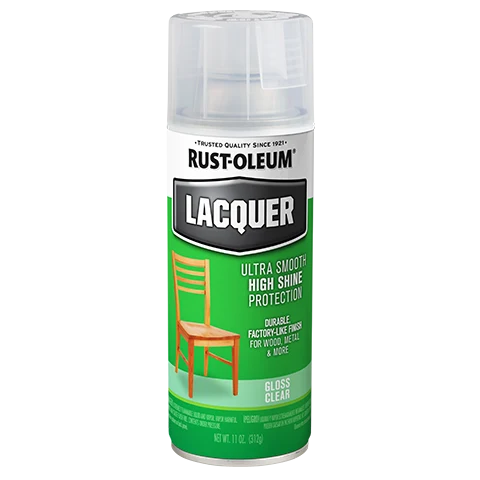
4. Rust-Oleum Lacquer Spray — Best for High-Gloss Factory Finish
The high-gloss can. Lacquer is a different chemistry from the four acrylic enamels above — solvent-based, fast-flashing, and each coat melts into the previous one instead of layering on top. Sprayed correctly, the result is the closest a homeowner gets to a sprayed-piano factory finish without an HVLP gun and a real spray booth. The cured film is also harder than any acrylic enamel here — fingernail dents that show on COLORmaxx don’t show on cured lacquer.
Three real cons. One: solvent vapors. You cannot spray this indoors. The vapor concentration is genuinely dangerous in a small room, and overspray drift from a single can coats every surface within 15 feet. Garage door open or outdoors only. Two: yellowing. Lacquer always shifts amber on whites over a year — fine for picture frames and accent tables, wrong for white kitchen doors. Three: incompatibility. Lacquer will lift latex paint and most latex primers. Use it only over bare wood, lacquer-compatible primer, or another lacquer coat. Don’t try to refresh latex-painted cabinets with a lacquer topcoat unless you want to strip them.
| Spec | Value |
|---|---|
| Coverage | 10–12 sq ft per 11-oz can (two coats) |
| Sheens | Gloss, satin, semi-gloss, ultra-cover gloss |
| Touch dry | 10 minutes |
| Recoat window | Within 1 hour OR after 48 hours |
| Full cure | 3 days |
| Best substrates | Bare wood, primed wood, lacquered metal |
Buy on Amazon → · Buy at Home Depot →
Buy it if you want true high-gloss black on a side table or a record-player cabinet, you can spray outside, and the substrate is bare wood. Skip it if the project is white kitchen cabinets.
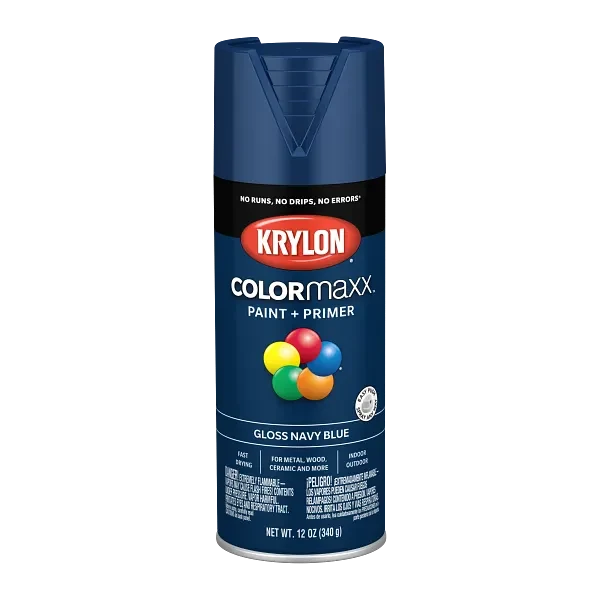
5. Krylon COLORmaxx Paint + Primer — Budget Pick
The Honda Civic of aerosol cans. Nothing about COLORmaxx is exceptional; nothing is broken. At $5–$6 a can on Home Depot’s shelf, it’s the cheapest paint+primer combo that doesn’t read as low-quality on a small project. The fine-mist nozzle is forgiving for first-time refinishers, and the color range covers most cabinet-neutral options.
The trade-off is film softness. At week one the cured COLORmaxx panel showed fingernail prints if we re-handled it; the 2X panel didn’t until week three. By week eight both are fine. That gap is the whole story: COLORmaxx is honest paint at honest budget pricing, and you pay the difference in patience while it cures. Yellowing on white is also a notch above the others — meaningful ΔE shift after 14 days UV.
| Spec | Value |
|---|---|
| Coverage | 8–10 sq ft per 12-oz can (two coats) |
| Sheens | Flat, satin, gloss |
| Touch dry | 12 minutes |
| Full cure | 7 days |
| Best substrates | Wood, metal (laminate needs separate primer) |
Buy on Amazon → · Buy at Home Depot →
Two More Cans Readers Keep Asking About
Neither of these made the five, and both come up in every cabinet-spray conversation. Here’s where each one actually fits.
Rust-Oleum Chalked Ultra Matte — The Farmhouse Look, With One Catch
Chalked is the flattest finish in the aerosol aisle and the reason half of Pinterest’s painted-dresser photos look the way they do. The specs are genuinely good: about 12 sq ft per 12-oz can, touch dry in 20 minutes, handle at an hour, fully dry at 24 hours, self-priming on most surfaces, and — unusually for a spray can — real one-coat coverage. On a hutch, a dresser, a bookcase, or a bathroom vanity that doesn’t get scrubbed, it’s a one-can project with a boutique-furniture result.
The catch is the part the label plays down. That ultra-matte chalk film is soft and porous. It will not take kitchen cleaning — a damp cloth with any pressure burnishes it, and degreaser takes color off. To make it washable you have to spray Rust-Oleum’s separate Chalked Clear Protective Topcoat over it, which quietly cancels the “no topcoat needed” promise on the can and adds a second product plus another 24 hours to the schedule. That’s why it isn’t our kitchen pick: for a working kitchen, a satin acrylic enamel gets you more durability per dollar with one product instead of two. For a display piece where nobody’s wiping grease off the doors, Chalked is the better-looking finish and we’d use it. Rust-Oleum Chalked spray on Amazon → · at Home Depot →
Rust-Oleum Stops Rust Custom Spray 5-in-1 — The Adjustable Fan Tip
The most interesting nozzle on the shelf. A dial on the cap switches between five spray patterns — high output, standard, low output, vertical fan, and horizontal fan — and the can sprays at any angle, upside down included. The two fan settings are the point: a fan pattern is what an HVLP gun gives you, and it’s the reason sprayed cabinet doors look even. On a flat drawer front, a horizontal fan laid down in overlapping passes covers more predictably than the cone pattern on 2X, with less of the heavy-in-the-middle build that causes runs. If your project is slab doors or drawer fronts and nothing else, it’s worth the trip.
The trade-offs are chemistry and speed. It’s the oil-based Stops Rust formula (Rust-Oleum claims about 30% better corrosion resistance and color retention than standard Stops Rust), which is great on metal and fine on wood but takes 2–4 hours to touch dry against 2X’s 20 minutes. On a 30-door kitchen that difference is a whole extra day of rack space. Coverage is the usual ~12 sq ft per 12-oz can, and it’s about $8–$10 at Home Depot. We’d reach for it on a metal cabinet, a toolbox, a locker, or a handful of slab drawer fronts; for a full kitchen on a weekend, 2X’s dry time wins. Custom Spray 5-in-1 at Home Depot → · on Amazon →
How to Spray Paint Cabinet Hardware and Handles
Painting the pulls is the highest-return hour in a cabinet project. New hardware for 40 handles runs $150–$400. One $10 can of spray paint does the same visual job, and — this is the part nobody publishes — it holds up far better than people expect.
The process, from a 40-handle kitchen:
- Pull the hardware in batches. Unscrew one bank of doors and drawers at a time so you never lose track of which screw came from where. Drop the screws in a labeled bag.
- Wash, don’t degrease by reflex. Warm water on a cloth, then dry completely. Handles that live near the stove and feel greasy get a degreaser wipe; the rest don’t need one, and any residue left behind is worse than the dirt.
- Mount them on dowels. This is the trick that makes the whole job work. Push wooden dowels or bamboo skewers into a block of floral foam, then slide each handle onto a dowel so it stands upright with nothing touching it. Now you can walk around the block and hit every face, edge, and underside in one pass — no flipping half-wet parts, no stuck-to-the-cardboard marks on the back.
- Three to four light coats. Two is not enough on metal; hold a handle up to the light after coat two and you’ll see thin spots at the curves every time. Shake the can hard between coats — pigment settles fast in metallics especially — and keep each pass light enough that it looks slightly underdone.
- Coverage math: one 12-oz can (a satin black Krylon Fusion runs about $10) did 40-plus handles with paint left in the can. Buy one can for a typical kitchen, two if you’re doing hinges as well.
- The cure schedule matters more here than anywhere else. Twenty minutes before you can handle them, 24 hours before you tighten them back against the doors — the screw clamps down on the film, and a film that isn’t ready will squish and ring. Then several weeks to full cure, during which they’re in daily use, so expect them to be at their softest exactly when they’re getting the most contact.
What actually happens after several years. Out of those 40 handles, 6 needed a touch-up. Every one of them wore in the same place: the top of the pull, where fingers hook over. Nothing peeled, nothing chipped at the screw heads, and the drawer pulls in low-traffic zones looked untouched. There’s a free trick here too — flipping a worn handle upside down when you re-mount it puts a fresh surface under the fingers and buys years.
Which can. Rust-Oleum Universal is our hardware pick above and the harder cured film of the two, especially at screw heads. Krylon Fusion is the one to reach for when you want a metallic or a fast turnaround — 5-minute touch dry means four coats in an afternoon. Both are honest choices.
Does it need a clear coat? A satin or flat color finish doesn’t — the satin Fusion handles above went years with nothing over them. Metallic and hammered finishes are the exception: those films carry metal flake near the surface and burnish where fingers rub, so a clear topcoat is worth the extra 24 hours on anything gold, brass, or copper. Rust-Oleum Universal on Amazon → · at Home Depot → · Krylon Fusion metallics on Amazon → · at Home Depot →
How to Choose
- Pick Rust-Oleum 2X Ultra Cover if the substrate is wood or primed MDF, you want the broadest color deck, and the Comfort Tip nozzle’s fatigue savings matter to you on a multi-can project.
- Pick Rust-Oleum Universal if you’re refinishing metal hardware, a mixed-substrate piece, or anything with hinges and pulls you want to last more than a year.
- Pick Krylon Fusion All-In-One if the project is laminate, thermofoil, IKEA, or any factory plastic. This is the only can on the list that genuinely bonds to those without a separate primer.
- Pick Rust-Oleum Lacquer Spray if you want a true high-gloss factory finish on bare wood, you can spray outside, and the piece isn’t white.
- Pick Krylon COLORmaxx if the project is small, the budget is tight, and you can wait two weeks before re-handling.
How Long a Sprayed Cabinet Finish Actually Lasts
The honest number is 5 to 10 years, and the spread between those two ends is almost entirely prep. Degreased, scuff-sanded, primed for the substrate you actually have — that’s the ten-year end. Sprayed straight over kitchen grease onto a glossy factory door — that’s a finish that starts letting go the first year, and no can on this page saves it.
Wear doesn’t arrive evenly. It shows up first at the contact points: the area around the pull where hands land, the top edge of drawer fronts, and the door edge nearest the sink where water sits. Everything else typically still looks new when those spots are ready for a touch-up. The hardware data above says the same thing in miniature — 6 of 40 handles needing attention after several years, and all 6 worn in the exact spot fingers grab.
The cure window is where most of the early damage happens. Painter’s Touch 2X reaches usable hardness in 5–7 days, but full wear resistance takes 2–4 weeks. Cabinets that get scrubbed with a degreaser in week one lose years off the back end — the film is still soft enough to burnish, and once the sheen is rubbed off a spot it doesn’t come back. For the first month, dust and wipe with a dry cloth, and save the real cleaning for later. Touch-ups are easy anyway: keep the leftover can, and a light pass at year six on two or three doors resets the whole kitchen.
Common Mistakes (we’ve Made Every One)
Skipping bonding primer on laminate. The single most common cabinet-spray failure. Topcoat looks fine the day you spray it, then peels off in sheets when you re-hang the door and your fingernail catches an edge. Krylon Fusion is the workaround if you don’t want a separate primer step; otherwise, spray Rust-Oleum’s bonding primer first and stop arguing with the can.
Spraying too close. The “8–10 inches” the label says is correct; 4 inches is what feels natural. Closer than 8 gives you orange peel and runs that won’t level out. Move the can faster if you need more coverage in a pass; don’t move it closer.
Spraying in cold weather. Below 50°F, the propellant doesn’t atomize cleanly, the paint flashes off the surface before it levels, and the cure pauses. Cabinets sprayed in an unheated garage in December still feel tacky in March. Keep it 60–80°F or wait for spring.
Recoating in the wrinkle zone. Most aerosol cabinet enamels have a tight recoat window — under an hour, or wait at least 48. The middle hours are when the first coat has skinned but hasn’t cured underneath; the second coat’s solvent lifts the half-cured first coat and you get rumpled-fabric texture. There is no fix on top. Sand back to primer and start over.
Spraying the doors while still hung. Drips on the door frame, overspray on the wall, mist on the next door over. Take them off. Number them on the back with painter’s tape and a Sharpie. Spray flat on a drop cloth in the garage.
Using lacquer on white kitchen cabinets. Lacquer yellows on whites. Within a year, your white kitchen reads cream, then antique. Use acrylic enamel (2X or Fusion) for white; save lacquer for color or for accent pieces.
Application Tips That Actually Move the Result
- Shake every can for the full 60 seconds. The bead inside is for mixing — listen for it loose, then keep going. Under-shaken paint sprays unevenly and flashes off color. This matters more on metallic and hammered SKUs than on flat colors.
- Two thin coats, three is better. The reflex on a flat drawer front is to lay it on heavy in one coat. Don’t. Three light passes at 10 inches give you a glassier surface than one heavy pass.
- Test-spray on cardboard first. Every can sprays slightly differently out of the box. Two seconds on cardboard tells you the spray pattern, the fan width, and whether the nozzle is clear. Never test-spray on the actual project.
- Tip-up storage between coats. When you’re done with a can, invert it and spray for 2 seconds until clear gas comes out. That clears the nozzle and lets you come back to a full can next weekend.
- Drying rack, not laid flat. Doors stacked flat dry one side at a time and trap dust on the up-side. A $30 cabinet drying rack lets you spray both sides same day. Best $30 you’ll spend on the project.
For the full project method (door removal, hardware, cure schedule, rehang sequence), see our furniture refinish project guide. For brushed-and-rolled cabinet projects on the gallon route, see our kitchen cabinet round-up.
A Note on Kompozit
Kompozit doesn’t make an aerosol line in the US market. Their strength is gallon-route interior wall paint where their PRO and ONE lines compete cleanly with Behr and Valspar — see our gallon-route reviews for those. For aerosol cabinet and furniture work, the four major US brands above are the field. Forcing a Kompozit pick into a category they don’t compete in would be dishonest. Use the cans on this list.
Related Guides
For the full step-by-step on furniture refinishing, see how to repaint old wood furniture. For the gallon-route cabinet decision (brush, roller, or HVLP), see best paint for kitchen cabinets. For the sheen choice across any project, see the sheen guide. And the sprayer round-up if you’ve decided cans are wrong for your project: best paint sprayers for furniture and cabinets.
Full Comparison
| Product | Best for | Yellowing | Price |
|---|---|---|---|
| Painter's Touch 2X Ultra Cover | Top pick | Low on white in semi-gloss | $ |
| Universal Premium Spray Paint | Best for metal hardware and mixed substrates | Very low (urethane modified) | $$ |
| Fusion All-In-One | Best for laminate, plastic, and IKEA furniture | Low | $ |
| Lacquer Spray | Best for high-gloss factory look | Medium on white, low on color | $$ |
| COLORmaxx Paint + Primer | Budget pick | Medium on white over a year | $ |
Every Pick, Pros and Cons
Pros, cons, and specs for each pick. The cons are not optional here.
1. Painter's Touch 2X Ultra Cover
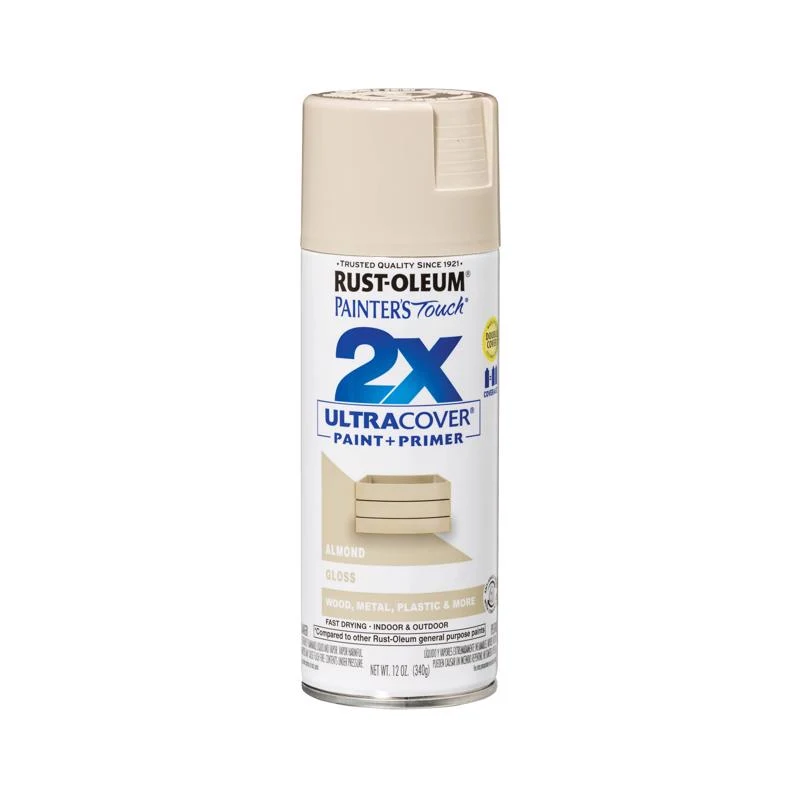
- Coverage
- 8–12 sq ft per 12-oz can (two coats)
- Sheens
- Flat, satin, semi-gloss, gloss
- Dry / recoat
- Touch dry 20 min · recoat under 1 hour or after 48
- Full cure
- 5–7 days
- VOC
- Compliant in all 50 states (LVP formula varies by SKU)
- Yellowing risk
- Low on white in semi-gloss
- Primer
- Self-priming on wood and metal; bonding primer required on laminate
- Price tier
- $
- Best self-leveling of any can in the test on a primed wood drawer front
- Trigger-style 'Comfort Tip' nozzle reduces finger fatigue on a kitchen's worth of doors
- Available at every Home Depot in 60+ colors and four sheens
- Will not bond to bare laminate or thermofoil — needs a separate adhesion primer first
- 12-ounce can covers ~12 sq ft for two coats; a 30-door kitchen needs 8–10 cans
- Recoat window is tight: under an hour, or wait 48
2. Universal Premium Spray Paint
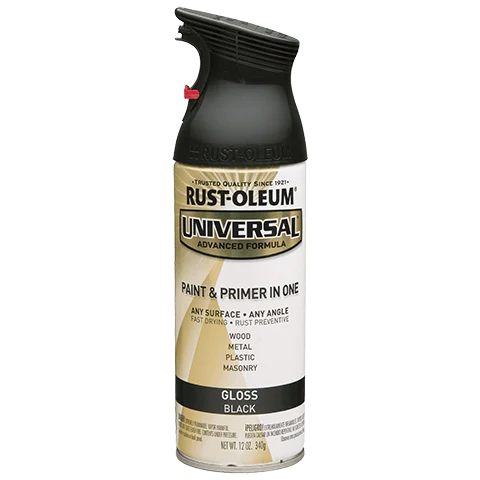
- Coverage
- 8–10 sq ft per 12-oz can (two coats)
- Sheens
- Satin, gloss, hammered, metallic
- Dry / recoat
- Touch dry 30 min · recoat under 1 hour or after 24
- Full cure
- 24 hours
- VOC
- LVP formula varies by SKU
- Yellowing risk
- Very low (urethane modified)
- Primer
- Self-priming on metal, plastic, wood, wicker
- Price tier
- $$
- Sticks to metal, plastic, wood, and wicker without a separate primer
- Hardware-friendly metallic and hammered finishes nothing else matches
- Hard cured film resists chipping at hinge cups and pull screws
- Heavier-feeling spray than 2X — easier to load up and run
- Color range is narrower than 2X (Universal deck is mostly metallics and basics)
- Costs roughly 30–40% more per can than 2X
3. Fusion All-In-One
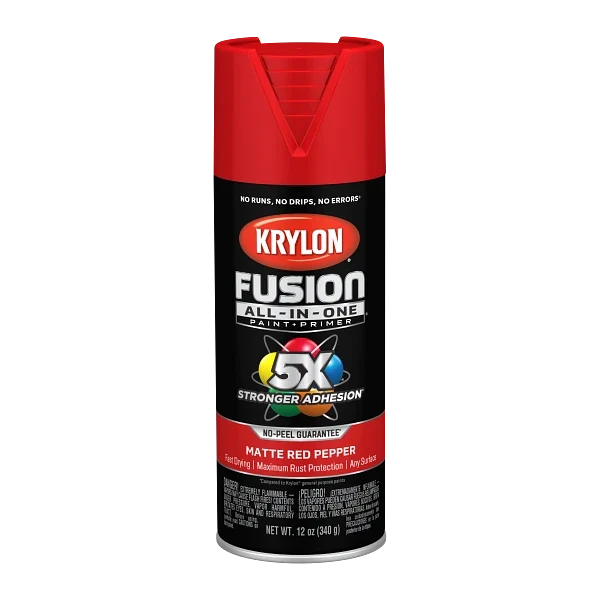
- Coverage
- 8–10 sq ft per 12-oz can (two coats)
- Sheens
- Satin, gloss, matte
- Dry / recoat
- Touch dry 5 min · recoat any time
- Full cure
- 7 days
- VOC
- LVP formula varies by SKU
- Yellowing risk
- Low
- Primer
- Self-priming on plastic, laminate, metal, wood
- Price tier
- $
- The only can in the test that genuinely bonds to bare laminate and thermofoil
- 5-minute touch-dry — fastest in the lineup
- EZ Touch 360-degree dial spray tip works at any angle, including upside-down
- Self-leveling is mediocre on flat panels; spray a little farther back than feels right
- Smaller color range than Rust-Oleum 2X
- Smell is sharper than the Rust-Oleum cans — fan and open garage door are mandatory
4. Lacquer Spray
- Coverage
- 10–12 sq ft per 11-oz can (two coats)
- Sheens
- Gloss, satin, semi-gloss, ultra-cover gloss
- Dry / recoat
- Touch dry 10 min · recoat any time within 1 hour or after 48
- Full cure
- 3 days
- VOC
- Solvent-borne; check state compliance
- Yellowing risk
- Medium on white, low on color
- Primer
- Lacquer-compatible primer (Rust-Oleum Specialty Lacquer Primer); incompatible with most latex primers
- Price tier
- $$
- True high-gloss factory finish — the only can here that competes with sprayed automotive lacquer
- Hard, brittle film resists fingernail dents better than acrylic enamels
- Each subsequent coat melts into the last — no visible layer lines
- Solvent-based; the only can in the test you cannot use indoors safely
- Yellows over time on whites — picture frames and side tables, not white kitchen doors
- Will lift latex paint underneath — use only over bare wood, lacquer-friendly primer, or another lacquer coat
5. COLORmaxx Paint + Primer
- Coverage
- 8–10 sq ft per 12-oz can (two coats)
- Sheens
- Flat, satin, gloss
- Dry / recoat
- Touch dry 12 min · recoat under 1 hour or after 48
- Full cure
- 7 days
- VOC
- LVP formula varies by SKU
- Yellowing risk
- Medium on white over a year
- Primer
- Self-priming on wood and metal; bonding primer required on laminate
- Price tier
- $
- Cheapest can in the test — often $5–$6 per can on Home Depot's shelf
- Wide color range with rust protection on metal
- Fine-mist spray tip is forgiving for first-time furniture refinishers
- Soft cured film for the first two weeks — fingerprints if you re-handle too soon
- Self-leveling is fine on small parts, visibly textured on a flat drawer front
- Won't bond to glossy laminate without an adhesion primer first
Painter's Touch Ultra Cover
On laminate, thermofoil, factory melamine, or any glossy factory finish, the topcoat will peel within months without a bonding primer underneath. Rust-Oleum's bonding primer in spray form pairs with every can on this list except the lacquer (which needs its own lacquer-compatible primer). Skipped primer is the single most common cabinet-spray failure we see in reader photos.
BUY ON AMAZON
Ask a Question