Roller vs Spray — Speed, Finish, and When Each Wins
Sprayers move five times faster and lay glass on cabinets. Rollers skip the masking and finish a room in an hour. A jobsite verdict, with back-rolling rules.

The 30-Second Answer
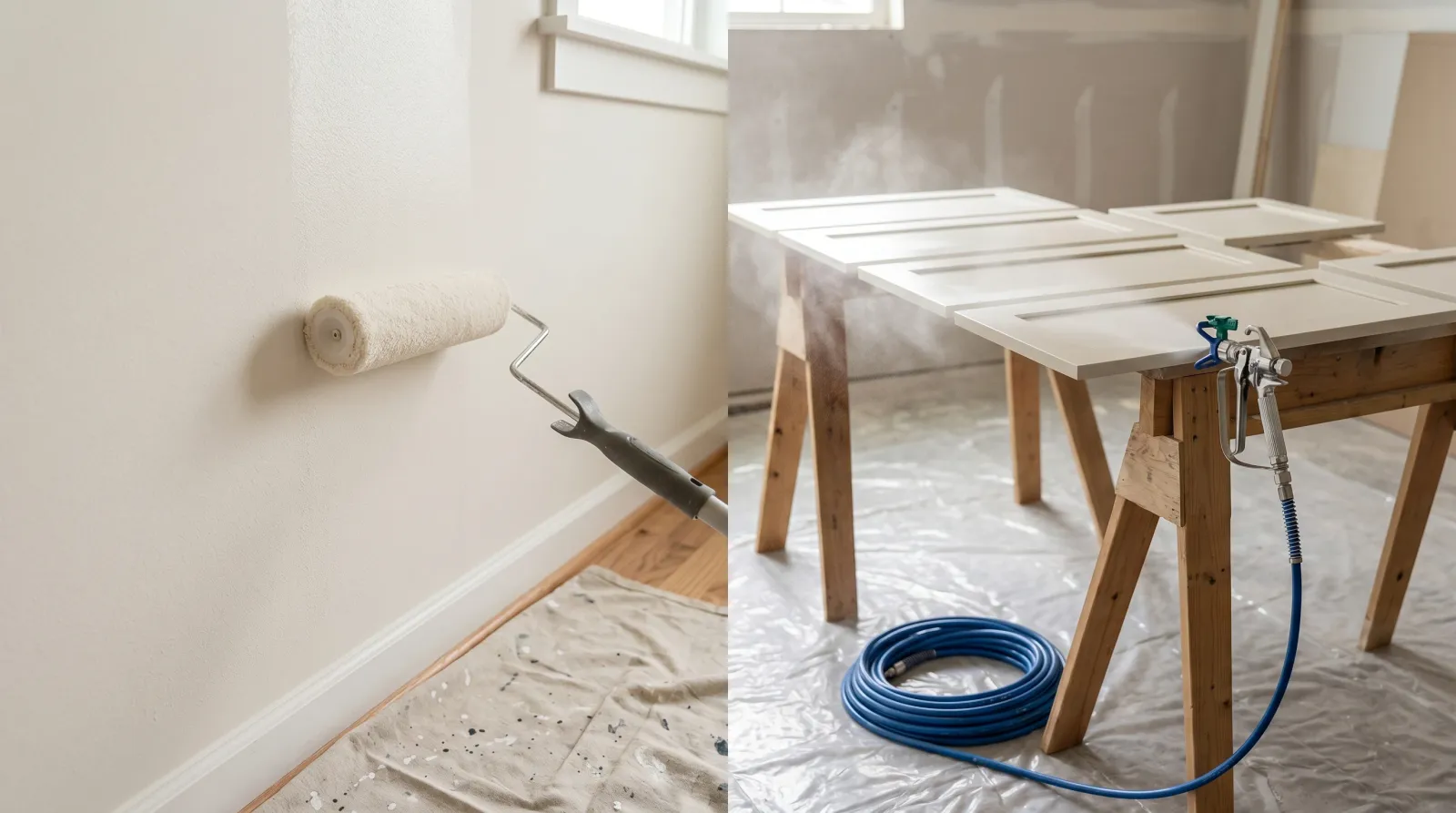
Spray on big bare surfaces and off-the-hinge cabinets. Roll inside a furnished house. A sprayer moves about five times faster on raw application, lays glass on flat panels, and costs you two hours of masking plus forty minutes of cleanup. A roller costs you twenty minutes of cleanup and leaves a fine stipple that’s invisible on a wall and wrong on a cabinet door. Pick by what’s harder: the painting or the prep.
At a Glance
| Roller | Spray | |
|---|---|---|
| Speed on big bare surfaces | 🟡 ~200 sq ft/hr | 🟢 ~1,000 sq ft/hr |
| Finish on flat panels | 🟡 fine stipple | 🟢 glass-flat |
| Masking and prep | 🟢 drop cloths only | 🔴 mask everything |
| Transfer efficiency | 🟢 over 90% | 🔴 30–50% airless outdoors |
| Cleanup time | 🟢 ~20 min | 🔴 ~40 min done right |
How to Tell Which Job You’re Actually On
Look at the room before you load anything. Is the furniture out? Are the floors covered in plastic already? Is the substrate bigger than 1,000 square feet and bare? Sprayer.
Is one wall getting touched up in a lived-in bedroom? Are the cabinets staying on the hinge? Is there a couch eight feet from the wall and a TV mounted next to it? Roller.
The deciding factor is almost never the paint or the surface. It’s the masking. If you’d spend more time tarping than painting, you’re rolling. If you’ve already got the room stripped for a full repaint, the sprayer earns its keep.
Speed on Big Surfaces
An airless with a 517 tip lays a wet coat on bare lap siding at roughly 1,000 square feet an hour. A 9-inch microfiber roller on the same siding does about 200. That’s the headline five-to-one ratio, and it’s real on the painting minutes.
It stops being five-to-one the moment you add the rest of the day. Masking a 2,000 sq ft house exterior takes two hours minimum: soffits, windows, doors, plants, deck boards, the neighbor’s car. Cleanup on an airless takes forty minutes if you do it right. Cleanup on a roller and tray takes ten.
Net it out on a 1,500 sq ft repaint: sprayer is maybe four hours faster end-to-end, not eight. On a single 200 sq ft bedroom wall, the sprayer is slower because the masking eats the savings.
Winner on bare exteriors and full-cabinet jobs: spray. Winner on furnished interiors and small surfaces: roller.
Finish Quality on Cabinets and Doors
A sprayed finish on a flat cabinet door is glass. No stipple, no brush marks, no texture. A tipped HVLP gun on Emerald Urethane or BM Advance, sprayed off the hinge in a garage, looks like a factory finish because it more or less is one.
A rolled finish on the same door, even with a 4-inch microfiber high-density foam mini-roller in a self-leveling waterborne alkyd, shows a fine stipple in raking light. At three feet under normal kitchen lighting it reads as smooth. Under the morning sun coming through a window at a low angle, you’ll see it. Some homeowners don’t care. Some do.
On walls, the math reverses. A sprayed wall without back-rolling looks fine until the light hits it sideways, and then you see thin spots where the spray fan overlapped or thinned out. A rolled wall has even mil thickness across the whole field. That’s why every interior paint TDS (Aura, Duration, Marquee) says “roll or back-roll” in the application notes.
Winner on cabinets and doors: spray. Winner on interior walls: roller.
Masking and Prep Time
This is where the sprayer loses most of its time advantage. Anything within ten feet of the spray fan gets atomized paint on it. Floors, ceilings, baseboards, light fixtures, windows, doorknobs, switch plates, the next room over if the door’s open.
A serious interior spray job means floor-to-ceiling plastic on every adjacent surface, painter’s tape on every edge, and drop cloths over anything that didn’t get plastic. Two to three hours of work before you spray a single square foot. Then another forty minutes pulling it all down.
Rolling is a drop cloth on the floor, painter’s tape on the baseboard if you don’t trust your cut-in, and that’s it. Ten minutes of setup. The cut-in goes with a brush and you’re rolling within fifteen minutes of walking in.
Winner: roller, by a wide margin, on any furnished interior.
Paint Waste and Overspray
An airless outdoors lands about 30 to 50 percent of the paint on the surface. The rest atomizes into the air, drifts with the breeze, and settles on whatever’s downwind. HVLP indoors with a tuned gun lands 65 to 80 percent. A roller lands over 90 percent. Almost everything that comes off the cover goes onto the wall.
On an $85-a-gallon Emerald Urethane cabinet job, the spray transfer hit is real money. Six gallons rolled cover what eight to ten gallons sprayed cover, depending on the gun.
The overspray also costs you in time. Spray on a windy day and you’re paying for the neighbor’s car to be detailed.
Winner: roller.
Cleanup and Gear Hassle
A roller and tray rinse out under a tap in five minutes. Most pros throw the cover away. A $4 microfiber isn’t worth the twenty minutes of getting all the paint out of the nap. Frame, tray, brush, done.
An airless cleanup, done right, is thirty to forty-five minutes: flush the line with water (or solvent for oil) until it runs clear, pull the tip and filter, soak both, run a pump-saver shot before storage, wipe the gun down. Skip a step and the gun seizes inside a week. Pump rebuilds run $150 to $300.
Cleanup isn’t the deciding factor on a big job. On a small one, it’s most of the work.
Winner: roller.
Back-Rolling — When You Need Both
Back-rolling is one painter spraying, another running a 1/2-inch nap roller right behind the gun while the paint is still wet. It pushes the sprayed coat into the substrate and evens out the mil thickness.
You need it on bare exterior siding: cedar, fiber-cement, T1-11, masonry. Spray-only leaves the paint sitting on top of the texture instead of bonded into it. Two summers later you’ll see flash and chalk where the film thinned.
You don’t need it on smooth interior drywall, on sprayed cabinet doors off the hinge, or on metal. The substrate doesn’t need the paint pushed into anything.
If you’re a solo painter spraying an exterior, you back-roll yourself. Spray a fifteen-foot section, set the gun down, grab the roller, back-roll while the coat is still wet, move on. It’s the right way and it’s slower than a two-man crew by maybe 30 percent.
Verdict by Use Case
- Sprayer: bare exterior siding over 1,500 sq ft, full kitchen cabinet repaints with the doors off the hinge in a garage, fences over 100 feet, garage interiors, masonry walls, anything where the room is empty and the masking is already done.
- Roller: interior walls and ceilings in a furnished house, small exteriors under 800 sq ft, single rooms, touch-ups, anywhere the masking would take longer than the painting.
- Both: exterior repaints where you spray and back-roll, and any pro cabinet job where the doors get sprayed off the hinge and the frames get rolled with a 4-inch mini-roller in place.
Top Picks by Side
Rolling walls or ceilings? See the best paint rollers round-up for the frames and microfiber covers that don’t shed fibers into the wet paint.
Buying your first sprayer? See the best paint sprayers round-up for the Graco / Wagner / Titan shortlist worth owning at each price tier. For the airless-vs-HVLP side of that decision, the airless vs HVLP comparison breaks down which gun fits which job.
For the broader three-way decision with a brush in the mix, see the spray vs roll vs brush verdict.
What’ll Bite You in Two Years
Spraying bare cedar siding without back-rolling. The paint looks fine the day you finish. Two summers of UV and one freeze-thaw cycle later, you’ll see flash spots where the mil thickness was thin and chalking where the coat never bonded into the wood. The fix is sand, prime, and recoat — a full job again. Back-roll the first time. Adds an hour to a 1,500 sq ft house and saves you a weekend in 2028.