Brush vs Roller — When to Reach for Which
Brush for trim, cut-in, and detail. Roller for walls and ceilings. A jobsite breakdown of coverage, finish, and prep effort — with a clear pick per use case.

The 30-Second Answer
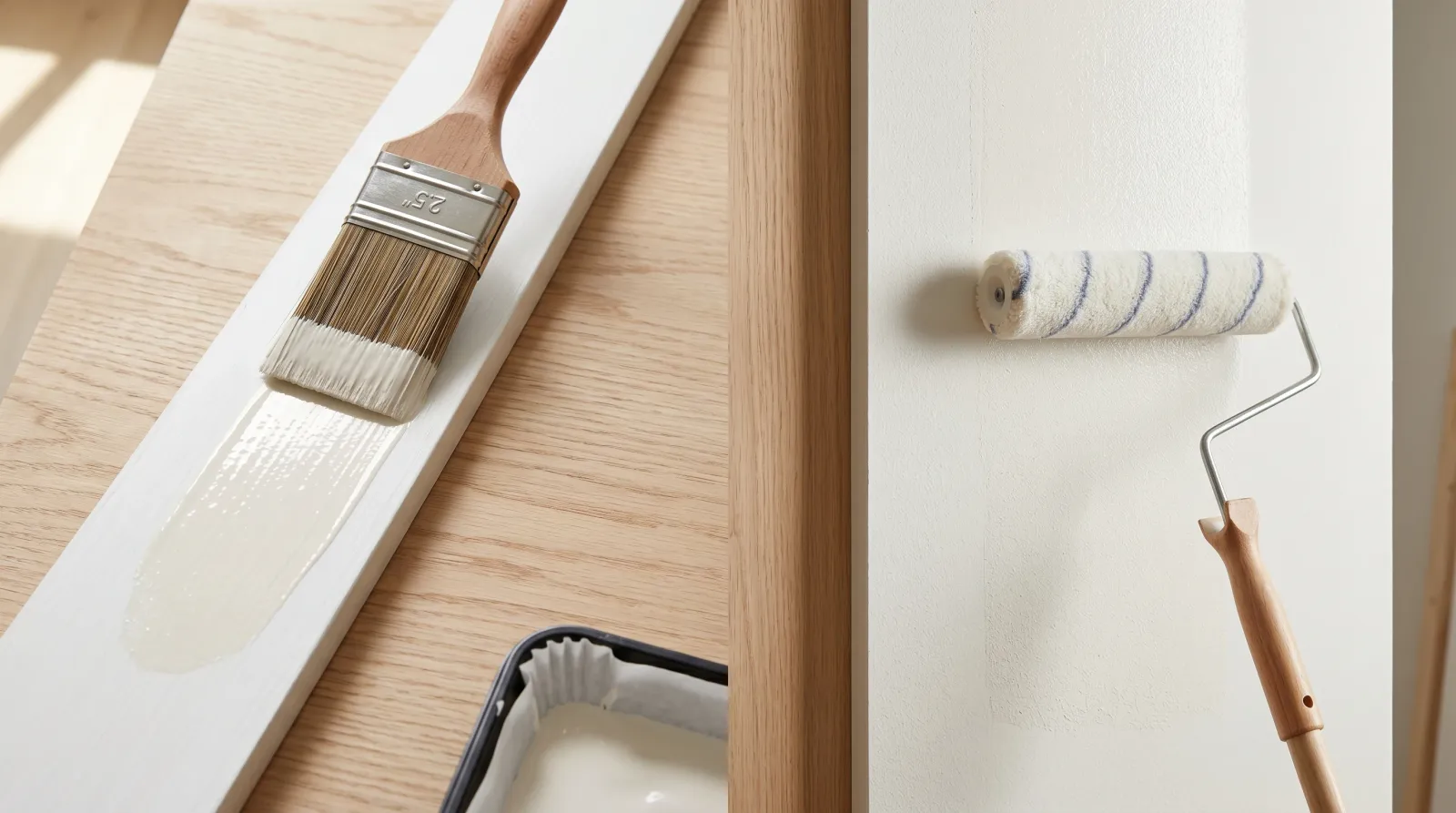
Brush for trim, cut-in, doors, and anything with a profile. Roller for walls, ceilings, and flat panels bigger than a dinner plate. That’s the whole rule. The brush is a precision tool that lays down maybe 50 square feet an hour. The roller is a coverage tool that does 200. Trying to substitute one for the other costs you time, finish quality, or both.
At a Glance
| Brush | Roller | |
|---|---|---|
| Coverage rate | 🟡 ~50 sq ft/hr | 🟢 ~200 sq ft/hr |
| Finish on flat walls | 🟡 stroke marks | 🟢 even stipple |
| Finish on trim | 🟢 lays flat | 🔴 skips profiles |
| Cut-in accuracy | 🟢 inside 1/16“ | 🔴 not the job |
| Setup + cleanup | 🟢 rinse and go | 🟡 frame, cover, tray |
How to Tell Which Job You’re Actually On
Look at the surface for three seconds before you load anything.
Run your hand across it. Flat and bigger than a sheet of paper? Roller. Anything with a bead, an ogee, a rabbet, or a corner inside half an inch of another plane? Brush. A slab door is a roller job with a brush touch-up on the edges. A six-panel door is a brush job all the way, because the stiles and rails take a roller but the panel insets and the sticking around them don’t.
The other test: where does your hand go to mask the cut line? If you’re reaching for tape, you’re about to roll. If you’re trusting the bristles, you’re brushing. Both are fine. Picking the wrong tool for the surface in front of you is what burns the day.
Side-By-Side: What Each Tool Actually Leaves on the Surface
A brush leaves brush marks. Even a good Purdy XL with conditioned latex shows tracks in raking light if you look at a wall straight on at sunset. That’s fine on trim where the profile breaks up the reflection. It’s not fine on a 12-foot stretch of flat drywall above a south-facing window.
A roller leaves stipple. The cover nap leaves a fine orange-peel texture that’s invisible at three feet and reads as “wall” to the eye. That stipple is what you want on a flat field. On trim, stipple looks like sandpaper. On a panel door, the roller skips the recess every single time and you brush it anyway.
That’s the whole appearance story. Brush = strokes, roller = stipple, neither one is wrong unless it’s on the wrong surface.
Coverage Rate
A 9-inch roller with a 3/8-inch microfiber cover, on a primed drywall wall, moves at roughly 200 square feet per hour with a single operator. That’s a 12x14 room in about an hour per coat once the cut-in is done.
A 2.5-inch angled sash brush on the same wall covers maybe 50 square feet an hour. Four times slower, and the finish is worse. The brush isn’t built for square footage. It’s built for accuracy.
On trim, the math inverts. A roller can’t even do the job — it skips every profile. So a brush at 50 sq ft/hr is the only honest number. There’s no roller alternative to compare against.
Winner for walls and ceilings: roller, by a wide margin. Winner for trim and detail: brush, by default — nothing else works.
Finish Quality
Brush finish on trim, applied with a conditioner like Floetrol in latex or thinned slightly with mineral spirits in alkyd, lays out flat as the bristle marks self-level over the first 90 seconds. A good China-bristle or Chinex brush leaves tracks shallow enough to disappear by the time the paint flashes off. That’s the trim look — soft sheen, no texture, no stipple.
Roller finish on walls is the standard wall look. The stipple depth depends on nap: 3/8-inch microfiber gives a tight even pattern that reads as smooth at three feet. 1/2-inch synthetic gives a pebbly orange peel that’s right for textured drywall and wrong for level-5 smooth. 1/4-inch foam gives a near-glass finish that’s right for cabinets and doors and wrong for anything that needs to hold a mil and a half of paint.
Cross-applications fall apart. Brush a wall and you see strokes. Roll trim and you see skipped detail and roller fuzz stuck in the wet paint. Pick the tool the surface is asking for.
Winner on trim: brush. Winner on walls: roller.
Prep and Cleanup
Brush setup is a brush and a can. Cleanup is a sink, some Murphy’s, and a comb. Five minutes either side.
Roller setup is a frame, a cover, a tray or a 5-gallon with a grid, a liner if you’re smart, drop cloths because rollers throw paint, and usually an extension pole. Cleanup is the tray, the cover (which most people throw away — a $4 microfiber cover isn’t worth the 20 minutes of rinsing), the frame, and the drop cloths. Twenty minutes either side, easy.
The brush wins setup and cleanup by a factor of three. That matters when you’re doing a single door or a window casing. It doesn’t matter when you’re doing a 1,400 sq ft repaint, because the roller saves you four hours on the wall and gives you the twenty minutes back twice over.
Winner: brush, but only on small jobs.
Cut-In and Detail
This isn’t a contest. A roller can’t cut in. The bevel on a 2.5-inch angled sash brush — Purdy XL Glide, Wooster Pro, Corona Vegas — is built specifically for the line where wall meets ceiling, wall meets trim, wall meets switch plate. Loaded right, held at 30 degrees, you cut a line inside 1/16 of an inch without tape.
A roller, even an edge roller or a corner roller, leaves a fat fuzzy line about 3/8 of an inch wide and stipples up against whatever it’s hitting. Useful for nothing except advertising.
If you’re trying to skip the cut-in, the answer isn’t a different roller. The answer is a brush, a steady hand, and ten minutes of practice on the back of a piece of cardboard.
Winner: brush. Not a contest.
Wall and Ceiling Speed
Roller. Walls and ceilings are flat, big, and unforgiving on coverage. The 9-inch roller with a microfiber 3/8-inch cover and an 18-inch extension is the only honest tool for the job. Ceilings, add a 4-foot extension pole and a 5-gallon bucket with a grid — the tray is too tippy when you’re working overhead.
An 18-inch roller is faster on a long unbroken wall and slower on anything with windows or breaks. For most residential, the 9-inch wins on flexibility.
Trying to brush a ceiling is a punishment. It’s also a guarantee of lap marks because you can’t keep a wet edge moving fast enough across 200 square feet of plaster.
Winner: roller.
Verdict by Use Case
- Brush all the way: trim, baseboards, casings, crown, mullions, six-panel doors, cabinet face frames, window sashes, anywhere you’re cutting in. Buy a 2.5-inch angled sash brush and a 1.5-inch trim brush. Done.
- Roller all the way: walls, ceilings, slab doors, flat slab cabinets, garage interiors, basement walls, large plywood panels. Buy a 9-inch frame, a microfiber 3/8-inch cover, and an 18-inch extension. Done.
- Both, in this order: any wall job. Cut in with the brush first, roll the field while the cut-in is still wet, feather the edge where the brush meets the roller. Stop in the middle of a wall and you’ll see the lap mark when the morning sun hits it.
No tie. The tools do different jobs.
Top Picks by Side
Brushing trim or cutting in? See the best paint brushes round-up for the Purdy / Wooster / Corona shortlist that holds an edge through three repaints.
Rolling walls or ceilings? See the best paint rollers round-up for the frames and covers that don’t shed fibers into your finish.
For the sheen-and-finish side of the decision, the sheen guide covers which sheen forgives which tool.
What’ll Bite You in Two Years
Skipping the cut-in to “roll right up to the ceiling” leaves a stippled fuzzy line at the top of every wall. You’ll see it the first time low afternoon sun comes in. By year two, when you go to repaint, you’ll have to brush that fuzz off the ceiling line because the new paint won’t lay flat over it. Cut in with a brush the first time. Five extra minutes a wall, and the next repaint goes twice as fast.
Frequently asked questions
Can I do a whole room with just a brush?+
Can I do trim with a roller?+
Do I really need to back-roll after a sprayer?+
What's the right roller nap for smooth drywall?+
- Best paint brushes
- Best paint rollers
- Sheen guide