Floetrol vs Thinning Paint With Water
Floetrol vs water, decided by chemistry. One buys open time, the other dilutes the binder. What each does to the cured film and how much to add per gallon.

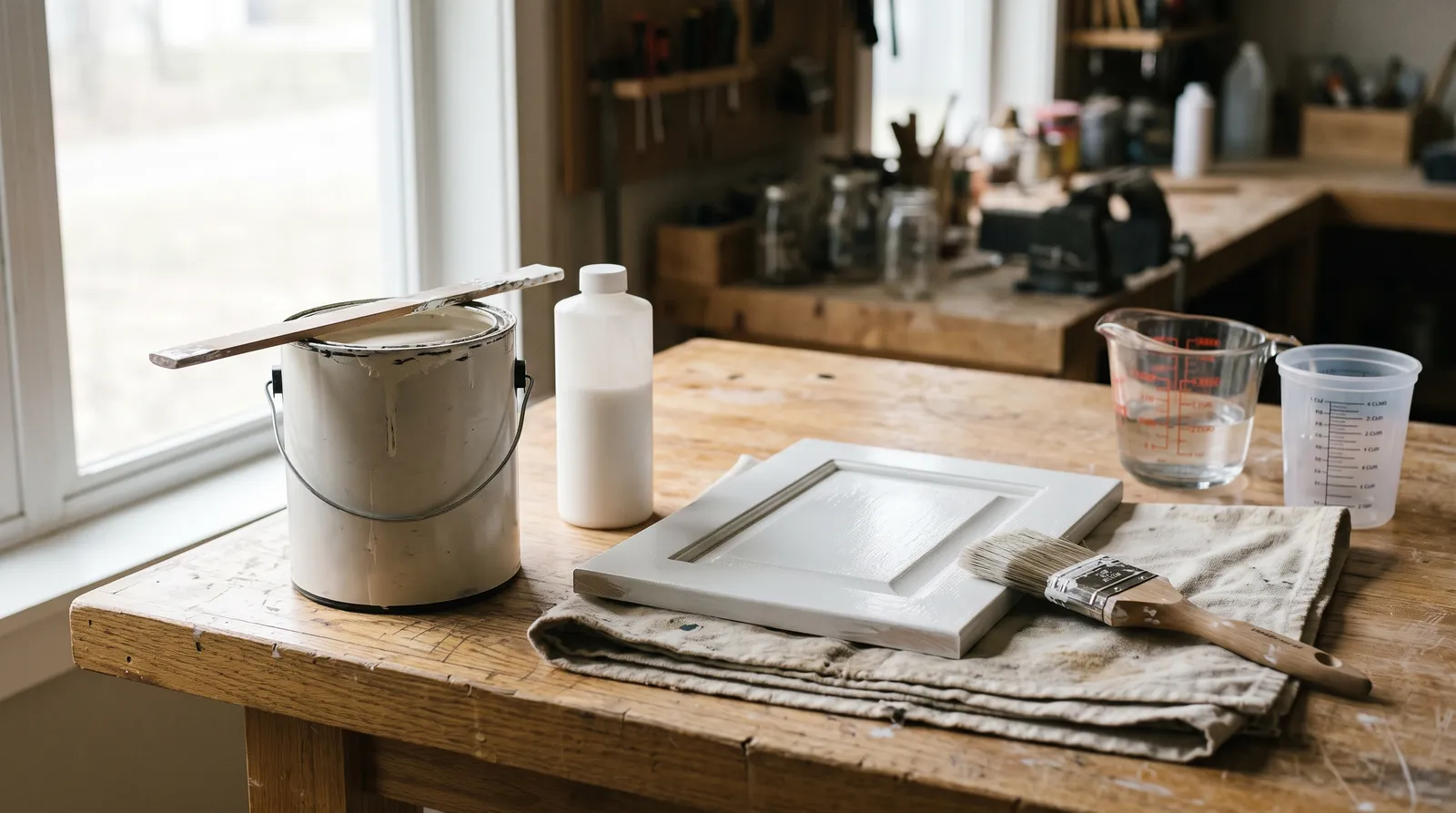
The 30-Second Answer
If your problem is brush marks, lap marks, or paint that skins over before you can lay it off, use Floetrol. If your problem is a gun that will not atomize or a mist coat that needs to soak into fresh drywall, use water. Floetrol buys working time by slowing evaporation. Water buys viscosity by removing solids, and every ounce of it costs you hide and scrub resistance. They solve different problems, and half the arguments about which one is better come from people who never named the problem.
At a Glance
| Floetrol | Water | |
|---|---|---|
| Effect on binder and hide | Dilutes ~6% at 8 fl oz per gallon, gives back coalescing aid | Dilutes 1:1; 13 fl oz per gallon is a straight 10% solids loss |
| Open time and leveling | ✓✓ (adds 5–15 minutes of wet edge) | ✗ (evaporates first, then the film sets faster than ever) |
| Viscosity drop for spraying | ✓ (mild; it is thicker than water) | ✓✓ (largest drop per ounce added) |
| Sheen and color uniformity | ✓✓ (small gloss knock on enamels) | ✗ at heavy doses (flashing, colorant float) |
| Cost per gallon of paint | $2–$4 added | $0 |
| Compatibility | Latex and acrylic only; never alkyd | Any water-borne paint; never alkyd |
| Where it belongs | Cabinets, doors, trim, pour painting | Mist coats, cup guns, ceilings, budget volume work |
How to Tell Which Problem You Actually Have
Load a brush and pull one full stroke across a scrap board. Wait ninety seconds, then try to brush back into the trailing edge of that stroke.
If the brush drags and leaves a ridge, the paint is setting before you can level it. That is an open-time problem, and water will not fix it. Water flashes off in the first minute and leaves the film drier than where you started.
If the brush moves fine but the paint came out of the can like pudding, or the gun fingers and spits, that is a viscosity problem. Measure it: 25 to 35 seconds through a Ford #4 cup is the working range for most latex through an HVLP.
Hot, dry, breezy conditions produce open-time problems. Thick paint, cold paint, and half-skinned cans produce viscosity problems.
What Each One Does to the Film
A latex paint film forms in two stages. Water leaves first, and then the binder particles, packed together and still soft, fuse into a continuous film. The second stage is the one that decides how the paint performs. Coalescence needs time and it needs the particles to stay soft long enough to flow into each other.
Water thins by subtraction. A typical interior latex runs 30% to 45% volume solids. Add 13 fl oz per gallon and you have removed 10% of everything: binder, pigment, extender. Dry film build per coat drops by the same fraction. The paint spreads farther, which feels like a win at the roller and shows up as thin hide on the second coat. Past 10% you are also disturbing the surfactant and rheology package the formulator balanced, which is why over-thinned paint foams, craters, and lets colorant float to the surface in streaks.
Floetrol thins by retardation. It is a water-borne conditioner built on glycol ethers with a low non-volatile content, so per ounce it dilutes the binder about as much as water does. What it adds is a slow-evaporating solvent fraction that keeps the binder particles mobile after the water has gone. The reason for that is the glycol ethers double as coalescing aids: they soften the acrylic particles temporarily so the film knits at a lower effective temperature. Longer wet edge, and slightly better film formation on a cold day.
Winner: Floetrol. The dilution cost is comparable. Only one of them gives something back to the film.
Open Time and Leveling
Open time is the window between the paint hitting the substrate and the surface becoming too set to rework. Modern acrylics run short by design, because fast dry means fast recoat. At 70°F and 50% relative humidity that window is 5 to 15 minutes. Push the room to 85°F with a fan running and it collapses under 5 minutes. That is when cabinet doors start showing every stroke.
Floetrol at 8 fl oz per gallon adds roughly 5 to 15 minutes back, depending on temperature and airflow. That is the difference between laying off a six-foot door in one pass and chasing a set edge across the middle rail. It also lets the film level under its own surface tension, so the ridges a synthetic brush leaves behind sink flat instead of curing in place. Raking light on semi-gloss finds every one of those ridges, which is why cabinet work is where the additive earns its money.
Water does the opposite. The wet edge looks longer for thirty seconds, then the added water flashes off and leaves a film with less binder to stay mobile than the can started with.
Winner: Floetrol. This is the entire reason the product exists.
Viscosity Drop for Spraying
Here the honest answer runs the other way. Floetrol is not a thin liquid. It pours closer to light cream than to water, so per ounce it drops viscosity less than plain water does. On an airless with a 0.015 tip, most premium latex sprays straight from the can and neither additive is required. On an HVLP, a gravity cup gun, or a handheld with a small orifice, you need a real reduction, and water is what gets you there.
The sequence for a fine-finish gun: stir in 8 fl oz of Floetrol per gallon for the leveling, run the Ford cup, then add water in 2 fl oz increments until you land in the 25 to 35 second window. On most cabinet enamels that lands around 6% Floetrol plus 4% to 6% water. Total added liquid stays under 15% and the film still builds. If you are spraying walls rather than doors, an airless machine skips this problem entirely.
Winner: Water. Ounce for ounce it is the stronger viscosity reducer, and for small-orifice guns that is the constraint.
Sheen and Color Uniformity
Overthinned paint flashes. When one part of a wall carries a heavier reduction than another, the two areas cure with different binder-to-pigment ratios at the surface and read as different gloss. Same optical mechanism as flashing over an unprimed patch: chemically the same paint, visually two paints. Heavy water reduction also lets colorant migrate, which on deep bases shows up as faint streaking once the film is dry.
Floetrol has one cost of its own. Because it contributes almost no binder, a heavy dose knocks a few gloss units off semi-gloss and gloss enamels. On matte, eggshell, and satin nobody sees it. On a high-gloss front door, keep it at 4 to 8 fl oz per gallon and no more.
Winner: Floetrol, by a clear margin on walls and by a narrow one on gloss enamels.
Cost per Gallon of Paint
Water is free. Floetrol runs about $12 to $18 a quart and $30 to $40 a gallon at retail, so 8 fl oz costs $2 to $4 per gallon of paint conditioned. On a two-gallon cabinet job that is pocket change against the cost of the doors. On a 20-gallon interior repaint of ceilings and closets, it is $60 spent on a surface nobody inspects in raking light.
Winner: Water. It is free, and on low-visibility surfaces the free option is the correct one.
Compatibility with What Is in the Can
Both additives are water-borne, so both are out for alkyd and oil-based enamel. Water in oil paint seizes and separates; Floetrol does the same thing with extra steps. The oil-side conditioner is Penetrol from the same manufacturer, and the oil-side thinner is mineral spirits unless the data sheet names naphtha.
Two more limits. High-solids designer formulas, Benjamin Moore Aura in particular, are specified to go on unmodified, and the manufacturer’s own application data says not to add anything. Elastomerics and masonry coatings are the other category to leave alone, because their film build is the product and thinning defeats it.
Floetrol has one use with no water equivalent: acrylic pour painting. Pourers run it at 1 part Floetrol to 1 or 2 parts paint to control density and surface tension so cells form and hold. Water at that ratio makes weak, translucent paint. For furniture and decorative work, the furniture paint round-up covers the base coats that take conditioner well.
Winner: Water on breadth, since it works in any water-borne product a label allows. Floetrol wins the specialty case outright.
Verdict by Use Case
- Use Floetrol if: you are brushing or rolling cabinets, doors, trim, or built-ins where lap marks would show; you are working above 80°F or in dry moving air; you are painting a large wall in one plane and need the wet edge to survive the cut-in; you are pouring acrylics.
- Use water if: you are misting new drywall over PVA primer so the coat soaks in; you are running an HVLP or cup gun that needs a genuine viscosity drop; you are rolling ceilings, closets, or a garage where nobody will read the sheen; you are pricing a high-volume repaint and the paint is already close to sprayable.
- Use both if: you are spraying a fine finish. Floetrol first for the leveling, then water in small steps to hit the cup number, total under 15%.
Neither one is a coverage extender. If you are thinning to stretch a gallon over more square feet, you are trading hide you will pay for with a third coat.
Top Picks by Side
Brushing and rolling with Floetrol? The additive only levels what the brush lays down evenly in the first place. The paint brush round-up covers the synthetic filaments that hold a wet edge, and the roller picks cover nap by surface.
Thinning with water for a gun? Start with airless vs HVLP to confirm you are on the right machine, then the HVLP sprayer round-up. Still choosing a method, brush vs spray has the labor math.
One caution before either bottle goes near siding: over-thinned exterior coats sit behind a lot of failures that get blamed on the substrate. If you are already seeing lifting outside, sort out peeling exterior paint before another reduced coat goes over it. For the solvent-by-paint-type breakdown, read how to thin paint properly.
Measure the additive into a graduated cup, not by eye out of the bottle. The whole argument between these two products lives in the difference between 6% and 20%, and nobody can pour that accurately from a gallon jug.