DEFY Extreme vs Ready Seal: Deck Stain Showdown
DEFY vs Ready Seal, settled. UV color hold, lap marks, prep load, mildew, and cost, with a straight verdict on which deck stain belongs on your boards.

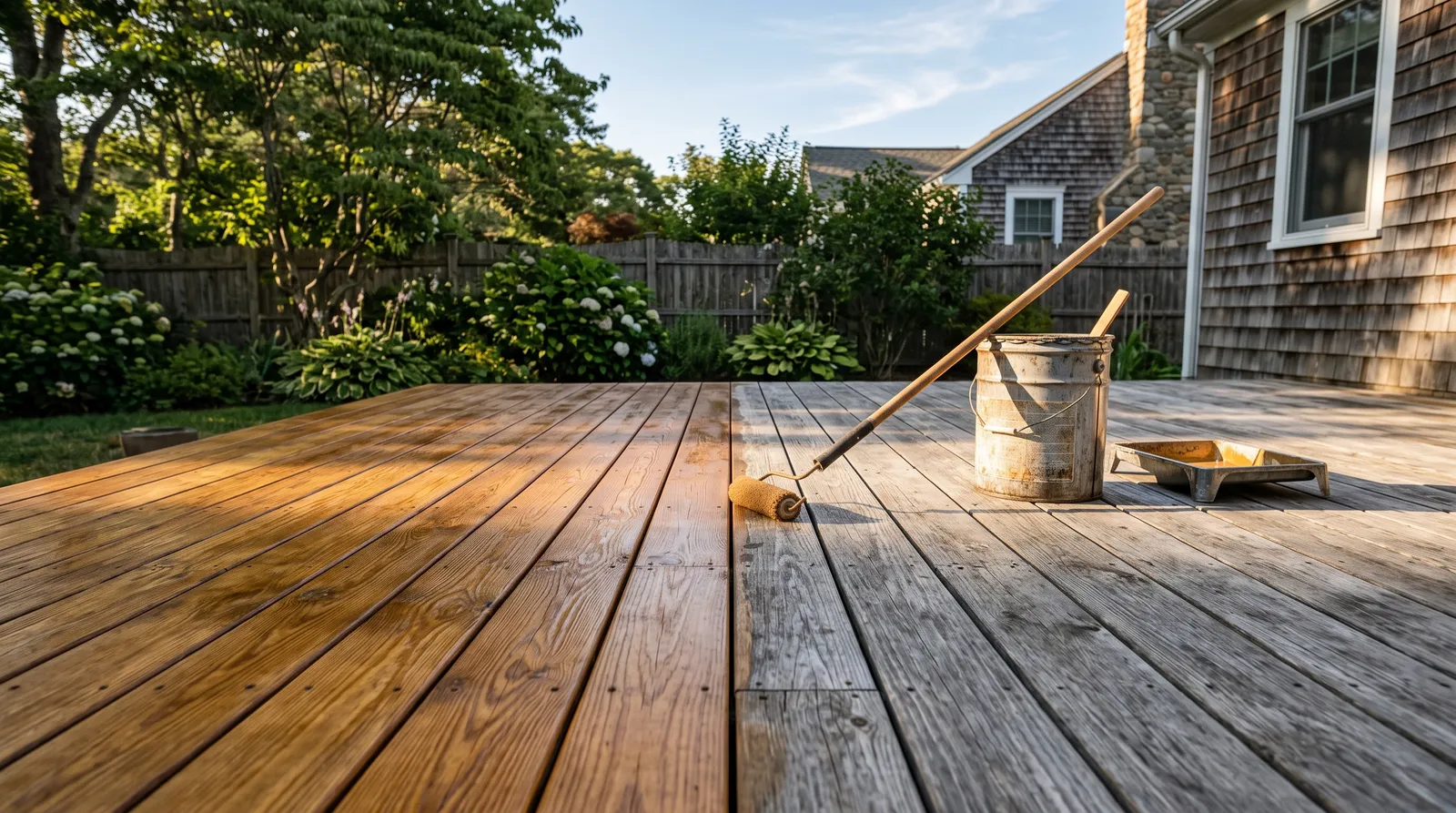
The 30-Second Answer
Ready Seal for fences, rough-sawn cedar, and anyone spraying a big job alone. DEFY Extreme for deck boards that take full sun all afternoon. Ready Seal is a paraffinic oil that cannot lap-mark and needs no back-brushing on rough wood, so a first-timer gets a clean job on the first try. DEFY Extreme is a water-based acrylic loaded with zinc oxide particles, and that zinc holds color on horizontal boards longer than the oil does. Choose on sun exposure and on how much you trust your own technique.
At a Glance
| DEFY Extreme | Ready Seal | |
|---|---|---|
| UV / color retention on horizontals | 🟢 zinc-oxide blocker, best in class | 🟡 fades sooner in full sun |
| Lap marks and wet edge | 🟡 real, keep the edge alive | 🟢 none, cannot over-apply |
| Prep load | 🔴 clean, brighten, wood must be dry | 🟢 clean only, tolerates damp wood |
| Recoat without stripping | 🟡 cleaner and brightener first | 🟢 wash and reapply |
| Mildew in hot humid climates | 🟢 no oil to feed it | 🟡 oil feeds surface mildew |
| Cleanup | 🟢 water | 🔴 mineral spirits |
| VOC and state availability | 🟢 under 100 g/L, ships anywhere | 🟡 check your state before ordering |
What Is Actually in the Two Cans
DEFY Extreme is a 100% acrylic resin carried in water, with zinc oxide nano-particles suspended in the film. The zinc is the whole pitch. It works the way mineral sunscreen works, scattering UV before it hits the lignin in the wood. Lignin breakdown is what turns cedar gray, so blocking UV is the only durable way to keep color.
Ready Seal is a blend of paraffinic oils and pigment, no acrylic, no film-former. It soaks in, it never sits on top as a coating, and it has no surface film to crack, peel, or blister. There is nothing to fail because there is nothing sitting on the surface.
Two different bets. DEFY bets on blocking the sun. Ready Seal bets on never having a film that can fail.
How to Tell What Is Already on Your Deck
Flick a few drops of water onto a board that gets weather. If it beads and sits there, something oily is still working. If it soaks in and darkens the wood inside ten seconds, the stain is spent no matter what the color looks like.
Then check the failure pattern. Water-based stains wear off in patches and go chalky at the edges, and a fingernail will lift a thin flake at the board ends. Oil stains do not flake at all. They just get lighter and grayer until the wood looks raw. Flaking means water-based. Even fading means oil. That one look decides whether you are stripping or just washing.
UV and Color Retention
Zinc oxide is a real UV blocker, not a marketing line. On a south-facing floor in zone 5, DEFY Extreme at 24 months still reads as a stained deck. The color has shifted, but it has not gone gray, and the boards do not need a full strip to bring back.
Ready Seal on the same floor typically wants a refresher at 12 to 18 months. The pigment load is lower and there is no UV blocker doing extra work, so the tone thins out over one hard summer. On vertical surfaces the picture changes completely. A Ready Seal fence in west Texas holds three years easily because vertical boards take a fraction of the UV dose that a floor does.
I see the same thing every spring: the fence looks fine and the deck floor looks a year older than it is. That is not the product failing. That is horizontal geometry.
Winner: DEFY Extreme, and only on horizontals. Call it a tie on fences and rails.
Application Forgiveness
Ready Seal wins this by a mile, and it is not close.
There is no wet edge to keep alive. Stop for lunch in the middle of a board, come back an hour later, pick up where you left off, and nothing shows. Two passes that overlap will not read as a dark stripe. You cannot over-apply it in the usual sense either, because whatever the wood will not absorb stays workable long enough to spread out. Spray it, roll it, brush it, pad it. On rough-sawn fence pickets you can run a sprayer without back-brushing and the job still looks even.
DEFY Extreme is a normal water-based stain with normal water-based rules. Work board length to board length, never stop mid-board, and keep the leading edge wet. Two coats go on wet-on-wet, the second inside about 30 minutes of the first, which means you are on a clock the whole time. Stop mid-board on a warm afternoon and you get a lap mark you will look at for two years.
DEFY also needs the wood dry and it does not want direct hot sun. Ready Seal will go onto damp wood and it does not care much what the sky is doing.
Winner: Ready Seal.
Prep Load
Ready Seal wants clean wood. Wash it, let it dry, stain it. That is the whole sequence on a fence.
DEFY wants clean, bright, dry wood, which is three steps, not one. Their process is a percarbonate wood cleaner to lift the gray dead fiber, then an oxalic acid brightener to reset the pH and open the grain, then two or three dry days. Skip the brightener and the acrylic sits on top of alkaline residue and lifts at the board ends the first freeze. That brightener step is not optional marketing. It is the step that makes water-based stains bond.
Both need mill glaze knocked off new lumber, and both need a pressure washer for anything with real weathering. If you are buying one for the job, see the pressure washers for paint prep round-up; a 1,800 to 2,300 PSI unit with a 25-degree tip is the right size for decks. Higher pressure furs the wood and then nothing lays down evenly.
Winner: Ready Seal.
Recoat and Maintenance
This is the part people forget when they compare price per gallon.
Ready Seal recoat: wash, dry, reapply. No stripper, no brightener, no sanding. A maintenance coat on a 400 sq ft deck is a Saturday morning and one gallon.
DEFY recoat: wash with their cleaner, brighten, dry, then two coats wet-on-wet. Same weekend structure as the original job, minus the stripping. Still more work and more product than Ready Seal asks for.
The one thing DEFY does not do is peel, which matters. A failed film-forming deck stain is a $600 stripping job. Neither of these products puts you there. If you are weighing that risk against a solid-color stain or paint, the solid stain vs paint on a deck comparison covers the peel math in full.
Winner: Ready Seal.
Mildew in Hot Humid Climates
Paraffinic oil is organic. In Houston, Tampa, or coastal Carolina, mildew will feed on it, and a Ready Seal deck under tree cover can go spotty and dark in one wet summer. Washing brings it back, but you will be washing.
DEFY Extreme has no drying oil for mildew to eat, and zinc oxide is mildly fungistatic on its own. In humid shade it stays cleaner between washes. The gap is small in Denver and obvious in Orlando.
Winner: DEFY Extreme.
Cost, Coverage, and Cleanup
Per gallon they land close. Both run roughly $45 to $60 retail, with five-gallon pails around $190 to $260 depending on color and where you buy.
Coverage is close too. On weathered decking figure 100 to 150 sq ft per gallon for either one, less on rough-sawn fence boards that drink. DEFY needs two coats, which sounds like double the material, but the second coat goes on wet into the first and only takes what the wood will still absorb. Real-world difference is maybe 20%, not 100%.
The gap shows up in the extras. DEFY’s cleaner and brightener add $30 to $50 to a deck-sized job. Cleanup is water for DEFY and mineral spirits for Ready Seal, plus the oily-rag routine: lay them flat outside to dry or drop them in a metal can with water. Bag up oily rags and they can self-ignite as the oil oxidizes. That is not a scare story, it is a house fire every summer somewhere.
Winner: Ready Seal on total product cost. DEFY on cleanup.
Verdict by Use Case
- Pick DEFY Extreme if: the surface is a deck floor with unshaded southern or western exposure, you live somewhere hot and humid, you want water cleanup, or you are in California or an OTC state where oil sealers get squeezed by VOC rules.
- Pick Ready Seal if: the job is a fence, a pergola, rough-sawn cedar, or anything you plan to spray. Also pick it if this is your first stain job. The forgiveness is worth more than 6 months of extra color life.
- Pick Ready Seal if you own a sprayer: the no-back-brush behavior on rough wood is the single biggest labor saver in either product line.
- It is basically a tie when: the surface is shaded, vertical, and small. A covered porch rail will look the same under either one at year three.
Top Picks by Side
Shopping either side? The best deck stain round-up has both of these ranked against the semi-transparent field, with notes on which colors hold up on pressure-treated pine versus cedar.
Not sure how transparent to go? Read the deck stain opacity guide first. Opacity drives lifespan harder than brand does, and picking the wrong one is the most common way people end up disappointed in a perfectly good product.
Doing a fence instead? The paint vs stain on a fence breakdown explains why almost nobody should paint a fence.
What Will Bite You in Two Years
For DEFY: the brightener step you skipped. Alkaline residue from the cleaner stays in the grain, the acrylic never truly grabs, and at month 18 you get lifting at cut ends and around fasteners where water sits longest. It looks like product failure. It is a prep failure. Cleaner, then brightener, always in that order, then wait for dry wood.
For Ready Seal: the coat you added on day three because it looked too dark. The color was still settling and you doubled the oil load. Now there is more oil than the wood can hold, it stays soft in August heat, it picks up dirt and footprints, and it will hold mildew like a sponge. One coat. Walk away. Look at it in two weeks.