Locker Room Paint: Specifier's Guide for Wet Areas (2026)
Locker room paint specified by zone: epoxy wall systems, anti-slip shower floors, and mold-resistant ceilings. DFT, ASTM standards, OSHA COF, and the contractor path.

Disclosure: Affiliate links to retailers and manufacturer-direct programs. Recommendations are spec-driven, not commission-driven.
Use Case
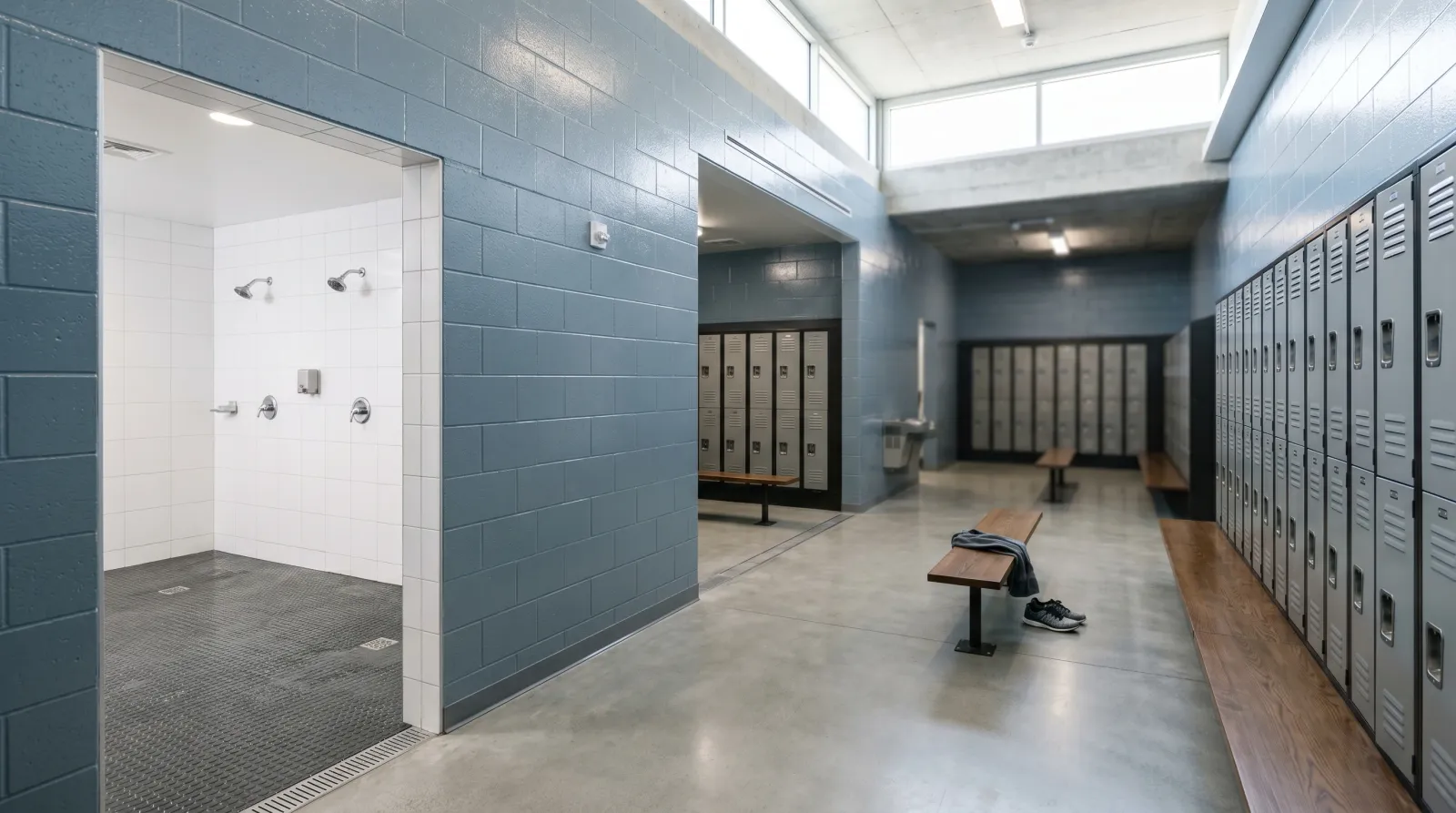
A locker room is a wet, high-traffic, high-humidity box that the building owner wants to clean with a pressure washer and a quaternary cleaner. The coating has to survive standing water, chlorine and quat sanitizers, body oils, foot fungus, abrasion from cleats and gym bags, and a relative humidity that sits near saturation every time the showers run. School athletic departments, fitness clubs, municipal pools, fire stations, manufacturing plant changing rooms, and military barracks all carry the same problem: a porous block wall and a concrete floor that mold and water will destroy unless the coating seals them.
The substrate is usually concrete masonry unit (CMU) block on the walls and a concrete slab on the floor. Both are alkaline, both are porous, and both move moisture. The spec is not one paint. It is a zoned system: a dense epoxy film on the walls that wipes clean and resists mildew, an aggregate-loaded anti-slip floor in the shower and wet-deck bays, and a mold-resistant ceiling coating that tolerates condensation.
Service life expectations run by zone and by product class. A budget latex repaint of a locker room fails in 18 to 24 months at the grout lines and behind the lockers. A pre-catalyzed water-based epoxy wall system holds 8 to 12 years with routine cleaning. An aggregate shower-floor epoxy delivers 7 to 10 years before the anti-slip profile wears smooth in the high-traffic lanes. Get the prep wrong on either surface and those numbers collapse to two years.
The coating choice here is a liability decision as much as a maintenance one. A slip-and-fall in a wet shower is the single most litigated facility hazard in this asset class, and the floor’s measured coefficient of friction is the first thing a plaintiff’s expert pulls. The spec calls for a documented anti-slip number, not a finish that “looks textured.”
Zoned Recommendation Matrix
A locker room is not monolithic. Each zone sees a different exposure, and the right system follows the exposure.
| Zone | Recommended system | Why |
|---|---|---|
| Changing area walls (CMU) | Wall System (pre-cat water-based epoxy, 2 coats) | Scrub resistance, mildew control, cleanable |
| Shower walls / wet bays | Wall System with extra coat or tile-clad epoxy | Constant wetting, quat and chlorine exposure |
| Shower floor / wet deck | Floor System (aggregate-broadcast epoxy) | OSHA 1910.22 anti-slip when wet |
| Dry locker / bench floor | Floor System without aggregate, or sealed concrete | Light traffic, ease of cleaning |
| Ceiling above showers | Mold-resistant epoxy or DTM acrylic | Condensation, drip, mildew |
| Steel lockers / partitions | DTM acrylic or shop-applied powder coat | Corrosion from chronic humidity |
Two failure-prone zones get under-specified the most. The shower-room ceiling, where condensation drips and feeds mold the moment a standard flat ceiling paint goes up, and the wall-to-floor cove, where water sheets down the wall and pools at the base. Spec a coved transition or a topcoat that laps from wall to floor at the shower bays so there is no open joint for water to wick into.
Spec Requirements
The spec block, before any product name. Walls and floors carry different numbers, so the table splits them.
| Spec | Walls (CMU) | Floors (concrete) |
|---|---|---|
| Dry film thickness (DFT) | 6–10 mils, 2+ coats | 12–25 mils total (with aggregate) |
| Coverage @ DFT | 150–250 sq ft/gal (filler coat lower) | 50–120 sq ft/gal |
| VOC | <100 g/L (water-based epoxy) | <100 g/L water-based; <340 g/L solvent-borne |
| Standards | ASTM D3273 (mold), ASTM D2486 (scrub) | ASTM D4060 (abrasion), ASTM C1028 / ANSI A326.3 (COF) |
| Substrate prep | SSPC-SP1 clean + ICRI CSP 1–2 (block filler over CSP); fill bug holes | Shotblast to ICRI CSP 3; HEPA-vacuum twice |
| Moisture | Cure 28 days new CMU; pH <10 before coating | ASTM F1869 MVE ≤3 lb or ASTM F2170 ≤75% RH |
| Service temp | Interior conditioned, 40°F–120°F | Interior; tolerate hot wash water to 140°F |
| Cure to service | Recoat 4–6 h; wet service 7 days | Foot traffic 24 h; full wet/chemical 7 days |
| Dew point / humidity | Substrate ≥5°F above dew point; RH <85% at application | Same; run showers off and dehumidify during cure |
| OSHA anti-slip | N/A (vertical) | Dynamic COF ≥0.42 wet per ANSI A326.3 |
Two numbers govern the result. On the wall, the substrate pH and cure: fresh CMU is strongly alkaline and a coating applied over green block saponifies, which is the soapy, soft-film failure you see peeling in sheets behind a locker room. On the floor, the MVE: a slab under a shower drain stays wet from below, and water-impermeable epoxy laid over it blisters.
State VOC variation matters if a solvent-borne tile-clad product is in the mix. California’s SCAQMD Rule 1113 and the OTC states cap industrial maintenance coatings tighter than the federal limit. The pre-catalyzed water-based epoxies named below all ship under 100 g/L and clear every state. Only the older solvent-borne tile-clad chemistries push the limit, and there is rarely a reason to specify them in a new locker room.
System Chemistry Compared
Four chemistries show up in locker room specs. The choice is driven by which zone and how wet it gets.
| Chemistry | Pot life | Recoat | Service exposure | UV stable | $/sq ft installed | Best for |
|---|---|---|---|---|---|---|
| Pre-catalyzed water-based epoxy | 8–16 h (catalyzed) | 4–6 h | Walls, ceilings, wet | Interior only | $1.50–3.50 | Locker room walls — the workhorse |
| Two-component (2K) epoxy floor | 30–45 min | 8–24 h | Floors, wet decks | No (interior) | $4–9 | Shower / wet-deck floors |
| Tile-clad solvent-borne epoxy | 4–6 h | 6–8 h | Heavy wet walls | No | $2.50–4.50 | High-abuse shower walls |
| DTM acrylic | N/A (1K) | 2–4 h | Ceilings, steel lockers | Yes | $1.00–2.50 | Ceilings, partitions, low-wet zones |
For the walls of a typical locker room, the pre-catalyzed water-based epoxy is the right answer: it brushes and rolls like a paint, cleans up with water, and cures to a dense, mildew-resistant film that takes a scrub brush and a quat cleaner. For the shower floor, a two-component epoxy with aggregate is the only chemistry that hits the anti-slip number and survives the chemical wash. DTM acrylic earns the ceiling and the steel lockers, where wetting is intermittent and UV stability helps under skylights.
Recommended Systems
Three full systems at different price-performance points. Each pairs a wall stack with a floor stack, because a locker room renovation buys both at once. Verify the specific product against the manufacturer’s current data sheet before bid.
System a — Sherwin-Williams ProIndustrial (premium, Long-Life)
Wall service life 10–12 years; shower floor 8–10 years.
| Layer | Product | DFT |
|---|---|---|
| Wall block filler | S-W PrepRite Block Filler (over bare CMU) | fills profile |
| Wall primer/seal | ProIndustrial Pre-Catalyzed Sealer | 2–3 mils |
| Wall topcoat | ProIndustrial Pre-Catalyzed Waterbased Epoxy (2 coats) | 5–7 mils |
| Shower-floor build | ArmorSeal 1000 HS Epoxy | 6–8 mils |
| Shower-floor topcoat | ArmorSeal 1000 HS with aluminum oxide broadcast | 6–8 mils |
| Total (floor) | 12–16 mils |
Sherwin-Williams ProIndustrial product page
System B — PPG (mid-Tier, Value)
Wall service life 8–10 years; wet-deck floor 7–9 years. Pitt-Glaze WB1 is the institutional standard on hospital and school CMU, and it carries here.
| Layer | Product | DFT |
|---|---|---|
| Wall primer | PPG Seal Grip Universal Acrylic Primer | 2 mils |
| Wall topcoat | Pitt-Glaze WB1 pre-catalyzed water-based epoxy (2 coats) | 5–6 mils |
| Floor topcoat | Aquapon WB water-based epoxy with anti-slip aggregate | 10–14 mils |
PPG Pitt-Glaze WB1 product page
System C — Rust-Oleum Industrial (budget / Fast-Turnaround)
Wall service life 5–7 years; shower floor 6–8 years. The right class for a tight budget or a fast summer turnaround on a school locker room, with shorter recoat windows and a lower installed cost.
| Layer | Product | DFT |
|---|---|---|
| Wall topcoat | Rust-Oleum 9100 System DTM epoxy (2 coats) | 6–8 mils |
| Shower-floor topcoat | Rust-Oleum Concrete Saver 9100 with aggregate | 12–18 mils |
Rust-Oleum Industrial product page
Systems Compared
| System | Total DFT (wall / floor) | $/sq ft installed | Service life | Best for |
|---|---|---|---|---|
| A — S-W ProIndustrial | 7–10 / 12–16 mils | $3.50–7 (wall) · $6–9 (floor) | 8–12 yrs | High-use clubs, varsity facilities, 24/7 fire stations |
| B — PPG | 5–6 / 10–14 mils | $2.50–5 (wall) · $5–7 (floor) | 7–10 yrs | Schools, municipal pools, general institutional |
| C — Rust-Oleum | 6–8 / 12–18 mils | $2–4 (wall) · $4–6 (floor) | 5–8 yrs | Tight budget, summer turnaround, low-use rooms |
Floor cost includes shotblast prep, build, topcoat, aggregate, and labor. Wall cost includes block filler on bare CMU, primer, and two finish coats. Doing the walls in-house with a maintenance crew drops the wall number by roughly 40 percent, and that is a defensible move on dry-zone walls. Do not in-house the shower floor.
Application and Contractor Path
Split the job by zone honestly. The walls and ceilings of a locker room are within reach of a competent in-house maintenance crew running a pre-catalyzed water-based epoxy: clean the block per SSPC-SP1, fill the bug holes with block filler, prime, and roll two finish coats with a 3/4-inch nap. That is a repaint a facility department can own.
The shower floor is a different job. It needs shotblasting to an ICRI CSP 3 profile, an ASTM F1869 moisture test, a two-component epoxy mixed on a controlled pot life, and an aggregate broadcast laid at a uniform rate to hit the anti-slip number. Spec a contractor with SSPC-QP1 certification (industrial coatings) or a documented flooring track record, and require the COF test result at closeout. For the wall-to-floor cove and the drain transitions, the contractor’s detailing is what keeps water out of the joint.
The manufacturer rep network on all three systems (Sherwin-Williams ProIndustrial reps, PPG architectural reps, Rust-Oleum Industrial distributors) will walk the room before bid, confirm the CMU pH and cure, and write the DFT schedule per zone. Use it. Catching green block or a wet slab before the crew shows up saves a callback and a peeling wall.
For prepping the block itself, the cinder block and CMU prep guide covers the block-filler step and the pH-cure window that decides whether the wall coating bonds or saponifies.
Why Standard Latex Fails in a Locker Room
The recurring question from facility buyers is why they cannot just roll a good kitchen-and-bath latex on the walls and call it done. The answer is film density. Latex eggshell, even a premium one, cures to a porous film with a measurable water-vapor permeance. In a room that hits 90-plus percent RH every time the showers run, that film absorbs moisture, swells, and gives mold spores a foothold at every micro-pore and grout line. Within two seasons the grout lines go black, the corners behind the lockers mildew, and the paint chalks where the quat cleaner has stripped it.
A pre-catalyzed or two-component epoxy cures to a cross-linked, dense, low-permeance film. Mold cannot root into it, the quat and chlorine cleaners do not strip it, and a scrub brush takes the grime off without taking the paint with it. That density is the whole reason the spec calls for epoxy on a wet wall and not the best latex on the shelf. The mold-resistant paint round-up covers the residential-grade options for a low-use changing area, but a working shower wall needs the industrial chemistry.
Failure Modes and How to Prevent Them
Five failures account for nearly every locker room coating callback.
- Saponification on fresh CMU. Cause: wall coating applied over green, high-pH block before the masonry cured. The alkali attacks the binder and the film turns soft and soapy, then peels. Prevention: cure new CMU 28 days, verify surface pH below 10 with a pH pencil, and use an alkali-resistant block filler and primer. The full mechanism is in the saponification failure guide adjacent to the condensation problem it shares.
- Floor blistering from substrate moisture. Cause: epoxy floor laid over a slab that stays wet from below the shower drains, with no MVE test run. Vapor lifts the coating in disc-shaped blisters. Prevention: ASTM F1869 or F2170 before coating; install a moisture-vapor-barrier primer if MVE exceeds 3 lb/1000 sq ft / 24h.
- Anti-slip profile wears smooth. Cause: aggregate broadcast too light, or a single high-traffic lane (shower entrance) abrades the texture flat within two years and the wet COF drops below the OSHA target. Prevention: broadcast aggregate to refusal in the topcoat, document the COF at install, and schedule a recoat of the wear lane on a 3-to-4-year cycle.
- Mildew at the wall-floor cove and behind lockers. Cause: an open joint or a dead-air pocket where water wicks and never dries. Prevention: cove the wall-to-floor transition at wet bays, lap the wall coating down into the floor system, and confirm the changing-area ventilation actually moves air behind the lockers.
- Ceiling drip-staining and peel. Cause: a flat latex ceiling paint over the shower that absorbs condensation, mildews, and sheds. Prevention: spec a mold-resistant epoxy or DTM acrylic on the shower ceiling and confirm exhaust ventilation pulls the moist air out during and after use.
Saponification and floor blistering are the two I see most on inspection reports, and both are settled in the prep phase. The pH check and the moisture test are an hour of work that prevents a strip-and-redo.
Where to Buy / Spec
| Channel | Best for | Path |
|---|---|---|
| Manufacturer-direct (S-W ProIndustrial, PPG, Rust-Oleum Industrial) | Spec’d renovations, rep walk-through, warranty | S-W ProIndustrial · PPG Pitt-Glaze WB1 · Rust-Oleum Industrial |
| Industrial distributor | Bulk block filler, aggregate, contractor accounts | Regional distributor with project pricing |
| Pro retail (S-W stores, PPG stores) | Wall repaint in-house, local pickup, contractor pricing | Store locator |
| Amazon Business | Small touch-up, fleet stocking of cleaners and rollers | Search by manufacturer |
Manufacturer-direct is the channel for any full renovation. The rep walk-through (pH check on the block, moisture call on the slab, DFT schedule per zone) is worth more than a retail discount on the can, and it is the difference between a wall that holds 10 years and one that peels behind the first row of lockers.
FAQ
Frequently asked questions about locker room paint specification are answered in the FAQ data above, covering contractor requirements, mold resistance, OSHA slip standards, substrate moisture, and downtime.