Food Plant Floor Coating: USDA Specifier's Guide (2026)
How to spec a food plant floor by zone: USDA and FDA acceptance, urethane cement vs novolac epoxy, DFT, MVE limits, anti-slip COF, and the contractor path.

Disclosure: Affiliate links to retailers and manufacturer-direct programs. Recommendations are spec-driven, not commission-driven.
Use Case
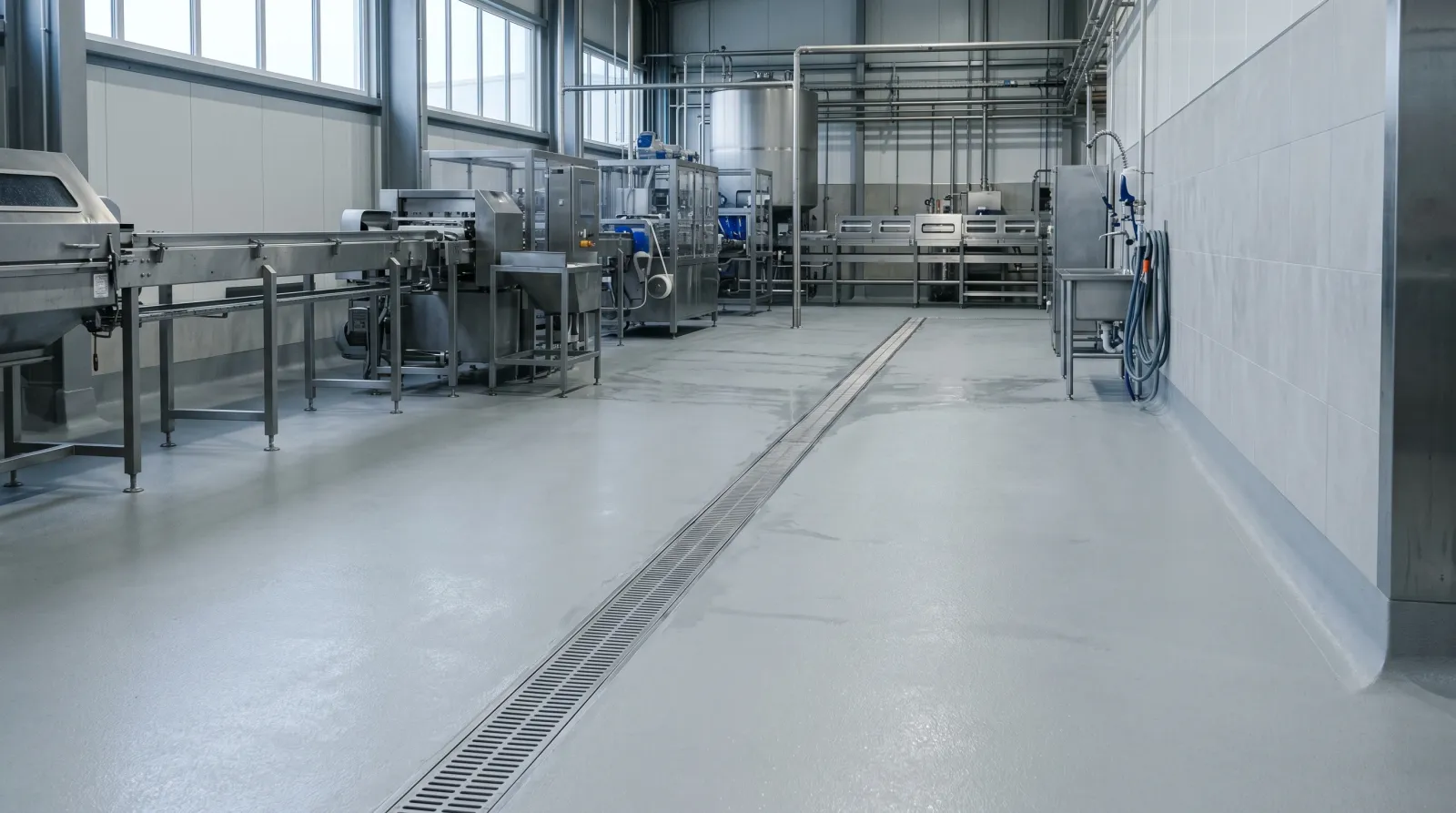
A food plant floor has to pass three inspections at once. The sanitarian wants a non-absorptive, seamless surface that drains and cleans. OSHA wants slip resistance under wet conditions. The plant manager wants it to survive forklift traffic, dropped product, steam cleaning, and the caustic clean-in-place chemistry that runs across it every shift. No single coating clears all three across every room, which is why a food-plant floor spec is a zone-by-zone decision, not a one-product call.
The governing reference is USDA acceptance for federally inspected meat and poultry operations, with FDA 21 CFR 175.300 covering incidental food contact. Neither is a stamp on a bucket. USDA approves the installed floor: non-absorptive, cleanable, coved at the wall, sloped to drain, with no open joints. The coating chemistry is what lets you build that floor and keep it intact through years of wash-down.
Service life expectations track the zone. A urethane cement floor in a wet-process room runs 10–15 years before a refresh broadcast. A novolac epoxy in dry packaging runs 8–12 years. A standard high-build epoxy dropped into a wash-down room because someone value-engineered the bid runs about 18 months before it debonds at the drains and starts harboring bacteria under the lifted edges. The cheap mistake in this pillar is treating every room as the same floor.
This guide covers the whole plant: which chemistry belongs in which zone, the spec block that earns the USDA sign-off, the multi-coat systems by tier, and the failure modes that put a coating contractor back on site under warranty. For the deep dive on the wet-process chemistry itself, see the urethane cement food plant guide.
Zoned Recommendation Matrix
A food plant is the textbook multi-zone asset. The same building runs a 35°F cooler, a 180°F cook room, a dry-goods warehouse, and a caustic wash bay. Spec by zone:
| Zone | Recommended system | Why |
|---|---|---|
| Wet process / cook / kill floor | System A (urethane cement, full broadcast) | Thermal shock from steam clean, acid and fat resistance, wet anti-slip |
| Wash-down / CIP areas | System A (urethane cement, coarse broadcast) | Caustic dwell, standing water, highest slip risk |
| Freezer / blast cell | System B (urethane cement, low-temp cure) | Sub-zero install and thermal cycling — see freezer room floor guide |
| Dry storage / packaging | System C (novolac or high-build epoxy) | Dry, no thermal shock, cost-driven |
| Dry bakery (flour, oven-adjacent) | System C with high-heat-tolerant epoxy | Dry heat without wash-down; epoxy is adequate |
| Maintenance / mechanical | System C epoxy, no broadcast | Out of the food zone; standard industrial floor |
The line that costs facilities money is the wash-down boundary. Where water and hot cleaning chemistry reach, urethane cement; where the floor stays dry, epoxy. Draw that line conservatively. Overspray, drain mist, and forklift tracking carry wash-down chemistry 10–15 feet past the obvious wet zone, and an epoxy floor 10 feet inside a “dry” line will still fail at the joints.
Spec Requirements
The spec block, before any product name. These are the values an inspector and a coatings rep will both check.
| Spec | Value |
|---|---|
| Dry film thickness (DFT) — wet zones | 3/16-inch to 1/4-inch (188–250 mils) urethane cement, broadcast |
| Dry film thickness — dry zones | 15–40 mils total novolac or high-build epoxy |
| Coverage at spec’d DFT | Urethane cement placed by trowel/gauge rake to thickness; epoxy 80–125 sq ft/gal per coat |
| VOC | 0–100 g/L; most food-floor chemistry is 100% solids, near-zero VOC; SCAQMD Rule 1113 and CARB SCM compliant |
| Standards | ASTM C580 (flexural), ASTM C722 (thermal shock), ASTM F1869 (MVE), ASTM D4060 (abrasion), ASTM D2047 (wet COF) |
| Certifications | USDA-acceptable installed surface; FDA 21 CFR 175.300; NSF/ANSI 51 on select SKUs |
| Substrate prep — concrete | ICRI CSP 5–6 (shotblast or diamond-grind) for urethane cement; ICRI CSP 3 for epoxy |
| Moisture vapor emission | Urethane cement tolerant to 12–15 lb/1000 sq ft/24h; epoxy ceiling 3 lb (ASTM F1869) |
| Service temperature | -40°F to 250°F (urethane cement); up to 140°F (epoxy) |
| Cure to service | Urethane cement: foot 8–12h, full 24–48h; epoxy: foot 24h, full 5–7 days |
| Ambient at application | Substrate ≥5°F above dew point; humidity under 85%; follow product low-temp limits in coolers |
| OSHA anti-slip COF | 0.5 static minimum, measured wet (ASTM D2047) in process and wash-down zones |
Two non-negotiables get missed at bid time. The first is the integral coved base. A food floor that meets the wall in a square 90-degree joint will not pass USDA, because that joint holds water and product. The cove is part of the floor system, formed in the same urethane mortar, radiused so a hose washes it clean. The second is slope: 1/4-inch per foot to the drains, verified with a level before the body coat goes down. A flat food floor ponds, and a ponded food floor grows what the inspector is there to find.
System Chemistry Compared
Four chemistries cover a food plant. Pick the class per zone before you pick a product.
| Chemistry | Pot life | Recoat window | Service temp | Wet COF holds | $/sq ft installed | Best for |
|---|---|---|---|---|---|---|
| Urethane cement | 15–30 min | 4–12 hr | -40°F to 250°F | Yes (broadcast) | $9–18 | Wet process, cook, wash-down, freezer |
| Novolac epoxy | 30–45 min | 8–24 hr | up to 140°F | With aggregate | $5–9 | Dry zones with chemical exposure |
| High-build epoxy | 30–60 min | 8–24 hr | up to 140°F | With aggregate | $4–7 | Dry storage, packaging, mechanical |
| MMA (methyl methacrylate) | 5–15 min | 1 hr | -40°F to 200°F | With aggregate | $10–16 | 24/7 plants needing 1-hour cure-to-service |
Urethane cement is the wet-zone default for one reason above the rest: it shares concrete’s thermal expansion coefficient, so a steam clean at 200°F does not shear it off the slab the way it shears off epoxy. Novolac epoxy is the chemical-resistant epoxy variant, worth the premium over standard epoxy in dry zones that still see acidic product or aggressive cleaners. MMA earns its place only in plants that cannot give up a process room for two days; it installs and cures to service inside an hour, including below freezing, but the odor during install forces ventilation planning and a crew certified on the chemistry.
Recommended Systems
Three full multi-coat stacks. System A and B are the wet-zone urethane cement specs; System C is the dry-zone epoxy. Most plants buy two of the three.
System A — Sherwin-Williams General Polymers FasTop (Premium Wet Process)
| Layer | Product | DFT |
|---|---|---|
| Body coat | General Polymers FasTop 12 Urethane Mortar | 3/16-inch (≈188 mils) |
| Broadcast | Graded quartz / aluminum oxide to refusal | (into wet mortar) |
| Seal coat | FasTop SL or FasTop TG Urethane Topcoat | 12–20 mils |
| Total | ≈200–215 mils |
Service life 10–15 years in wet-process and cook zones. The FasTop line carries the USDA-acceptable, FDA 21 CFR 175.300 chemistry and installs over green concrete at 5–7 days cure. Spec sheet at Sherwin-Williams General Polymers flooring.
System B — Sika Sikafloor PurCem (Premium Wet Process / Freezer)
| Layer | Product | DFT |
|---|---|---|
| Body coat | Sikafloor-21 PurCem Self-Smoothing | 3/16-inch to 3/8-inch |
| Broadcast | Graded quartz to refusal | (into wet mortar) |
| Seal coat | Sikafloor-31 PurCem | 15–25 mils |
| Total | ≈210–280 mils |
Service life 10–15 years. PurCem has a low-temperature variant rated to install and cure inside a running freezer, which is why it carries the freezer and blast-cell zones in System B. Sika heavy-duty flooring page.
System C — Tnemec Tneme-Glaze Novolac Epoxy (Dry Zones)
| Layer | Product | DFT |
|---|---|---|
| Primer | Tnemec Series 201 Epoxoprime | 4–6 mils |
| Build coat | Tnemec Series 280 Tneme-Glaze Novolac | 8–12 mils |
| Topcoat | Tnemec Series 280 (second coat) | 8–12 mils |
| Total | 20–30 mils |
Service life 8–12 years in dry storage, packaging, and dry-bakery zones. Novolac chemistry holds against acidic product and CIP overspray that a standard epoxy can’t. Broadcast aluminum oxide into the build coat where the zone needs wet anti-slip. Tnemec products. For the dry-zone install where chemical exposure is light, a Sherwin-Williams ArmorSeal or Rust-Oleum EpoxyShield Pro stack is a lower-cost alternative. See the warehouse epoxy floor guide for those systems.
Systems Compared
| System | Total DFT | $/sq ft installed | Service life | Best for |
|---|---|---|---|---|
| A — SW FasTop urethane cement | ≈200–215 mils | $11–16 | 10–15 years | Wet process, cook, wash-down |
| B — Sika PurCem urethane cement | ≈210–280 mils | $12–18 | 10–15 years | Wet process, freezer, blast cell |
| C — Tnemec novolac epoxy | 20–30 mils | $5–9 | 8–12 years | Dry storage, packaging, dry bakery |
Installed pricing assumes a 5,000+ sq ft scope through a manufacturer-rep contractor with shotblast prep, integral cove, and drain detailing included. The cove and drain work is real money on a food floor and it does not appear on a generic epoxy bid, so compare bids on the full installed package, not the per-foot floor field rate.
Application & Contractor Path
This is not a DIY product class, and on a USDA floor that statement is not negotiable. The integral cove, the drain terminations, the saw-cut keys, and the broadcast-to-refusal technique all require a crew that installs urethane cement routinely. Field-mixing a three-component urethane mortar wrong, or missing the recoat window on the seal coat, produces a floor that delaminates at the drains inside the first year.
Specify a contractor with SSPC-QP1 certification at minimum, and pull the manufacturer’s certified-installer roster. Sherwin-Williams General Polymers, Sika, BASF Master Builders, and Tnemec each maintain rep networks that publish region-by-region installer lists and run free pre-bid site visits. Use the site visit. It catches the MVE reading, the drain slope, and the wash-down boundary before the bid lands, which is worth more than any material discount.
Three questions before you sign:
- Has this crew placed this specific urethane cement line in a federally inspected plant in the last 12 months? USDA-floor detailing is a skill set, not a product feature.
- How do they form the integral cove and terminate at the drains? If the answer is vague, the floor will fail there first.
- What is the dew-point and substrate-temperature protocol, especially in coolers? A contractor coating a 38°F cooler floor without surface-temperature and dew-point logging should not be on the bid list.
The novolac epoxy dry-zone work (System C) is closer to standard industrial flooring and a competent commercial coatings crew can install it, provided they honor the recoat window and broadcast where the spec calls for anti-slip.
Failure Modes & How to Prevent Them
Five failures account for almost every food-plant floor warranty call. All five are settled in the specification phase, not on the application day.
- Thermal-shock debonding in wet zones. Cause: standard epoxy specified where steam cleaning or boiling spills hit the floor; the thermal differential shears it off the slab. Prevention: urethane cement in every zone that sees hot water or steam clean, no exceptions for “it’s only the edge of the room.”
- Delamination at drains and joints. Cause: square wall joints, no integral cove, poor drain termination; water gets under the coating and lifts it. Prevention: integral coved base in the same urethane mortar, saw-cut termination keys at drains and doorways, slope verified to 1/4-inch per foot before placement.
- Bacterial harborage in failed edges. Cause: any of the above lets the coating lift, and the void under a lifted edge becomes a Listeria reservoir the sanitarian will find. Prevention: seamless, monolithic install with no open joints; this is the entire point of the system.
- Wet slip claims. Cause: over-smoothed seal coat, no aggregate broadcast, worn texture in traffic lanes. Prevention: broadcast aluminum oxide or quartz to refusal for a wet COF of 0.5; schedule a refresh broadcast at year 6–8 in worn lanes.
- MVE-driven failure in dry-zone epoxy. Cause: novolac or high-build epoxy specified over a slab above 3 lb/1000 sq ft/24h with no moisture barrier. Prevention: ASTM F1869 test pre-bid in dry zones; install an MVE barrier primer above 3 lb, or switch that zone to urethane cement, which tolerates the moisture.
The first two account for the majority of the field claims in this category, and both come down to detailing at the wall and the drain. A perfect floor field with a bad cove is a failed food floor.
Where to Buy / Spec
| Channel | Best for | Path |
|---|---|---|
| Manufacturer-direct (SW General Polymers, Sika, Tnemec, BASF) | Spec’d USDA projects, rep support, system warranty | SW General Polymers · Sika flooring · Tnemec |
| Certified-installer network | Wet-zone urethane cement, integral cove, drain detail | Manufacturer rep roster by region |
| Industrial distributor | Dry-zone epoxy material, contractor accounts | Regional industrial coatings distributors |
| Amazon Business / pro retail | Dry-zone touch-up, maintenance stock | Search by manufacturer; local SW or BM Pro store |
Manufacturer-direct is the recommended channel for any wet-zone work. The rep writes the spec, runs the pre-bid site visit, and stands behind the installed-system warranty in a way a retail purchase cannot.
FAQ
Can I apply this without a contractor? Not for the wet-zone urethane cement work on a USDA floor. The cove, drain detailing, and broadcast technique require a certified crew. The dry-zone novolac epoxy (System C) can be installed by a competent commercial coatings crew that honors the recoat window.
What’s the warranty? Manufacturer product warranties run 1–5 years; certified-installer system warranties run 5–10 years on the installed floor. The installed warranty is the one a facility manager needs. Confirm it covers labor and material both, and that it names the cove and drain terminations, since that is where claims originate.
Does this comply with VOC limits in California? Most food-plant floor chemistry is 100% solids and near-zero VOC, which clears SCAQMD Rule 1113 and CARB SCM limits with room to spare. Verify the SDS for the specific seal coat and tint base before bidding a California job.
Is the floor OSHA-compliant for a wet process room? Only if the aggregate broadcast delivers a static COF of 0.5 measured wet (ASTM D2047, OSHA 1910.22). A smooth urethane cement floor is not compliant in a wash-down zone. Specify broadcast to refusal and a maintenance refresh at year 6–8.