Freezer Floor Coating: Cold-Storage Specifier's Guide (2026)
Freezer floor coating systems compared by DFT, thermal-shock rating, and cure-at-temperature. Urethane cement vs MMA, USDA prep, and the install timing that holds at minus 20 degrees.

Disclosure: Affiliate links to retailers and manufacturer-direct programs. Recommendations are spec-driven, not commission-driven.
Use Case
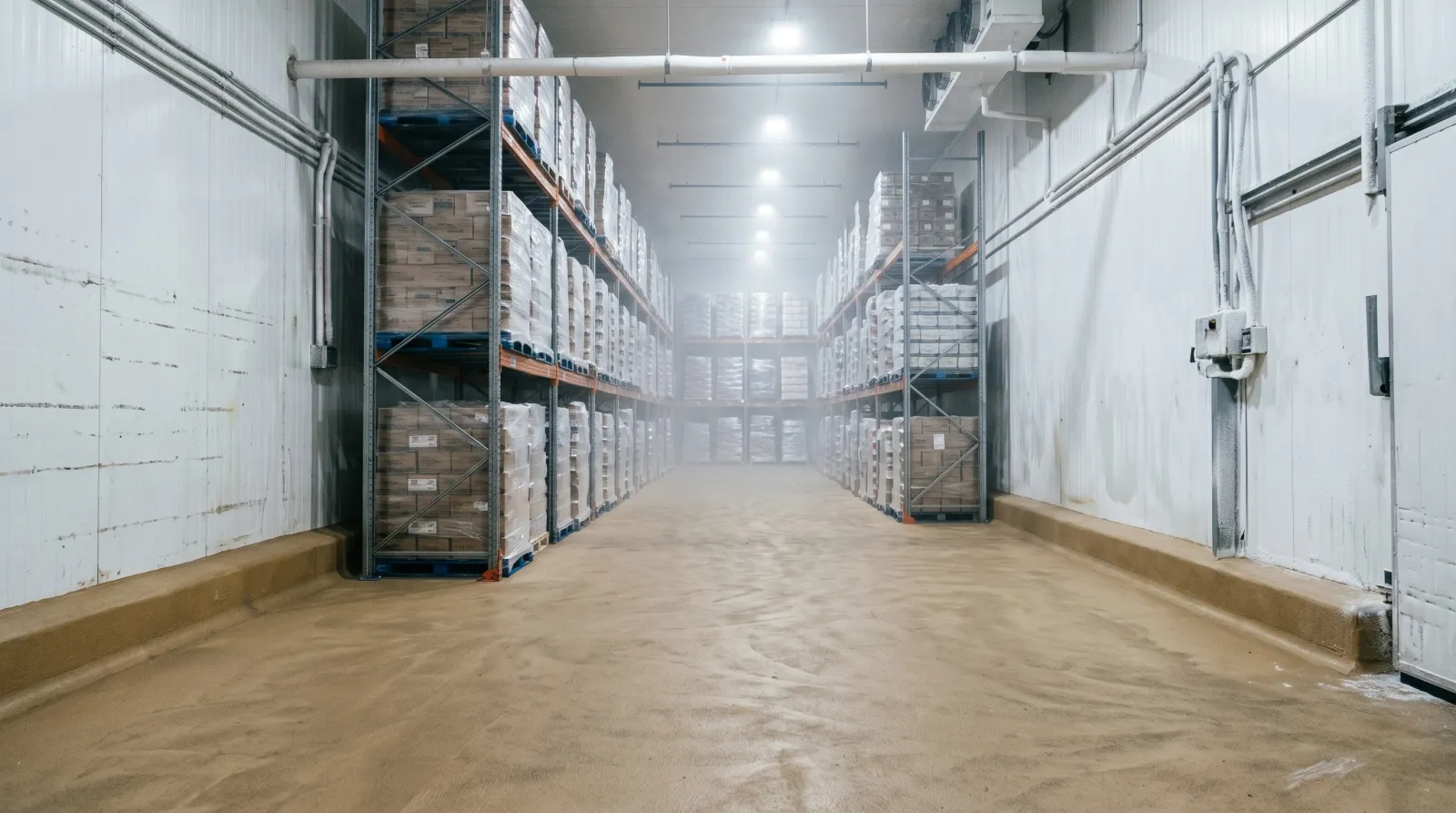
A freezer floor coating has the hardest service environment in commercial flooring. The asset is a cold-storage slab held continuously between minus 10°F and minus 30°F, walked by foot and pallet-jack traffic, washed down on a sanitation schedule, and hit with thermal shock every time product cycles through a blast-freeze tunnel or a hot-water cleanout meets a frozen surface. The coating has to stay bonded through that thermal swing, resist abrasion under wheeled loads, shed water that would otherwise freeze into a slip hazard, and pass a USDA sanitation audit in a meat, poultry, dairy, or frozen-prepared-food facility.
Service life expectations track the chemistry. A properly installed troweled urethane cement system runs 15–20 years in a freezer, longer than almost any other industrial floor, because the thick mortar matrix wears slowly and the breathable chemistry tolerates the moisture drive that destroys epoxy. A thin-film MMA system installed cold runs 8–12 years and earns its place on speed, not longevity. A misapplied epoxy floor — the wrong answer that gets specified because someone reused a dry-warehouse spec — fails inside two years, often inside one defrost cycle.
The environment punishes three things that ambient floors forgive. Thermal shock cracks rigid coatings at the slab interface. Vapor drive from a warmer subgrade pushes moisture up through the concrete into the back of the coating, where it freezes and lifts the film. And the freezer cannot easily be warmed for installation, so the cure chemistry has to either tolerate a planned shutdown-and-rewarm or cure at sub-zero temperature. Those three constraints, not the topcoat color, decide the spec.
Zoned Recommendation Matrix
A cold-storage facility is not a single thermal zone, and the floor spec changes at the door threshold. Map the system to what each zone actually sees.
| Zone | Recommended system | Why |
|---|---|---|
| Blast-freeze tunnel | System A (heavy urethane cement, 1/4-inch) | Maximum thermal-shock cycling; thickest mortar matrix wins |
| Main freezer / holding | System A or System B | Continuous sub-zero, pallet-jack abrasion, USDA cove base |
| Cooler / chill (33–40°F) | System B (medium urethane cement) | Above freezing; lower thermal demand, still wet and food-safe |
| Dock / staging vestibule | System B with heavier broadcast | Temperature swing at the door, hot-tire and forklift traffic, ice melt |
| Occupied freezer needing no shutdown | System C (cold-cure MMA) | Cures at minus 20°F; the only chemistry that skips the rewarm |
For a single small walk-in freezer, skip the matrix and trowel one urethane cement system across the slab with an integral cove. The zoned approach earns its keep on a distribution-scale cold campus where the tunnel, the holding freezer, and the dock each have a different worst-case load.
Spec Requirements
The spec block before any product gets named. Cold storage tightens several of these numbers relative to a dry warehouse.
| Spec | Value |
|---|---|
| Dry film thickness (DFT), urethane cement body | 125–250 mils (1/8-inch to 1/4-inch troweled); thicker in the blast tunnel |
| Dry film thickness, MMA cold-cure system | 4–8 mils topcoat over a 3–5 mil primer; total system 60–90 mils with mortar |
| Coverage at spec’d thickness | Mortar yield by area, not gal/sq ft; ~25 sq ft per unit at 1/4-inch (verify per data sheet) |
| VOC limit | <100 g/L (SCAQMD Rule 1113 industrial maintenance); CARB SCM-compliant SKUs available |
| Standards | ASTM C722 thermal shock, ASTM F1869 MVE, ASTM C779 abrasion, ASTM D7234 pull-off, ASTM F2170 in-slab RH |
| Substrate prep, concrete | ICRI CSP 4 to CSP 5 (aggressive shotblast or scarify); a freezer mortar needs deeper profile than a thin coating |
| Moisture vapor emission ceiling | Higher tolerance than epoxy, but test it; urethane cement is breathable, MMA is not, so verify the manufacturer ceiling against ASTM F1869 / F2170 |
| Service temperature (cured) | -40°F to 250°F continuous; thermal-shock rated per ASTM C722 |
| Cure to service, urethane cement | 8–24 hours at recommended substrate temp; full cure 3–7 days |
| Cure to service, cold-cure MMA | 1–2 hours at minus 20°F substrate |
| Application substrate temp | Urethane cement: 50–85°F (room must be warmed). MMA: down to minus 20°F |
| Dew point / humidity ceiling | Substrate ≥5°F above dew point; controlled-condition install for urethane cement |
| OSHA anti-slip COF | 0.5 dry minimum (1910.22); broadcast aggregate sized for cold wet traffic |
| Floor-to-wall transition | Integral coved base, minimum 4-inch radius, for USDA sanitation compliance |
Three numbers carry a freezer floor: the thermal-shock rating (ASTM C722), the moisture readings, and the substrate temperature the cure chemistry actually requires. The cove base is the spec line most often dropped at value-engineering, and it is the one a USDA inspector checks first.
System Chemistry Compared
A freezer narrows the chemistry field fast. Epoxy and polyaspartic, the workhorses of dry industrial floors, both lose here.
| Chemistry | Pot life | Recoat / cure | Service temp | Thermal shock | $/sq ft installed | Best for |
|---|---|---|---|---|---|---|
| Urethane cement | 15–30 min | 8–24 hr to service | -40°F to 250°F | excellent | $8–16 | Freezers, blast tunnels, food-plant wet zones |
| Cold-cure MMA | 10–20 min | 1–2 hr at minus 20°F | -40°F to 200°F | good | $12–22 | Occupied freezers, no-shutdown installs |
| Standard epoxy | 1–4 hr | 8–24 hr | up to 140°F | poor (cracks cold) | $4–9 | Dry warehouses only; wrong for freezers |
| Polyaspartic | 20–45 min | 30 min–4 hr | -40°F to 250°F | fair; brittle at sub-zero | $6–10 | Showrooms, dry retail; not cold wet zones |
Urethane cement wins the freezer on thermal-shock tolerance and a coefficient of thermal expansion close to concrete, which is why it owns the cold-storage and food-plant categories. MMA wins the narrow case where the room cannot be shut down and rewarmed, because it cures at sub-zero temperature in a couple of hours. Epoxy and polyaspartic do not belong on a freezer slab. Both go brittle in the cold and crack under the first hard thermal cycle.
Recommended Systems
Three full multi-coat stacks. Systems A and B are troweled urethane cement at two thickness tiers; System C is the cold-cure MMA answer for an occupied freezer. All three assume an aggressive CSP 4–5 prep and a coved floor-to-wall transition.
System A: Sherwin-Williams FasTop Urethane Cement (heavy 1/4-Inch, Blast Tunnel / Main Freezer)
| Layer | Product | DFT |
|---|---|---|
| Primer / scratch coat | FasTop SL40 urethane cement scratch coat | 60–90 mils |
| Body coat | FasTop TG5 troweled urethane mortar | 125–250 mils |
| Topcoat / seal | FasTop 12MR urethane seal with aluminum oxide broadcast | 10–15 mils |
| Total | ~200–355 mils (up to 1/4-inch+) |
Service life 15–20 years in continuous sub-zero service. The TG5 troweled mortar is the thickness that absorbs thermal-cycling movement; the 12MR seal closes the surface for sanitation and adds the anti-slip aggregate. Specify the integral cove base in the same urethane cement so the floor and wall junction is monolithic. Spec sheets and the certified-applicator roster are on the Sherwin-Williams ProIndustrial high-performance flooring pages.
System B: BASF Ucrete UD200 (medium-Build Urethane Cement, Cooler / Holding)
| Layer | Product | DFT |
|---|---|---|
| Primer | Ucrete moisture-tolerant primer | slab-condition dependent |
| Body coat | Ucrete UD200 troweled mortar | 1/4-inch (250 mils) |
| Topcoat | Ucrete DP10 aliphatic seal with anti-slip aggregate | 10–20 mils |
Service life 12–18 years. Ucrete is the reference urethane cement in cold storage; UD200 is the heavy-duty grade rated for steam-clean and thermal-cycling service, which is why it shows up in dairy and frozen-protein plants. BASF Master Builders Solutions publishes thermal-shock data per ASTM C722 on the Ucrete product line. Run the install through a Ucrete-certified applicator; field-mix ratio error on a urethane mortar is unforgiving.
System C: Sika Cold-Cure MMA / PurCem (occupied Freezer, No Shutdown)
| Layer | Product | DFT |
|---|---|---|
| Primer | Sikafloor MMA primer (cures to minus 20°F) | 3–5 mils |
| Body / mortar coat | Sikafloor PurCem HM-20 urethane mortar (where warm-up is possible) | 125–250 mils |
| Topcoat | Sikafloor MMA seal with quartz broadcast | 4–8 mils |
Service life 8–12 years. This is the spec when the freezer stays cold and stays in service. The MMA chemistry cures at minus 20°F and reaches foot traffic in 1–2 hours, so a room comes back online the same shift. The trade-off is a sharp styrene odor during install (ventilation and a sanitation hold are required) and a certified-installer-only application. Where the room can be warmed even briefly, the PurCem urethane mortar carries more thermal-shock margin than a pure thin-film MMA build. Reference the Sika industrial flooring PurCem and MMA documentation.
Systems Compared
| System | Total thickness | $/sq ft installed | Service life | Best for |
|---|---|---|---|---|
| A · SW FasTop urethane cement | up to 1/4-inch+ | $10–16 | 15–20 years | Blast tunnels, main freezers, heavy thermal cycling |
| B · BASF Ucrete UD200 | 1/4-inch | $9–14 | 12–18 years | Coolers, holding freezers, dairy and protein plants |
| C · Sika cold-cure MMA | 60–90 mils (thin-film) | $12–22 | 8–12 years | Occupied freezers, no-shutdown retrofits |
Installed pricing assumes a 5,000+ sq ft scope through a manufacturer-certified urethane-cement or MMA applicator with aggressive prep and coved base included. Jobs under 1,500 sq ft run 30–60% higher per foot because the mortar mobilization and the cove labor do not scale down. MMA carries the highest material cost; its value is the shutdown it avoids, not the price per foot.
Application & Contractor Path
This is not a DIY or general-painter product class. Troweled urethane cement is a self-leveling-mortar trade with a tight pot life and a ratio-sensitive mix; cold-cure MMA adds sub-zero handling and styrene management. Spec a contractor with SSPC-QP1 certification at minimum, and require the manufacturer’s product-specific certified-applicator credential. Sherwin-Williams, BASF Ucrete, and Sika each maintain certified-installer rosters, and a urethane-cement floor installed by a crew certified on a different manufacturer’s product is a warranty gap.
Three contractor-qualifying questions before signing:
- Has this crew troweled this specific urethane cement in a freezer in the last 12 months? Cold-storage installation is a thermal-logistics problem (warm-up, dew-point control during cure, rewarm schedule) that an ambient food-plant crew has not solved.
- What is the moisture protocol? ASTM F1869 calcium chloride plus ASTM F2170 in-slab RH on a freezer slab is non-negotiable, because the vapor drive under a frozen floor is worse than under a dry warehouse and the testing has to happen before the room is brought up to install temperature.
- How is the cove base detailed? USDA wants a coved, harborage-free floor-to-wall junction. A contractor who bids a square joint to save labor will pass the coating audit and fail the sanitation audit.
The manufacturer rep path matters more here than on a standard floor. BASF, Sherwin-Williams, and Sika all offer a pre-bid freezer site visit through their protective-coatings reps, and that visit catches the moisture problem, the rewarm-schedule problem, and the cove detail before they become change orders. Use it.
Failure Modes & How to Prevent Them
Five failures account for nearly every cold-storage floor warranty claim. Each is preventable in the specification phase, not the application phase.
- Thermal-shock cracking from the wrong chemistry. Cause: a rigid epoxy or polyaspartic specified off a dry-warehouse template, then cracked by a blast-freeze or hot-washdown cycle. Prevention: specify urethane cement (or cold-cure MMA) rated to ASTM C722 thermal shock. Never reuse a warehouse epoxy spec in a freezer.
- Moisture-driven delamination from below. Cause: vapor drive from a warm subgrade pushing moisture up through a frozen slab, freezing behind the film and lifting it. Prevention: ASTM F1869 and ASTM F2170 testing pre-bid; respect the manufacturer’s moisture ceiling and add a moisture-mitigating primer where the slab exceeds it. Urethane cement’s breathability buys margin, not immunity.
- Cure failure from coating below temperature. Cause: a standard urethane cement troweled into a cold room that never reached its 50°F cure minimum, leaving an undercured, soft floor. Prevention: warm the room and hold it during cure, or switch to a cold-cure MMA system rated to the actual slab temperature. Track substrate temperature, not air temperature.
- Sanitation failure at the floor-to-wall junction. Cause: a square joint instead of an integral cove, creating a harborage point that fails USDA inspection regardless of how good the field of the floor is. Prevention: specify a 4-inch-radius integral cove base in the same urethane cement, detailed and inspected.
- Slip hazard from under-aggregated topcoat. Cause: condensation and ice forming on a smooth seal coat in a wet sub-zero room. Prevention: broadcast aluminum oxide or quartz sized for cold wet traffic to hold static COF at or above 0.5 (OSHA 1910.22); a freezer floor needs more aggregate than a dry aisle, not less.
The first two — wrong chemistry and untested moisture — produce most of the freezer claims I have seen. Both get decided on the spec sheet long before a trowel touches the slab.
Where to Buy / Spec
| Channel | Best for | Path |
|---|---|---|
| Sherwin-Williams ProIndustrial / FasTop rep | Spec’d freezer projects, full system warranty, certified applicators | SW high-performance flooring |
| BASF Master Builders / Ucrete rep | Ucrete-spec cold storage, dairy and protein plants | BASF Master Builders Solutions |
| Sika industrial flooring rep | PurCem and cold-cure MMA, no-shutdown retrofits | Sika USA flooring |
| Industrial distributor / certified applicator | Bulk mortar supply, contractor accounts | Through the manufacturer certified-installer roster |
Manufacturer-direct through a certified applicator is the only sensible channel for a freezer floor. Troweled urethane cement and cold-cure MMA are not retail products; the material warranty and the labor warranty both run through the certified-installer network, and the pre-bid freezer site visit is where the moisture and rewarm problems get caught. There is no Amazon Business path that delivers an installed, warranted cold-storage floor.
FAQ
The freezer-specific questions a buyer asks are answered in the system frontmatter and repeated here in short:
Cold-cure MMA is the only chemistry that lets you coat an occupied freezer without warming and relocating product. Standard urethane cement needs the room brought up to 50°F, coated, then cycled back down. Run ASTM F1869 and F2170 moisture testing before any bid, because the vapor drive under a frozen slab is the leading cause of delamination. Specify USDA-acceptable urethane cement with an integral coved base, not just a listed material on a square joint. And never reuse a dry-warehouse epoxy spec in a freezer — thermal shock cracks rigid epoxy, which is why urethane cement owns this category.