MMA Floor Coating: Cold-Cure Specifier's Guide (2026)
MMA floor coating systems compared by DFT, cure-to-service, and service temp. Cold-cure install, ICRI CSP prep, ASTM specs, and where MMA beats epoxy or urethane cement.

Disclosure: Affiliate links to retailers and manufacturer-direct programs. Recommendations are spec-driven, not commission-driven.
Use Case
MMA floor coating gets specified when two conditions stack: the slab is cold, and the facility cannot shut down. MMA is methyl methacrylate, a 100% reactive acrylic resin that cures by a catalyzed exothermic reaction rather than by solvent flash or slow chemical crosslink. The field advantage is a 1-hour cure to service across a temperature range that stops other chemistries cold. Epoxy stalls below 50°F. Urethane cement slows in deep cold. MMA cures down to roughly -20°F substrate temperature with the right benzoyl peroxide catalyst loading.
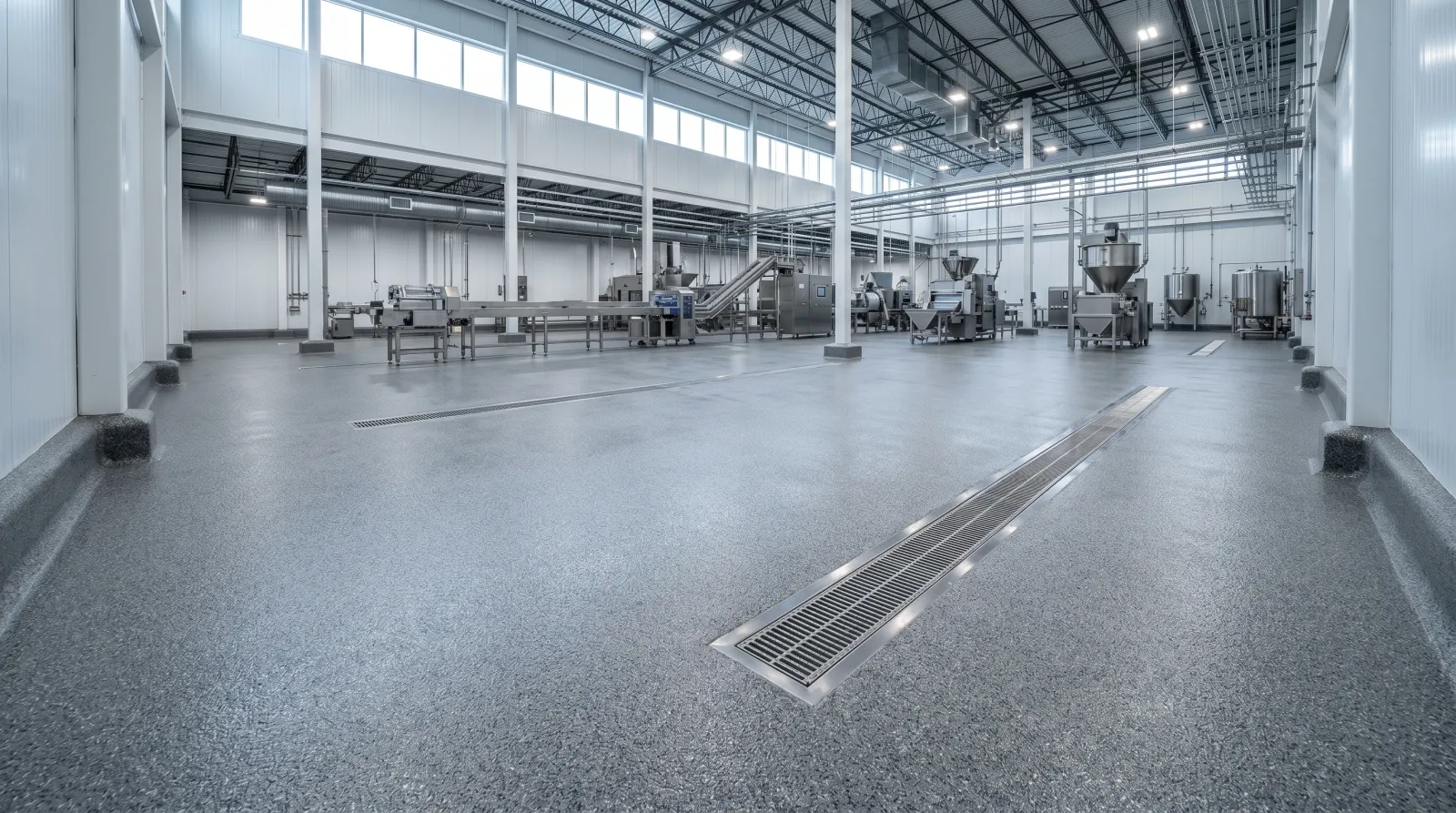
That combination decides the spec on blast freezers, refrigerated food and beverage plants, cold-storage docks, dairy and brewery wet-process floors, commercial kitchens, hospital and pharmaceutical wet zones, aircraft hangars on a turnaround, and any 24/7 line that loses six figures a day when a section goes down. A poultry plant that runs two shifts and sanitizes on the third does not have a 5-day window for an epoxy build. MMA gives them the floor back before the next sanitation cycle.
Service life expectations: 10–15 years on a full-depth broadcast mortar system in food and beverage process areas, 8–12 years on a double-broadcast wear course under cart and pallet traffic, 15–20 years on heavy-duty MMA in a freezer where thermal cycling destroys epoxy at the joints. MMA stays flexible at temperature, so it tolerates the slab movement that cracks rigid epoxy in a -20°F room. UV stability is good on the aliphatic seal coats, which matters on dock edges and hangar aprons that see daylight.
Where MMA loses the spec: any project on a tight budget with a normal weekend window (epoxy or polyaspartic is cheaper), any space that cannot tolerate the monomer odor during cure with no ventilation path, and any installer who is not certified on the specific MMA line. The odor and the pot-life discipline are the real constraints, not performance.
Zoned Recommendation Matrix
A food and beverage plant is not one floor. The spec maps a system tier to each zone:
| Zone | Recommended system | Why |
|---|---|---|
| Blast freezer / -20°F storage | System A (full MMA mortar, cold-cure catalyst) | Cures at sub-zero; flexes with thermal cycling that cracks epoxy |
| Process / washdown wet area | System A or B (MMA mortar with quartz broadcast) | Thermal-shock washdown, organic-acid resistance, integral cove base |
| Cooler / packaging | System B (MMA double broadcast) | Cart and pallet abrasion at moderate cold |
| Loading dock | System B with UV-stable seal | Hot-tire, daylight, freeze-thaw at the threshold |
| Office / dry storage | Standard epoxy, NOT MMA | No cold-cure or fast-return need; MMA is overspec and overpriced |
| QC lab / break area | System C (thin-build MMA seal) | Light traffic, cleanability, fast reopen |
For a single-zone asset (one freezer, one kitchen), skip the matrix and pick one system across the slab.
Spec Requirements
The spec block, before naming any product:
| Spec | Value |
|---|---|
| Dry film thickness (DFT) — full mortar system | 180–250 mils (primer + MMA mortar broadcast + seal) |
| DFT — double-broadcast wear course | 80–160 mils total |
| DFT — thin-build seal system | 20–40 mils |
| Coverage at spec’d DFT | Job-mixed mortar by weight; seal coats 80–120 sq ft/gal |
| VOC | Solvent-free 100% reactive; near-zero regulated VOC, SCAQMD Rule 1113 compliant. Control monomer odor, not VOC. |
| Cure to foot traffic | 45 minutes to 1 hour |
| Cure to full service | 1–2 hours including wheeled and washdown loading |
| Pot life | 10–20 minutes at 70°F; drops below 10 minutes at 90°F |
| Recoat window | Tight; broadcast and seal passes timed to the gel, same-day operation |
| Catalyst | BPO (benzoyl peroxide) loading varies with slab temperature; low-temp ratio below 30°F |
| Service temperature (cured) | -20°F to 200°F continuous; tolerates thermal-shock washdown |
| Substrate prep — concrete | ICRI CSP 3 to CSP 5; shotblast or scarify, integral cove base requires a clean fillet |
| Substrate prep — steel | SSPC-SP10 near-white blast where MMA runs over plate or pan decks |
| Moisture vapor emission ceiling | 3 lb/1000 sq ft/24h (ASTM F1869); above 3 lb requires an MVE-tolerant MMA primer |
| Ambient at application | Substrate ≥5°F above dew point; MMA cures cold but condensation still ruins the bond |
| OSHA anti-slip COF | 0.5 dry minimum (1910.22); quartz or aluminum oxide broadcast on wet-process zones |
Three numbers govern an MMA job: the BPO catalyst ratio matched to slab temperature, the substrate temperature relative to dew point, and the MVE rate. The catalyst math is unique to MMA and is where an untrained crew fails. Too little BPO in a cold room and the floor never cures. Too much in a warm room and the material gels in the bucket before it hits the slab.
System Chemistry Compared
Before naming systems, the chemistry-class comparison every specifier should run for a cold or fast-return floor:
| Chemistry | Pot life | Recoat window | Service temp | UV stability | $/sq ft installed | Best for |
|---|---|---|---|---|---|---|
| Standard epoxy | 1–4 hr | 8–24 hr | up to 140°F | 🔴 ambers under UV | $4–9 | Dry warehouses, budget builds, normal downtime |
| Polyaspartic | 20–45 min | 30 min–4 hr | -40°F to 250°F | 🟢 UV-stable | $6–10 | Showrooms, dealerships, fast-cycle retail |
| Urethane cement | 30–90 min | 4–12 hr | -40°F to 250°F | ⚪ mid; some yellowing | $8–14 | Food processing, thermal-shock zones, wet rooms |
| MMA (methyl methacrylate) | 10–20 min | same-day, timed to gel | -20°F to 200°F | 🟢 UV-stable on seal | $12–25 | Sub-zero install, 1-hour reopen, 24/7 plants |
MMA sits at the top of the price band and wins on two axes nothing else matches together: it cures cold and it reopens in an hour. Epoxy is the cheap answer when you have a weekend and a room above 50°F. Urethane cement is the food-plant workhorse when you have a 12-hour window and the room is not sub-zero. MMA is the chemistry you spec when the freezer cannot warm up and the line cannot stop. For a closer head-to-head on the fast-cure tier, the polyaspartic floor coatings guide covers the showroom and dealership case where polyaspartic beats MMA on cost.
Recommended Systems
Three full multi-coat stacks at different depth and price points. All three reference an ICRI CSP 3+ prep, a 3 lb/1000 sq ft/24h MVE ceiling, and a BPO catalyst ratio matched to slab temperature.
System A — Sika Full-Depth MMA Mortar (premium Freezer / Process Floor)
| Layer | Product | DFT |
|---|---|---|
| Primer | Sikafloor-201 MMA Primer | 10–15 mils |
| Body / broadcast wear course | Sikafloor-205/206 MMA mortar with quartz broadcast | 120–180 mils |
| Seal coat | Sikafloor-220 / 200-series MMA seal | 15–25 mils |
| Total | 145–220 mils |
Service life 10–15 years in food-process and freezer service. The full-depth quartz mortar gives the thermal-shock resistance and the integral cove base a USDA inspector wants, and the cold-cure catalyst takes it down to sub-zero install. This is the spec for a blast freezer or a wet-process line that runs continuously. Confirm the food-contact certification on the exact SKU through your Sika industrial flooring rep.
System B — Sherwin-Williams General Polymers MMA (mid-Tier Wear Course)
| Layer | Product | DFT |
|---|---|---|
| Primer | General Polymers MMA Primer | 8–12 mils |
| Body coat | General Polymers MMA mortar, quartz double broadcast | 180–250 mils |
| Seal coat | General Polymers MMA Sealer | 15–20 mils |
| Total | 200–280 mils |
Service life 8–12 years under cart and pallet traffic. General Polymers is the Sherwin-Williams resinous flooring line and runs through the same ProIndustrial rep network most facilities already buy from. The double broadcast builds the wear course without a full structural mortar, which lands the price below System A on cooler and packaging zones. Sherwin-Williams General Polymers flooring.
System C — Florock / BASF MMA Thin-Build Seal (budget Light-Traffic Retrofit)
| Layer | Product | DFT |
|---|---|---|
| Primer | Florock MMA Primer | 8–12 mils |
| Seal coat (broadcast) | Florock MMA UV-stable seal, light aluminum oxide | 12–20 mils |
| Total | 20–32 mils |
Service life 6–10 years on light commercial and lab traffic. This is the thin-build MMA spec when the slab is sound, the budget is fixed, and the draw is the 1-hour reopen rather than full mortar depth. A QC lab, a break area, or a small kitchen that has to be back in service on the next shift. Skip on any wet-process or freezer floor that needs a full mortar. Florock resinous flooring.
Systems Compared
| System | Total DFT | $/sq ft installed | Service life | Best for |
|---|---|---|---|---|
| A — Sika full-depth MMA mortar | 145–220 mils | $14–22 | 10–15 years | Blast freezers, wet-process food and beverage |
| B — SW General Polymers MMA | 200–280 mils | $12–18 | 8–12 years | Coolers, packaging, cart and pallet zones |
| C — Florock MMA thin-build seal | 20–32 mils | $8–12 | 6–10 years | Labs, break areas, light-traffic fast reopen |
Installed pricing assumes a 5,000+ sq ft scope through a manufacturer-certified MMA contractor with shotblast prep and integral cove base included. Sub-1,000 sq ft jobs run 30–60% higher per foot on every system because the crew, the cold-room scheduling, and the odor management cost the same on a small floor.
System Chemistry Compared vs the Cost of Downtime
The installed cost is half the case. Run the total cost of ownership against downtime and MMA changes shape on the spreadsheet. A 10,000 sq ft freezer floor in epoxy reads cheaper at $5/sq ft installed, $50,000. The catch is the 5-to-7-day shutdown, plus the warm-up and re-freeze cycle, plus the spoiled-inventory and lost-throughput exposure on every one of those days. A plant that books $80,000 a day through that room loses more in downtime than the entire MMA premium.
MMA at $16/sq ft installed is $160,000 on the same floor, but the room is back in an hour. Over a 12-year horizon the epoxy floor also cracks at the joints from thermal cycling and gets recoated or replaced once inside that window, while the flexible MMA mortar rides the cycling. The capex line favors epoxy. The TCO line, once downtime and the freezer’s thermal movement are priced in, favors MMA on any room that cannot warm up or shut down.
Application & Contractor Path
MMA is not a DIY product class and not a job for a general commercial painting crew. The 10-to-20-minute pot life, the temperature-keyed BPO catalyst ratio, and the same-day broadcast-and-seal timing mean a single applicator or an untrained crew will gel material before it reaches the floor or miss the broadcast window. Spec a contractor with SSPC-QP1 certification at minimum, plus the manufacturer’s MMA-specific applicator certification. Sika, Sherwin-Williams General Polymers, BASF MasterTop, and Florock all publish certified-installer rosters by region.
Three contractor-qualifying questions before you sign:
- Have they installed this specific MMA line in the last 12 months, and in a cold room? MMA catalyst chemistry and cold-cure technique do not transfer cleanly between manufacturers. A crew fluent on Sika mortar is not automatically fluent on General Polymers.
- What is the BPO catalyst protocol for the slab temperature on this job? The applicator should quote the low-temp initiator ratio for a freezer install without hesitating. If they describe one mix ratio for all conditions, they have not done cold MMA.
- How is odor managed and who gets notified? The monomer odor travels. A competent MMA contractor brings a ventilation plan, schedules the pour for off-hours, and coordinates with adjacent tenants before the first bucket opens.
For sub-500 sq ft thin-build seal retrofits, the System C class can sometimes be installed by a contractor with general resinous-flooring experience, provided they honor the pot life and have run MMA before. Above 1,000 sq ft, and on any mortar system or freezer floor, the manufacturer certification is not optional.
Failure Modes & How to Prevent Them
Five failures account for nearly every MMA warranty claim. Prevent these and the system delivers its rated service life.
- Uncured or soft floor from a wrong catalyst ratio. Cause: BPO loading set for warm conditions but applied in a cold room, so the exotherm never completes and the floor stays tacky or rubbery. Prevention: catalyst ratio keyed to measured slab temperature, not air temperature; the manufacturer’s low-temp initiator table on every cold install.
- Material gelling in the bucket before placement. Cause: warm ambient, too much catalyst, or a crew working a batch larger than the pot life allows. Prevention: small batches sized to the 10-to-20-minute window, reduced catalyst in warm conditions, and enough hands to place each batch before gel.
- Moisture-driven delamination from below. Cause: MVE above 3 lb/1000 sq ft/24h with no moisture-tolerant primer, common on old slabs and slabs-on-grade without a vapor barrier. Prevention: ASTM F1869 calcium chloride testing pre-bid in three locations minimum; specify an MVE-tolerant MMA primer above 3 lb. For the diagnostic side of slab moisture and salts, see the concrete floor efflorescence guide.
- Condensation-driven bond failure on a cold slab. Cause: substrate at or below dew point during the pour, so a film of condensation forms under the primer. MMA cures cold but it will not bond through condensation. Prevention: substrate ≥5°F above dew point, verified with a surface thermometer and a sling psychrometer through the whole pour.
- Cove-base and joint cracking under thermal cycling. Cause: a rigid or under-built integral cove, or a seal coat too thin to ride the slab movement in a freezer. Prevention: full-depth mortar at the cove fillet, manufacturer-specified joint treatment, and System A depth in any room that cycles through deep cold.
The catalyst ratio and the dew-point control are the two failures unique to MMA. Both are decided by the crew on the day of the pour, not in the specification, which is why the contractor’s MMA certification carries more weight on this chemistry than on any other floor coating.
Where to Buy / Spec
| Channel | Best for | Path |
|---|---|---|
| Sika industrial flooring rep | Spec’d freezer and food-plant projects, certified applicators, system warranty | Sika flooring |
| Sherwin-Williams General Polymers rep | Mid-tier MMA through an existing ProIndustrial account | SW General Polymers |
| Florock / BASF distributor | Thin-build seal retrofits, lab and light-traffic scopes | Florock |
| Local SW or BM Pro store | Material pickup on small certified-crew jobs | Walk-in, account holder pricing |
Manufacturer-direct is the only channel that makes sense on MMA above 1,000 sq ft. The reactive chemistry, the certification requirement, and the cold-room scheduling all run through the rep network, and most major manufacturers include a free pre-bid site visit. That visit catches the MVE problem, the dew-point exposure, and the odor-management plan before the bid lands. Amazon Business and retail shelves do not carry food-plant MMA mortar systems, and a floor this critical should not be bought off a shelf.
FAQ
Can I apply MMA flooring without a contractor? No, not on any mortar system or cold-room floor. The pot life and the temperature-keyed catalyst math require a manufacturer-certified crew. A thin-build seal under 500 sq ft can sometimes go to a contractor with general resinous-flooring experience who has run MMA before.
What’s the warranty? Manufacturer product warranties run 1–5 years; installer warranties through certified applicators run 5–10 years on the installed system. The installed warranty covering both labor and material is the one a facility manager should hold, especially on a freezer floor where a callback means thawing the room.
Does MMA need a specific concrete moisture level? Yes. ASTM F1869 MVE at or below 3 lb/1000 sq ft/24h, or an MVE-tolerant primer above that. Cold slabs-on-grade in food plants frequently test high; test before bidding, not after the floor fails.
Is MMA OSHA-compliant and food-plant safe? Cured MMA broadcast with quartz or aluminum oxide meets OSHA 1910.22 anti-slip at 0.5 static COF dry, and select SKUs carry USDA acceptance and NSF/ANSI 51 food-contact eligibility. Verify the certification on the exact product. The cure-phase monomer odor is an occupied-space and ventilation question, handled by scheduling and airflow.