Anti-Slip Walkway Coatings: OSHA 1910.22 Specifier's Guide (2026)
Anti-slip walkway coating systems compared by COF, DFT, and aggregate grade. OSHA 1910.22 traction targets, ICRI CSP prep, and the contractor path that passes inspection.

Disclosure: Affiliate links to retailers and manufacturer-direct programs. Recommendations are spec-driven, not commission-driven.
Use Case
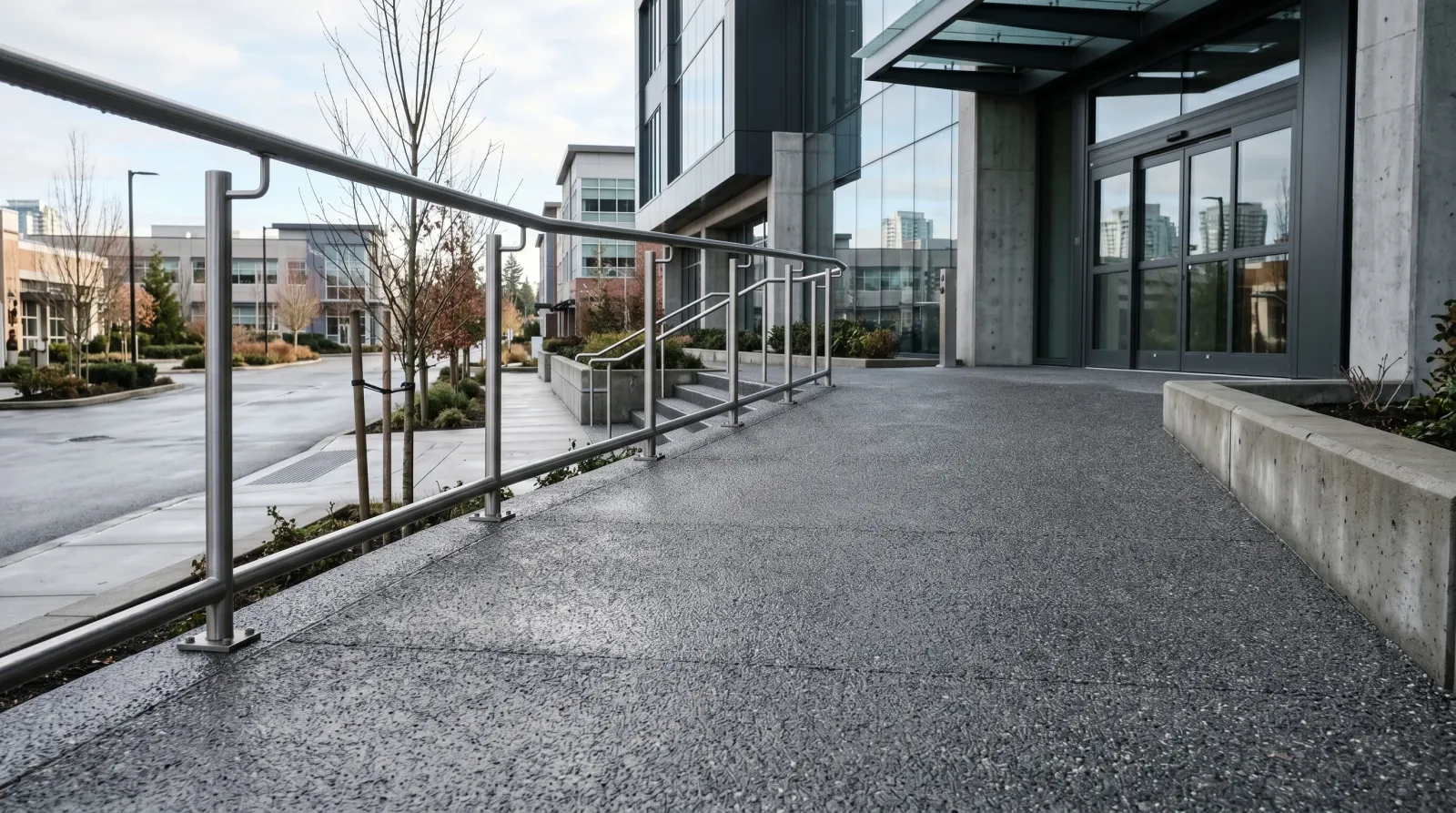
An anti-slip walkway coating does one job the rest of the floor spec can ignore: it has to hold a person upright on a wet, sloped, or contaminated surface. The asset is a pedestrian route. Entry vestibules, exterior approach ramps, loading-dock stairs and landings, kitchen aisles, locker-room floors, pool surrounds, wash-down corridors in food and pharma plants, and any ADA accessible route that the building has to keep passable in rain. These are the surfaces that generate slip-and-fall claims, and a fall claim averaged across general liability runs into five figures before anyone argues about who maintained the floor.
The coating supplies traction the bare substrate doesn’t. Troweled concrete cures slick. Quarry tile glazes over with grease film. Steel diamond plate reads fine dry and turns to ice the moment it’s wet. The spec target is a measured coefficient of friction (COF) that survives water, not a texture you eyeballed. OSHA 1910.22 makes the building responsible for keeping walking-working surfaces “in a safe condition,” and the design number the industry settled on is a static COF of 0.5 dry and a dynamic COF of 0.42 wet. ADA accessible routes carry the same expectation through ANSI A117.1.
Service life depends more on the exposure than the chemistry. A covered interior corridor holds traction five to seven years. An exterior ramp under de-icing salt and snowplow scrape loses its aggregate in three to five. The number that fails first is the COF on the worn walking path, not the film thickness or the color. The whole reason this is its own coating class, separate from a general floor coating, is that the aggregate doing the work is also the thing that wears out and the thing that fights you on cleaning. The rest of this guide is about getting that balance right per zone.
Zoned Recommendation Matrix
Walkways aren’t one surface. The traction a wet exterior ramp needs would shred mop heads in a hospital corridor. Match the system to what the zone actually sees.
| Zone | Recommended system | Why |
|---|---|---|
| Exterior entry ramp / approach | System A (epoxy build + UV-stable topcoat, 16-grit aluminum-oxide) | Wet + slope + salt; needs max wet DCOF and UV stability |
| Loading-dock stairs / landings | System A with coarse broadcast | Steel-toe traffic, oil, snow tracked in |
| Interior lobby / vestibule transition | System B (aggregate-filled, 36–60 grit) | Wet-shoe transition zone, but cleanable matters |
| Kitchen / wet processing aisle | System C (urethane cement, fine quartz) | Hot wash-down, grease, thermal shock; epoxy fails here |
| Healthcare / pharma corridor | System B fine broadcast, sealed | Daily wet clean, must clear DCOF without grime traps |
| Pool surround / locker room | System A fine aluminum-oxide, UV-stable seal | Constant water, bare feet, chlorinated splash |
Don’t carry one product across every zone to simplify procurement. The cleanability complaint that comes back from a hospital corridor coated in 16-grit is the same coating that’s keeping someone upright on the ramp outside. Spec by zone.
Spec Requirements
The traction numbers carry the spec. Everything else supports them.
| Spec | Value |
|---|---|
| Dry film thickness (DFT) | 10–40 mils total system, by aggregate grade and chemistry |
| Coverage @ DFT | 50–125 sq ft / gal (broadcast systems consume more in the build coat) |
| VOC | under 100 g/L water-based epoxy (CARB / SCAQMD compliant); solvent options under 250 g/L are restricted under SCAQMD Rule 1113 and the OTC states |
| Slip resistance | static COF ≥0.5 dry (ASTM D2047); dynamic COF ≥0.42 wet (ASTM F1679 / F2508, ANSI A326.3) on ramps and wet routes |
| Standards | ASTM D2047 (static COF), ASTM F1869 (MVE), ASTM D4060 (abrasion), ASTM D7234 (pull-off adhesion) |
| Substrate prep (concrete) | ICRI CSP 3 shotblast for broadcast systems; CSP 2 grind acceptable for thin aggregate-filled topcoats only |
| Substrate prep (steel) | SSPC-SP6 commercial blast minimum; SSPC-SP10 near-white for exterior and wash-down exposure |
| Moisture ceiling | ASTM F1869 MVE ≤3 lb/1000 sq ft / 24h, or install an MVE barrier primer |
| Service temp | -20°F to +180°F (epoxy/polyaspartic); urethane cement to +250°F for hot wash-down |
| Cure to service | Foot traffic 24h · full traffic 3–7 days · full chemical/abrasion resistance 7–14 days |
| Dew point / humidity | Substrate ≥5°F above dew point; ambient RH ≤85% during all coats |
Two prep specs matter more than the rest. On concrete, the ICRI CSP profile decides whether the system bonds at all. A broadcast build coat needs CSP 3 from a shotblaster; an acid etch leaves a CSP 1 surface that a heavy anti-slip film peels off in sheets within a year. On exterior steel stairs and dock plate, SSPC-SP6 is the floor and SP10 near-white is the number for any surface that gets wet, because a coating over residual mill scale lifts at the first freeze-thaw.
The moisture test is the one specifiers skip and regret. Anti-slip coatings are thick and vapor-tight. Vapor driving up through an exterior slab on grade has nowhere to go and blisters the film between the aggregate. Run the ASTM F1869 calcium chloride test before you coat any slab on grade or any below-grade landing. If it reads over 3 lb, the spec calls for an MVE barrier primer (Sika MVE Stop, ArmorSeal 1K HS) before the system goes down.
System Chemistry Compared
Pick the chemistry for the exposure before you pick a product. The aggregate is the same across most of these; the binder is what survives the environment.
| Class | Pot life | Recoat | Service temp | UV stable | $/sq ft installed | Best for |
|---|---|---|---|---|---|---|
| Epoxy + aggregate broadcast | 30–45 min | 8–24h | -20°F to 180°F | No (ambers in sun) | $5–10 | Interior ramps, lobbies, covered routes |
| Polyaspartic / urethane topcoat | 15–30 min | 1–2h | -40°F to 200°F | Yes | $8–14 | Exterior ramps, fast-turnaround routes |
| Urethane cement (fine quartz) | 30 min | 12h | -40°F to 250°F | Yes | $12–22 | Kitchen, food/pharma wash-down aisles |
| MMA (methyl methacrylate) | 5–15 min | 1h | -40°F to 200°F | Yes | $14–26 | 24/7 facilities, freezer-room walkways |
| Acrylic / single-pack textured | n/a | 2–4h | 0°F to 150°F | Moderate | $2–4 | Light-duty interior, budget touch-up |
For most exterior walkways and ramps the right answer is an epoxy build coat with aluminum-oxide broadcast, sealed and topcoated with a UV-stable polyaspartic. The epoxy bonds and builds, the polyaspartic stops the ambering and shrugs off salt. Standalone epoxy in direct sun chalks and yellows within a season; the topcoat is not optional outdoors. Urethane cement is the spec where heat and grease meet water, which is a commercial kitchen or a meat-processing aisle. Single-pack textured acrylics belong on a covered breakroom step or a budget interior touch-up, not on any surface that has to defend a fall claim.
Recommended Systems
System A — Epoxy Broadcast With UV-Stable Topcoat
The exterior-ramp standard. High wet DCOF, aluminum-oxide aggregate, sealed back with a UV-stable coat so it holds color and traction outdoors. Service life 7–10 years covered, 5–7 years exposed. Total DFT 16–23 mils.
| Layer | Product | DFT |
|---|---|---|
| Primer | Sherwin-Williams ArmorSeal 1K HS Epoxy Sealer | 2–3 mils |
| Build coat | ArmorSeal 1000 HS Epoxy | 6–8 mils |
| Aggregate / topcoat | ArmorSeal 1000 HS broadcast with 16–36 grit aluminum-oxide, sealed back | 8–12 mils |
For exterior exposure, replace the seal-back coat with a polyaspartic (S-W ArmorSeal HS Polyurethane or equivalent) to stop UV ambering.
Sherwin-Williams ProIndustrial ArmorSeal page →
System B — Aggregate-Filled Epoxy (In-House Friendly)
Factory-filled anti-slip topcoat. No separate broadcast step, so an in-house crew can run it on a small entry or landing. Finer texture cleans better, which makes it the interior-corridor and vestibule pick. Service life 5–7 years interior. Total DFT 10–12 mils.
| Layer | Product | DFT |
|---|---|---|
| Primer | Rust-Oleum Concrete Saver 5300 System Primer | 2 mils |
| Topcoat (filled) | Rust-Oleum Concrete Saver AS Anti-Slip Floor Coating | 8–10 mils |
Rust-Oleum Industrial product page →
System C — High-Build Broadcast for Heavy or Wet Routes
A specifier-grade troweled and broadcast system for dock landings, wash-down aisles, and routes that take abuse. Tnemec’s Deco-Tread builds a thick quartz or aluminum-oxide floor sealed with a chemical-resistant WB epoxy. Service life 10+ years. Total DFT 21–34 mils.
| Layer | Product | DFT |
|---|---|---|
| Primer | Tnemec Series 201 Epoxoprime | 3–4 mils |
| Build / aggregate | Tnemec Series 222 Deco-Tread broadcast | 15–25 mils |
| Sealer | Tnemec Series 287 Enviro-Pox WB seal coat | 3–5 mils |
For hot wash-down kitchen aisles, substitute a urethane cement body (Tnemec Series 211 or BASF Ucrete) for the epoxy build. Standard epoxy fails under thermal shock at the wash-down line.
Systems Compared
| System | Total DFT | $/sq ft installed | Service life | Best for |
|---|---|---|---|---|
| A — Epoxy broadcast + UV topcoat | 16–23 mils | $6–10 | 5–10 yrs | Exterior ramps, dock stairs, pool surrounds |
| B — Aggregate-filled epoxy | 10–12 mils | $3–5 | 5–7 yrs | Interior corridors, vestibules, small in-house jobs |
| C — High-build broadcast | 21–34 mils | $10–18 | 10+ yrs | Wash-down aisles, heavy dock landings |
Cost includes prep, primer, build, aggregate, seal, and contractor labor. In-house application of System B on a small landing drops cost roughly 40 percent, with a corresponding drop in service life if the prep is short of CSP 2. The broadcast systems are not a cost-saving DIY play; the value is in a measured COF that survives wet, and that comes from the prep and the aggregate embedment a trained crew gets right.
Application & Contractor Path
Honest call: System B on a sub-300-square-foot entry or single landing is within reach of a facility crew that can grind to a CSP 2 profile and apply a filled topcoat. Read the data sheet, run the dew-point math, and keep ambient RH under 85 percent during the coat. Above that, or anywhere a slip-and-fall history or an ADA route is in play, the broadcast systems (A and C) want a contractor with SSPC-QP1 certification, or NACE / AMPP Level 2 inspection on the larger jobs. The prep is the reason. Shotblasting concrete to ICRI CSP 3 and blasting steel to SSPC-SP10 takes equipment and a crew that does it daily.
Aggregate embedment is the other reason to spec the pro path. Broadcasting aluminum-oxide into a wet build coat at the right rate and timing, then sealing it back so the grain locks without burying the traction, is a feel job. Too little and the floor reads slick wet; too much and you’ve built a grime trap that fails the cleanability spec the day it’s commissioned. Manufacturer rep network: Sherwin-Williams ProIndustrial reps, Rust-Oleum Industrial distributors, and the Tnemec / Carboline rep network all run COF mockups on request. Ask for a sample panel at the spec’d aggregate grade and pull a wet DCOF reading on it before you commit the whole route.
Failure Modes & How to Prevent Them
- Traction loss on the walking path. The aggregate wears off the trafficked center line first while the edges still read coarse, and the wet DCOF on the path drops below 0.42 while a careless inspection of the edges says the floor is fine. Prevention: test the COF on the worn path, not the perimeter. Schedule a re-broadcast or seal-coat refresh at the 0.42 wet trigger, not when the color fades.
- Blistering from slab moisture. Vapor driving up through an exterior or below-grade slab lifts the film in domed blisters between the aggregate. Prevention: ASTM F1869 calcium chloride test before coating any slab on grade. If MVE is over 3 lb/1000 sq ft / 24h, install an MVE barrier primer first.
- UV ambering and chalking outdoors. A standard epoxy walkway in direct sun yellows and chalks within a season, and the chalk layer itself becomes a slip plane when wet. Prevention: seal exterior systems with a UV-stable polyaspartic or aliphatic urethane topcoat. Never leave bare epoxy as the wear surface outdoors.
- Delamination over poor prep. A heavy anti-slip film over an acid-etched (CSP 1) or solvent-cleaned-only surface peels in sheets under foot shear at ramp transitions. Prevention: shotblast concrete to ICRI CSP 3 for broadcast systems; SSPC-SP6 minimum, SP10 for wet exposure on steel.
- Grime-trap cleanability failure. Coarse 16-grit aggregate spec’d into a daily-wet-cleaned corridor packs with soil, fails the cleanability standard, and tempts staff to strip and re-coat smooth, which removes the traction entirely. Prevention: match aggregate grade to the zone. Fine 36–60 grit or a filled topcoat for cleaned interiors; reserve coarse aggregate for exterior ramps and dock approaches.
- Application below dew point. Moisture condenses on the substrate between coats and blisters the system at the bond line. Prevention: keep the substrate at least 5°F above dew point through every coat, logged in the contractor’s QC record.
Where to Buy / Spec
| Channel | Best for | Link |
|---|---|---|
| Manufacturer-direct (S-W Industrial, Rust-Oleum, Tnemec) | Spec’d projects, COF mockups, rep support, warranty | S-W ProIndustrial · Rust-Oleum Industrial · Tnemec |
| Industrial distributor (Sherwin Industrial, Rawlins US) | Bulk aggregate, primer, seal coat for contractor accounts | (regional) |
| Pro retail (Sherwin-Williams stores, BM Pro) | Small landings, in-house jobs, local pickup | (S-W store locator) |
| Amazon Business | Aggregate-filled product and aggregate for spot repair | (search by manufacturer) |
Specifier’s Bid Language
Boilerplate to drop into an RFP for an anti-slip walkway scope:
“Provide and install [System A — epoxy broadcast with UV-stable topcoat] per Sherwin-Williams ArmorSeal specification (or approved equal: Tnemec Series 222, Rust-Oleum Concrete Saver). Aluminum-oxide aggregate broadcast in build coat; finished surface to achieve dynamic COF ≥0.42 wet per ANSI A326.3 / ASTM F2508, verified on a sample panel before full application. Concrete prep: shotblast to ICRI CSP 3, HEPA-vacuum twice. ASTM F1869 MVE test required prior to coating; if over 3 lb/1000 sq ft / 24h, install MVE barrier primer. Steel prep: SSPC-SP10 near-white for exterior/wash-down exposure. Exterior systems topcoated with UV-stable polyaspartic. Contractor to be SSPC-QP1 certified and provide a wet DCOF test report at commissioning. Warranty: minimum 5 years on adhesion, 3 years on traction.”
Push back on any bid that warranties traction at under 3 years or skips the wet DCOF report. The report is the document that defends the building when a fall claim arrives.