How to Paint a Concrete Patio
Painting a concrete patio the right way — etch, pressure-wash, prime, then a masonry-grade epoxy or acrylic with a UV-resistant topcoat. What survives a summer, and what doesn't.

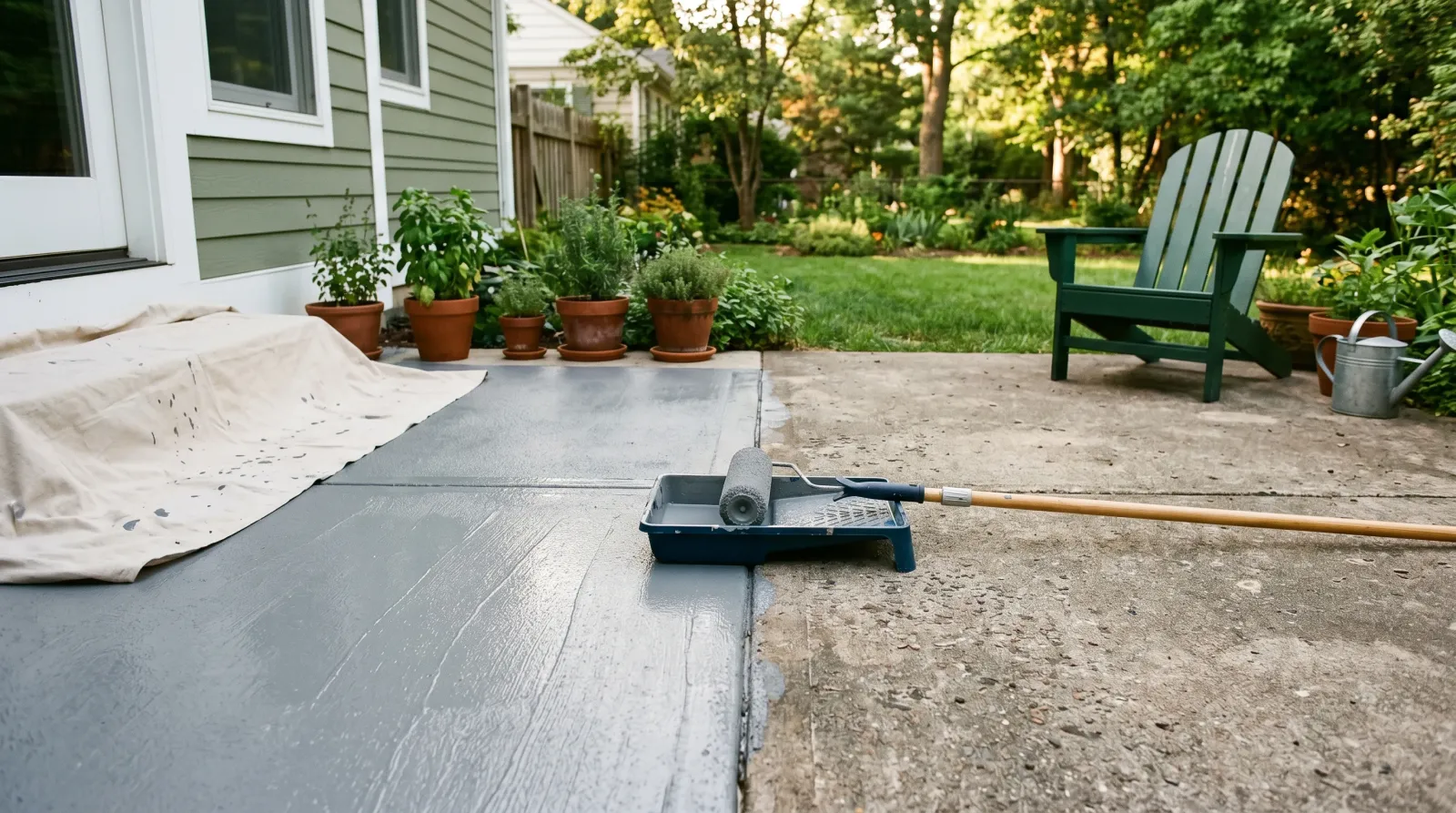
A patio looks like a basement floor that someone moved outdoors. It isn’t. The sun cooks the topcoat, the rain pools where the slope went wrong, and a dark color you loved in the can turns into a griddle in August. Treat it like a basement and the coating fails by the second summer.
TL;DR
- Cure window: new concrete waits 28 days, 60 in cool weather.
- Prep: pressure-wash, degrease, acid-etch to CSP 2–3. All three. No shortcuts.
- Primer: masonry bonding primer (Behr Concrete & Masonry or Loxon by SW). Not a generic interior primer.
- Paint: Drylok 1-Part Epoxy Floor Paint, Rust-Oleum EpoxyShield Patio, or Behr Granite Grip. Match the product to the use.
- Topcoat: UV-resistant clear sealer. Non-negotiable on a sunny patio.
- Color: mid-tone or lighter. Dark colors read hot.
- Cure: 24 hours to walk on, 7 days for furniture, 14 before a hose-down.
Why a Patio Is Different from a Garage Floor
A garage floor sees tire heat, oil, road salt, and almost no UV. A patio sees UV, freeze-thaw, pooling water, and the occasional Weber. Different problems, different chemistry.
The two patio-specific failure modes nobody warns you about. UV breaks down most amine-cured epoxies; the surface chalks and yellows inside one season unless a UV-stable urethane sits on top of it. And the slab moves with temperature more than an interior slab — that movement opens hairline cracks at every control joint, and the coating tears with them if you didn’t seal the joints first.
A residential patio is also rarely flat. The original slope to drain, if it exists at all, sends water somewhere. That somewhere is where the coating fails first. Plan for it.
What You’re Actually Painting
A patio slab is a few inches of cement-and-aggregate poured over compacted base, with a saw-cut or tooled control joint every 8–10 feet. Surface might be a smooth power-trowel, a broom finish, or a stamped pattern. Each takes paint differently.
Power-troweled is the hardest case. The cement paste rises to the top and seals the pores. Nothing bonds to it without etching or grinding. A broom-finish or rough float gives you usable profile out of the box — sometimes enough to skip the etch, sometimes not. Test a corner before you commit. Stamped patios still hold release agent in the surface for years; strip it with TSP first or the coating lifts in patches.
The Cure-Window Rule
New concrete waits 28 days at 70°F. Cool weather slows the cure; in zones 5 and 6, a slab poured in October isn’t paintable until late spring. The pH at the surface stays high (12–13) for the first month and eats most coatings.
The cheap test is a phenolphthalein indicator from a masonry-supply store. Wet the slab, spot the indicator. Bright pink means the pH is still hot. Pale pink or clear means you’re close. If the patio sits on poor drainage or a high water table, also run a calcium chloride moisture test (ASTM F1869) — the $25 kit tells you whether vapor drive will lift your coating.
Pressure-Wash, Degrease, Etch — All Three
Patios collect everything: barbecue grease, leaf tannins, lawn fertilizer overspray, bird droppings, sunscreen tracked from bare feet. Skip the cleaning and you’re painting over contaminants that will telegraph through the coating in a month.
Step 1 — Pressure-wash
3,000 PSI minimum, 25-degree tip, held 12 inches off the surface. Walk it in overlapping passes. Pay attention to control joints — they collect crud nobody can see. A 1,500-PSI consumer washer doesn’t have the snot to clear set-in tannins; rent the bigger machine.
Step 2 — Degrease
Krud Kutter or a TSP substitute, applied wet, scrubbed in with a stiff push broom, rinsed. Grease ghosts are usually centered under where the grill lives. Hit those spots twice. Let the slab dry overnight before the etch; wet concrete dilutes the acid and you lose the profile.
Step 3 — Acid-etch
Muriatic acid diluted 4:1 with water, or pre-packaged etching crystals. Spray with a pump-up garden sprayer, scrub with a long-handle brush until the foaming dies (about 10 minutes), rinse twice. Wear chemical goggles, a respirator, and rubber boots. Ventilate even outdoors; fumes pool in still air.
Two rinses, not one. Leftover acid neutralizes your primer. Run a litmus strip on a damp spot afterward; it should read 6–7. Below 4, rinse a third time. Etched slab feels like 80- to 100-grit sandpaper under your hand. Any glossy corner gets etched again.
Seal the Joints Before You Prime
Control joints move. The slab on either side expands and contracts about 1/8 inch across a 20-foot run between summer and winter. Coating bridged across an open joint tears every spring.
Caulk the joints with a self-leveling polyurethane sealant (Sikaflex 1c SL or Quikrete Self-Leveling). It pours in flat, sets in 24 hours, and stays flexible across the slab’s seasonal movement. Joints wider than 1/4 inch get a backer rod first to keep the sealant from sinking. Cure the joints overnight before priming. Skip this step and your first crack is at the joint, in the first March after install.
Primer Choice
Patios call for a masonry-rated bonding primer, not a general-purpose interior primer.
Behr Concrete & Masonry Bonding Primer. The cheap, widely available option at Home Depot. Water-based, penetrates the etched slab, locks down residual dust, and gives the topcoat a chemical-and-mechanical bond. About $35/gal, covers 200–300 sq ft per coat.
Loxon Conditioner by Sherwin-Williams. The pro version. Designed for masonry, handles high-pH residual without chalking, and pairs with the SW exterior line. $55–70/gal at SW pro stores. Use this if you’re already in an SW system on the rest of the house.
Drylok Etching Primer. Combination etch-and-primer for a slab that’s only mildly smooth. Save it for repaints over a previously coated patio where you don’t want to acid-etch through the old coating. Not a substitute for proper etching on bare concrete.
One coat, full coverage, roll in two directions. Hit dry spots with a second pass — etched concrete drinks primer unevenly, and a holiday at this layer will telegraph through the topcoat. Cure 4 hours at 70°F, longer below 60°F. The label rounds down; the technical data sheet on the manufacturer’s website has the real numbers.
Paint — Three Real Choices
Three patio coatings that actually hold up. Skip everything sold as “patio paint” at $25/gallon — those are tinted concrete sealers, not coatings, and they wear off in a season.
Drylok 1-Part Epoxy Floor Paint. A water-based epoxy-modified acrylic from the company that makes the basement-waterproofing line. Stocked at Home Depot and Lowe’s. Self-priming on a properly profiled slab; works as a one-can system on smaller patios. Tinted to a usable palette of grays, tans, and a workable terra-cotta. About $50/gal, covers 300 sq ft per coat. Service life on a typical patio: 4–6 years with a UV topcoat over the top, 2–3 without. Best DIY one-can answer.
Rust-Oleum EpoxyShield Patio. The dedicated patio sibling of the garage kit. UV-stable formulation — the acrylic-urethane chemistry is engineered for sunlight, where the garage version isn’t. Ships with anti-slip flake. One-can application, no mixing of Part A and Part B. $60–80/gal at big-box. Slightly tougher than Drylok 1-Part under chair leg drag and foot traffic. Service life 5–7 years with the proper topcoat.
Behr Premium Granite Grip. A textured one-step coating with a gritty, slip-resistant finish. One coat application over the bonding primer. The texture provides built-in slip resistance, which earns its place on patios with steps and around pool decks. Less aesthetic flexibility (it always reads textured), but the texture hides hairline cracking and minor surface flaws better than a smooth coating. About $50/gal at Home Depot. Recoat at year 3–5.
The decision tree is short. Full-sun patio, smooth finish: EpoxyShield Patio. Cracked or pitted slab, slip matters: Granite Grip. Tight budget, one-can answer: Drylok 1-Part. Deeper picks live in the masonry paint round-up and the concrete floor paint round-up.
Color Choice — Heat, Not Just Looks
This is the part most homeowners get wrong. Patios bake in direct sun. Surface temperature on a dark gray or charcoal coating in full afternoon sun runs 140–160°F. Light gray or sand: 100–115°F. The math is brutal — about 30–50°F of delta between a charcoal and a light gray on the same patio, same hour.
Practical rules:
- Full-sun patio with bare-foot traffic. Light gray, tan, sand, or warm white. LRV above 40. The kids will tell you if you got it wrong.
- Partial-shade patio, mostly furniture. Mid-gray, taupe, or a muted terra-cotta. LRV 25–40. You can chase the design call here.
- Heavily shaded patio. Anything you want. Charcoal reads expensive under tree canopy and won’t cook.
- Pool deck. Light only. Wet feet plus dark surface plus glare equals slip and burn. Walking-pool-decks are always white, cream, or pale gray.
The other heat consideration: dark coatings expand more than light ones. On a patio with marginal joint detailing, dark coatings tear at the joints sooner. Light colors aren’t just cooler; they last longer.
Apply, Then Apply Again
Roll with a 1/2-inch nap microfiber on a 9-inch frame and an extension pole long enough that you’re not on your knees. Cut-in the perimeter and around drains with a 2.5-inch angled sash brush, then roll while the cut-in is still wet. Stopping mid-square is how you get lap marks at the edge.
Two coats. Always two coats. The first fills profile and looks blotchy; the second is what you see for the next five years. Back-roll in the direction you walk in from the house.
Anti-slip additive goes into the second-to-last coat. Broadcast glass beads or aluminum-oxide grit into the wet film, then roll the topcoat over it. Pool decks, steps, and any slope above 2% get this without exception. Skip it and the first wet morning is when somebody falls.
The UV Topcoat — Don’t Skip This
Most one-part patio coatings chalk, fade, and yellow in direct sun within 18 months. A UV-resistant clear urethane sealer on top extends the service life by 2–3 years and keeps the color reading true.
Rust-Oleum Concrete Saver clear urethane is the widely stocked option, $40/gal at most home centers. Apply in a thin coat with a microfiber roller after the color coat has cured 48–72 hours. One coat is enough. Re-seal every 2 years on a heavily used patio — it’s a 30-minute Saturday job that pays off in years of finish life.
If you’re using EpoxyShield Patio or a coating that explicitly markets UV stability, you can argue the topcoat is optional. Argue it on a covered porch. On open sun, put the sealer on anyway.
Cure — Real Numbers
- Touch-dry: 4–6 hours at 70°F.
- Foot traffic, soft soles: 24 hours.
- Furniture back on the patio: 7 days. Chair feet bite a green coating and leave dents that don’t heal.
- Hose-down or full rain exposure: 14 days.
- Heavy outdoor furniture, grill, planters with wet drainage: 14 days.
The slab temperature drives all of this, not the air. A patio in late September gets cold overnight even when daytime air is 70°F. Use a surface thermometer. Below 50°F the coating doesn’t crosslink. Above 85°F your wet edge is gone before you finish the cut-in.
Humidity matters too. Below 85% RH while applying, ideally below 70%. Above that and the coating skins before it lays down. Don’t paint a patio the morning after a thunderstorm.
Where Patio Paint Goes Wrong
- Peeling at expansion joints. You didn’t seal them. The slab moves; the coating tears. Strip the affected 4-inch band, caulk the joint, recoat.
- Chalking and fading in 12 months. No UV topcoat. The coating itself is fine; the surface oxidized. Clean, scuff, and topcoat.
- Hot tire pickup at the driveway transition. Patio coating ran into the driveway. Patio paint isn’t garage paint. Strip the driveway portion and use a true garage epoxy on that strip.
- Pooling water that lifts the coating in dime-sized blisters. Drainage problem, not a paint problem. Grind the low spots, level with a self-leveling patcher, recoat. Or live with annual touch-ups.
- Surface so hot you can’t walk on it barefoot. Color was too dark. Recoat in a lighter LRV next time. Don’t argue with thermodynamics.
- Coating cracks following the slab cracks. A patio over a settling base will keep cracking. Inject hairline cracks with a polyurethane crack filler before the next recoat, but understand the slab is the root cause.
Common Mistakes
- Pressure-washing and calling it prep. Wash, degrease, and etch. Three steps.
- Skipping the joint sealant. The single most common cause of first-spring failure.
- Using interior or garage floor paint outdoors. UV kills both within a season.
- One coat to save time. The second coat is the one you see. Always two.
- Putting the grill back at day 3. Seven days for furniture, fourteen for a hot grill.
- Charcoal in full sun. It looks good in the chip. It cooks in July.
Maintenance and Longevity
A patio coating done right lasts 5–7 years before a full recoat, with a UV-topcoat re-seal every 2 years. Done wrong — no etch, no joint sealant, no UV topcoat — it fails in 1–2 years and looks worse than bare concrete on the way out.
Yearly maintenance is light. Sweep monthly. Pressure-wash at low PSI once in spring after pollen drops. Spot-treat grease near the grill with a degreaser, not bleach; bleach softens the coating. Inspect control joints every fall; recaulk any that opened. Touch up chips at chair-leg corners before the bare patch grows.
Save the can, the color match, and the topcoat brand. The year-5 recoat is a one-day refresh if you’ve got the product info. Without it, you’re guessing, and the guess usually means stripping and starting over. The two extra weekends of patience up front are what’ll bite you in two years if you skip them.
Ask a Question