Flat Roof Coatings: Low-Slope Specifier's Guide (2026)
Flat roof coating systems compared by substrate and chemistry: silicone, acrylic, urethane, and SPF. DFT in mils, ASTM D6083 and D6694, ponding water, and the contractor path.

Disclosure: Affiliate links to retailers and manufacturer-direct programs. Recommendations are spec-driven, not commission-driven.
Use Case
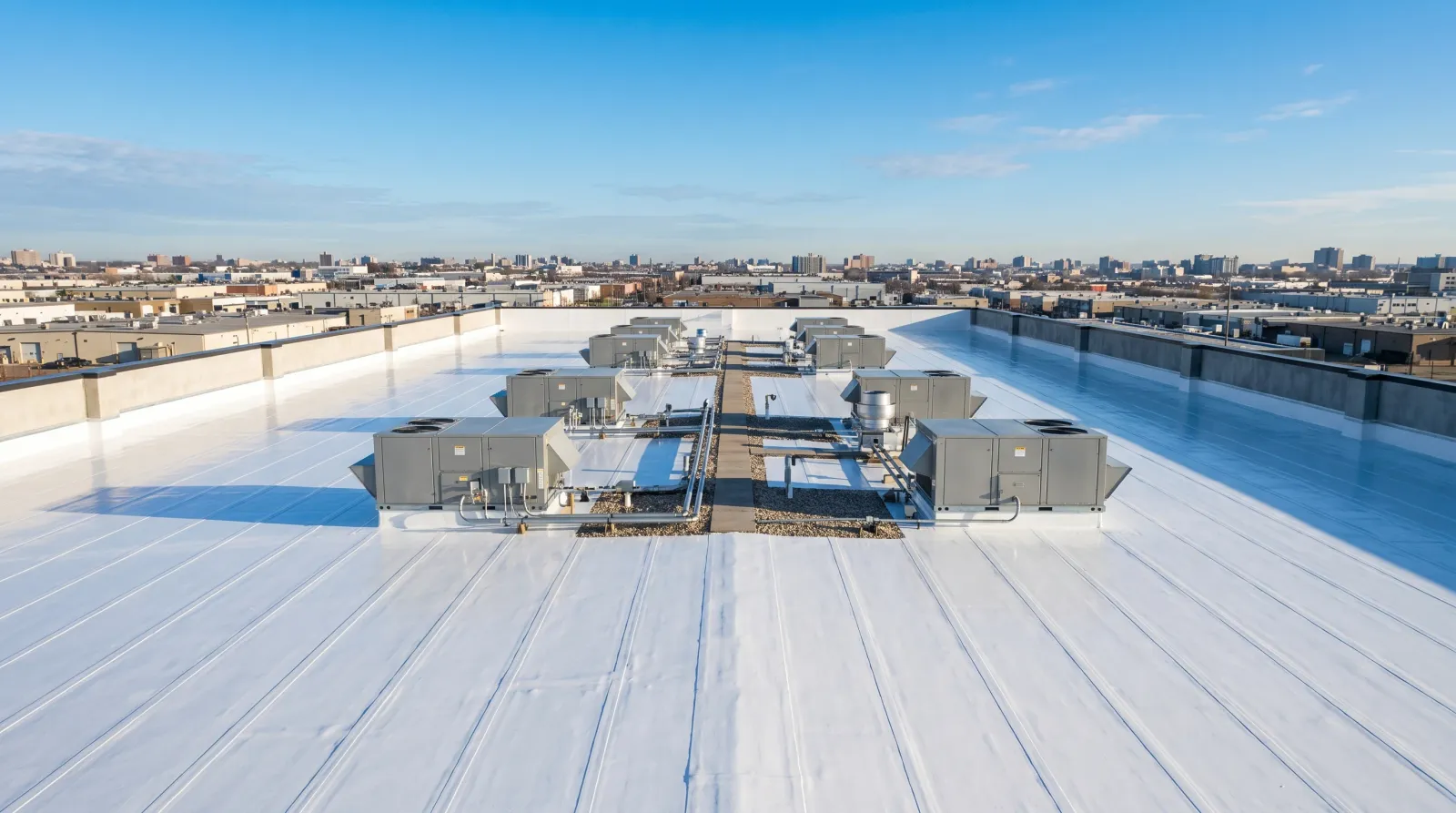
A flat roof coating is a liquid-applied, monolithic membrane that restores a low-slope roof without a tear-off. The asset is a commercial or institutional roof at a slope under 2:12 (built-up, modified bitumen, single-ply TPO/EPDM/PVC, or metal) that has reached the back half of its service life but still holds a sound, dry substrate. The coating extends that roof 10 to 20 years, adds a reflective white surface that cuts rooftop heat load, and avoids the cost and landfill of stripping the old membrane. For a facility manager, the math is straightforward: a restoration coat runs a fraction of a tear-off, ships as a capital-maintenance line rather than a full reroof, and keeps the building dry through the next budget cycle.
The spec gets written on warehouse and distribution roofs, retail and grocery boxes, schools and municipal buildings, light-industrial plants, and any metal roof with leaking lap seams. The driver is one of three: a roof that leaks at seams and penetrations but has life left in the field, an energy mandate that calls for a reflective cool-roof surface, or a capital plan that needs to defer a reroof five to ten years.
Service life depends entirely on chemistry and dry film thickness. A thin reflective maintenance coat at 10 to 15 mils dry buys 5 to 10 years. A full silicone restoration system at 25 to 30 mils dry, with the seams reinforced and the details detailed, carries a 15 to 20 year system warranty. The coating fails early from three causes: trapped moisture under the membrane that was never scanned, a substrate that was not cleaned and tested for adhesion, or a film applied below the spec’d mil thickness. None of those is a product defect. All three are preventable in the pre-coat survey.
Spec Requirements
The spec block earns the trust before any product gets named. Numbers vary by chemistry and manufacturer; the categories do not.
| Spec | Value |
|---|---|
| Dry film thickness (DFT) | 20–40 mils dry total for restoration systems; 10–20 mils dry for reflective maintenance coats |
| Coverage @ DFT | 1.0–1.5 gal per 100 sq ft per coat at spec’d mils (varies by chemistry and solids) |
| VOC | under 50 g/L silicone high-solids; under 100 g/L waterborne acrylic; under 250 g/L moisture-cure urethane under SCAQMD Rule 1113 |
| Standards | ASTM D6083 (acrylic), ASTM D6694 (silicone), ASTM D6522 (moisture-cure urethane), ASTM C1305 (crack bridging), ASTM E1980 (SRI) |
| Reflectivity / cool roof | CRRC-rated; Energy Star; Title 24 aged-reflectance compliance where required |
| Substrate prep — single-ply / mod-bit | Power-wash to remove chalk and dirt; pull-test adhesion; reinforce all seams and penetrations |
| Substrate prep — metal roof | SSPC-SP2/SP3 hand or power tool on rust; spot-prime with rust-inhibitive primer; seal lap seams |
| Moisture survey | Infrared or nuclear scan on any roof over ten years old; wet areas cut and replaced before coating |
| Service temp | Continuous rooftop exposure, roughly -20°F to 180°F surface; verify product range |
| Cure to rain | 2–8 hours to shed water (acrylic, weather-dependent); silicone cures under high humidity, acrylic does not |
| Ambient at application | 50°F and rising; substrate ≥5°F above dew point; RH under 85% for acrylic |
Three numbers govern the install: the DFT relative to the warranty term, the adhesion pull test against the prepared substrate, and the moisture state of the assembly below the membrane. Miss any one and the coating fails on the roof, not in the can.
The VOC line varies by region. Waterborne acrylic and high-solids silicone clear SCAQMD Rule 1113 and the OTC states without issue. Moisture-cure urethane is the chemistry to verify on a California or Northeast job; the solvent-borne grades run higher and the low-VOC versions are the ones to specify there. State your product against the project ZIP before you bid.
System Chemistry Compared
Pick the chemistry to the substrate and the ponding condition first, then the brand. Four classes cover almost every low-slope roof.
| Chemistry | Recoat / cure | Ponding water | UV stability | $/sq ft installed | Best for |
|---|---|---|---|---|---|
| Silicone (ASTM D6694) | 2–8 hr; cures on humidity | 🟢 Excellent — built for standing water | 🟢 Excellent | $1.50–3.50 | Dead-flat roofs, ponding, single-ply restoration |
| Acrylic (ASTM D6083) | 2–6 hr; needs dry weather | 🔴 Re-emulsifies under prolonged ponding | 🟢 Excellent | $0.90–2.25 | Sloped-to-drain roofs, reflective cool-roof coats |
| Moisture-cure urethane (D6522) | 4–24 hr; cures on humidity | 🟡 Tolerates incidental ponding | 🟡 Aromatic chalks; aliphatic top holds | $1.75–3.75 | Metal roofs, high-traffic roofs, foot-traffic abrasion |
| SPF + coating (spray foam) | foam then coat | 🟡 Depends on the top coat | 🟡 Depends on the top coat | $4.00–7.00 | Adding R-value and slope, re-cover with insulation |
Silicone owns the ponding-water roof. It is the only chemistry that holds up to standing water without breaking down, which is why it dominates restoration on dead-flat single-ply. Acrylic is the cost and reflectivity leader on any roof that drains, and it carries the cleanest cool-roof numbers. Moisture-cure urethane brings abrasion and impact resistance for metal roofs and roofs that see service traffic. Spray foam is the answer when the roof needs R-value or positive slope built up, with a coating over the foam for UV and weather protection. For the deep version of the top two, see the silicone roof coatings guide and the elastomeric roof coating guide.
Recommended Systems
Three full multi-coat stacks at different chemistries and price-performance points. Each is a real restoration system, not a single product. Verify the specific product against the project warranty term before bid.
System A — GACO GacoFlex S2000 Silicone (ponding-Grade Restoration)
| Layer | Product | DFT |
|---|---|---|
| Repair | GacoPatch + reinforcing fabric at seams and penetrations | embedded |
| Primer (as required) | GacoFlex E5320 epoxy primer on metal or contaminated substrate | 1–2 mils |
| Topcoat | GacoFlex S2000 high-solids silicone (two passes) | 20–30 mils dry total |
| Total | 20–32 mils |
Service life 15–20 years with a registered system warranty. S2000 is a high-solids silicone that cures under humidity and holds up to standing water, which makes it the answer for a dead-flat single-ply or mod-bit roof that ponds after rain. The single-coat capability cuts labor against two-coat acrylic, and the cured film stays flexible through freeze-thaw. The trade-off is that silicone attracts dirt over time and a future recoat has to be silicone over silicone, so it locks the roof into one chemistry. GacoFlex S2000 product page.
System B — Sherwin-Williams SWRR Acrylic (reflective Cool-Roof, Sloped Substrate)
| Layer | Product | DFT |
|---|---|---|
| Repair | SW Roof Mastic + polyester fabric at seams, flashings, fasteners | embedded |
| Base coat | SWRR Acrylic Roof Coating (white) | 10–12 mils dry |
| Topcoat | SWRR Acrylic Roof Coating (white) | 10–12 mils dry |
| Total | 20–24 mils |
Service life 10–15 years on a roof that drains. SWRR is a waterborne acrylic that carries CRRC reflectance numbers and Title 24 cool-roof compliance, making it the spec for an energy mandate or a hot-climate distribution box where cooling load is the line item. Two coats build the mil thickness; the white surface drops rooftop temperature 50–80°F against a black membrane. The hard rule on acrylic is drainage. It re-emulsifies under prolonged ponding, so it is specified for positive-slope roofs only. SWRR roof coatings page.
System C — Henry 587 Moisture-Cure Urethane (metal Roof, Traffic-Rated)
| Layer | Product | DFT |
|---|---|---|
| Primer | Henry 925 BES adhesive/primer on aged single-ply or metal | as required |
| Base coat | Henry moisture-cure urethane base | 10–15 mils dry |
| Topcoat | Aliphatic urethane top (UV-stable, color-stable) | 8–12 mils dry |
| Total | 18–27 mils |
Service life 12–18 years. Moisture-cure urethane is the abrasion and impact choice for a metal roof with leaking laps or a roof that sees regular service foot traffic around RTUs and equipment. The aromatic base builds film and adhesion; the aliphatic topcoat holds color and gloss against UV where a bare aromatic would chalk. Urethane tolerates incidental ponding better than acrylic but is not a long-term standing-water coating. Henry roof coatings page.
Systems Compared
| System | Total DFT | $/sq ft installed | Service life | Best for |
|---|---|---|---|---|
| A — GACO GacoFlex S2000 silicone | 20–32 mils | $1.50–3.50 | 15–20 years | Dead-flat roofs, ponding water, single-ply restoration |
| B — SW SWRR acrylic | 20–24 mils | $0.90–2.25 | 10–15 years | Sloped roofs, cool-roof mandates, reflectivity |
| C — Henry moisture-cure urethane | 18–27 mils | $1.75–3.75 | 12–18 years | Metal roofs, leaking laps, service-traffic abrasion |
Pricing assumes a 20,000+ sq ft roof through a manufacturer-certified contractor with seam reinforcement and a registered system warranty. Small roofs under 5,000 sq ft run 30–60% higher per square foot because mobilization and detail labor do not scale down. Over a 20-year horizon, a silicone restoration at $2.50 per square foot replacing a $9–14 per square foot tear-off is the strongest total-cost-of-ownership case on the roof, provided the substrate passes the moisture scan.
Application and Contractor Path
A commercial roof coating is not a maintenance-crew job. The DFT, the adhesion pull test, the seam-and-penetration detail course, and the wet-film readings per coat are all warranty-gating, and the manufacturer ties the system warranty to a certified applicator. Specify a contractor with one of the following:
- Manufacturer certification on the specific product line (GACO Certified Contractor, Sherwin-Williams roof-coating applicator, Henry/Carlisle certified roofer).
- A documented roofing track record on the membrane type being coated; TPO restoration is not EPDM restoration.
- Fall-protection compliance to OSHA 1910.28 and 1910.29 for low-slope work, with a written plan for the crew on the roof.
Three contractor-qualifying questions before signing:
- Did you run a moisture scan, and where are the wet areas marked? A contractor who wants to coat without an infrared or nuclear survey on a ten-year-old roof is bidding a warranty claim, not a roof.
- What is the wet-film gauge protocol per coat? Each pass gets checked with a wet-film comb against the spec’d mils. A contractor who cannot describe the gauge and the reading frequency will under-apply and blame the product.
- Who registers the system warranty, and is the labor covered? The registered, labor-inclusive warranty is the one that pays for the next failure. A material-only warranty leaves the building owner holding the tear-off.
The manufacturer-rep network on all three systems runs a free pre-coat roof survey: substrate identification, adhesion pull test, moisture scan review, and a coverage-rate calculation per square. Use it. Catching wet insulation or a failed pull test before the first coat costs an afternoon. Catching it after the roof is coated costs the whole job.
Failure Modes
Five failures cover the bulk of roof-coating rejections and warranty claims. Each one traces to the survey, not the can.
- Coating over trapped moisture. Cause: no infrared or nuclear scan before the restoration coat, so saturated insulation got sealed under a monolithic film. The moisture drives blistering, adhesion loss, and eventually a worse leak than the one being fixed. Prevention: a moisture survey on any roof over ten years old; wet areas cut out and replaced as roofing work before the coating goes down. See the diagnosis on coating and paint blistering for the same mechanism on other substrates.
- Adhesion failure from skipped prep. Cause: chalk, dirt, biological growth, or a release agent on the old membrane was never washed off, and the coating never bonded. Prevention: power-wash to a clean substrate, run an adhesion pull test on the prepared surface, and verify against the manufacturer’s minimum before scaling up.
- Under-applied film thickness. Cause: the crew stretched the material to save cans and the dry film landed under the spec’d mils, so the system carries the warranty of a thin maintenance coat instead of a restoration. Prevention: wet-film gauge readings per coat, coverage-rate tracking against squares applied, and a third-party check on large roofs.
- Acrylic on a ponding roof. Cause: a waterborne acrylic was specified or substituted on a dead-flat roof that holds water, and the film re-emulsified at the low spots. Prevention: silicone (ASTM D6694) on any roof that ponds 48 hours after rain, or correct the drainage and slope to drain before an acrylic goes down.
- Failed seams and penetrations. Cause: the field coat went down but the seams, laps, flashings, and pipe penetrations were not reinforced with fabric and mastic, and the roof leaks at the details while the field stays sound. Prevention: a detail course first — fabric-reinforced mastic at every seam, fastener, and penetration — then the field coat over a sound, detailed base.
Coating over wet insulation is the most expensive failure on this list because the only fix is to strip the coating, replace the insulation, and recoat. It is also the most preventable. A moisture scan is a half-day on the roof; it is the cheapest insurance the spec buys.
Where to Buy / Spec
| Channel | Best for | Path |
|---|---|---|
| Manufacturer-direct (GACO, Sherwin-Williams, Henry rep) | Spec’d restoration projects, registered system warranties, pre-coat survey | GACO · SW roof coatings · Henry |
| Distributor (Beacon, SRS, ABC Supply) | Bulk 5-gal and drum, contractor accounts, beads and fabric | Roofing distributor with project pricing |
| Pro retail (Sherwin-Williams stores) | Local 5-gal pickup, contractor pricing, small-roof maintenance coats | Local store account |
| Amazon Business | Small outbuilding maintenance coats, fleet stocking | Spec-verify the product first |
Manufacturer-direct is the recommended channel on every roof above 5,000 sq ft. The rep survey — substrate ID, adhesion pull test, moisture scan review, and coverage math — is worth more than any retail discount on the pail, and it is the gate to the registered system warranty.