Elastomeric Roof Coating: Specifier's Guide (2026)
Elastomeric roof coating compared by chemistry for low-slope membranes and metal. ASTM D6083, DFT in mils, ponding water, and the contractor path.

Disclosure: Affiliate links to retailers and manufacturer-direct programs. Recommendations are spec-driven, not commission-driven.
Use Case
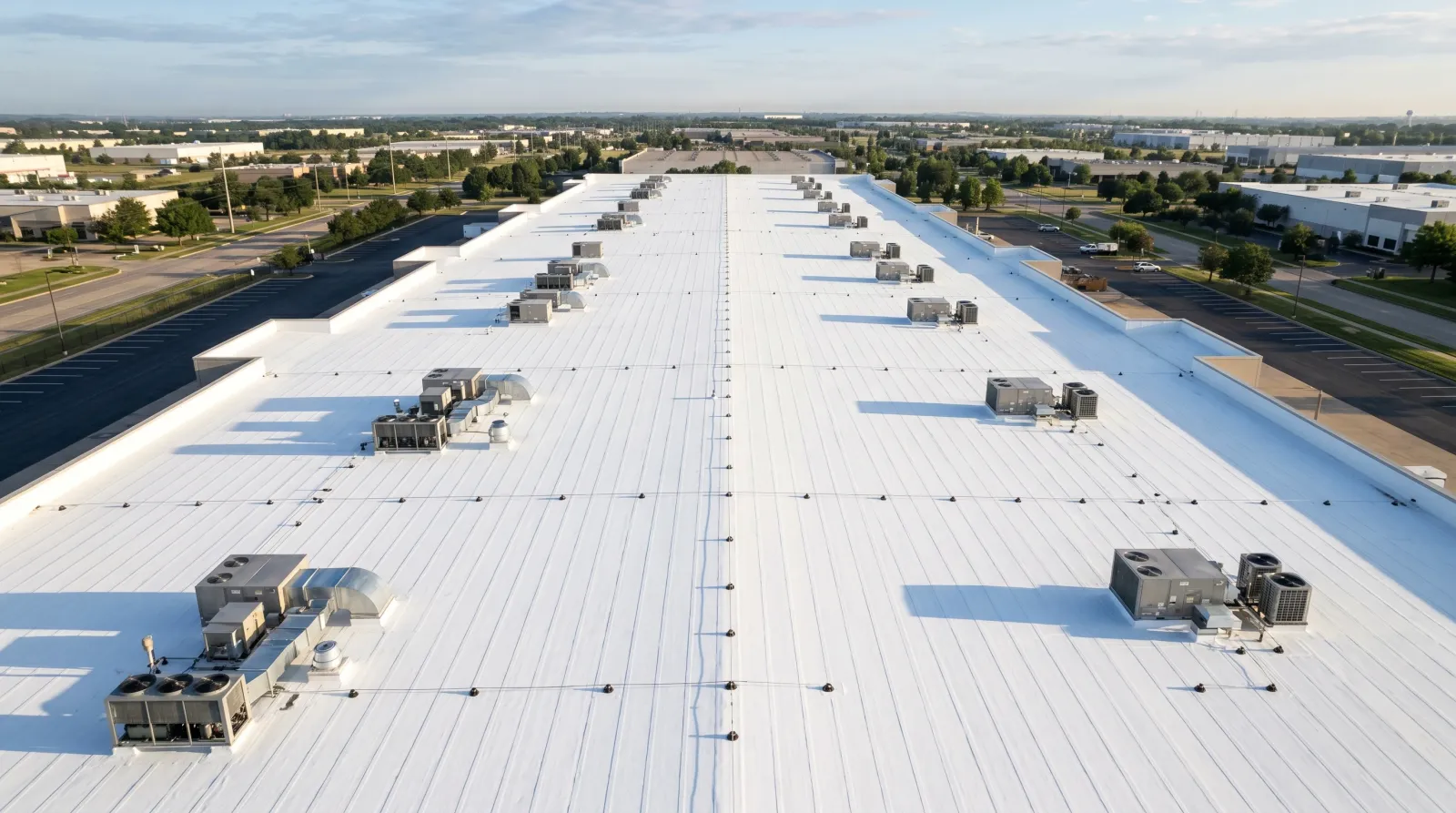
An elastomeric roof coating is a liquid-applied, fluid-membrane restoration system for a low-slope commercial roof that has aged out of its original warranty but still has sound substrate underneath. It is sprayed or rolled over an existing built-up roof, modified-bitumen, EPDM, TPO, PVC, metal, or aged spray polyurethane foam, and it cures into a seamless, monolithic film that reflects solar heat, bridges hairline cracks, and re-seals the seams and penetrations that age opens up. The asset is the roof of a warehouse, distribution center, big-box retail, school, manufacturing plant, or strip mall. These are the flat or near-flat roofs that make up most commercial square footage in the United States.
The economic case is recover-versus-replace. A tear-off and re-roof runs $7 to $14 per square foot and sends the old membrane to landfill. A coating restoration over a sound substrate runs $2 to $5 per square foot installed and renews the roof in place. The catch is the phrase “sound substrate.” Coating does not fix wet insulation, structural deck movement, or a membrane past structural failure. It restores a roof that has surface-weathered but is still watertight, and it resets the service-life clock by 10 to 20 years depending on the chemistry and the dry mil thickness the spec calls for.
Service life tracks chemistry and build. A waterborne acrylic at 20 dry mils delivers 10 to 15 years on a positive-drainage roof. A 100% silicone at 25 to 30 dry mils delivers 15 to 20 years and survives ponding water that destroys acrylic. Both fail early when the substrate is dirty, wet, or never adhesion-tested. The reflective top surface earns the second payback: a white elastomeric coating drops rooftop temperature 50°F to 80°F on a summer afternoon and cuts cooling load on any air-conditioned single-story building.
Spec Requirements
The spec block governs the bid. Numbers move with the chemistry and the warranty tier; the categories do not. A roof is a single-zone asset, so one system gets written across the deck rather than a zone matrix.
| Spec | Value |
|---|---|
| Dry film thickness (DFT) | 20–40 mils total dry, two coats minimum; warranty tier sets the floor (e.g., 20 mils for 10-year, 30 mils for 20-year on silicone) |
| Coverage @ spec’d DFT | 1.0–1.6 gal per 100 sq ft per coat for acrylic; 1.0–1.5 gal per 100 sq ft per coat for silicone (substrate porosity drives the high end) |
| VOC | <50 g/L waterborne acrylic; <100 g/L high-solids silicone; solvent-borne silicones run higher, so verify SCAQMD Rule 1113 and CARB before a California bid |
| Standards | ASTM D6083 (acrylic), ASTM D6694 (silicone), ASTM D6522 elongation/tensile, ASTM C1549 solar reflectance, UL 790 / ASTM E108 fire class |
| Cool-roof rating | CRRC-listed values; ENERGY STAR Roof Products listing; initial SRI calculated from C1549 reflectance and C1371 emittance |
| Substrate prep, single-ply/BUR | Low-pressure power wash to remove chalk and dirt; rinse; full dry; ASTM D6083 adhesion test (pull patches) before bid |
| Substrate prep, metal | Treat rust to SSPC-SP3 power-tool clean or SSPC-SP6 commercial blast on heavy corrosion; rust-inhibitive primer; re-fasten and seal panel seams |
| Substrate prep, aged SPF | Re-coat or repair foam blisters; sand chalk; silicone tie-coat per manufacturer |
| Reinforcement | Polyester fabric embedded in base coat at all seams, fasteners, curbs, drains, and penetrations; not optional on any warranted system |
| Ambient at application | Air and substrate 50°F to 95°F; substrate ≥5°F above dew point; no rain in the cure window (24–48 hr for acrylic before rain-safe) |
| Ponding tolerance | Acrylic: positive-drainage roofs only. Silicone: rated for permanent ponding |
| Cure to service | Rain-resistant in 2–8 hr (silicone) or 12–24 hr (acrylic); full cure 7–14 days |
Three numbers decide the outcome: total dry mils against the warranty tier, the adhesion-test result before bid, and the dew-point/substrate-temperature window during application. Miss the mil thickness and the warranty drops a tier or voids. Skip the adhesion test and the film delaminates. Spray below the dew point and the film never bonds.
System Chemistry Compared
Two chemistries carry almost every commercial restoration spec: acrylic and silicone. Two more (polyurethane and silicone-modified asphalt/SEBS) hold niches. The choice is driven by drainage, climate, and budget before any product name comes up.
| Chemistry | Recoat window | Ponding water | UV / weather | $/sq ft installed | Best for |
|---|---|---|---|---|---|
| Waterborne acrylic | 12–24 hr | 🔴 Positive drainage only; re-emulsifies under standing water | 🟢 Excellent reflectance; chalks slowly over years | $2.00–3.50 | Positive-drainage low-slope, cool-roof energy projects, lowest cost |
| 100% silicone | 2–8 hr | 🟢 Rated for permanent ponding | 🟢 Excellent UV and weather; holds elongation | $3.00–5.00 | Ponding roofs, low-slope with poor drainage, aged SPF, humid climates |
| Polyurethane (aliphatic top) | 4–12 hr | 🟡 Tolerates intermittent ponding | 🟢 Strong abrasion and traffic resistance | $4.00–6.00 | Roofs with foot traffic, mechanical-equipment decks, tougher film needed |
| Silicone-modified / SEBS rubber | 8–24 hr | 🟡 Limited | 🟡 Mid-tier | $2.50–4.00 | Budget metal-roof restoration, fast single-coat repair |
Acrylic wins on cost and reflectance for any roof that drains. Silicone wins the moment water stands, and most aged low-slope roofs pond somewhere. Polyurethane wins where the roof takes foot traffic or equipment loading and needs an abrasion-resistant film. If the roof ponds and the budget is tight, silicone still wins, because acrylic over standing water is a failure waiting for the first wet season.
Recommended Systems
Three full multi-coat stacks at different chemistry and price points. Each is a real manufacturer system, not a single can. Confirm the substrate-specific primer and the warranty tier against the manufacturer’s published system before bid.
System a: GACO GacoFlex S2000 Silicone (ponding-Rated, Long-Life)
| Layer | Product | DFT |
|---|---|---|
| Primer (porous/aged) | GacoFlex E5320 epoxy primer or DS1110 silicone tie-coat | 2–4 mils |
| Base coat | GacoFlex S2000 silicone, polyester embedded at seams/penetrations | 10–15 mils |
| Topcoat | GacoFlex S2000 silicone (white) | 10–15 mils |
| Total | 22–34 mils |
Service life 15 to 20 years. GacoFlex S2000 is a 100% silicone that cures fast, holds elongation, and survives permanent ponding water that breaks down acrylic. Single-coat options exist for repair scopes, but the warranted restoration runs base plus topcoat with reinforcement at every detail. This is the system the spec calls for on a roof with standing-water history or drainage that cannot be corrected. GacoFlex S2000 product page.
System B: Henry 587 Tropi-Cool 100% Silicone (metal and Single-Ply)
| Layer | Product | DFT |
|---|---|---|
| Primer (metal/aged) | Henry 167 Rust Inhibitive Primer or 887 Silicone Primer | 2–3 mils |
| Base coat | Henry 587 Tropi-Cool silicone, 4-inch polyester at seams and fasteners | 12–15 mils |
| Topcoat | Henry 587 Tropi-Cool silicone (white) | 12–15 mils |
| Total | 26–33 mils |
Service life 15 to 20 years. Henry 587 Tropi-Cool is a high-solids silicone with a strong record on metal-roof restoration and aged single-ply. The 167 rust-inhibitive primer is the differentiator on a corroded standing-seam or R-panel metal roof: treat the rust, re-fasten, seal the seams with embedded polyester, then build the silicone over it. ENERGY STAR-listed and CRRC-rated white for cool-roof rebate and Title 24 compliance. Henry 587 Tropi-Cool product page.
System C: Sherwin-Williams SWR Acrylic Roof System (positive-Drainage, Cost-Driven)
| Layer | Product | DFT |
|---|---|---|
| Primer/bleed-block | S-W Loxon or SWR Acrylic Primer per substrate | 2–4 mils |
| Base coat | SWR Acrylic Elastomeric base, reinforcing fabric at details | 10–15 mils |
| Topcoat | SWR Acrylic Elastomeric topcoat (white) | 10–15 mils |
| Total | 22–34 mils |
Service life 10 to 15 years on a positive-drainage roof. The Sherwin-Williams acrylic elastomeric system lands at the lowest installed cost of the three and carries the best initial solar reflectance for a cool-roof energy project. Specify it only where the roof drains. Acrylic re-emulsifies under standing water, so any ponding history routes the job to silicone. The advantage of the S-W path is the local commercial-store contractor network and rep support on the spec. Sherwin-Williams roof coatings.
Systems Compared
| System | Total DFT | $/sq ft installed | Service life | Best for |
|---|---|---|---|---|
| A. GACO GacoFlex S2000 silicone | 22–34 mils | $3.25–5.00 | 15–20 years | Ponding roofs, poor drainage, aged SPF, longest life |
| B. Henry 587 Tropi-Cool silicone | 26–33 mils | $3.00–4.75 | 15–20 years | Metal roofs, aged single-ply, rust-inhibitive prime |
| C. S-W SWR Acrylic | 22–34 mils | $2.00–3.50 | 10–15 years | Positive-drainage roofs, cool-roof energy projects, lowest cost |
Pricing assumes a 20,000+ sq ft scope through a manufacturer-approved applicator, two-coat build with reinforcement, on a substrate in restorable condition. Heavy prep (rust treatment, wet-insulation removal, extensive seam repair) adds $0.50 to $2.00 per square foot and is the line item most often underbid. Run the numbers over the full service-life horizon: a silicone restoration at $4 per square foot delivering 18 years costs about $0.22 per square foot per year, against a $10 tear-off at 25 years near $0.40 per square foot per year, before the cooling-load savings on either.
Application and Contractor Path
A liquid-applied roof restoration is a contractor-installed system on any scope that carries a manufacturer warranty. The reasons are specific: the warranty attaches to a documented adhesion test, a gallons-per-square mil-thickness log, embedded reinforcement at every detail, and a manufacturer field inspection at closeout. A facility maintenance crew can handle seam touch-ups and small patches on an accessible roof with fall protection in place, but it cannot produce the paperwork that makes a 15-year warranty real.
Spec a contractor with one of the following:
- Manufacturer-approved applicator status on the specific product line (GACO Approved Contractor, Henry-certified roofing contractor, Sherwin-Williams approved applicator). Approval is what unlocks the system warranty.
- A current state roofing or general contractor license carrying the appropriate workers-comp and liability coverage for rooftop work.
- A documented OSHA 1910.28 / 1926.501 fall-protection program for crews working at the roof edge and around skylights and openings.
Three contractor-qualifying questions before signing:
- What was the adhesion-test result on this roof, and where are the pull patches? ASTM D6083 adhesion testing on the actual substrate, before the bid is finalized, is the difference between a system that bonds and one that sheets off in two years.
- What is the gallons-per-square target, and how is mil thickness verified during application? Under-application is the most common cause of premature failure and warranty denial. A wet-mil gauge in continuous use during the spray, logged per roof section, is the answer.
- Who files the manufacturer field-inspection report at closeout? That report is what activates the warranty. A contractor who cannot deliver a signed inspection keyed to the system warranty leaves the building owner with paint on a roof and no coverage behind it.
Every major manufacturer on this list runs a free pre-bid roof survey through the rep network: moisture scan, substrate condition, drainage assessment, and a system recommendation with the warranty tier. Use it. Catching wet insulation at the survey stage costs a core sample; catching it after the coating blisters costs the whole job over again.
Failure Modes
Five failures cover the bulk of premature elastomeric-roof rejections and warranty claims.
- Coating over trapped moisture. Cause: a coating applied over wet insulation or a damp substrate. Solar heat drives the vapor up through the film and lifts it into blisters within the first cooling season. Prevention: an infrared or capacitance moisture survey before bid; core and replace any wet insulation; verify a dry substrate before the base coat goes down. The mechanics are the same as on a wall. See why coatings blister over moisture and how to prevent it.
- Under-application below the warranty mil thickness. Cause: the crew sprayed thin to stretch material across more square footage. The film weathers through years early and the warranty denies on the mil-thickness log. Prevention: gallons-per-square target written into the contract; wet-mil gauge logged per section; manufacturer field verification at closeout.
- Acrylic over ponding water. Cause: a waterborne acrylic spec’d on a roof that ponds. The film re-emulsifies, softens, chalks, and washes thin at the low spots. Prevention: silicone for any roof with standing-water history; correct drainage where the budget allows; never write acrylic on a roof that holds water past 48 hours.
- No reinforcement at seams and penetrations. Cause: the polyester fabric skipped at curbs, drains, fasteners, and laps to save labor. Movement at the detail cracks the unreinforced film first. Prevention: embedded polyester in the base coat at every detail, inspected before the topcoat covers it.
- Application below dew point or on a dirty substrate. Cause: spraying onto a substrate within 5°F of the dew point, or over chalk and dirt that was never washed off. The film never develops adhesion and delaminates. Prevention: low-pressure wash and full dry; sling psychrometer in use during application; substrate temperature held 5°F above dew point through the cure window.
Trapped moisture and under-application account for most of the field failures I review. Both are caught in the pre-construction survey and the wet-mil log. Neither is a field improvisation.
Where to Buy / Spec
| Channel | Best for | Path |
|---|---|---|
| GACO / Holcim rep network | Silicone restoration over ponding roofs and aged SPF; approved-applicator warranty | GacoFlex S2000 page |
| Henry Company rep / distributor | Metal-roof and single-ply silicone restoration; Tropi-Cool spec | Henry 587 Tropi-Cool page |
| Sherwin-Williams commercial store | Acrylic cool-roof systems; local contractor network and rep support | S-W roof coatings |
| Amazon Business / distributor | Repair-scope material, 5-gal pails for patch and seam work, fleet stocking | Business account with project pricing |
Manufacturer-direct through an approved applicator is the recommended channel on any warranted restoration above 5,000 sq ft. The rep network bundles the moisture survey, the adhesion test, the system spec, and the field inspection. Those services carry the warranty; a retail discount on the pail does not.
FAQ
See the frontmatter for the full Q&A: contractor requirement, coating over an active leak, silicone versus acrylic on ponding roofs, warranty voids, and the energy payback.