Intumescent Fire Paint for Structural Steel: Specifier's Guide (2026)
Intumescent coatings compared for 1-hr, 2-hr, and 3-hr ratings on structural steel. UL 263, ASTM E119, DFT by W/D ratio, topcoat compatibility, and contractor path.

Disclosure: Affiliate links to manufacturer-direct programs and industrial distributors. Recommendations are spec-driven, not commission-driven.
Use Case
Intumescent paint is the passive fire-protection coating that lets an architect leave structural steel exposed without losing the hourly fire rating the building code requires. The chemistry is a layered formulation of an acid catalyst, a carbon donor, a blowing agent, and a binder. At roughly 400°F the binder softens, the acid catalyst attacks the carbon donor, and the blowing agent expands the softened film into a carbonaceous char 30 to 100 times the dry film thickness. The char insulates the steel from the radiant and convective heat of the fire long enough to hit the hourly endurance rating tested under ASTM E119 in a UL 263 listed assembly.
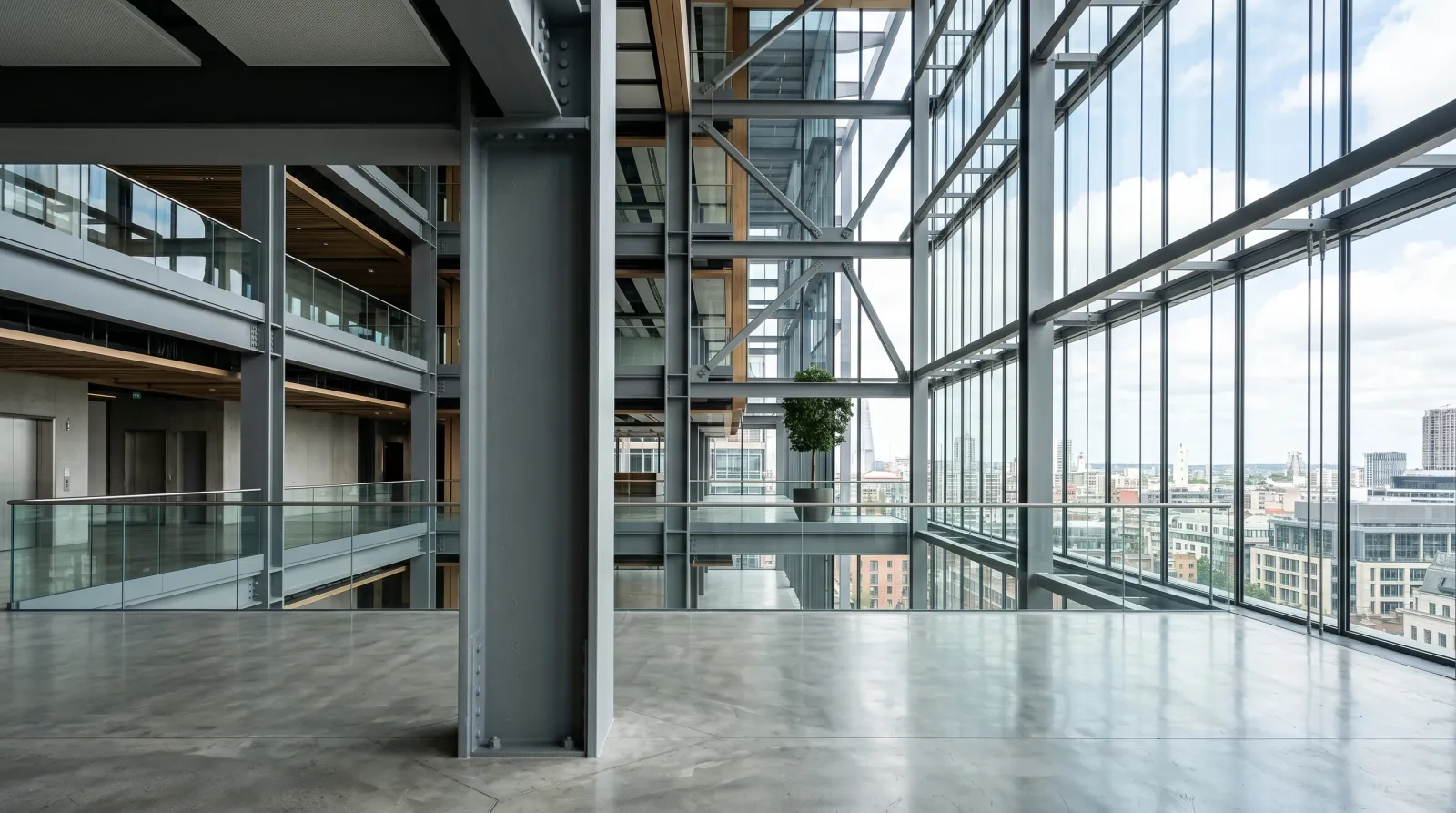
The spec gets written into commercial atria, exposed-steel office buildings, parking structures above grade, museums and libraries with feature beams, transportation terminals, and any building where the architect chose exposed steel over enclosed steel for visual reasons. The building code (IBC Chapter 7) sets the hourly rating per occupancy and construction type — typically 1-hour on columns in Type II-B construction, 2-hour on columns in Type I-B, and 3-hour on primary columns in high-rise Type I-A construction. Bridges, petrochemical, offshore, and LNG facilities use a different chemistry (epoxy intumescent, UL 1709 hydrocarbon-fire rating) for the same purpose under harsher environmental exposure.
Service life for waterborne acrylic intumescents in conditioned interior space is 20 to 30 years. Epoxy intumescents in exposed exterior service deliver 25 to 40 years with the proper topcoat. Both chemistries fail prematurely from substrate moisture, primer incompatibility, or field DFT applied below the UL design listing for the W/D ratio of the member.
Zoned Recommendation Matrix
A single commercial steel building rarely needs one system across every member. Hourly ratings vary by structural role, exposure conditions vary by location in the envelope. The spec for a Type I-B exposed-steel office tower:
| Zone / member | Hourly rating | Recommended chemistry | Why |
|---|---|---|---|
| Primary interior columns (Type I-B) | 2-hour | Waterborne thin-film acrylic (System A) | Conditioned interior; cost-driven; paintable finish |
| Primary beams above ceiling | 2-hour | Spray-applied fire-resistive material (SFRM) or waterborne intumescent | Hidden; SFRM cheaper, intumescent if access matters |
| Exposed atrium columns | 1-hour or 2-hour per IBC | Waterborne intumescent with decorative topcoat | Visual surface; architect-specified color and sheen |
| Parking deck columns (open to weather) | 1-hour | Epoxy intumescent (System B) with polyurethane topcoat | Wet exposure, salt spray, mechanical impact |
| Plant room / utility steel | Varies | Either chemistry per code; spec least-cost compliant | No visual requirement |
For a single-zone asset — an interior atrium, an enclosed mechanical floor — pick one system and write it across the slab. Multi-zone is the rule for any building over three stories with exterior structural exposure.
Spec Requirements
The spec block, before naming product. Numbers vary by manufacturer and UL design; the categories do not.
| Spec | Value |
|---|---|
| Dry film thickness (DFT) | 12–80 mils; keyed to W/D ratio and hourly rating per UL design listing |
| Hourly rating | 1, 1.5, 2, 3, or 4 hours under ASTM E119 (UL 263 listed assembly) |
| Hydrocarbon rating (if applicable) | 1, 2, 3, or 4 hours under UL 1709 (epoxy intumescents only) |
| Surface burning | ASTM E84 Class A: flame spread ≤25, smoke developed ≤450 |
| VOC limit | <250 g/L waterborne; <420 g/L solvent-borne epoxy under SCAQMD Rule 1113 |
| Substrate prep — interior shop-primed | SSPC-SP3 power tool cleaning of field damage; primer touch-up |
| Substrate prep — bare structural steel | SSPC-SP6 commercial blast minimum; SSPC-SP10 near-white for epoxy intumescents and exterior |
| Compatible primer | Inorganic zinc silicate or two-component epoxy per UL design listing — no substitutions |
| Compatible topcoat (interior) | Waterborne or solvent-borne acrylic at 1.5–2.5 mils DFT; aesthetic finish only |
| Compatible topcoat (exterior) | Aliphatic polyurethane at 2–3 mils DFT (Carbothane 134 HG, Interthane 990, Amercoat 450H) |
| Ambient at application | 50°F to 90°F; relative humidity <85%; substrate ≥5°F above dew point |
| Recoat window between intumescent passes | 6–24 hours per manufacturer TDS; varies with temperature and pass thickness |
| Cure to handle | 24–48 hours at 70°F, 50% RH; full cure 7 days before topcoat |
| Field DFT inspection | AWCI Technical Manual 12-A; magnetic pull-off gauge; 1 reading per 100 sq ft minimum |
Three numbers govern the rating: the DFT relative to the W/D of the member, the primer compatibility with the UL listing, and the moisture environment at application. Miss any one and the rating fails inspection or fails in service.
System Chemistry Compared
Two chemistries cover almost every commercial spec. A third (cementitious SFRM) is not a paint and competes on cost rather than aesthetics.
| Chemistry | Hourly rating range | Substrate exposure | UV / weather | $/sq ft installed | Best for |
|---|---|---|---|---|---|
| Waterborne thin-film acrylic | 1–3 hour ASTM E119 | 🟢 Interior, conditioned | 🔴 Interior only — fails outdoors without topcoat | $4–9 | Commercial offices, atria, retail, institutional |
| Epoxy intumescent | 1–4 hour ASTM E119; 1–4 hour UL 1709 | 🟢 Interior, exterior, immersion | 🟢 Excellent with polyurethane topcoat | $12–28 | Petrochemical, offshore, parking decks, LNG, exterior steel |
| Cementitious SFRM (spray-applied) | 1–4 hour ASTM E119 | ⚪ Concealed only | 🔴 No exterior service | $2–5 | Above-ceiling beams, concealed members, lowest cost |
Waterborne wins on interior cost. Epoxy wins on exterior durability and on hydrocarbon-pool-fire exposure. Cementitious SFRM wins on price for any member that nobody will ever see — and loses immediately the moment the architect wants exposed steel.
Recommended Systems
Three full multi-coat stacks at different price-performance points. Two are epoxy intumescents (Carboline, AkzoNobel) and one is the major PPG line. All three carry both UL 263 and UL 1709 listings — verify the specific design number against your project rating before bid.
System a — Carboline Pyroclad X1 (epoxy Intumescent, Hydrocarbon-Rated)
| Layer | Product | DFT |
|---|---|---|
| Primer | Carbozinc 859 inorganic zinc OR Carboguard 890 epoxy | 3–5 mils |
| Intumescent | Pyroclad X1 epoxy intumescent | 12–60 mils per UL design |
| Topcoat (exterior) | Carbothane 134 HG aliphatic polyurethane | 2–3 mils |
| Total | 17–68 mils |
Service life 25–40 years exterior. Pyroclad X1 carries UL 263 hourly ratings to 3 hours on cellulosic fire and UL 1709 ratings to 4 hours on hydrocarbon pool-fire exposure. The spray-applied build is fast on accessible members; recoat between passes runs 6–8 hours at 70°F. Carboline Pyroclad X1 product page.
System B — AkzoNobel International Chartek 7 (epoxy Intumescent, Offshore Standard)
| Layer | Product | DFT |
|---|---|---|
| Primer | Interzinc 22 inorganic zinc OR Intergard 269 epoxy | 3 mils |
| Intumescent | Chartek 7 epoxy intumescent | 20–80 mils per UL 1709 design |
| Topcoat | Interthane 990 aliphatic polyurethane | 2–3 mils |
| Total | 25–86 mils |
Service life 30–40 years on offshore and petrochemical exposure; Chartek has the longest installed track record in hydrocarbon fire protection of any product on this list. Specify Chartek 7 when the project sees salt-spray exposure, immersion, or any exterior service that has to survive a 25-year inspection cycle. Heavier per-foot than Pyroclad X1 at equivalent ratings; chosen on track record, not coverage rate. AkzoNobel Chartek 7 product page.
System C — PPG PITT-CHAR XP (epoxy Intumescent, Federal Facility Spec)
| Layer | Product | DFT |
|---|---|---|
| Primer | AMERCOAT 68HS epoxy OR Dimetcote 9 inorganic zinc | 3–5 mils |
| Intumescent | PITT-CHAR XP epoxy intumescent | 15–70 mils per design |
| Topcoat | PSX 700 siloxane OR Amercoat 450H aliphatic polyurethane | 3–5 mils |
| Total | 21–80 mils |
Service life 25–35 years. PITT-CHAR XP carries DoD MIL-PRF qualification, U.S. Navy approval, and is the most common epoxy intumescent on federal contracting work. The PSX 700 siloxane topcoat is the differentiator on this stack — 12-year gloss retention beats standard polyurethane by 4 to 6 years on south-facing exterior steel. PPG PITT-CHAR XP product page.
Systems Compared
| System | Total DFT range | $/sq ft installed | Service life | Best for |
|---|---|---|---|---|
| A — Carboline Pyroclad X1 | 17–68 mils | $14–22 | 25–40 years | Commercial, petrochemical, parking decks, fast schedule |
| B — AkzoNobel Chartek 7 | 25–86 mils | $18–28 | 30–40 years | Offshore, LNG, harshest exterior exposure |
| C — PPG PITT-CHAR XP | 21–80 mils | $16–24 | 25–35 years | Federal, MIL-spec, long-cycle gloss-critical exterior |
Pricing assumes a 10,000+ sq ft scope of steel surface through a manufacturer-rep certified contractor with shop or field primer included. Small-scope retrofits run 30–80% higher per square foot.
A waterborne thin-film alternative (Sherwin-Williams Firetex FX5120, Jotun Steelmaster 1200WF, Albi Clad TF) lands at $4–9 per square foot installed for interior conditioned service. Specify waterborne when the building is fully enclosed and conditioned. The epoxy systems above are the answer for any project that sees weather, salt, or hydrocarbon-fire risk.
Application and Contractor Path
Intumescent paint is not a DIY product and is rarely installed by a general commercial painting crew. The DFT-to-rating relationship requires per-member calibration, AWCI 12-A inspection protocol, and a documented compatibility chain from primer to topcoat under a specific UL design number. Specify a contractor with one of the following:
- Manufacturer certification on the specific product line (Carboline Authorized Applicator, AkzoNobel International Approved Applicator, PPG PMC certified contractor).
- SSPC-QP1 or QP3 certification for industrial coatings work.
- NACE/AMPP CIP Level 2 inspector on staff or sub-contracted for DFT inspection.
Three contractor-qualifying questions before signing:
- Has the crew applied this product line, under this UL design number, in the last 18 months? Intumescent chemistry varies enough between manufacturers that Pyroclad X1 experience does not transfer to Chartek 7 without a calibration day.
- What is the field DFT inspection protocol? AWCI 12-A is the standard; a contractor who cannot describe the gauge type, frequency, and acceptance criteria should not be on the bid list.
- Who issues the UL inspection certificate at closeout? The certificate keys the building permit closeout and the certificate of occupancy. A contractor who cannot deliver a signed inspection report keyed to the UL design number leaves the building owner exposed.
The manufacturer-rep network on all three systems (Carboline, AkzoNobel, PPG) includes a free pre-bid review of the structural drawings — W/D calculations per member, DFT schedule per zone, and primer-compatibility check against the project spec. Use it. Catching a primer incompatibility at the drawing stage costs hours; catching it after shop fabrication costs weeks and six figures.
Failure Modes
Five failures cover the bulk of intumescent field rejections and warranty claims.
- DFT below UL design listing for the member W/D. Cause: field crew applied a single mil-count across all members instead of per-W/D calibration. Prevention: DFT schedule keyed to each member’s W/D in the project drawings; AWCI 12-A inspection at one reading per 100 sq ft minimum; failing zones recoated before sign-off.
- Primer incompatibility with the UL design. Cause: shop applied a non-listed primer to save cost or schedule. Prevention: cross-reference shop primer SKU to the specific UL design number written into the spec before fabrication releases.
- Moisture-driven blistering or delamination. Cause: condensation on the steel during application, substrate temperature within 5°F of dew point, or topcoat applied before the intumescent fully cured. Prevention: sling psychrometer or surface thermometer in continuous use during application; 7-day cure before topcoat; humidity below 85%.
- Topcoat incompatibility. Cause: a topcoat outside the manufacturer’s listed compatibility chart was applied for aesthetic reasons. Prevention: confirm topcoat against the manufacturer’s compatibility chart and the UL design listing both. Architect-driven color choices route through the manufacturer rep, not around them.
- Mechanical damage in service. Cause: forklift impact, ladder marks, conduit hangers drilled into the coating, or HVAC retrofit work cutting through the film. Prevention: building owner trained on the consequence of cutting through the coating; touch-up program documented in the O&M manual; repair kits stocked by facility maintenance.
Field DFT failures account for the majority of the rejections I review. Primer incompatibility is the most expensive failure mode because the only fix is strip and re-spec. Both are preventable in the pre-construction phase.
Where to Buy / Spec
| Channel | Best for | Path |
|---|---|---|
| Carboline rep network | Spec’d commercial and industrial projects; Pyroclad X1 hydrocarbon-rated work | Carboline rep locator |
| AkzoNobel International Approved Applicator | Offshore, LNG, salt-spray exposure; Chartek 7 spec | AkzoNobel Chartek 7 page |
| PPG PMC rep | Federal and DoD work; PITT-CHAR XP under MIL-PRF qualification | PPG PITT-CHAR XP page |
| Industrial distributor (Rawlins Paints US, ICA, KTA-Tator) | Multi-manufacturer projects, mixed-system bids | Distributor account with project-specific pricing |
Manufacturer-direct is the recommended channel on every project above 5,000 sq ft of coated steel. The rep network includes the pre-bid drawing review, the UL design listing match, and the field inspection protocol — together those services are worth more than any retail discount on the can.
FAQ
Can a general commercial painting crew install intumescent paint? On small interior touch-up scopes, sometimes — provided they hold a manufacturer-product-specific training certificate and follow the AWCI 12-A inspection protocol. On any new-construction scope, an SSPC-QP1 or manufacturer-certified applicator is the answer. The DFT-to-rating math is not a field-improvised process.
What’s the warranty? Manufacturer warranties on the product run 5–10 years for waterborne and 10–15 years for epoxy intumescents. Installed-system warranties through certified contractor networks extend to 15–25 years on the major epoxy lines. The installed warranty is the one that matters; confirm it covers labor and material under documented inspection.
Does intumescent paint comply with SCAQMD Rule 1113? The major waterborne acrylic intumescents (Sherwin-Williams Firetex, Albi Clad, Jotun Steelmaster) ship at <250 g/L and meet Rule 1113. Epoxy intumescents (Pyroclad X1, Chartek 7, PITT-CHAR XP) ship under the industrial maintenance category at <420 g/L. Verify the specific product SDS before bidding a California or OTC state job.
How is the rating verified at building inspection? The contractor delivers a UL inspection report keyed to the project’s UL design number, member-by-member DFT measurements meeting or exceeding the design listing, and a signed certification from the certified applicator. The building inspector cross-checks against the IBC-required hourly rating per occupancy. No UL report, no certificate of occupancy.
What happens if the coating gets cut or drilled in service? The rated assembly is compromised at the breach. Repair kits sold by every major manufacturer include compatible primer, intumescent, and topcoat; the breach is feathered, recoated to the original DFT, and documented in the O&M log. Untouched-up damage means the member fails inspection on the next rating cycle and the certificate of occupancy is at risk.
Is intumescent paint the same as fire-retardant paint sold at a paint store? No. Consumer-grade fire-retardant paints (Class A flame-spread coatings sold for wood paneling and theater backdrops) are surface-burning treatments to ASTM E84, not hourly-rated structural-steel protection to ASTM E119. The two categories carry different codes, different listings, and different price bands. A retail Class A coating cannot be specified for a rated structural-steel assembly.
Related
Frequently asked questions
How does intumescent paint actually provide a 2-hour fire rating?+
Why does DFT vary so much across the same building?+
Waterborne vs epoxy intumescent — which one does the spec call for?+
What primer does the spec call for under intumescent paint?+
Can the steel be primed at the shop and intumescent applied in the field?+
How is intumescent DFT inspected in the field?+
- Warehouse floor coating system comparison
- Polyaspartic floor coatings specifier guide
- VOC regulations for industrial coatings