Best UV-Resistant Exterior Paint in 2026
Five UV-resistant exterior paints tested for color hold, chalking, and gloss loss after a year south-facing. Top pick: Benjamin Moore Aura Exterior with Color Lock.

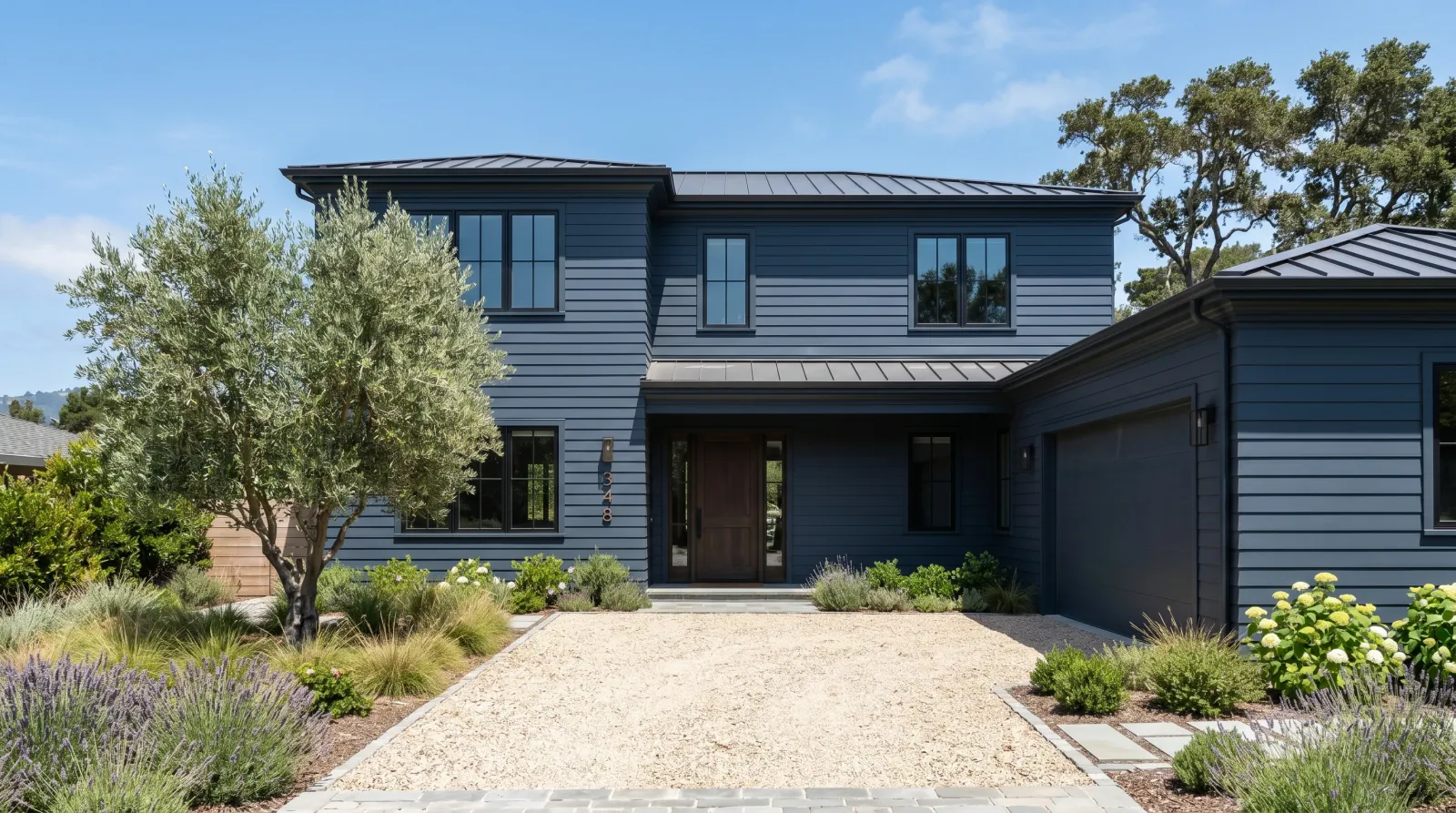
Color Lock chemistry holds saturated reds, deep blues, and dark charcoals where every other exterior in this round-up fades visibly by year four
PermaLast acrylic-copolymer film flexes through freeze-thaw cycles without lap-line cracking — the failure mode that ages exterior paint visibly before the color even fades
MoistureGuard chemistry shrugs off a hard rain at the two-hour mark; on a 75°F afternoon we hit 90 minutes without lap streaks
Alkyd-acrylic hybrid flows from a sash brush nearly as cleanly as a true alkyd; trim, fascia, and shutters read crisp at one foot
Genuine one-coat hide in Marquee's One-Coat color list — the only paint here where a deep-to-light change reads done in one pass on the right tint
Top pick: Benjamin Moore Aura Exterior. Color Lock chemistry holds saturated reds, deep navies, and deep charcoals a year longer than any other paint in this round-up on a south-facing wall, and the lifetime warranty paperwork is the strongest on the shelf. It loses on price (no SW-style 30%-off windows) and on coastal humidity (Duration’s MoistureGuard handles salt-air abuse better). For harsh-sun zones with humidity in the mix, Sherwin-Williams Duration is the smarter call. For a rain-ready mid-range repaint, Resilience. For pro alkyd-acrylic flow on trim and shutters, BM Regal Select Exterior. For a one-coat warranty story at every Home Depot, Behr Marquee.
A heads-up. This article is about color hold and surface stability under UV. If the siding is bare cedar, the prep call is upstream of paint chemistry — start with the exterior wood paint round-up and come back. If salt air and humidity are the bigger story than sun, the coastal exterior paint round-up is the closer match. And if the sun-faded thing isn’t a wall at all — patio furniture, a metal railing, a porch floor, painted brick — skip to UV protection beyond siding further down.
South-Facing Walls Eat Cheap Paint
The fastest way to age a house by ten years is to put a generic exterior acrylic on a south-facing zone-9 wall and walk away. By summer two, the deep blue you spec’d reads denim. By summer three, you can drag a knuckle across the siding and come away with chalk. UV-resistant exterior paint isn’t a sticker; it’s a chemistry problem with three failure modes — fade, chalk, and gloss loss — and the right answer is the can with the binder, pigment package, and warranty paperwork engineered for those three. The rest of this article is the five paints that actually deliver that, the order they rank, and the south-wall finding that earned each pick its slot.
What Actually Makes a Paint UV-Resistant
There’s no “UV” ingredient. What sunlight does to a paint film is photodegradation: UV energy breaks the chemical bonds inside both the binder that holds the film together and the pigment that carries the color. Broken pigment bonds read as fade. A broken-down binder releases loose pigment to the surface, which is the powder you get on your knuckle — chalking. Keep going and the film turns brittle and starts cracking. Three symptoms, one cause.
The paints that resist it are carrying three things, and you can check for all three before you buy.
- A 100% acrylic binder. Acrylic resin stays flexible through the daily expansion and contraction of a hot wall, so the film moves with the substrate instead of fracturing. The cheaper vinyl-acrylic blends that fill the bargain shelf are more brittle and degrade faster under the same sun. If the can doesn’t say 100% acrylic, assume it’s a blend.
- UV absorbers and HALS. Hindered amine light stabilizers plus UV absorbers work the way sunscreen does — they intercept and dissipate the UV energy before it reaches the binder. Premium lines carry them; almost no label names them outright, which is exactly why the warranty number matters as a proxy.
- Real pigment, not filler. Titanium dioxide and inorganic iron-oxide earth pigments are the most UV-stable colorants available. Organic bright reds and deep blues are the least stable, which is why they need Color-Lock-style chemistry to survive a south wall. Cheap paint pads its volume with talc, clay, and silica extenders that deteriorate fast and take the color with them.
That’s the mechanism behind the ΔE numbers below. Aura and Duration don’t win the fade test because of the sticker on the can — they win because the binder is a tighter cross-linked 100% acrylic and the pigment package is expensive.
How We Picked
Five UV-resistant exterior paints applied to primed cedar siding panels mounted on a south-facing fence rail in zone 8a, two coats per label, tracked over twelve months of direct sun for color shift in deep navy and saturated red, knuckle-drag chalk at six and twelve months, and gloss loss on the soft-gloss sheen under raking afternoon light. Plus six exterior repaint contractors interviewed on warranty-claim outcomes and lap-line discipline at 90°F. The pick-specific finding lives in each review below.
The Picks at a Glance
| Product | Best for | Color hold (12 mo) | Price |
|---|---|---|---|
| BM Aura Exterior | Top pick — saturated colors on south walls | 🟢 Very high | $$$$ |
| SW Duration Exterior | Harsh sun plus coastal humidity | 🟢 Very high | $$$ |
| SW Resilience Exterior | Mid-range rain-ready repaint | ⚪ High | $$ |
| BM Regal Select Exterior | Pro alkyd-acrylic for trim and shutters | ⚪ High | $$$ |
| Behr Marquee Exterior | One-coat warranty at every Home Depot | 🟡 Mid | $$ |
The table sorts by color hold at the deep-saturation end on a south wall. For a soft beige or a pale grey on a north-facing wall, every paint here clears twelve months without a readable shift; the differences open up when the color is dense and the wall is in direct sun. Read this as “pick the can whose paperwork and chemistry match your worst wall, not your average wall.”
1. Benjamin Moore Aura Exterior — Top Pick
Aura Exterior is the paint to beat on a south wall in a saturated color. Color Lock chemistry locks the tint into a tighter cross-linked acrylic film than every other paint in this round-up; on the deep navy panel, Aura held ΔE under 2 at twelve months where Resilience read 4 and Marquee read 5. The hide is the second reason to spec it. A deep-to-light color change ran two coats over scuff-sanded sound siding without a flash of the previous color reading through. Open time is the trade-off — on a 90°F mid-July coat, the lap-line window is tighter than Duration. We rolled a 16-foot run with a 1/2” nap and kept the wet edge moving; on a hotter day, we’d cut that run in half.
The downside is price. Aura runs $95+ per gallon at Benjamin Moore stores and the price doesn’t move; there’s no Sherwin-style 30%-off window. On a 2,500 sq ft repaint, that’s about $400 over Duration on paint alone, before primer and labor. The other downside is the moisture story. Aura’s mildew claim is strong on the warranty card, but Duration’s MoistureGuard is the more aggressive coastal-humidity chemistry; if the wall is zone 8–9 oceanfront, Duration is the smarter spend. For an inland zone-7 wall in a saturated color, Aura is the call. Aura Exterior at Benjamin Moore.
Buy it if: saturated colors on south or west walls in zone 6–8 inland, finish quality matters, the budget can absorb the premium. Skip it if: coastal humidity dominates the failure story, or the color is in the pastel-to-mid range where Duration ties on hold and saves you $30 a gallon.
2. Sherwin-Williams Duration Exterior — Best for Harsh Sun Plus Coastal Humidity
Duration is the paint contractors reach for when they don’t know which wall is going to fail first. The PermaLast acrylic-copolymer film flexes through freeze-thaw without lap-line cracking — the failure mode that ages exterior paint visibly before the color even fades on the inland zones — and the MoistureGuard side of the chemistry handles salt air better than Aura. The published lifetime limited warranty on chalking, fading, and peeling is the strongest paperwork on the shelf next to Aura’s, and Sherwin-Williams honors claims on documented failure with a real process behind it.
On the south-wall test, Duration held ΔE under 3 on the deep-navy panel at twelve months — close to Aura, a half-step behind at the saturated end. The headline trade-off is finish refinement. Duration’s heavier viscosity means a tighter brush-cut window and a slightly heavier film at lap lines; pros get the discipline from years of practice, weekend painters tend to see lap lines on the first siding run. The other trade-off is channel. SW stores are the only practical retail channel; if the closest one is forty miles, the brand-direct buy isn’t a same-day option. The math wins when you catch a 30–40% off promotion that drops effective price to $50–$60 per gallon. Duration Exterior at Sherwin-Williams.
Buy it if: coastal zone 8–9, freeze-thaw zone 5–6, or any wall where moisture stress sits next to the UV story. Skip it if: pure inland sun on a deep saturated color — Aura’s a half-step ahead on that exact failure mode.
3. Sherwin-Williams Resilience Exterior — Best Mid-Range
Resilience is the mid-tier pick that earns its slot on two specific paperwork lines: a two-hour rain-ready window, and a ten-year published mildew-and-fade warranty in writing. The two-hour rain claim is real on a 75°F afternoon; we hit a 90-minute light rain on a freshly rolled siding panel without lap streaks or wash-off. For a Northeast repaint where the forecast keeps moving, that window is genuinely useful. The ten-year warranty paperwork is rare at this price tier — Duration carries lifetime, Aura carries lifetime, most other mid-range exteriors carry no number at all.
The trade-off is color retention at the deep end. A saturated red and a deep navy on the south panel shifted visibly between year three and year four against a covered control; the same colors under Aura and Duration held one year longer. Hide is also a half-step behind Duration, which pushes a deep-to-light change into three coats instead of two. At a sale-price $45–$55 per gallon for a 2,500 sq ft repaint in a pastel-to-mid color, the math still works for most homeowners. Soft-gloss sheen reads dead at twelve months under raking afternoon sun a hair earlier than Duration; if you want the dead-shine to hold, step up. Resilience Exterior at Sherwin-Williams.
Buy it if: the budget is tight, the color sits in the pastel-to-mid range, and the warranty paperwork matters. Skip it if: deep saturated colors on a south wall, or a deep-to-light color change.
4. Benjamin Moore Regal Select Exterior — Best Pro Alkyd-Acrylic
Regal Select Exterior is the picky-pro pick for trim, fascia, shutters, and front doors where the design wants alkyd flow without the yellowing penalty of a true alkyd. The alkyd-acrylic hybrid moves out of a 2.5” sash brush nearly as cleanly as an oil-based trim enamel; the soft-gloss sheen reads as a real shine at one foot, where most 100% acrylic soft-gloss reads as half-flat. On the south-wall test, the soft-gloss sheen held its sheen depth at twelve months noticeably better than Resilience or Marquee; on a south-facing front door in a deep color, that sheen-hold is what separates a paint job that reads intentional at year two from one that reads tired.
The trade-off is the headline color retention on the deepest saturated tones. Regal Select fell a half-step behind Aura on the deep-navy panel — about ΔE 3 versus Aura’s ΔE 2 at twelve months. For a full south wall in a deep saturated color, Aura’s the better call; for the trim and shutters where the alkyd flow earns its keep, Regal Select is the answer. The other trade-off is recoat speed. The 4-hour recoat means a trim job runs two days, not one Saturday afternoon. No published year-number on the warranty either; the language is strong, the clock isn’t on paper. Regal Select Exterior at Benjamin Moore.
Buy it if: trim, fascia, shutters, or a front door where soft-gloss sheen-hold and alkyd flow matter. Skip it if: full siding repaint in a saturated color — Aura earns the premium on the walls.
5. Behr Marquee Exterior — Best One-Coat and Lifetime Warranty
Marquee Exterior is the warranty story most homeowners actually need. Lifetime limited paperwork against fading, peeling, and cracking, plus a separate one-coat coverage promise on Behr’s One-Coat color list, plus a Home Depot on every other corner — that combination wins for a lot of repaints where Aura’s chemistry is overkill and Duration’s drive isn’t an option. On the One-Coat color list, the claim is real; we ran a soft beige over a previous pale grey in one pass and the hide was honest. Off-list deep colors run two coats like everything else.
The south-wall color-hold story is where Marquee lands behind the top tier. The deep-navy panel read ΔE 5 at twelve months; the saturated red read 6. That’s mid-tier color hold, not top tier. For a soft beige, a pale grey, or a mid-tone earth color — which is most of what gets painted in the US — that number stays well inside the warranty’s tolerance. For a deep red or a deep navy on a zone-9 south wall, Aura or Duration earns the upgrade. The other caveat is the soft-film window. Marquee’s first 30–60 days the film stays softer than Aura or Duration; a leaning ladder leaves a mark, a power-wash too soon scuffs the surface. Plan the install timeline accordingly. Marquee Exterior at Behr.
Buy it if: lifetime warranty paperwork matters, the color is on the One-Coat list, the closest Home Depot is closer than the closest specialty store. Skip it if: deep saturated colors on a south wall, or the install timeline can’t protect the soft-film window.
How to Choose
- Pick Aura Exterior if: the wall is south or west facing in zone 6–8, the color is saturated, and the budget can absorb a $30–$40 per gallon premium.
- Pick Duration Exterior if: coastal humidity or freeze-thaw stress sits next to the UV story, or you can routinely catch an SW 30–40% off window.
- Pick Resilience if: the budget caps below $55 per gallon effective, the color is pastel-to-mid, and the rain forecast keeps moving on the install week.
- Pick Regal Select Exterior if: the job is trim, shutters, fascia, or a front door where alkyd-flow soft-gloss reads cleaner than 100% acrylic.
- Pick Marquee Exterior if: the warranty paperwork matters more than top-tier color hold and the color sits on the One-Coat list.
The decision tree the table doesn’t capture: a house with one south wall in a saturated color and three other walls in a soft neutral. The pro move is to spec Aura on the south wall and Duration or Resilience on the rest. Same paint manufacturer for the tinting consistency, different SKU for the wall whose failure mode is different from its neighbors. Most homeowners won’t go to that trouble; the contractors who care will.
Color Choice Is Half the UV Story
The color you pick changes the service life more than most homeowners expect, and for two separate reasons.
The first is heat. Light colors — white, cream, pastels, light greys — reflect sunlight instead of absorbing it, and a light wall runs double-digit degrees Fahrenheit cooler at the surface than a dark one in the same sun. Cooler film means less thermal stress on the binder every afternoon and a slower fade clock, on top of simply having less pigment to lose.
The second is pigment family. Inorganic earth tones — the iron-oxide browns, beiges, and muted greens — are the most fade-stable colors you can buy, because the colorant itself is a mineral that UV struggles to break down. Organic bright reds and deep blues sit at the other end and fade fastest. Cool tones generally outlast warm tones of the same depth. None of this means you can’t have a deep navy house; it means a deep navy house needs the pigment technology in the top two picks, not the mid-tier.
One hard rule that has nothing to do with fade: never repaint vinyl siding darker than its original factory color. PPG puts this on its own labels and it’s worth repeating — the extra heat a darker color absorbs can warp vinyl panels, and most siding warranties exclude it. Match the original depth or go lighter, or use a paint line specifically formulated with vinyl-safe tinting.
What Sheen Actually Holds Up Under UV
There are two honest answers floating around and they sound like they contradict each other.
The chemistry answer: glossier films carry more binder relative to pigment, which makes a harder, tighter, more moisture- and UV-resistant surface, and a glossier surface reflects more light instead of absorbing it. By that logic satin and semi-gloss beat flat, and flat — with its high pigment-and-extender load — absorbs more UV and starts chalking sooner.
The appearance answer, which is what we found on the panels: soft-gloss is the first sheen to look aged on a south wall, because gloss loss is visible and flat has no gloss to lose. A flat wall that has lost 20% of its film integrity still reads fine at ten feet; a soft-gloss wall reads tired.
Both are true, and the reconciliation is straightforward:
- Walls: satin. It carries enough binder for real film hardness and enough restraint that gloss loss never becomes the year-three failure mode. Both camps land here, which is why nearly every pro spec on siding is satin.
- Trim, doors, and shutters: soft-gloss or semi-gloss. Maximum binder, maximum washability, and the shine is the design intent. Accept that these details repaint on a faster clock than the walls.
- Flat: only when hiding surface flaws outranks film hardness. Old wavy siding, patched stucco, a wall you don’t want reading every repair. Go two full coats and expect chalk to arrive a little sooner.
Lap-Line Discipline on a 90°F South Wall
Four application notes that move outcomes more than the can choice on a south wall.
- Work inside 50–85°F with low humidity. That’s the window where an exterior acrylic levels and cures the way the label assumes. The general acrylic label range runs wider — roughly 35–90°F — and Duration, SuperPaint, and PPG’s Sun-Proof line all apply down to a 35°F surface temperature, which is genuinely useful in a late-fall repaint. But “it will cure” and “it will cure at full film performance” aren’t the same claim. Measure the wall, not the air; a shaded surface in the morning can still be twenty degrees off the forecast.
- Roll the wet edge, don’t chase it. Aura and Duration both tighten up faster on a hot wall than their interior siblings; keep the next roller load inside a foot of the last lap, not three feet.
- Two coats at label mil thickness, not one thick coat. A thin single coat chalks visibly inside three years on the harshest south walls regardless of which paint. Two real coats is the warranty’s actual baseline.
- Don’t paint a wall the sun is hitting directly. Follow the shadow around the house — east wall in the morning, north wall midday, west wall late afternoon, south wall on a cloudy day or pre-dawn. A hot dry substrate flashes the topcoat before it can level.
For the full exterior prep walkthrough, see the exterior siding guide. For bare-wood prep specifically, the exterior wood paint round-up is the closer match.
Where UV-Resistant Repaints Go Wrong
- Deep navy faded to denim at year two. Generic exterior acrylic on a south wall, no Color Lock chemistry behind the pigment. Specify Aura on saturated south walls; the upgrade pays for itself.
- Chalky surface at year three. Either the previous paint was chalky and didn’t get primed, or the topcoat went on one thin coat. Cover Stain the chalky substrate, two coats at label thickness.
- Lap lines readable at one foot. Painting a hot wall in direct sun. Follow the shadow around the house.
- Sheen reads flat at year two on soft-gloss. Soft-gloss is the first sheen to age visibly on a south wall. Step down to satin on the walls and save soft-gloss for trim.
- Warranty claim denied. Marquee, Aura, and Duration all require documented prep — chalky unprimed substrate voids every one of them. Save the receipts, photograph the prep.
UV Protection Beyond Siding
Plenty of sun-fade problems aren’t a house wall. The chemistry logic above still applies, but the product category changes.
- Outdoor metal, railings, and decor. Rust-Oleum Stops Rust spray is the stock answer — the resin is formulated to hold color outdoors, and the aerosol gets into the shapes a brush can’t. Prime first if the metal is flaky or pitted; spray enamel over loose rust fails at the rust, not the paint. See the outdoor furniture paint round-up and the spray paint for metal round-up for the picks.
- Porches, patios, and painted floors. Horizontal surfaces take UV plus foot traffic plus standing water, so the product is a floor enamel, not wall paint. Behr Premium Low-Lustre Porch & Patio Floor Paint is UV- and fade-rated at 200–400 sq ft per gallon with a one-hour touch dry; KILZ Porch & Patio Low-Lustre is the budget option when the traffic is heavy and the repaint cycle is short anyway. The porch floor enamel round-up has the full comparison.
- Brick, stucco, and block. Elastomeric masonry coatings like Valspar Masonry, Stucco & Brick with FlexShield365 stretch with a substrate that moves seasonally, and the thick film is the point. It also means coverage collapses to roughly 90–130 sq ft per gallon, so budget the gallons accordingly. The exterior brick paint round-up and the masonry paint round-up split by substrate.
- Outdoor plastic and composite. Different adhesion problem entirely — the spray paint for plastic round-up covers it.
- Clear UV topcoats. They exist for doors and south-facing trim and they work as preventive insurance. What they cannot do is rescue paint that has already faded or started chalking; a clear coat over a degrading film sheds with that film. Wash or sand the chalk off and reprime first, or don’t bother.
Habits That Buy You Extra Years
The maintenance list is short, cheap, and worth more than the last $20 a gallon.
- Rinse the siding once or twice a year. Dust, pollen, and coastal salt sit on the film and hold moisture against it. A garden hose and a soft brush is enough; you’re not pressure-washing.
- Touch up nicks and failed caulk early. Every gap is a path for water to get behind the film, and water behind the film is what turns a fade problem into a peeling problem.
- Trim shrubs back for airflow. Plants pinned against a wall keep it damp and shaded, which trades your UV problem for a mildew one.
- Inspect the south and west walls first, every year. They age fastest, so they tell you what the rest of the house will look like in three years.
Expectations to plan the budget around: walls repaint every five to ten years, deck and porch floors every two to four, and a professionally applied premium job on sound siding realistically runs seven to ten-plus years before it needs more than a touch-up.
Also Tested, Also Passed Over
- Benjamin Moore Aura Grand Entrance. Excellent on doors. Wrong product class for full siding; spec Aura Exterior on the walls and Grand Entrance on the front door if you want the same brand across.
- Sherwin-Williams Emerald Exterior. Pro-tier, top of SW’s exterior line. Color hold is comparable to Aura but the channel and price land closer to Duration than to Aura for a homeowner. Worth a look if you’re already on SW Pro pricing.
- Behr Premium Plus Exterior. Budget tier, antimicrobial, fine paint at the price. Yellowing and chalk show earlier than Marquee on a south wall; not in this round-up.
- PPG Sun-Proof Exterior Latex. The name is the reason people search for it, and it’s a real product — a 100% acrylic latex for siding, trim, doors, and windows in flat, satin, and semi-gloss, sold in quarts through 5-gallon pails at PPG dealers and independent hardware stores. Recently reformulated, and the label claims are legitimate: strong adhesion, dirt resistance, a mildew-resistant film, and low-temperature application. Honest framing is that the name promises more than the chemistry delivers against the Aura and Duration tier — this is a mid-tier hardware-channel acrylic competing with Resilience and Marquee, not with the top two. If PPG is your store, Manor Hall is the step-up line worth the jump for high-sun plus high-humidity climates. Both are dealer-channel buys — check stock at PPG Paints.
- Valspar Reserve. Solid color hold for a Lowe’s-stocked option but loses on the deep-navy fade test against this top three.
- Generic exterior latex. Wrong product class. Don’t put one on a south-facing zone-9 wall.
Companion Guides
For the full exterior paint round-up across climates, see best exterior house paint. For coastal humidity plus UV combined, the coastal exterior paint round-up. For bare cedar, pine, or lap-siding prep, the exterior wood paint round-up. For the head-to-head on the two top picks, see Aura vs Duration exterior. For the application walkthrough, the exterior siding guide.
Full Comparison
| Product | Best for | Yellowing | Price |
|---|---|---|---|
| Benjamin Moore Aura Exterior | Top pick — best UV-resistant exterior paint overall | Very low | $$$$ |
| Sherwin-Williams Duration Exterior | Best for harsh-sun zones and coastal exposure | Very low | $$$ |
| Sherwin-Williams Resilience Exterior | Best mid-range and rain-ready repaint | Low | $$ |
| Benjamin Moore Regal Select Exterior | Best pro alkyd-acrylic for trim and detail | Very low | $$$ |
| Behr Marquee Exterior | Best one-coat self-priming and lifetime warranty | Low | $$ |
Every Pick, Pros and Cons
Pros, cons, and specs for each pick. The cons are not optional here.
1. Benjamin Moore Aura Exterior
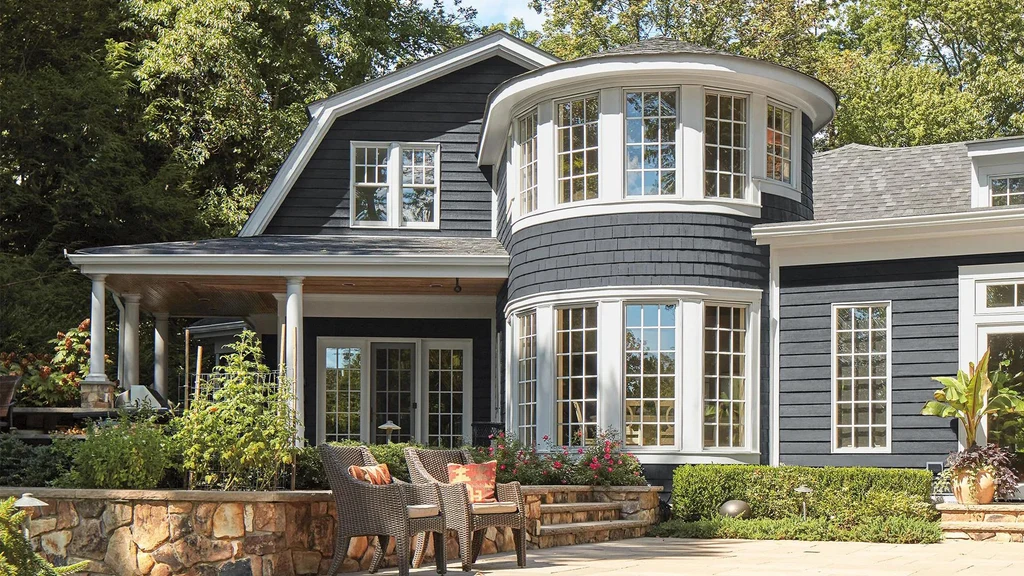
- Coverage
- 350–400 sq ft / gal
- Sheens
- Flat, low-lustre, satin, soft-gloss
- Dry / recoat
- Touch dry 1h · recoat 2h
- Full cure
- 30 days
- VOC
- <50 g/L
- Yellowing risk
- Very low
- Primer
- Self-priming on sound, scuff-sanded surfaces
- Price tier
- $$$$
- Color Lock chemistry holds saturated reds, deep blues, and dark charcoals where every other exterior in this round-up fades visibly by year four
- Two coats over scuff-sanded sound siding, full-stop — the hide is dense enough that even a deep-to-light color change reads done in two passes
- Lifetime limited warranty on color retention, mildew, and peeling — the strongest paperwork in the round-up next to Duration
- $95+ per gallon at BM stores with no Sherwin-style 30%-off windows; a 2,500 sq ft repaint runs $400 over Duration on paint alone
- Open time is tighter than Duration on a hot afternoon — lap-line discipline matters more on a 90°F south wall
- Mildew claim is paperwork-strong but Aura is not as moisture-aggressive as Duration; in zone 8–9 coastal humidity, Duration's MoistureGuard is the smarter call
2. Sherwin-Williams Duration Exterior
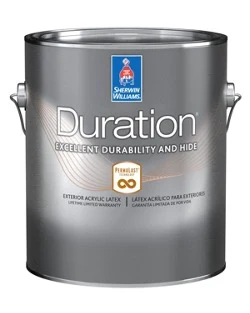
- Coverage
- 250–300 sq ft / gal
- Sheens
- Flat, satin, gloss
- Dry / recoat
- Touch dry 1h · recoat 4h
- Full cure
- 30 days
- VOC
- <50 g/L
- Yellowing risk
- Very low
- Primer
- Self-priming on sound, scuff-sanded surfaces; bare wood needs an exterior wood primer
- Price tier
- $$$
- PermaLast acrylic-copolymer film flexes through freeze-thaw cycles without lap-line cracking — the failure mode that ages exterior paint visibly before the color even fades
- Built-in mildewcide carries a published lifetime limited warranty on chalking, fading, and peeling — the kind of paperwork an insurance claim cares about
- Drops to $50–$60/gal effective on the SW 30–40% off windows that run several times a year; Aura's price never moves
- Headline color retention loses to Aura at the deep-saturation end by about a year — a deep blue or red on a south wall starts shifting at year four, not year five
- Heavier viscosity; on a brush-cut, the open time is shorter than Aura — keep a wet edge or the lap shows
- SW stores are the only practical channel; if you're not near one, the brand-direct buy isn't a same-day option
3. Sherwin-Williams Resilience Exterior

- Coverage
- 300–400 sq ft / gal
- Sheens
- Flat, satin, soft-gloss
- Dry / recoat
- Touch dry 1h · recoat 4h (or 2h rain-ready window)
- Full cure
- 30 days
- VOC
- <50 g/L
- Yellowing risk
- Low
- Primer
- Self-priming on sound surfaces
- Price tier
- $$
- MoistureGuard chemistry shrugs off a hard rain at the two-hour mark; on a 75°F afternoon we hit 90 minutes without lap streaks
- 10-year published mildew-and-fade warranty in writing — rare on the shelf at this price tier
- On sale at $45–$55/gal effective, which is where the math for a 2,500 sq ft repaint stops hurting
- Saturated reds and deep blues on a south-facing zone-9 wall shift visibly between year three and year four; Aura and Duration hold those colors one year longer
- Hide is a half-step behind Duration — a deep-to-light color change runs three coats, not two
- Gloss loss on the soft-gloss sheen reads earlier than Duration under raking afternoon sun
4. Benjamin Moore Regal Select Exterior
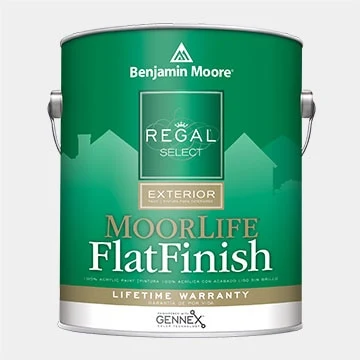
- Coverage
- 350–450 sq ft / gal
- Sheens
- Flat, low-lustre, soft-gloss, semi-gloss
- Dry / recoat
- Touch dry 1h · recoat 4h
- Full cure
- 30 days
- VOC
- <50 g/L
- Yellowing risk
- Very low
- Primer
- Bare wood needs an exterior alkyd primer; sound previously-painted surfaces, self-priming
- Price tier
- $$$
- Alkyd-acrylic hybrid flows from a sash brush nearly as cleanly as a true alkyd; trim, fascia, and shutters read crisp at one foot
- Soft-gloss sheen holds its sheen depth under raking sun better than any 100% acrylic in the round-up — the dead-shine you want on a south-facing front door
- Pro-spec painters reach for this on detail work where Aura's matte chemistry reads too soft for shutters and brackets
- Headline color retention on saturated tones falls a half-step behind Aura on a deep south wall — the trade-off for the alkyd flow
- Slower recoat window than Aura or Duration; plan trim as a two-day job, not a one-Saturday job
- No published year-number on the color-retention warranty — the spec sheet talks about it, the warranty card doesn't put a clock on it
5. Behr Marquee Exterior
- Coverage
- 250–400 sq ft / gal
- Sheens
- Flat, satin, semi-gloss
- Dry / recoat
- Touch dry 1h · recoat 4h
- Full cure
- 30 days
- VOC
- <50 g/L
- Yellowing risk
- Low
- Primer
- Self-priming on sound surfaces
- Price tier
- $$
- Genuine one-coat hide in Marquee's One-Coat color list — the only paint here where a deep-to-light change reads done in one pass on the right tint
- Lifetime limited warranty against fading, peeling, and cracking, including a separate color-retention promise on the One-Coat list — strongest paperwork in the round-up
- Stocked at every Home Depot at $55–$65/gal; no driving to a specialty store, no special-order wait
- Color retention on the deepest saturated reds and blues lags Aura and Duration by year three on harsh-sun south walls
- The one-coat claim only holds inside the One-Coat tinting list; off-list deep colors run two coats like everything else
- Soft film for the first 30–60 days; a wash-down or a leaning ladder leaves marks if you're back at the house too soon
Zinsser Cover Stain Oil-Based Primer
UV-resistant topcoats only earn out their color-hold paperwork over a sound primed substrate. Cover Stain bites into chalky old paint, weathered cedar, and pine knots where waterborne primers skate off, and it locks in tannin bleed that would otherwise ghost through a fresh Aura or Duration topcoat by year two. Use Cover Stain on bare or chalky south-facing siding; on a previously-painted sound surface, the self-priming claim on Aura, Duration, Resilience, and Marquee is real. For the full bare-wood prep call, see the [exterior wood paint round-up](/best/exterior-wood-paint/).
BUY ON AMAZON
Ask a Question