UltraWhite
SW 9500 · #F6F7F2 · LRV 94 — near-white with a hint of color, very light — near-white, broadens small spaces.
- 1Classic Gray74
- 2Alabaster82
- 3UltraWhite94
- 4White100
What Color Is UltraWhite, Really?
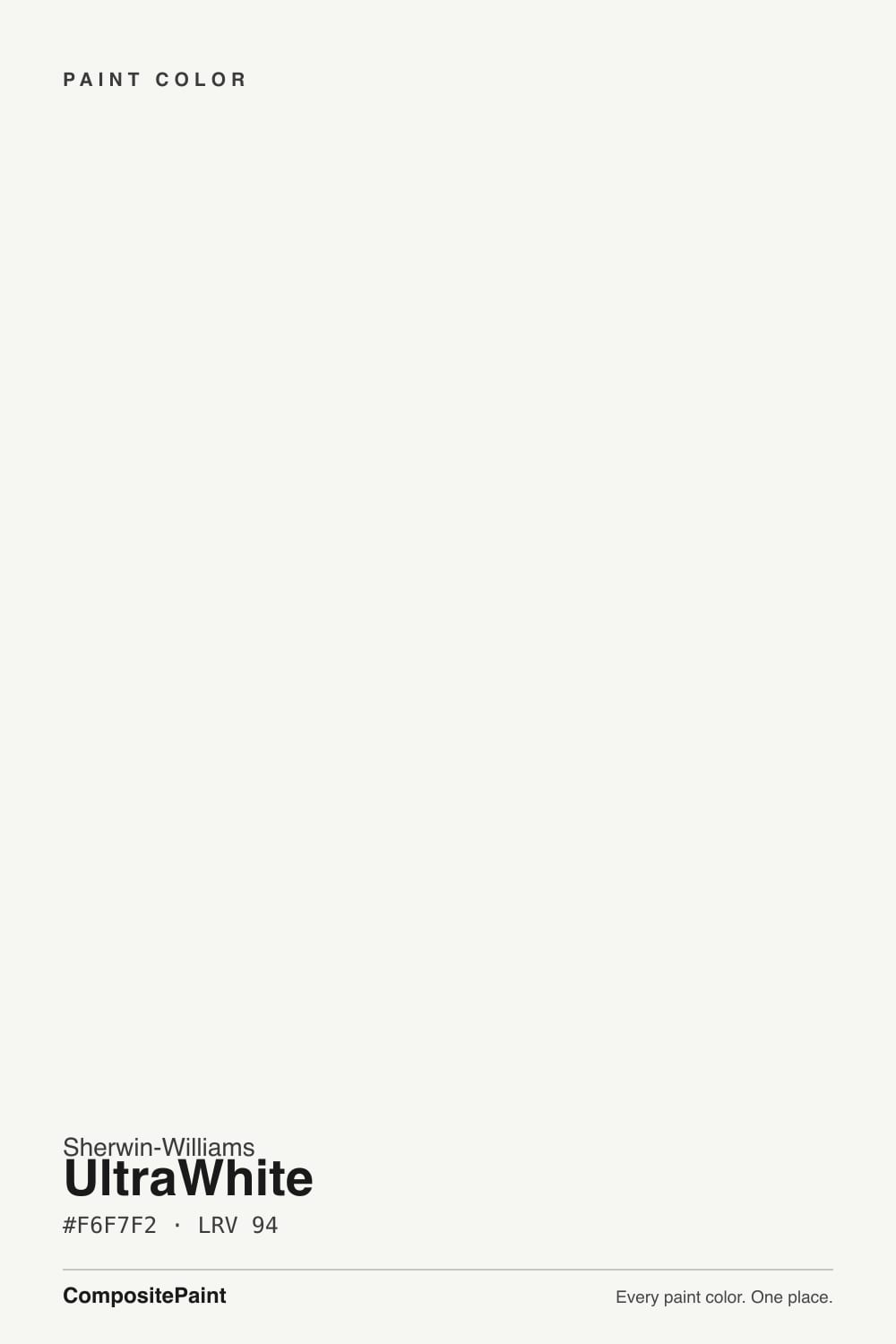
UltraWhite SW 9500 is a bright, near-neutral white. Its LRV of 94 places it at the very top of the range, so it reflects almost all the light that reaches it and reads unmistakably as white on any wall. The hex value #F6F7F2 shows the faintest lean: green sits a shade above red, and blue lowest, which gives a barely perceptible cool-green cast rather than a cream or a blue.
People choose it when they want white to be white. Most popular whites carry a visible undertone, warm or cool, that quietly tints the room. UltraWhite stays out of the way, which makes it useful on ceilings, on trim behind strong wall colors, and in rooms where artwork or cabinetry should carry the color instead.
The practical catch is the brightness itself. At LRV 94 it can glare in strong south light, and it shows every dent, seam, and patch in the drywall. It also looks cold next to warm whites and creams, so if the rest of the house leans creamy, this white will read as the odd one out.
There is very little undertone to talk about, which is the point of the color. At hex #F6F7F2 the green channel sits marginally above red and blue is the lowest, so the paint has a whisper of green-yellow in it rather than the pink, blue, or cream you find in most whites. At an LRV of 94 that trace is almost impossible to name on its own.
It shows up by comparison. Put UltraWhite next to a creamy white and it looks cool and clean. Put it next to a blue-based white and it looks slightly softer and warmer. Against warm oak or brass it reads crisp; against cool gray tile it can look almost identical to the tile grout.
If your existing trim, cabinets, or ceiling are already painted a warm white, sample UltraWhite directly beside them. At this lightness the mismatch is subtle on a chip and obvious on a wall.
Best Rooms and Uses for UltraWhite
Ceilings are the most reliable use. At LRV 94 it lifts the whole room and keeps a low ceiling from pressing down, and its lack of undertone means it will not fight whatever the walls are doing. It also works as a trim and door white behind strong colors, where the extra brightness makes the contrast read clean.
On walls it suits rooms that need light more than mood: hallways without windows, basements, laundry rooms, small bathrooms, and galleries or studios where the artwork or product should be the color in the room. Kitchens with dark islands take it well.
It is a good cabinet and millwork white for modern and minimal interiors. On exteriors it works as a bright trim color against dark siding. Its weakness is character: in a room that wants softness or age, UltraWhite can feel flat, and a warmer white will do more.
How Lighting Changes UltraWhite
An LRV of 94 means UltraWhite gives back nearly everything the room gives it, so it amplifies the light source rather than changing it. In north-facing rooms, where daylight is cool and blue-leaning, it can read slightly gray or steely, especially on a large flat wall. That is normal for any white this bright.
South and west light do the opposite. Strong sun makes it luminous and, in the middle of a summer afternoon, occasionally glaring on a wall that faces the window directly. East rooms look clean and bright in the morning and settle down later.
Bulbs are the easiest lever. Warm 2700K light gives UltraWhite a gentle cream tone at night and makes a room feel comfortable. Neutral 3500K keeps it looking true. Cool 4000K and above sharpen it toward a clinical, showroom white, which suits a laundry or a workshop more than a bedroom.
Most complaints about UltraWhite are a light mismatch. Upload a photo of your actual room and see it on your walls — then ask for the same wall in north light or evening lamps before you buy a single sample.
Need It From Another Brand?
Any paint counter can custom-tint Sherwin-Williams SW 9500 directly. If you would rather stay in one brand's own deck, these are the closest stock matches, measured as ΔE2000. Under 2 is a difference you will not see on the wall.
| Brand | Closest color | ΔE | LRV | |
|---|---|---|---|---|
| Behr | Snow FallW-F-600 · Behr | 0.5 | 93 | Color page → |
| Benjamin Moore | Chantilly Lace2121-70 · Benjamin Moore | 0.5 | 91 | Color page → |
| Valspar | New ReamV148 · Valspar | 0.5 | 91.6 | Color page → |
| PPG / Glidden | Delicate WhitePPG1001-1 · PPG / Glidden | 1.3 | 88 | Color page → |
| Glidden | Delicate WhitePPG1001-1 · Glidden | 1.1 | 88 | Color page → |
| Dutch Boy | Super White001W · Dutch Boy | 0.0 | 92 | Color page → |
Similar Sherwin-Williams Colors
The nearest shades to UltraWhite within Sherwin-Williams's own range, ranked by perceptual color distance — useful when you want the same look a touch lighter, darker, or warmer.
WCAG 2.1: AA is 4.5 : 1 for normal text, 3 : 1 for large text, AAA is 7 : 1.
UltraWhite vs Similar Colors
High Reflective White SW 7757 at LRV 93 and hex #F7F7F1 is the nearest match in the line. The two are essentially interchangeable on a wall, with UltraWhite reflecting one point more. White Snow SW 9541 at LRV 90 and hex #F5F4EE is a small step down in brightness with slightly more warmth.
The warm alternatives separate clearly. Cheviot SW 9503 at LRV 89 and hex #F6F2E8 and Frost Bite SW 9505 at LRV 88 both read cream beside UltraWhite. Snowbelt SW 9623 at LRV 87 and hex #EEF1EC goes the other way, cooler and slightly green.
Across brands, Dutch Boy Super White 001W shares the exact hex #F6F7F2. Behr Snow Fall W-F-600 at LRV 93, Valspar New Ream V148 at LRV 91.6, Benjamin Moore Chantilly Lace 2121-70 at LRV 91, and Farrow and Ball All White No. 2005 at LRV 92 are all effectively the same white. Glidden Delicate White PPG1001-1 at LRV 88 is visually identical in normal room light.
Colors That Go With UltraWhite
Because it has almost no undertone, UltraWhite pairs with nearly anything, and its best use is making other colors look deliberate. Needlepoint Navy SW 32 at LRV 13 and Succulent SW 9650 at LRV 14 both gain definition next to it, whether on an island, a door, or an accent wall. Illusive Green SW 9164 at LRV 29 gives a mid-tone step between the two extremes.
For softer schemes, Hinting Blue SW 6519 at LRV 68 keeps the room light while adding a cool wash of color that UltraWhite frames cleanly.
If you want walls and trim to stay in the white family with a little separation, Cheviot SW 9503 at LRV 89 and White Flour SW 7102 at LRV 87 are warmer whites that read cream beside it. Snowbelt SW 9623 at LRV 87 is the cooler option. Wood tones, black hardware, and chrome all sit comfortably against it.
Coordinated palette
Generated by hue-rotating #F6F7F2 in HSL space. Pair UltraWhite with one accent and one neutral — the swatches below are starting points, not final picks.
UltraWhite FAQ
Is UltraWhite warm or cool?
It is close to neutral with a very slight cool-green trace. At hex #F6F7F2 the green channel sits just above red and blue is the lowest, which keeps it from reading as either a cream or a blue-white. Next to a creamy white it will look cool, and next to a blue-based white it will look a touch softer.
What LRV is UltraWhite?
UltraWhite has an LRV of 94, which sits at the very top of the light reflectance scale. It reflects nearly all the light in a room, making it one of the brightest whites available. That reflectance is exactly why it works so well on ceilings and in rooms that get little daylight.
How is UltraWhite different from High Reflective White?
High Reflective White SW 7757 sits at LRV 93 and hex #F7F7F1 against UltraWhite's LRV 94 and #F6F7F2. That is a one-point difference in reflectance and a nearly identical hex, so on a wall the two are effectively the same. Pick whichever your painter can source; the choice will not change how the room looks.
Does UltraWhite work on ceilings and trim?
Yes, those are its strongest uses. At LRV 94 it lifts a ceiling and keeps a low room from feeling closed in, and its lack of undertone means it never tints the wall color below. On trim and doors behind a saturated wall color it gives clean, well-defined edges.
Will UltraWhite look too stark in a dark room?
It can. Very bright whites need light to look good, and in a cool north-facing room UltraWhite's LRV of 94 can read slightly gray or clinical on a large wall. Warm 2700K bulbs soften it noticeably at night. If the room needs comfort rather than brightness, a warmer white such as Cheviot SW 9503 at LRV 89 is the safer choice.
Is UltraWhite the same as Chantilly Lace?
They are extremely close. Benjamin Moore Chantilly Lace 2121-70 sits at LRV 91 and hex #F4F6F1 against UltraWhite's LRV 94 and #F6F7F2, which makes them visually identical in normal room light. UltraWhite is fractionally brighter, but you would need them side by side on the same wall to notice.
Have you painted with UltraWhite?
Rate it — one tap helps the next reader decide.
Ask a Question