Marshmallow
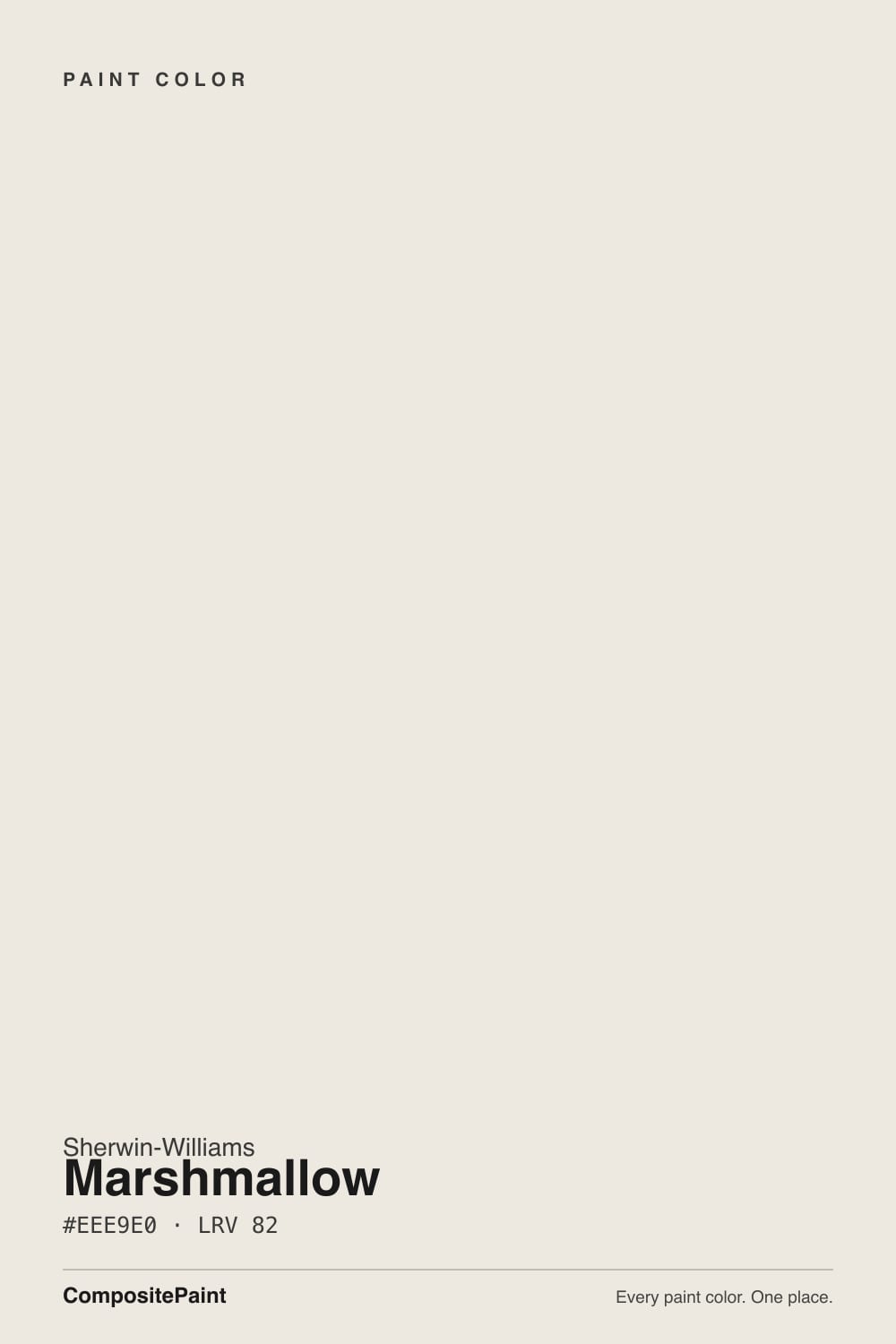
SW 7001 · #EEE9E0 · LRV 82 — warm red-orange tone, very light — near-white, broadens small spaces.
- 1First Star69
- 2Classic Gray74
- 3Marshmallow82
- 4Chantilly Lace91
- 5Ultra Pure White97
What Color Is Marshmallow, Really?
Marshmallow (SW 7001) is a soft warm white, hex value #EEE9E0 with an LRV of 82. That places it near the top of the light scale, so it reflects a great deal of light and reads bright on a wall. The hue sits at 39 degrees, which is the warm cream and tan range, and there is enough of it in the mix to keep the color from ever looking blue or clinical. At this lightness, though, most people in most rooms will just call it white.
It gets chosen for the same reason most soft whites do: it is warm without being yellow. Compared with a creamier white it stays closer to neutral, and compared with a bright white it never goes cold. That makes it easy to use everywhere at once, on walls, trim, and cabinets in the same house, which is how it is most often specified.
The practical catch is that it is one of a crowded field. Several Sherwin-Williams whites and a long list of colors from other brands land within a hair of it, so if you are matching existing paint you should compare chips rather than assume. The other thing to watch is contrast: put Marshmallow next to a brighter, cleaner white in the same sightline and it will look slightly dingy by comparison, even though on its own it reads perfectly clean.
Marshmallow is warm. Its hue sits at 39 degrees, in the cream and soft tan range, and in the hex #EEE9E0 the red channel runs highest with blue lowest. The gap is small, which is exactly why it works: the warmth is enough to soften the white, not enough to make it look yellow.
Where the undertone appears depends on what sits beside it. Against a bright, blue-based white it looks clearly creamy. Against a beige or tan wall it flips and reads as a clean white. Against Snowbound (SW 7004), hex #EDEAE5 at LRV 83, which carries much less warmth, Marshmallow is obviously the warmer of the two. Against Creamy (SW 7012), hex #EFE8DB at LRV 81, the comparison reverses and Marshmallow looks restrained and almost neutral.
The useful test is to sample it with one cooler white and one creamier white at the same time. Seeing it in the middle tells you quickly which side of white you actually want.
Best Rooms and Uses for Marshmallow
An LRV of 82 makes Marshmallow a whole-home white. It works on walls in any room, brightening small or dim spaces without the glare that a near-100 white can throw, and it is particularly useful in north-facing rooms where a cooler white would feel harsh.
Trim and millwork are the other main use. Because the warmth is mild, it reads as clean trim against most wall colors, including warm neutrals and muted greens where a stark white would look jarring. Baseboards, casings, crown molding, and interior doors all take it, and painting walls and trim both in Marshmallow gives a soft monochrome finish in millwork-heavy rooms.
On cabinets it gives a settled, custom look rather than a builder-grade one, and its slight warmth hides small imperfections better than a bright white. Outdoors it works as a warm body or trim color with wood, stone, and darker doors and shutters. It is a backdrop color, not a statement one.
How Lighting Changes Marshmallow
At LRV 82 Marshmallow reflects most of the light in the room, so it never looks dim. What changes is how warm it appears. North-facing rooms get cool, indirect daylight, which cancels out much of the 39-degree hue and leaves the color reading as a clean, soft white. That is one of its best uses, since it keeps cold rooms from feeling colder.
South and west light do the opposite. In strong afternoon sun the cream side comes forward and the walls take on a gentle warmth, which some people love and others find too soft. East rooms are warm in the morning and settle back by afternoon.
Bulbs push it further than windows do. Warm 2700K lamps bring out the cream clearly, especially at night on a large wall. Neutral 3500K to 4000K light keeps it crisp and closer to a plain white. Check a sample under your own fixtures after dark, not just in daylight.
Most complaints about Marshmallow are a light mismatch. Upload a photo of your actual room and see it on your walls — then ask for the same wall in north light or evening lamps before you buy a single sample.
Need It From Another Brand?
Any paint counter can custom-tint Sherwin-Williams SW 7001 directly. If you would rather stay in one brand's own deck, these are the closest stock matches, measured as ΔE2000. Under 2 is a difference you will not see on the wall.
| Brand | Closest color | ΔE | LRV | |
|---|---|---|---|---|
| Behr | Pillar WhiteUL150-9 · Behr | 0.6 | 82 | Color page → |
| Benjamin Moore | Dune White968 · Benjamin Moore | 1.7 | 80 | Color page → |
| Valspar | Shell White7007-12 · Valspar | 0.9 | 82 | Color page → |
| PPG / Glidden | Linen RufflePPG1075-1 · PPG / Glidden | 0.6 | 83 | Color page → |
| Glidden | Almond RocaPPG1072-1 · Glidden | 1.7 | 82 | Color page → |
| Dutch Boy | Swan White024W · Dutch Boy | 1.2 | 82 | Color page → |
Similar Sherwin-Williams Colors
The nearest shades to Marshmallow within Sherwin-Williams's own range, ranked by perceptual color distance — useful when you want the same look a touch lighter, darker, or warmer.
WCAG 2.1: AA is 4.5 : 1 for normal text, 3 : 1 for large text, AAA is 7 : 1.
Marshmallow vs Similar Colors
Alabaster (SW 7008), hex #EDEAE0 at LRV 82, is the comparison everyone asks about, and the honest answer is that they are nearly the same color. Identical LRV, and the hex values differ by a single step. On a wall you will not reliably tell them apart, so choose whichever your store or contractor already has.
Snowbound (SW 7004), hex #EDEAE5 at LRV 83, is the real alternative. It is a point lighter and carries noticeably less warmth, so it reads cooler and slightly grayer, which can feel sterile in a north room where Marshmallow stays inviting. Creamy (SW 7012), hex #EFE8DB at LRV 81, is the warmer end of the group and reads clearly yellow next to Marshmallow.
Across brands, Behr's Pillar White (UL150-9), C2's Scroll (C2-980), and Rodda's Sugar (CA021), all at LRV 82, sit within 0.6 of Marshmallow and are effectively the same color. Benjamin Moore's Dune White (968) at LRV 80 is 1.70 away, visually identical in normal room light. Clare's Classic (PNT100-LT-12) at LRV 82 is 3.61 away, close but visibly different side by side and distinctly cooler.
Colors That Go With Marshmallow
If you want trim to read crisper than the walls, step to a brighter, cleaner white and keep the gap small so the two do not clash. If you want a seamless look instead, use Marshmallow on both walls and trim, which is a common approach in rooms with a lot of millwork.
Within the Sherwin-Williams line, its immediate neighbors are useful as ceiling or adjacent-room whites. Cotton (SW 9581), hex #EEEBE1 at LRV 83, is a touch lighter and slightly less warm, and Snowbound (SW 7004), hex #EDEAE5 at LRV 83, is the cooler option if you want the ceiling to recede. Creamy (SW 7012), hex #EFE8DB at LRV 81, goes the other way for a warmer, more traditional pairing.
Beyond paint, Marshmallow sits comfortably with warm oak and walnut, rattan, brass, black metal, and brushed nickel. It also gives muted mid-tone colors, greens and blues especially, a soft backdrop that does not compete with them.
Coordinated palette
Generated by hue-rotating #EEE9E0 in HSL space. Pair Marshmallow with one accent and one neutral — the swatches below are starting points, not final picks.
Marshmallow FAQ
Is Marshmallow warm or cool?
Marshmallow is a warm white. Its hue sits at 39 degrees in the cream range, and in the hex #EEE9E0 red is the strongest channel and blue the weakest. The warmth is mild rather than obvious, so at LRV 82 it usually reads simply as a soft white, warming up under afternoon sun and warm bulbs.
What LRV is Marshmallow?
Marshmallow has an LRV of 82, on a scale where 0 is black and 100 is pure white. That is high enough to reflect most of the light in a room, so it brightens small or dark spaces and makes them feel more open. It stops short of the glare you can get from a near-100 bright white.
How is Marshmallow different from Alabaster?
Barely at all. Alabaster (SW 7008) has the same LRV of 82, and its hex #EDEAE0 differs from Marshmallow's #EEE9E0 by a single step. Painted on a wall, most people cannot tell them apart. If you are deciding between the two, pick on availability rather than expecting a visible difference, and compare against a cooler white like Snowbound (SW 7004) at LRV 83 if you want a real choice.
Does Marshmallow work in a dark room?
Yes, it is one of the better options for one. At LRV 82 it returns most of the light it receives, so it lifts a dim room rather than weighing it down. Its mild warmth also keeps north-facing spaces from feeling cold, which is the usual failure of a cleaner, blue-based white in low light.
Is Marshmallow good for trim and cabinets?
Yes to both. Its warmth is mild enough that it reads as clean trim against warm neutrals, greens, and blues where a stark white would look harsh. On cabinets it gives a soft, settled finish and hides minor surface flaws better than a bright white. Many people run it on walls, trim, and cabinets together for a quiet monochrome look.
What is the closest match to Marshmallow in other brands?
Behr's Pillar White (UL150-9) at LRV 82 is 0.55 away, C2's Scroll (C2-980) at LRV 82 is 0.56 away, and Rodda's Sugar (CA021) at LRV 82 is 0.50 away, so all three are effectively the same color. Benjamin Moore's Dune White (968) at LRV 80 is 1.70 away, which is visually identical in normal room light.
Have you painted with Marshmallow?
Rate it — one tap helps the next reader decide.
Ask a Question