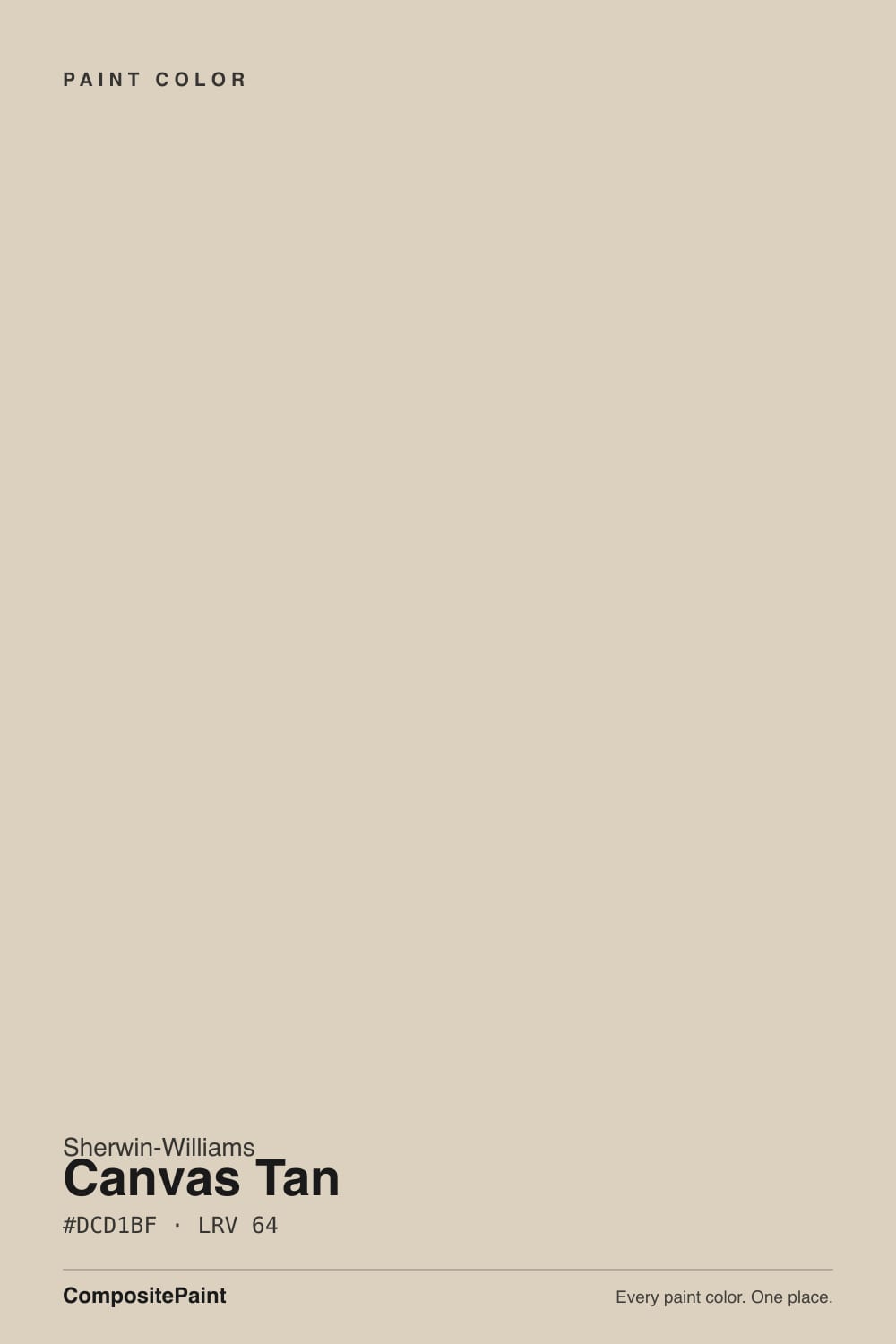
Canvas Tan
SW 7531 · #DCD1BF · LRV 64 — warm red-orange tone, light — bounces daylight without going clinical.
- 1Light French Gray53
- 2Accessible Beige58
- 3Canvas Tan64
- 4Pale Oak69
- 5Shoji White74
What Color Is Canvas Tan, Really?
Canvas Tan SW 7531 is a light warm neutral. Its hex value #DCD1BF sits at hue 37, in the red-orange to yellow range, with around 29 percent saturation, so the warmth is real and visible rather than a faint tint. An LRV of 64 makes it a light color that bounces daylight around a room without going white, and it holds enough color to keep large walls from looking blank.
People pick it when a greige feels too cool and a full beige feels too heavy. It behaves like a soft tan that still functions as a neutral, so it works as a whole-house body color and sits comfortably with wood, stone, and cream trim. Rooms painted in it read calm and slightly sunlit rather than crisp or modern.
The catch is the warmth itself. At 29 percent saturation this color leans clearly warm, and in strong afternoon sun it can push toward peach or yellow on the brightest wall. Beside a cool gray floor or a blue-white trim it can also look muddier than expected. Sample it on the sunniest and the dimmest wall in the same room, then look again at night under your own bulbs.
Canvas Tan has a warm red-orange undertone. Hue 37 sits between orange and yellow, and at roughly 29 percent saturation that warmth is not hidden. It is not a greige and it has no gray-blue in it, so it will never read cool.
Where the warmth shows depends on the neighbors. Against a bright, clean white it looks clearly tan and slightly golden. Against a deeper beige it can look almost like an off-white. Against a cool gray tile or a blue-based trim the contrast makes it look yellower and heavier than it is on the chip.
Because the undertone leans a little red, it flatters warm wood and terracotta and can clash with pink-toned stone, where the two warms compete. Hold the sample directly against your floors, counters, and existing trim, since fixed finishes decide whether the warmth reads golden or muddy.
Best Rooms and Uses for Canvas Tan
This is a whole-house neutral. At LRV 64 it lights up hallways, stairwells, and open living areas while keeping enough color to look intentional. It suits bedrooms, dining rooms, and living rooms, and it is a common choice for a body color that runs through several connected spaces.
It is especially useful in north-facing rooms and basements, where the warmth counteracts cool, flat light that makes gray-based neutrals look dreary.
On trim it is usually too warm and too dark, so keep trim in a separate white. On cabinets it works for a soft, traditional kitchen, though the warmth reads more country than contemporary.
Outside it is a strong exterior body color. A light warm tan pairs naturally with stone, brick, and wood, and it takes a darker shutter or front door well. Because it sits at LRV 64 it also hides dust and pollen better than a white body would.
How Lighting Changes Canvas Tan
At LRV 64 Canvas Tan reflects a good amount of light, so it keeps rooms feeling open, but the warm undertone means the light source changes its character noticeably. North-facing rooms get cool, flat daylight, which tames the warmth and lets Canvas Tan read as a soft, balanced neutral. That makes it a reliable choice for rooms that usually feel cold.
South and west rooms do the opposite. Strong warm light exaggerates the red-orange, and in late afternoon the sunlit wall can look distinctly golden or slightly peach. East rooms warm up in the morning and settle back by afternoon.
Bulbs push it the same way. Warm 2700K lamps deepen the golden side, which feels cozy at night but can look yellow if the room is already warm. Cooler 3500K to 4000K bulbs pull it back toward neutral tan. Check a sample at midday and again after dark.
Most complaints about Canvas Tan are a light mismatch. Upload a photo of your actual room and see it on your walls — then ask for the same wall in north light or evening lamps before you buy a single sample.
Need It From Another Brand?
Any paint counter can custom-tint Sherwin-Williams SW 7531 directly. If you would rather stay in one brand's own deck, these are the closest stock matches, measured as ΔE2000. Under 2 is a difference you will not see on the wall.
| Brand | Closest color | ΔE | LRV | |
|---|---|---|---|---|
| Behr | Roman PlasterPPU7-10 · Behr | 0.8 | 65 | Color page → |
| Benjamin Moore | Dusty Road1017 · Benjamin Moore | 2.0 | 64 | Color page → |
| Valspar | Vanderbilt BeachV134-1 · Valspar | 0.8 | 64.9 | Color page → |
| PPG / Glidden | SourdoughPPG1084-3 · PPG / Glidden | 2.0 | 63 | Color page → |
| Glidden | SourdoughPPG1084-3 · Glidden | 1.4 | 64 | Color page → |
| Dutch Boy | Elemental White421-1DB · Dutch Boy | 2.0 | 63 | Color page → |
Similar Sherwin-Williams Colors
The nearest shades to Canvas Tan within Sherwin-Williams's own range, ranked by perceptual color distance — useful when you want the same look a touch lighter, darker, or warmer.
WCAG 2.1: AA is 4.5 : 1 for normal text, 3 : 1 for large text, AAA is 7 : 1.
Canvas Tan vs Similar Colors
Accessible Beige SW 7036 at LRV 58 is the comparison people make most often. It is six points darker at hex #D1C7B4 and carries more gray, so it reads as a greige that grounds a room. Canvas Tan at LRV 64 is lighter and cleaner in its warmth, closer to a true tan. Choose Accessible Beige when you want a neutral that anchors, and Canvas Tan when you want a warm neutral that lifts.
Within the line, Oyster Bar SW 7565 at LRV 64 matches the value almost exactly, while Stucco SW 7569 at LRV 63 leans a shade deeper.
Across brands, HGTV Home by Sherwin-Williams Canvas Tan HGSW 4018 shares the same hex at a deltaE of 0. Clare Turbinado at 0.47, Behr Roman Plaster PPU7-10 at 0.77, and Farrow and Ball Joa's White No. 226 at 0.89 are direct matches. Benjamin Moore Dusty Road 1017 at 1.98 is visually identical in normal room light, and Portola Paints Figueroa at 3.15 is very close but worth sampling first.
Colors That Go With Canvas Tan
A white trim is the first decision. A warmer, softer white keeps the wall looking intentional and mellow, while a clean bright white gives crisper contrast but can make the tan look yellower by comparison. Avoid a blue-based white, which fights the red-orange undertone.
For a second wall color, the near neighbors in the line make easy transitions. Natural Tan SW 7567 at LRV 65 is nearly the same value with a slightly softer edge, Maison Blanche SW 7526 at LRV 66 is a touch lighter and creamier, and Rivers Edge SW 7517 at LRV 63 and Stucco SW 7569 at LRV 63 both step down a fraction for a connected room or a ceiling break.
For grounding, choose real depth rather than another light neutral: a dark wood floor, a black or bronze fixture, or a deep accent on a door. Brass, aged bronze, oak, walnut, rattan, and terracotta all sit naturally with it, while chrome and cool gray stone can look disconnected.
Coordinated palette
Generated by hue-rotating #DCD1BF in HSL space. Pair Canvas Tan with one accent and one neutral — the swatches below are starting points, not final picks.
Canvas Tan FAQ
Is Canvas Tan warm or cool?
It is clearly warm. The undertone is red-orange at hue 37 with about 29 percent saturation, so this is a true warm tan rather than a greige. It has no gray-blue in it, which is why it works well in north-facing rooms that need warming up.
What LRV is Canvas Tan?
Canvas Tan has an LRV of 64. On a scale of 0 for black to 100 for pure white, that makes it a light color. It reflects enough daylight to keep rooms open and airy while still holding visible color, so walls do not read as an off-white.
Does Canvas Tan look yellow or orange on the wall?
It can in strong light. The red-orange undertone at 29 percent saturation shows most in south and west rooms during the afternoon, where the sunlit wall can look golden or slightly peach. In north light the same color settles into a balanced, soft tan.
What white trim goes with Canvas Tan?
A warmer, softer white keeps the wall looking mellow and intentional. A clean bright white gives crisper contrast but makes the tan look yellower by comparison. Steer clear of blue-based whites, since the cool cast fights the red-orange undertone and can leave the wall looking muddy.
Is Canvas Tan good for exteriors?
Yes. At LRV 64 it is a light warm body color that pairs naturally with brick, stone, and wood, and it takes a dark shutter or front door well. It also hides dust and pollen better than a white body, which matters on a large elevation.
How is Canvas Tan different from Accessible Beige?
Accessible Beige SW 7036 sits at LRV 58 with hex #D1C7B4, so it is darker and carries more gray, which makes it read as a greige. Canvas Tan at LRV 64 is lighter and warmer with a cleaner tan character. Pick Accessible Beige to ground a room and Canvas Tan to lift it.
Have you painted with Canvas Tan?
Rate it — one tap helps the next reader decide.
Ask a Question