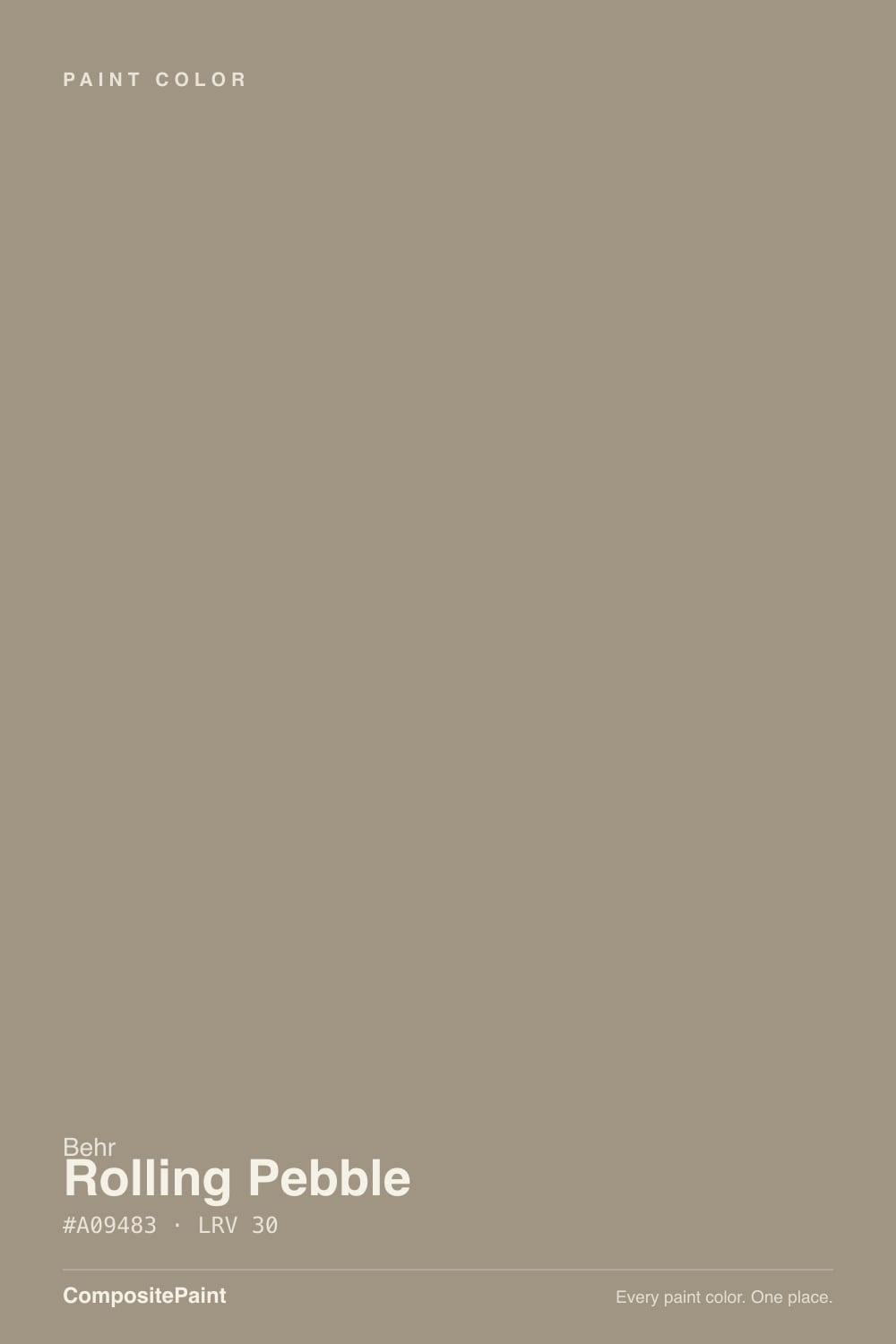
Rolling Pebble
PPU7-23 · #A09483 · LRV 30 — warm red-orange tone, mid-tone — versatile but shifts visibly with light.
- 1Anonymous20
- 2Renwick Olive25
- 3Rolling Pebble30
- 4Revere Pewter55
- 5Agreeable Gray60
What Color Is Rolling Pebble, Really?
Rolling Pebble PPU7-23 is a warm mid-tone greige. Its hex is #A09483 and its LRV is 30, which puts it squarely in the middle of the range, dark enough to have real presence on a wall but far from a deep or dramatic color. The hue is 35 degrees with only 13 percent saturation, so the warm red-orange lean is there but heavily muted, the way a river stone is brown without ever looking brown.
People pick it when they want a neutral with weight. A pale beige can vanish; at LRV 30 Rolling Pebble reads as a color, and the low saturation keeps it from becoming a statement. It is a common choice for accent walls, exteriors, and cabinetry, and for anyone who wants a taupe that does not tip pink.
The catch is the mid-tone itself. At LRV 30 the color swings noticeably with light, looking soft and sandy in sun and considerably darker and grayer in the evening. It also drops a lot of light out of a small room. Sample a large patch and check it after dark before you buy.
The undertone is warm red-orange at hue 35, but the saturation is only 13 percent, so what you actually see is a grayed taupe with warmth underneath. It is not a pink beige and not a green greige. On a chip it can look plain gray; across a full wall the warm side becomes clear.
What surrounds it decides how much of that warmth surfaces. Against a cool gray, Rolling Pebble looks distinctly brown and warm. Against a true brown or a warm oak floor it looks grayer and cooler by comparison. Against a bright white trim it reads as a clean mid taupe with the warmth visible but restrained.
Hold your sample next to your flooring and any stone or tile. Because the color is so lightly saturated, nearby finishes have an outsized say in which direction it appears to lean, more so than with a fully saturated color.
Best Rooms and Uses for Rolling Pebble
At LRV 30 this is a mid-tone that carries a full room without turning it dark, as long as the room has decent light. It suits living rooms, dining rooms, bedrooms, and home offices, and it makes a good accent wall in a space that is otherwise light. In a small windowless room it will feel closed in.
Cabinets and built-ins are a strong use. A muted warm taupe reads custom on an island or a lower run, pairs naturally with wood counters, and hides wear better than a light color does.
Outdoors it works well as a body color. Its warm stone character sits comfortably with brick, natural stone, and cedar, and it takes white or cream trim without conflict. On a front door it is too quiet to make a statement; use a darker color there. Behr paint is sold at The Home Depot, so a large exterior sample is easy to pick up first.
How Lighting Changes Rolling Pebble
At LRV 30 Rolling Pebble reflects less than a third of the light in a room, so the amount of light you have matters. This is the band where a color can look completely different at nine in the morning and at nine at night.
North-facing rooms get cool indirect daylight, which mutes the warm red-orange lean and makes the color read grayer, deeper, and more stone-like. South and west rooms bring warm sun that lifts the hue 35 warmth forward, and Rolling Pebble looks sandier and softer, especially in late-afternoon light. East rooms are warm early and settle gray by afternoon.
Bulbs move it just as far. Warm 2700K lamps bring out the taupe warmth and can make it feel cozy or muddy depending on the room. Cooler 3500K to 4000K bulbs flatten the warmth and push it toward gray. Because a 30 LRV goes dim quickly, look at the sample under your own fixtures at night.
Most complaints about Rolling Pebble are a light mismatch. Upload a photo of your actual room and see it on your walls — then ask for the same wall in north light or evening lamps before you buy a single sample.
Need It From Another Brand?
Any paint counter can custom-tint Behr PPU7-23 directly. If you would rather stay in one brand's own deck, these are the closest stock matches, measured as ΔE2000. Under 2 is a difference you will not see on the wall.
| Brand | Closest color | ΔE | LRV | |
|---|---|---|---|---|
| Sherwin-Williams | Keystone GraySW 7504 · Sherwin-Williams | 1.5 | 29 | Color page → |
| Benjamin Moore | WeimaranerAF-155 · Benjamin Moore | 1.0 | 31 | Color page → |
| Valspar | Coastal Villa6005-2A · Valspar | 1.7 | 29.9 | Color page → |
| PPG / Glidden | Stone GrayPPG1023-5 · PPG / Glidden | 0.5 | 30 | Color page → |
| Glidden | Stone GrayPPG1023-5 · Glidden | 0.5 | 30 | Color page → |
| Dutch Boy | Clifton Point420-4DB · Dutch Boy | 1.2 | 30 | Color page → |
Similar Behr Colors
The nearest shades to Rolling Pebble within Behr's own range, ranked by perceptual color distance — useful when you want the same look a touch lighter, darker, or warmer.
WCAG 2.1: AA is 4.5 : 1 for normal text, 3 : 1 for large text, AAA is 7 : 1.
Rolling Pebble vs Similar Colors
Greywood HDC-CT-20 at LRV 31 and hex #9E9588 has a touch more green, so beside Rolling Pebble it reads slightly cooler. Bridle Path ECC-43-2 at LRV 31 is nearly the same hex and would not read as a different color on a wall. Pure Earth PPU7-05 at LRV 31 with hex #A79481 is the warmest of the group and the one to choose if you want more sand and less stone. Dusty Olive PPU8-20 at LRV 31 leans green enough to notice next to white trim.
Cross-brand, PPG and Glidden Stone Gray PPG1023-5 at deltaE 0.53 and Dunn-Edwards Early American Classic DESS43 at deltaE 0.87 are matches for practical purposes. Benjamin Moore Weimaraner AF-155 at deltaE 0.99, C2 Paint Riff C2-811 at 1.08, and Sherwin-Williams Keystone Gray SW 7504 at 1.49 are visually identical in normal room light. Farrow and Ball Charleston Gray No. 243 at deltaE 3.76 and Rust-Oleum Oat Latte 391446 at 4.57 are close but visibly different side by side.
Colors That Go With Rolling Pebble
The Behr neighbors are close enough to be alternates rather than partners. Greywood HDC-CT-20 at LRV 31 and Bridle Path ECC-43-2 at LRV 31 are the same wall in most rooms. Dusty Olive PPU8-20 at LRV 31 leans slightly green, Pure Earth PPU7-05 at LRV 31 leans a little warmer, and Clay HDC-NT-04A at LRV 31 sits between them. Any of these can serve an adjacent room if you want continuity rather than contrast.
For trim, a clean white gives the mid-tone a crisp edge, and a soft warm white keeps the whole scheme quieter. Either works; a cream will emphasize the warmth.
Cross-brand, Benjamin Moore Weimaraner AF-155 at LRV 31 and Sherwin-Williams Keystone Gray SW 7504 at LRV 29 are in the same territory if you are matching across products. Oak, walnut, and cedar all sit well with it. Aged bronze and black hardware read cleaner against it than bright chrome.
Coordinated palette
Generated by hue-rotating #A09483 in HSL space. Pair Rolling Pebble with one accent and one neutral — the swatches below are starting points, not final picks.
Rolling Pebble FAQ
Is Rolling Pebble warm or cool?
Rolling Pebble is warm, but quietly so. Its undertone is warm red-orange at hue 35 with only 13 percent saturation, so the warmth is muted into a taupe rather than an obvious brown. In cool north light it can read close to gray, while warm light brings the sandy side forward.
What LRV is Rolling Pebble?
Rolling Pebble PPU7-23 has an LRV of 30. On a scale from 0 for black to 100 for pure white, that makes it a true mid-tone, reflecting under a third of the light that reaches it. It has enough depth to read as a color on a full wall without going dark.
Is Rolling Pebble a gray or a beige?
It is a greige, which means both. The hue sits at 35 degrees, firmly in the warm range, but at 13 percent saturation there is enough gray in it to read as neutral. Next to a cool gray it looks brown; next to a warm brown it looks gray.
Does Rolling Pebble work in a dark room?
It is a risk. At LRV 30 the color reflects less than a third of the light it receives, so in a room with little daylight it will look considerably deeper and grayer than the chip. If the room is dim and small, expect it to feel closed in rather than cozy.
What white trim goes with Rolling Pebble?
A clean white gives the best contrast against an LRV 30 wall and makes the trim read crisp. A soft warm white also works and keeps the whole scheme calmer. Avoid a strong cream, which will pull the warm red-orange undertone forward and can make the wall look muddier than intended.
Is Rolling Pebble good for exteriors or cabinets?
Yes to both. As an exterior body color its muted warm stone character sits well with brick, natural stone, and cedar, and holds up under strong outdoor light. On cabinets and islands the LRV 30 depth reads custom and hides wear better than a light color, though the room needs enough light to keep it from going heavy.
Have you painted with Rolling Pebble?
Rate it — one tap helps the next reader decide.
Ask a Question