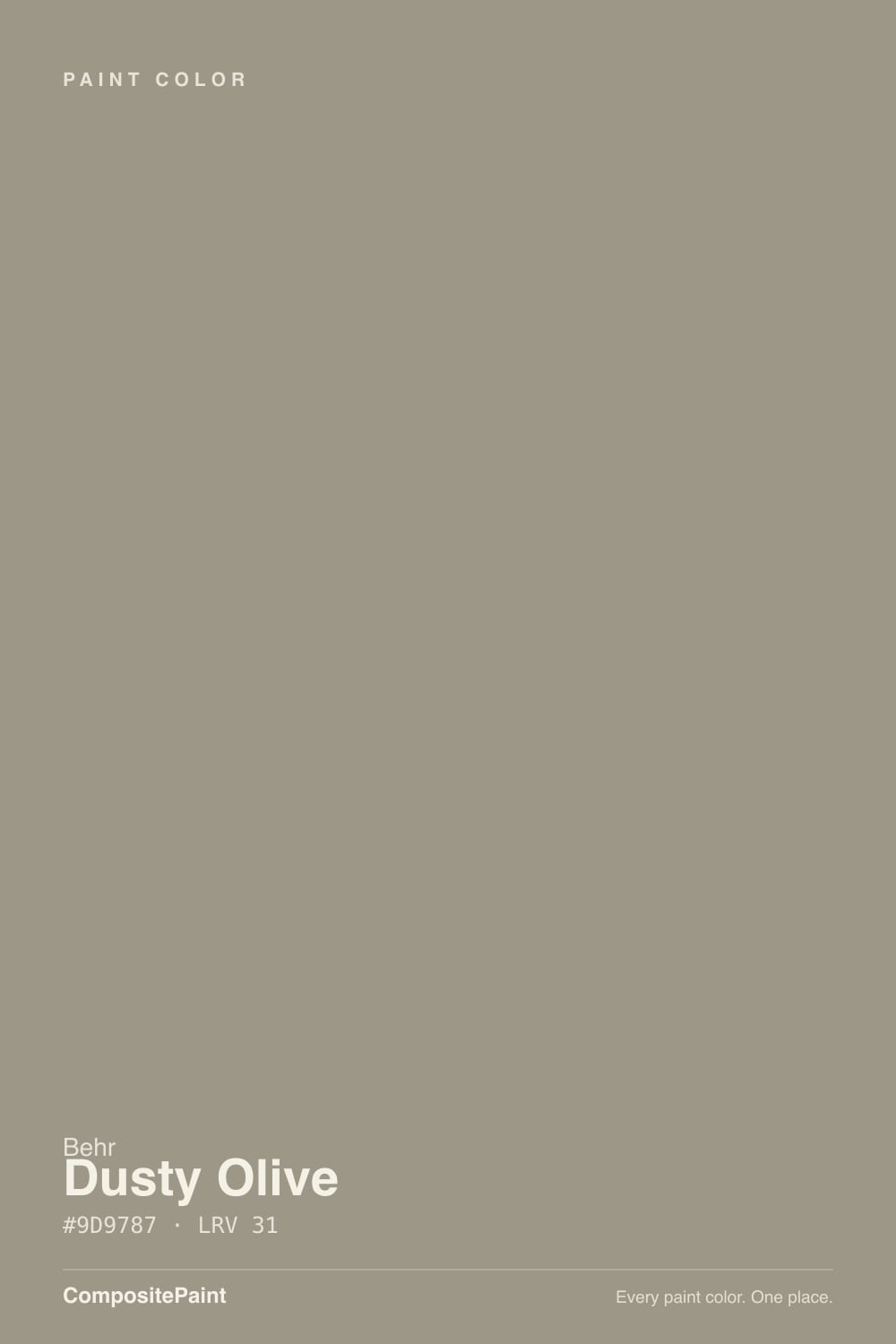
Dusty Olive
PPU8-20 · #9D9787 · LRV 31 — warm red-orange tone, mid-tone — versatile but shifts visibly with light.
- 1Anonymous20
- 2Curio Gray26
- 3Dusty Olive31
- 4Revere Pewter55
- 5Agreeable Gray60
What Color Is Dusty Olive, Really?
Dusty Olive PPU8-20 is a soft, grayed neutral rather than the green its name suggests. The hex is #9D9787 and the LRV is 31, a solid mid-tone: dark enough to hold a full wall, light enough that a room does not close in. The hue sits at 44 degrees on the warm yellow-orange side of the wheel, but saturation is only 10 percent, so what you actually see is a muted greige with a faint olive-tan cast.
People pick it for the same reason they pick any good greige. It behaves like a neutral in most light but never looks flat or plastic, and the sun-faded quality suits linen, oak, rattan, and unglazed pottery. It sits comfortably in rooms that mix warm wood with black or bronze metal, and it can run through a hallway and an open plan without fighting the rooms it connects.
The catch is that a 10 percent saturation color has almost no character of its own, so it borrows from the room. Next to a green sofa it goes gray. Next to gray tile it goes green. Under warm evening light it can read distinctly tan, close to khaki. Paint a large sample, move it from wall to wall over a full day, and check it at night before committing.
The base here is warm. At 44 degrees the hue sits between yellow and orange, which is why the color settles into tan and khaki territory rather than true green. Saturation of just 10 percent grays that warmth down heavily, and the result is a neutral with a soft olive impression rather than an actual olive.
The undertone shows most in strong daylight and against clean white trim, where the yellow warmth separates clearly. Against a real green, whether a plant wall, a tile, or another paint, Dusty Olive gives up and reads gray. Against a cool gray it does the opposite and looks noticeably warm and slightly green.
Before committing, hold it next to your floors and any stone or countertop already in the room. Low-saturation colors like this take their direction from whatever sits closest to them, so the surrounding materials decide whether it looks olive, taupe, or plain gray.
Best Rooms and Uses for Dusty Olive
An LRV of 31 makes this a genuine mid-tone, which means it has presence on a wall without turning a room dim. It works in living rooms, bedrooms, home offices, and dining rooms, and it is particularly good in hallways and stairwells, where a truly neutral color tends to look empty and this one does not.
On cabinetry it gives a kitchen island or a run of lowers a soft, aged look that pairs well with wood counters and bronze or brass pulls. It also suits built-ins, mudroom lockers, and interior doors when you want them to recede quietly rather than pop.
Outside, it is a natural exterior body color, especially on homes with stone, brick, or cedar, where its grayed warmth blends into the landscape. Keep the trim in a separate white rather than trimming it in the same color, or the whole facade will flatten out.
How Lighting Changes Dusty Olive
With an LRV of 31, Dusty Olive reflects a moderate amount of light, so the room it lives in has real influence. North-facing rooms get cool, indirect daylight that mutes the warmth: the color looks grayer, cooler, and slightly heavier there, and any olive impression retreats toward stone. South-facing rooms do the reverse, bringing the yellow-orange base forward so the walls read warmer and closer to khaki.
East rooms look cleanest in the morning and warm through the day. West rooms stay flat early and glow tan in the late afternoon.
Bulbs shift it just as much. Warm 2700K lamps push it toward tan and can make it look beige at night. Cooler bulbs near 3500K to 4000K strip the warmth back out and let the gray-green side lead. Because a 31 LRV loses light quickly after dark, look at a sample under your own evening fixtures.
Most complaints about Dusty Olive are a light mismatch. Upload a photo of your actual room and see it on your walls — then ask for the same wall in north light or evening lamps before you buy a single sample.
Need It From Another Brand?
Any paint counter can custom-tint Behr PPU8-20 directly. If you would rather stay in one brand's own deck, these are the closest stock matches, measured as ΔE2000. Under 2 is a difference you will not see on the wall.
| Brand | Closest color | ΔE | LRV | |
|---|---|---|---|---|
| Sherwin-Williams | Honed SoapstoneSW 9126 · Sherwin-Williams | 0.8 | 31 | Color page → |
| Benjamin Moore | BriarwoodHC-175 · Benjamin Moore | 1.4 | 32 | Color page → |
| Valspar | Aspen Gray6004-2A · Valspar | 2.5 | 31.3 | Color page → |
| PPG / Glidden | Stone GrayPPG1023-5 · PPG / Glidden | 2.7 | 30 | Color page → |
| Glidden | Stone GrayPPG1023-5 · Glidden | 2.7 | 30 | Color page → |
| Dutch Boy | Dusky Gray439-3DB · Dutch Boy | 3.1 | 32 | Color page → |
Similar Behr Colors
The nearest shades to Dusty Olive within Behr's own range, ranked by perceptual color distance — useful when you want the same look a touch lighter, darker, or warmer.
WCAG 2.1: AA is 4.5 : 1 for normal text, 3 : 1 for large text, AAA is 7 : 1.
Dusty Olive vs Similar Colors
Milk Thistle MQ6-26, #9B9886 at LRV 31, is essentially the same color; you would need them touching to see a difference. Rolling Pebble PPU7-23, #A09483 at LRV 30, runs warmer and more clearly tan, which suits rooms with red-toned wood. Moon Rock QE-58, #A1998C at LRV 32, is a hair lighter and grayer, the better choice if the olive impression bothers you. Bridle Path ECC-43-2, #A29682 at LRV 31, is the most obviously beige of the group.
Across brands, Sherwin-Williams Honed Soapstone SW 9126 at LRV 31 has a color difference of 0.8 and Dunn-Edwards Calico Rock DE6229 sits at 0.83, though Calico Rock is a little deeper at LRV 28. Benjamin Moore Briarwood HC-175 at LRV 32 and a difference of 1.38 is visually identical in normal room light. Farrow and Ball Chemise No. 216 at LRV 29 and 3.9 is close but visibly different side by side, reading cooler and grayer.
Colors That Go With Dusty Olive
Start with trim. At LRV 31 there is roughly fifty points of separation between the walls and any white trim, so contrast is never the problem; the choice is temperature. A warm or creamy white keeps the tan side of the color comfortable, while a cleaner white sharpens the walls and makes the olive lean more visible.
For a tone-on-tone or adjacent-room scheme, stay in the family. Moon Rock QE-58 at LRV 32 is a slightly grayer step sideways, Rolling Pebble PPU7-23 at LRV 30 is warmer and tanner, and Milk Thistle MQ6-26 at LRV 31 is close enough to use as a second coat of the same idea in a connected space.
For contrast, go dark and warm rather than cold: bronze, aged brass, black metal, oak or walnut floors, and natural stone. Jute, leather, and unbleached linen all sit well against it.
If you are matching across brands, Sherwin-Williams Honed Soapstone SW 9126 is the closest equivalent.
Coordinated palette
Generated by hue-rotating #9D9787 in HSL space. Pair Dusty Olive with one accent and one neutral — the swatches below are starting points, not final picks.
Dusty Olive FAQ
Is Dusty Olive warm or cool?
It is a warm color. The hue sits at 44 degrees, between yellow and orange, so the base is warm even though the name says olive. Saturation of only 10 percent keeps that warmth quiet, which is why in cool north light the color can pass for a soft gray. Against a true gray it looks clearly warm again.
Is Dusty Olive actually green or is it a greige?
In practice it is a greige with an olive impression. The hue is on the yellow-orange side rather than in the green range, and at 10 percent saturation there is very little color to see. Most people read it as a warm gray-tan on the wall, with the olive quality showing up mainly next to clean white trim or cool gray surfaces.
What LRV is Dusty Olive and what does it mean?
Dusty Olive has an LRV of 31. Light reflectance value runs from 0 for black to 100 for white, so 31 is a true mid-tone: it holds enough depth to look like a color on the wall but still keeps a room feeling open. In a dim or north-facing space it will read noticeably heavier than it does on the chip.
What white trim goes with Dusty Olive?
Any white will contrast plainly against an LRV 31 wall, so pick by temperature. A creamy or warm white flatters the yellow-orange base and keeps the whole scheme soft. A cleaner, brighter white sharpens the edges and makes the olive-green side of the color more noticeable. Sample both on the same wall, since the effect is easy to see at this contrast level.
Is Dusty Olive good for exteriors and cabinets?
Yes to both. Outside, its grayed warmth blends with stone, brick, and cedar, which makes it a comfortable full-body color on a house that should sit into its landscape. On cabinets it gives an aged, quiet look that works with wood counters and bronze or brass hardware. Keep trim in a separate white in both cases so the surfaces read as distinct.
How is Dusty Olive different from Honed Soapstone?
Sherwin-Williams Honed Soapstone SW 9126 is #9D9887 with an LRV of 31, and the measured color difference from Dusty Olive is 0.8. That is below the level most people can see, so for practical purposes they are the same color from two brands. Choose whichever line you are already buying rather than trying to see a difference between them.
Have you painted with Dusty Olive?
Rate it — one tap helps the next reader decide.
Ask a Question