Best Polyurethane for Hardwood Floors
Five floor polyurethanes tested on white oak and maple panels for abrasion, scuffing, and dog-nail scratching. Top pick: Bona Traffic HD for any floor that gets real traffic.

Two-component waterborne polyurethane with an isocyanate crosslinker; it lost the least material of any finish in our abrasion cycle and was the only pick our dog-nail rig could not put a white line into
Single-component self-crosslinking waterborne. Open the can, pour, roll. No hardener, no pot life, no half-used mix to throw away at the end of the night
600–700 sq ft per gallon is the highest coverage in the round-up, and at $45–$60 a gallon it finishes a 900 sq ft floor in three coats for what one gallon of Traffic HD costs
Self-crosslinking waterborne that does not amber, sold off the shelf at both big boxes. The only pick here that answers a Saturday-morning maple floor problem the same Saturday
Two coats instead of the usual three or four. Rust-Oleum builds the film about twice as thick per pass, and on our panels the two-coat build measured out close to a three-coat standard waterborne
Disclosure: Some links below are affiliate links. We earn a commission if you buy through them, at no extra cost to you. Picks are based on the criteria in “How We Picked”. No brand pays for placement.
Top pick: Bona Traffic HD. It’s the most durable clear finish a homeowner can legally buy without a contractor’s license, it lost the least film in our abrasion cycle, and it was the only one of the five our dog-nail rig couldn’t put a permanent white line into. Traffic HD wins on hardness, cure speed, and color clarity over white oak. It falls short on price, at $120–$150 a gallon before the hardener, and on pot life, because four hours after you mix it the leftovers are garbage. If your floor is a bedroom rather than a hallway, Minwax Super Fast-Drying Polyurethane for Floors does 80 percent of the job at a quarter of the cost, with an amber cast that red oak actually wants. Skip this whole tier if you’re finishing a maple floor with an oil-based can. That’s the one combination on this page that always ages badly.
Five finishes, two chemistries, one decision that drives everything else.
Oil-Based or Waterborne Is the Real Fork
Everything else on this page is downstream of this choice.
Oil-based polyurethane is a solvent-carried resin that cures by oxidation. It goes on amber and gets more amber every year. It’s cheap, it covers 600–700 sq ft per gallon, and it builds a thick forgiving film that hides a mediocre sanding job. It also stinks badly enough to drive you out of the house for three days, and its abrasion resistance sits below every waterborne in this round-up. Minwax Super Fast-Drying for Floors is the category’s best current version.
Waterborne polyurethane carries the resin in water and cures by coalescence, then by crosslinking. It dries water-clear and stays that way. Recoat windows run 2–3 hours instead of overnight. The good ones (Bona Traffic HD, Bona Mega ONE) outlast oil-based finishes by years. The tradeoffs are cost, a thinner film per coat, and a much narrower temperature window during application.
Inside waterborne there’s a second split that matters more than the brand name. Single-component finishes (Mega ONE, Minwax Ultimate, Varathane Ultra Thick) crosslink with themselves over about a week. Two-component finishes (Traffic HD) get an isocyanate hardener poured in on site, and the crosslink density that produces is the whole reason the product costs what it does. You’re buying chemistry, not marketing.
The old story that “water-based isn’t as tough” died around 2010. It’s still repeated at paint counters by people who last used a waterborne floor finish in 1998.
How We Picked
Five finishes on matched white oak and hard maple panels at 70°F and 45% RH, rolled with each manufacturer’s specified applicator at the specified coat count over a 100/120/150-grit sanding sequence, cured 14 days. We measured film loss under a weighted 180-grit disc at 500 cycles on a 0.001 g scale, scratch visibility from a fixed-load steel stylus at three weights, and ambering with a colorimeter on maple at 0, 30, and 90 days under UV-A. Application behavior got scored separately on a 4 by 8 foot white oak mock-up, rolled twice: once by someone who’s finished forty floors, once by someone who’d never held a floor applicator. We did that because half of what makes a finish good is whether it punishes inexperience. Pricing checked July 2026 across both big boxes, Amazon, and two regional flooring distributors.
The Five Side by Side
| Product | Best for | Chemistry | Coats | Price |
|---|---|---|---|---|
| Bona Traffic HD | Hallways, kitchens, rentals, dogs | 2-part waterborne | 2 over sealer | $$$$ |
| Bona Mega ONE | Whole-house waterborne, no mixing | 1-part waterborne | 3 | $$$ |
| Minwax Super Fast-Drying for Floors | Red oak, pine, budget jobs | Oil-based | 2–3 | $ |
| Minwax Ultimate Floor Finish | Maple and white oak, home center | Waterborne | 3 | $$ |
| Varathane Ultra Thick | Finishing a floor in a weekend | Waterborne, 2x build | 2 | $$ |
Coverage varies more than the price column suggests. Minwax Super Fast-Drying stretches 600–700 sq ft per gallon; Varathane Ultra Thick lands near 200. Do the gallon math per square foot before you decide which one is expensive.
Pick by Situation
- Entry hall, kitchen, rental, or a house with a large dog: Bona Traffic HD.
- Whole house in waterborne, without the pot-life clock: Bona Mega ONE.
- Red oak or heart pine, and the budget is the constraint: Minwax Super Fast-Drying for Floors.
- Maple, ash, or gray-stained white oak, bought at a home center today: Minwax Ultimate Floor Finish.
- One room, one weekend, first time doing this: Varathane Ultra Thick.
The Picks in Detail
Bona Traffic HD, Top Pick
The finish every flooring contractor in the country recommends when the customer asks what’s best, and one of the few times the trade consensus and the test data agree completely.
Two-component waterborne. You pour a hardener bottle into the gallon, shake, wait 15 minutes, and roll. The isocyanate crosslinker builds a film density that single-component finishes reach only partially, and the abrasion numbers show it plainly: at 500 cycles under the weighted disc, Traffic HD lost 41 mg of film where Minwax Ultimate lost 68 mg and the Minwax oil-based lost 79 mg. That’s not a rounding difference. On a hallway that number is the gap between recoating at year ten and recoating at year six.
The dog-nail test is the one that sold me. Our rig drags a rounded steel stylus at 900 grams across the cured panel, which is roughly what a 60-pound dog does taking a corner on hardwood. On every other finish here it left a visible white scratch that stayed white. On Traffic HD it left a burnish line that mostly disappeared after a damp microfiber pass. The film is hard enough to deform rather than fracture, which is the whole ballgame on a floor.
Application is where the price gets real. Four hours of pot life after mixing. That’s generous by two-component standards and still means a 1,200 sq ft first floor gets mixed in two batches with the second one going in before the first flashes off. Rolling is easy. It lays out flat with a T-bar or a microfiber applicator and levels well. The mistake is over-rolling, which puts bubbles into a fast-setting film that has no time to release them.
The other real cost is buying it. No Home Depot, no Lowe’s. Flooring distributors and Amazon, sold as three gallons in a case, plus hardener bottles. A single bedroom will leave you with two spare gallons you can’t return.
Buy it for any floor with traffic, pets, kids, or tenants, and any floor you don’t want to touch again for a decade. Skip it if the room is a formal dining room, the budget is tight, or you can’t finish the mixed batch inside four hours.
Bona Mega ONE, Runner-Up
Same lab, no hardener. Mega ONE is Bona’s single-component self-crosslinking waterborne, and it’s the answer for anyone who reads the Traffic HD pot-life paragraph and quietly panics.
It gave up ground in the abrasion cycle, at 53 mg lost versus Traffic HD’s 41 mg. That still puts it ahead of everything at the home center, and it costs roughly two-thirds of Traffic HD per gallon. Best durability-per-dollar in the waterborne field.
The catch is the first week. Single-component finishes crosslink slowly with ambient moisture and time, and the Mega ONE panel we scratched on day three took marks that the day-fourteen panel shrugged off. Real-world translation: keep everything off the floor for a full week, not the three days people talk themselves into.
One handling note. It rolls thinner than the Minwax and Varathane products, so a lap mark is a genuine risk on long boards. Work the full length of the board, keep a wet edge, and don’t stop in the middle of a run to answer the door.
Buy it for a whole-house waterborne job where you want pro durability and no mixing clock. Skip it if you need furniture back on the floor in 48 hours.
Minwax Super Fast-Drying Polyurethane for Floors, Best Oil-Based and Best Value
The cheapest good answer on this page, and on the right wood it isn’t a compromise at all.
600–700 sq ft per gallon. Three-hour recoat. $45–$60 at either big box, and often five dollars less at an independent hardware store than online once shipping is counted. Three coats on a 900 sq ft floor takes about five gallons and comes in under $300 in material. Traffic HD on the same floor is closer to $600 before the sealer.
What you’re buying is amber. On red oak, heart pine, or walnut that’s the point — the finish puts back the warmth that a clear waterborne leaves out, and a red oak floor under three coats of oil-based poly has a depth that no water-clear finish reproduces. On maple, ash, birch, or any gray or white-washed stain, the same chemistry is a slow disaster. Our maple panels shifted 4.1 ΔE in 90 days under UV-A, and that shift keeps going for years. A gray-stained white oak floor finished in oil-based poly reads greenish-tan by year three. I’ve seen it happen twice on jobs where the homeowner picked the can on price.
The smell is the other honest cost. This is a solvent product with real VOC content, and a house getting three coats is uninhabitable for the finishing days plus 24 hours. Box fans in the windows blowing out, doors to the rest of the house sealed, and an organic-vapor cartridge respirator on your face, not a dust mask. Our painting respirator round-up covers which cartridge does what.
Durability sits at the bottom of this field, at 79 mg lost in the abrasion cycle. On a guest room that’s irrelevant. On a kitchen it means a recoat in year five.
Buy it for red oak, pine, and walnut floors where the budget matters and the traffic is moderate. Skip it for maple, ash, or anything stained gray or white.
Minwax Ultimate Floor Finish, Best Waterborne at a Home Center
The one that solves the actual Saturday problem: you have a maple floor, you can’t have it turning yellow, and you’re not waiting four days for a Bona shipment.
Self-crosslinking waterborne, four sheens including a genuine matte, 400–500 sq ft per gallon, two-hour recoat with no sanding inside the window. Three coats fit into one long day. Our maple panels held at 0.4 ΔE after 90 days under UV-A, which is inside the range where nobody can see it.
It’s the fussiest product here about conditions. Under 65°F the film goes milky and stays milky for days. Over 80°F it skins before your applicator gets across a 15-foot room and you end up with a lap ridge you have to screen out. Bona’s finishes tolerate a wider band. Get the room to 70°F and hold it there for the whole job and this problem disappears entirely.
Grain raise on coat one is worse than the Bona products, enough that the first coat on bare oak dried rough enough to feel through a sock. Screen it with 220-grit, vacuum, tack, then coat two. Don’t skip that step and then complain about the texture.
Abrasion landed at 68 mg lost. Middle of the pack, well behind both Bona finishes, comfortably ahead of the oil-based.
Buy it for maple, ash, and light-stained white oak when you want it today from a shelf. Skip it if your workspace is a cold garage in February.
Varathane Ultra Thick Floor Finish, Best for a One-Weekend Floor
Rust-Oleum’s pitch is that two coats do the work of three or four, and the film thickness measurements backed that up on our panels within about 10 percent.
The self-leveling behavior is what earns it a slot. On the mock-up floor, this was the only finish where the first-timer’s section and the pro’s section looked the same from six feet away. Applicator stipple flows out. Small lap marks close up. For someone who has never finished a floor, that forgiveness is worth more than a better abrasion number.
Two things to understand before you buy it. Coverage drops to roughly 200 sq ft per gallon because the film is twice as thick, so the cheap-looking price per gallon is not a cheap price per square foot. And a thick glossy film magnifies whatever the sander left behind — every drum swirl and edger halo shows up bigger under 2x film build than it would under a thin waterborne. Rent the orbital sander and take the extra pass through 150-grit; the finish will not hide your prep.
Satin, semi-gloss, and gloss only. No matte.
Buy it for a single room, a tight weekend, and a first-time refinisher. Skip it if the sanding was rushed.
What Sheen Actually Does on a Floor
Satin, for most floors, most of the time.
Gloss looks spectacular for about four days and then shows every footprint, every dust bunny, and every scratch under a raking window. Matte is the current design answer on white oak, it reads gorgeous in photographs, and in a sunny room it holds skin oil from bare feet in a way that drives some people up the wall. Semi-gloss splits the difference badly enough that almost nobody chooses it deliberately.
The sheen also changes what the floor forgives. A satin floor hides a marginal sanding job. A gloss floor announces it. If your prep was good, take whatever sheen you want; if it was rushed, go satin or matte and the floor will cover for you.
Where Floor Finish Jobs Go Wrong
Almost none of these are can failures.
- Finish peels off in sheets a month later. The floor was waxed, or an acrylic polish sat on it. Neither sands off cleanly with a screen; you need a full sand to bare wood.
- Milky or cloudy waterborne film. Applied under 65°F, or applied over a floor still damp from a wet tack. Warm the room, wait 24 hours, and mild cases clear on their own.
- Deep scratches show up as white lines within weeks. Not enough film. Two coats where three were spec’d, or a first coat that soaked into raw end grain because no sealer went down.
- Lap marks running the width of the room. The wet edge flashed. Work along the boards, not across, and don’t stop mid-run.
- Bubbles frozen into the surface. Over-rolling a fast-setting waterborne, or shaking the can instead of stirring it. Stir. Always stir.
- Floor looks yellow-green two years later. Oil-based polyurethane on maple, ash, or a cool-toned stain. This is chemistry, not a defect, and the only fix is a full sand and a waterborne recoat.
- Rug outline printed into the finish. A rug went down before day seven. Permanent. Sand and refinish that section.
- Roller marks along the baseboards. The cut-in was brushed and the field was rolled, and the two films leveled differently. Cut in one board’s width and roll into it while wet. For the same problem on trim and doors, our brush mark fix guide applies.
Application Notes Worth Following
- Sand up through the grits and don’t skip one. 100, 120, 150 for a waterborne finish. Every grit you skip leaves scratches the next one can’t remove, and the finish magnifies whatever is left. Fresh floor sanding abrasives cut faster and load less than the ones that came with the rental.
- Vacuum, then tack with a slightly damp microfiber, then vacuum the baseboards. Dust falling off the trim into a wet floor is the most common ruined-coat story there is.
- Hold the room at 68–72°F and 40–50% RH. For the whole job and for 48 hours after. Every application problem in the section above traces back to temperature.
- Roll along the boards, never across them. The applicator follows the grain; the film levels along the grain. Crossing the boards prints the pattern into the floor.
- Use a sealer under the two-component finishes. It controls absorption, prevents side bonding between boards, and locks the wood color. It also saves you a coat of the expensive stuff.
- Screen after the first coat on bare wood. 220-grit, every time, regardless of what the recoat window allows. Waterborne raises grain and the first coat is where you fix it.
- Wear an organic-vapor respirator for the oil-based finish. A dust mask does nothing against solvent vapor. Full-room ventilation, no pilot lights, no space heaters.
- Wait the full seven days before rugs. The number is real. This is the rule people break most and regret longest.
For the deeper prep methodology on old finished wood, our guide to working over stained wood covers the diagnostic steps.
Also Considered, Also Passed
- Bona Traffic Naturale. Same crosslinked chemistry with a raw-wood look. If you want a floor that reads unfinished, it’s the best product for that specific job, and it costs even more than Traffic HD.
- Varathane Crystal Clear Floor Finish. Solid home-center waterborne with the same aluminum-oxide loading, but it wants a minimum of four coats. Minwax Ultimate gets there in three.
- Varathane Premium Floor Finish (oil-based). Real competition for the Minwax oil-based pick. Minwax edged it on coverage and on the 3-hour recoat; buy the Varathane if it’s the one on the shelf.
- Loba 2K Supra AT. European two-component waterborne that competes directly with Traffic HD on hardness. Distribution in the US is thin outside major metros.
- Waterlox Original Tung Oil. Wonderful on a plank floor you want to maintain by wiping rather than recoating. It’s a penetrating oil-varnish, not a film-building polyurethane, and it belongs in a different round-up. The wax versus poly comparison covers where penetrating finishes make sense.
- Any “one-coat” floor polyurethane. No such product builds enough film to protect a floor. Two coats minimum, three on bare wood, and the marketing on the label does not repeal that.
Match the finish to the wood and the traffic, in that order. Red oak in a bedroom takes the Minwax oil-based and everybody’s happy. Maple anywhere takes a waterborne, no exceptions. A hallway, a kitchen, or a floor with a dog on it takes Bona Traffic HD, and the extra $300 buys back four years of not doing this again.
Full Comparison
| Product | Best for | Yellowing | Price |
|---|---|---|---|
| Bona Traffic HD Satin | Top pick — most durable finish a homeowner can buy | None — stays water-clear over white oak and maple | $$$$ |
| Bona Mega ONE Satin | Runner-up — best waterborne with no mixing | None | $$$ |
| Minwax Super Fast-Drying Polyurethane for Floors | Best oil-based and best price per square foot | High — warm amber that deepens with age | $ |
| Minwax Ultimate Floor Finish | Best waterborne you can buy at a home center | None — self-crosslinking, stays clear over light woods | $$ |
| Varathane Ultra Thick Floor Finish | Best for finishing a floor in one weekend | None | $$ |
Every Pick, Pros and Cons
Pros, cons, and specs for each pick. The cons are not optional here.
1. Bona Traffic HD Satin
- Coverage
- 350–500 sq ft / gal per coat
- Sheens
- Extra matte, matte, satin, semi-gloss, gloss
- Dry / recoat
- Recoat 2–3h · light foot traffic 24h
- Full cure
- Furniture 48h · area rugs 7 days · full hardness 5–7 days
- VOC
- Low; GREENGUARD Gold certified waterborne
- Yellowing risk
- None — stays water-clear over white oak and maple
- Primer
- Bona ClearSeal or another waterborne sealer coat first
- Price tier
- $$$$
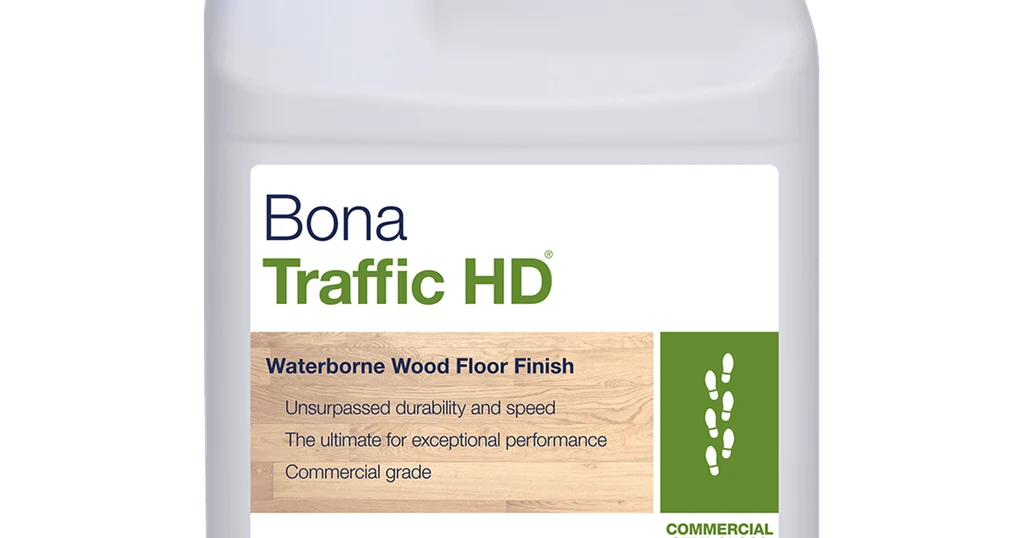
- Two-component waterborne polyurethane with an isocyanate crosslinker; it lost the least material of any finish in our abrasion cycle and was the only pick our dog-nail rig could not put a white line into
- Cures fast enough to live on. Light foot traffic at 24 hours, furniture back at 48, and you are not waiting a week to walk barefoot through your own hallway
- Non-ambering, so white oak stays the color you sanded it to instead of going yellow-orange in year three, and GREENGUARD Gold certification means the house is habitable the same evening
- Roughly $120–$150 a gallon plus the hardener, three to four times the per-gallon cost of the Minwax oil-based pick
- Once you pour the hardener in you have about four hours of pot life. Mixed finish that sits overnight is trash, so a big floor means mixing in stages and keeping a wet edge under the clock
- You will not find it at Home Depot or Lowe's. It ships in a 3-pack of gallons from flooring distributors and Amazon, which means buying more than a single room needs
2. Bona Mega ONE Satin
- Coverage
- 350–500 sq ft / gal per coat
- Sheens
- Extra matte, satin, semi-gloss
- Dry / recoat
- Recoat 2h · light foot traffic 24h
- Full cure
- Area rugs 7 days · full hardness 5–7 days
- VOC
- Low; GREENGUARD Gold certified waterborne
- Yellowing risk
- None
- Primer
- Waterborne sealer recommended; self-sealing on a screen-and-recoat
- Price tier
- $$$
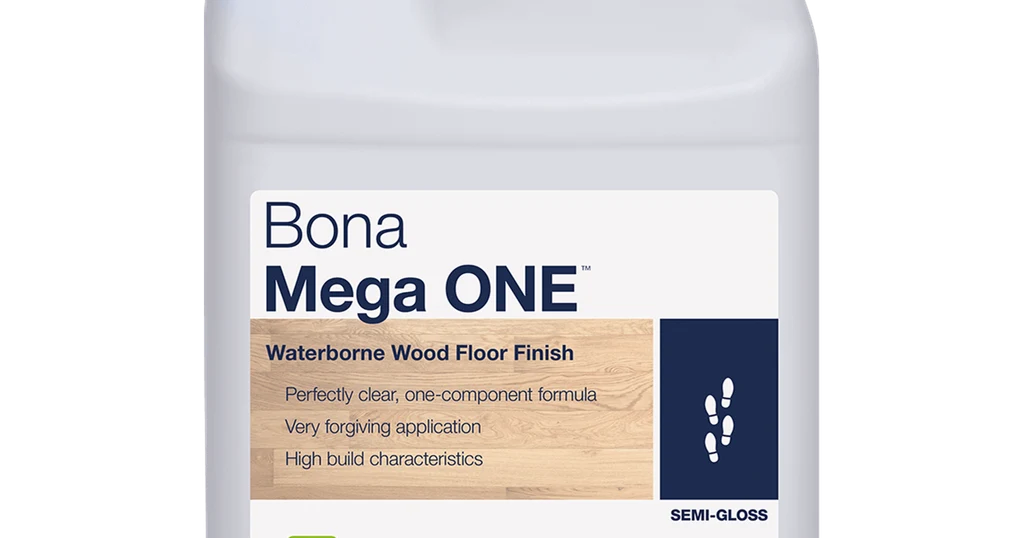
- Single-component self-crosslinking waterborne. Open the can, pour, roll. No hardener, no pot life, no half-used mix to throw away at the end of the night
- Roughly 80 percent of Traffic HD's abrasion resistance at about two-thirds the price, which is the best durability-per-dollar in the waterborne half of this round-up
- Two-hour recoat window means three coats in one long day on a normal-size room, and the leftover gallon keeps for the next project
- Softer film than Traffic HD for the first week. Slide a sofa across it on day three and you will see the mark
- Same distribution problem as its big brother. Flooring supply houses and Amazon only, sold in 3-gallon cases
- Rolls thinner than the oil-based picks, so lap marks show if you stop mid-run on a long board. Work the length of the board and do not stop in the field
3. Minwax Super Fast-Drying Polyurethane for Floors
- Coverage
- 600–700 sq ft / gal per coat
- Sheens
- Satin, semi-gloss, gloss
- Dry / recoat
- Recoat 3h · light foot traffic 12–18h
- Full cure
- 7 days before heavy traffic, rugs, or furniture
- VOC
- Oil-based; a separate 350 g/L SKU is sold for VOC-restricted states
- Yellowing risk
- High — warm amber that deepens with age
- Primer
- None; 2 coats over stain, 3 on bare wood
- Price tier
- $
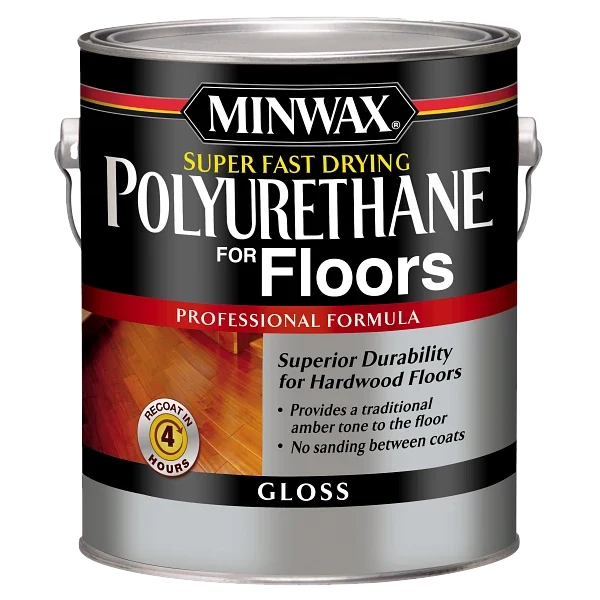
- 600–700 sq ft per gallon is the highest coverage in the round-up, and at $45–$60 a gallon it finishes a 900 sq ft floor in three coats for what one gallon of Traffic HD costs
- Three-hour recoat on an oil-based floor finish is genuinely fast; the older oil-modified products wanted 8 to 12 hours between coats
- The amber cast is a feature on red oak, heart pine, and walnut. It puts back the warmth that a waterborne finish leaves out
- It ambers, and it keeps ambering. On maple, ash, or a gray-stained white oak floor the finish will pull the color yellow within two or three years
- Solvent smell is serious. Plan on the house being unlivable for the finishing days and for 24 hours after the last coat, with fans in the windows
- Softer film than either Bona pick. Our abrasion cycle wore through it about 40 percent sooner, which on a busy hallway is the difference between a 7-year recoat and a 10-year recoat
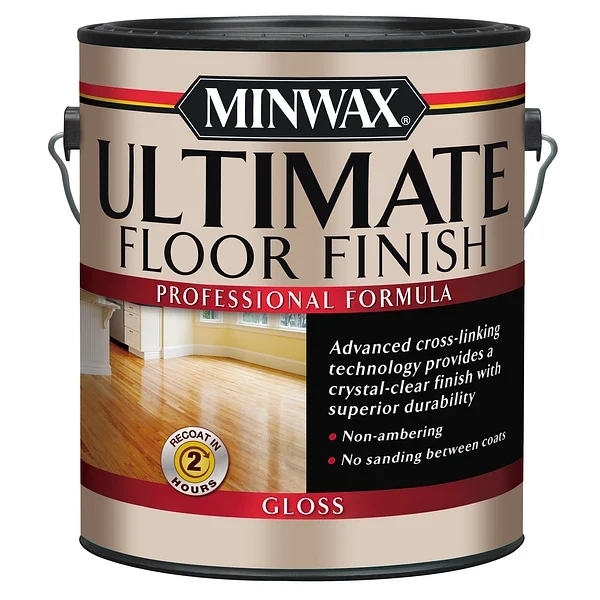
4. Minwax Ultimate Floor Finish
- Coverage
- 400–500 sq ft / gal per coat
- Sheens
- Matte, satin, semi-gloss, gloss
- Dry / recoat
- Recoat 2h · light foot traffic 24h
- Full cure
- 7 days before heavy traffic and cleaning
- VOC
- Waterborne, low odor
- Yellowing risk
- None — self-crosslinking, stays clear over light woods
- Primer
- None; 2 coats over stain, 3 on bare wood
- Price tier
- $$
- Self-crosslinking waterborne that does not amber, sold off the shelf at both big boxes. The only pick here that answers a Saturday-morning maple floor problem the same Saturday
- Two-hour recoat with no sanding between coats inside the window; three coats on bare wood fit into one day
- Four sheens including a true matte, which is the sheen most people actually want on a modern white oak floor and the one the oil-based picks do not offer
- Abrasion resistance sits below both Bona finishes. On a hallway with a dog it is a 5 to 7 year recoat, not a 10 year one
- Fussy about temperature. Under 65°F it stays milky in the film and takes forever to clear; over 80°F it skins before the roller reaches the far wall
- Raises grain harder than the Bona products on the first coat, so budget a real 220-grit screen after coat one or the floor feels like fine sandpaper
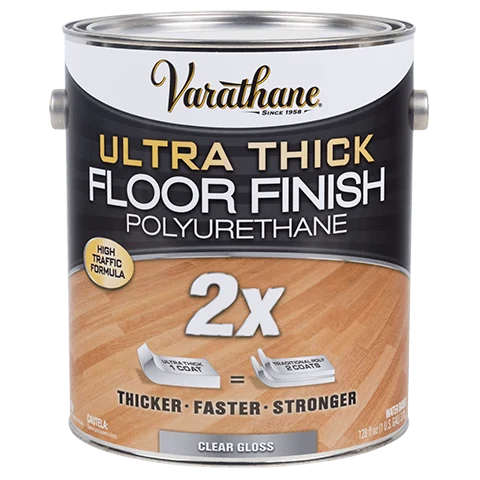
5. Varathane Ultra Thick Floor Finish
- Coverage
- ≈200 sq ft / gal per coat (about 2x standard film build)
- Sheens
- Satin, semi-gloss, gloss
- Dry / recoat
- Recoat per label, no sanding between coats
- Full cure
- 7 days before rugs and heavy furniture
- VOC
- Waterborne, soap-and-water cleanup
- Yellowing risk
- None
- Primer
- None; 2-coat system on bare or stained wood
- Price tier
- $$
- Two coats instead of the usual three or four. Rust-Oleum builds the film about twice as thick per pass, and on our panels the two-coat build measured out close to a three-coat standard waterborne
- Self-leveling formula hides applicator marks better than any other waterborne here, which makes it the most forgiving pick for a first-time floor refinisher
- Aluminum oxide loading gives it real scuff resistance for a home-center product, and cleanup is soap and water
- Thick film means low coverage. Figure roughly 200 sq ft per gallon per coat, so the gallon math is closer to the Bona picks than the price tag suggests
- A thick waterborne film is less tolerant of a bad sanding job. Every swirl mark from a drum sander telegraphs through and gets magnified by the gloss
- Fewer sheen options than Minwax Ultimate, and no matte
Bona ClearSeal Waterborne Sealer
Floor finish does not take a primer, it takes a sealer, and the sealer does three jobs a topcoat cannot. It controls how much finish the raw wood drinks, so the expensive topcoat sits on the surface where it earns its money instead of soaking into end grain. It stops side bonding between boards, which is what causes a solid sheet of finish to tear at the seams when a wide-plank floor shrinks in January. And it locks the color, so a raw white oak floor stays the tone you sanded it to. ClearSeal is the non-ambering choice under Bona Traffic HD or Mega ONE and covers roughly 500–600 sq ft per gallon. Use AmberSeal instead if you want the warm oil-finish look under a waterborne topcoat. On the Minwax and Varathane picks, the first coat of finish acts as its own sealer and no separate product is needed.
BUY ON AMAZON
Ask a Question