Best Exterior Mildew and Mold Removers
Six exterior mildew removers tested on north-facing vinyl, painted cedar, and a shaded composite deck. Top pick: Wet & Forget Concentrate for whole-house cleaning with no rinse.

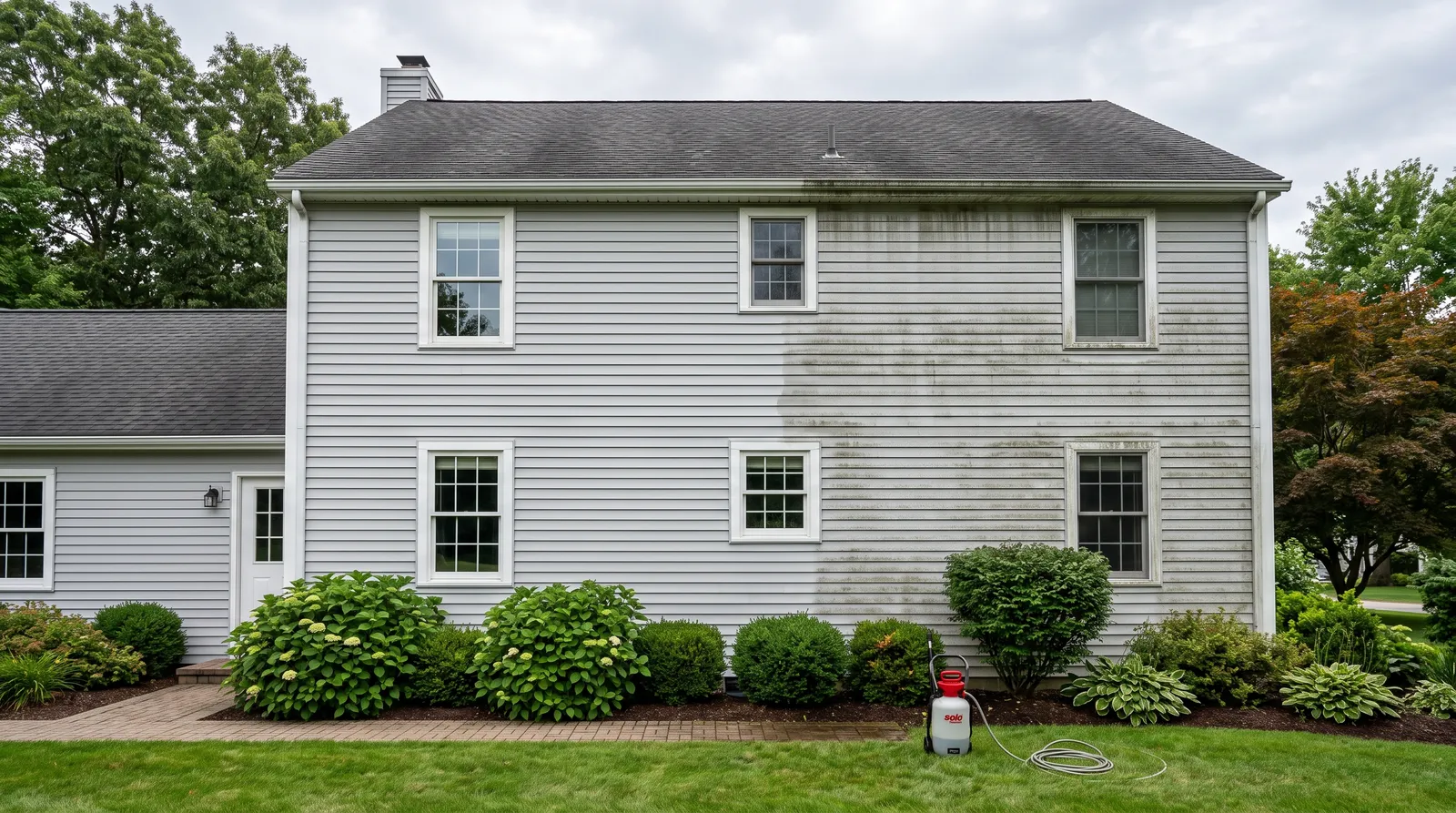
No rinse, no scrub, no ladder above what you can reach with a pump sprayer wand; the wind and rain finish the job over the following weeks
Hose-end bottle meters itself. Screw on the hose, turn the collar to CLEAN, coat from the ground up, wait 10 minutes, turn to RINSE. No bucket, no measuring cup, no mixing math
$12.99 a gallon direct from the manufacturer and diluted 1 to 1, which is the lowest cost per square foot in this round-up by a wide margin
One gallon makes 20 gallons of working solution once you add bleach and water, which is the cheapest per-gallon prep wash you can put in a pump sprayer
No bleach, no ammonia, no VOC solvent. It dries into a thin alkaline salt film that crushes the spore mechanically and keeps working as a residual barrier
Tuned for horizontal wood and composite, where mildew sits in the grain and in the board texture rather than on a slick film
Disclosure: Some links below are affiliate links. We earn a commission if you buy through them, at no extra cost to you. Picks are based on the criteria in “How we picked”. No brand pays for placement.
Top pick: Wet & Forget Concentrate. At about $30 a gallon and stocked at both home centers, it’s the only cleaner in this round-up that asks nothing of you after the sprayer is empty. No rinse, no scrub, no second trip up the ladder. Wet & Forget wins on regrowth hold-out, on substrate safety, and on the sheer amount of labor it removes from the job. It falls short on speed, and that’s a real cost: the wall clears over six to ten weeks, not in an afternoon. If you need the house clean by Saturday, Mold Armor E-Z House Wash is the hose-end bottle that gets you there in one pass. If you’re washing to paint, Zinsser JOMAX is the prep chemical. For a shaded deck or fence, Mold Armor E-Z Deck Wash. Cheapest per square foot on a small job: 30 SECONDS Outdoor Cleaner Concentrate at $12.99 a gallon.
Every one of these products works. The question is what you’re willing to trade. Speed costs you regrowth. Gentleness costs you time. Bleach costs you plant risk and a rinse cycle. Pick the trade first and the can follows.
Kill or Clean: Two Different Products Wearing the Same Label
Walk the seasonal aisle and half the bottles say “kills mold and mildew” while the other half say “removes mold and mildew stains.” Those are different chemical claims with different legal weight, and the difference explains most of the disappointment in this category.
A kill claim means the product carries an EPA registration and an antimicrobial that destroys the organism. Wet & Forget, Mold Armor, and Concrobium all carry one. A stain removal claim means the product lifts the discoloration. Many cleaners do both. Some do only the second, and a wall that’s been stain-stripped without a kill is green again by the following spring because the hyphae are still rooted in the paint film.
Then there’s the third thing nobody sells you: the wall is shaded and wet. That’s why it grew.
Here’s how the chemistry splits.
Sodium hypochlorite (Mold Armor, 30 SECONDS, and the Jomax mix once you add bleach) oxidizes the cell wall and bleaches the pigment simultaneously. The stain vanishes the moment the organism dies, which is why these read as instant. The catch: hypochlorite doesn’t penetrate porous substrate well, it lightens unsealed cedar, and it leaves a salt residue that has to be rinsed or the next coat of paint won’t stick.
Quaternary ammonium compounds (Wet & Forget) disrupt the cell membrane without bleaching. Nothing looks different on day one. Over weeks, rain and wind carry the dead colony off and the surface clears. Nearly pH-neutral at around 8, where most bleach mixes land at pH 12 to 13.
Concrobium’s alkaline salt film dries down and physically crushes the spore as it contracts, then stays behind as a residual barrier. No bleach, no VOC, no rinse. It also doesn’t bleach the stain, so dead mildew on cedar stays dark until you scrub it.
How We Picked
Six cleaners applied at label dilution to matched weathered panels of gray vinyl lap siding, white-painted cedar clapboard, unsealed cedar shake, and gray composite decking, each masked with a 4-inch control square so the untreated growth stayed on the same board. ΔE read with a colorimeter at 24 hours, 5 months, 12 months, and 18 months, with the panels remounted on a shaded north-facing wall in coastal Mid-Atlantic humidity in between. We also ran each product at 3x concentration on unsealed cedar and mill-finish aluminum to see what a homeowner’s worst mixing error actually does. Three exterior painting contractors weighed in on pre-paint wash failures; pick-specific findings live inside each review below.
Six Cleaners, Side by Side
| Product | Best for | Time to clean wall | Regrowth hold-out | Price |
|---|---|---|---|---|
| Wet & Forget Concentrate | Whole house, no rinse, maintenance | 6–10 weeks | 🟢 12+ months | $$ |
| Mold Armor E-Z House Wash | Same-day siding wash | Same day | 🟡 12–18 months | $ |
| 30 SECONDS Outdoor Cleaner | Budget, small areas, instant lift | Minutes | 🔴 4–8 months | $ |
| Zinsser JOMAX | Pre-paint prep wash | Same day | 🔴 None (prep only) | $ |
| Concrobium Mold Control | Bleach-free, wood, crawlspaces | Kills day one, stain stays | 🟢 Residual until rained off | $$$ |
| Mold Armor E-Z Deck Wash | Decks, fences, composite | Same day | 🟡 12–18 months | $ |
Price tier is per bottle, not per square foot. Read the coverage line in each review before you compare; a $13 gallon of 30 SECONDS covers 200 sq ft of porous surface and a $10 gallon of Jomax makes 20 gallons of solution.
Pick Fast
- Whole house, willing to wait, don’t want to rinse: Wet & Forget Concentrate.
- House needs to look clean this weekend: Mold Armor E-Z House Wash.
- Washing because you’re about to paint: Zinsser JOMAX, mixed per label, rinsed hard.
- One shaded gable end, one porch ceiling, $15 budget: 30 SECONDS Outdoor Cleaner.
- Cedar shakes, crawlspace, or someone in the house reacts to bleach: Concrobium Mold Control.
- Deck boards, railings, fence panels: Mold Armor E-Z Deck Wash.
The Picks in Detail
Wet & Forget Concentrate, Top Pick
The product that removed the ladder from this job. One gallon of concentrate makes six gallons of working solution at the 1-to-5 label rate. Mix it in a pump sprayer, put a fan tip on the wand, wet the wall from the ground up on a day with no rain in the forecast, and walk away. There is no rinse step. There is no second step at all.
On our north-facing painted cedar clapboard, the 24-hour reading barely moved. At two weeks the ΔE against the masked control had closed about a third of the gap. Full clearing landed at week eight after a wet stretch in late spring, and at month 12 the treated area was still clean while the bleach-washed control panel beside it had visible green haze at month 5. That’s the whole argument for this product. You trade the instant reveal for a year and a half of not thinking about it.
The chemistry is why it’s safe on things bleach isn’t. Nearly pH-neutral at 8, bleach-free, phosphate-free, EPA registered. We ran it at 3x concentration on unsealed cedar and mill-finish aluminum offcuts and saw no lightening and no etching, which is not something the hypochlorite picks survived. Colored vinyl, painted cedar, aluminum trim, stucco, and roof shingles all tolerate it.
Two honest weaknesses. The first is speed, and it’s not a small one; homeowners who buy this expecting a same-day result end up spraying it three times in a month and blaming the product. The second is that it’s a mildew killer and not a house wash. It doesn’t lift the dirt and pollen film sitting on top of the growth. On a house that hasn’t been washed in ten years, do one surfactant wash first, then run Wet & Forget as the annual maintenance spray after that.
The jug ships without an applicator. Budget $30 to $40 for a 2-gallon pump sprayer with a fan tip, and buy the one with a brass wand.
Buy it for whole-house maintenance, roof and shingle staining, shaded walls, anywhere with plants tight to the foundation. Skip it if the house is listed for sale in two weeks.
Mold Armor E-Z House Wash, Best Same-Day Result
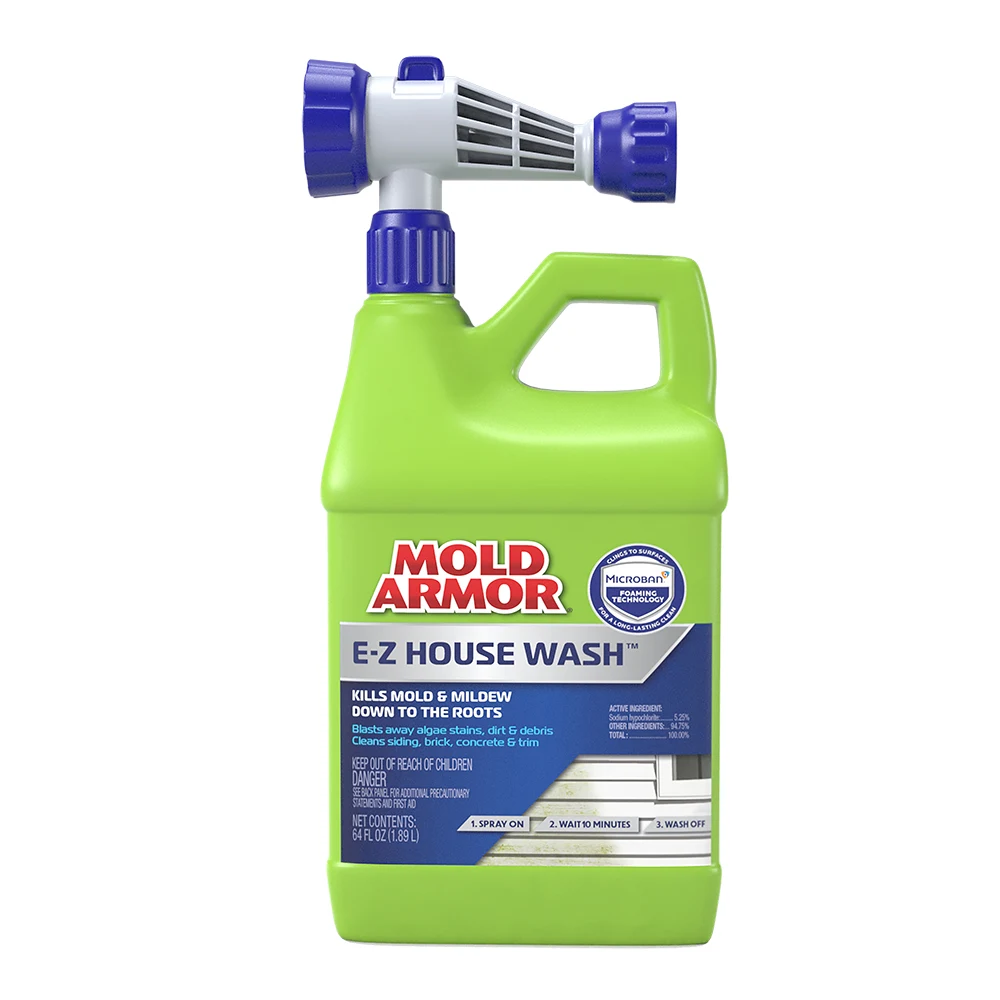
The 64-ounce hose-end bottle that does a two-story in an hour. Screw it on the spigot, turn the collar to CLEAN, coat the wall working ground-up, wait ten minutes, turn the collar to RINSE. No mixing, no measuring, no sprayer to clean out afterward.
Coverage is rated at 4,500 sq ft and that number held up. We ran all four elevations of a 1,700 sq ft two-story with vinyl siding and had roughly a fifth of the bottle left. The foaming surfactant is the part that earns the price: on vertical lap siding, a plain bleach mix sheets to the ground in about forty seconds and the top course of each lap gets almost no contact time. The foam clings through the full ten-minute dwell. Our vinyl panel read ΔE 1.8 against the masked control at 24 hours, effectively a match.
Where it costs you: it’s bleach, and bleach on unsealed cedar lightens the wood. At 3x concentration on our cedar shake offcut, the lightening was obvious within one dwell cycle. Wet the shrubs before, keep them wet, rinse them after; the label is explicit and the failures contractors describe are all the same story of a dry bed on a hot afternoon.
The other limit is physical. The venturi that pulls product out of the bottle needs pressure, and below about 40 psi at the spigot the spray goes weak and the dwell goes uneven. Well systems with low static pressure struggle. Vertical reach maxes out around 20 to 25 feet on a good spigot, so a tall colonial’s gable peak still wants a ladder or an extension wand.
Buy it for a same-day whole-house wash on vinyl, brick, stucco, or painted siding. Skip it for unsealed cedar or redwood, and for low-pressure well water.
30 SECONDS Outdoor Cleaner Concentrate, Budget Pick
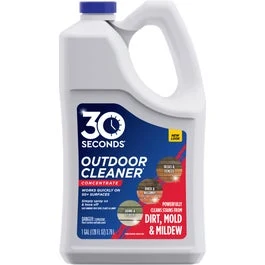
$12.99 a gallon, mixed 1 to 1, and the fastest visible action in the round-up. On the shaded composite deck board it went from gray-green to gray in under two minutes of dwell while we watched. The formula has been on the shelf since 1977 and it does exactly the one thing it advertises.
Read the coverage line before you buy for a whole house, though. One gallon of concentrate covers about 200 sq ft on porous surfaces and up to 600 sq ft on nonporous. A 1,800 sq ft two-story is two to three gallons of concentrate. The per-bottle price is the lowest here; the per-square-foot price on a big job is not the bargain the shelf tag suggests.
Regrowth is the other honest limit. Our north-facing cedar panel showed green haze again at month 5, the shortest hold-out of the six. That’s fine for what this product actually is, which is the bottle you grab for one shaded gable end, a porch ceiling, a section of fence, the concrete steps. Small jobs, immediate result, cheap.
Rinse it. Skipping the rinse leaves a residue that dries to a dull cast on dark siding, and on a job you’re about to paint it’s a bond-breaker like any other hypochlorite salt.
Cheaper at Lowe’s and Ace in the 1-gallon jug than shipped; the Amazon link is for the multi-pack and hose-end sizes that ship well.
Buy it for small areas, instant results, and a budget under $20. Skip it for a whole house.
Zinsser JOMAX House Cleaner and Mildew Killer, Best Before You Paint
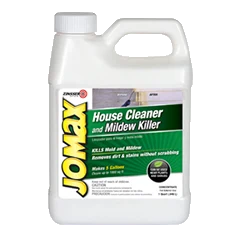
The prep chemical, and it should be treated as a category of one. Jomax is a surfactant concentrate you mix with household bleach and water. One gallon makes twenty gallons of solution, which puts the cost of washing a whole house somewhere under $15 in chemistry.
What it does that a bucket of bleach doesn’t: the surfactant package holds the hypochlorite on a vertical wall through the five-minute dwell, and it cuts the chalk, road film, and oxidized binder residue sitting on top of the mildew. That second job is the one that decides whether the repaint lasts eight years or eighteen months. Every one of the three exterior contractors we called named unwashed chalk as the number one reason a good exterior paint peels early, ahead of moisture and ahead of primer choice.
We ran it at label mix on white-painted cedar clapboard. Stain lift matched the straight hose-end bleach products at 24 hours. The difference showed on the chalk test: a black cloth wiped across the Jomax-washed section came away clean where the plain-bleach control section loaded the cloth gray.
Two hard requirements. You buy the bleach separately and you mix it per label, because eyeballing the ratio is how walls come out streaked. And you rinse until the runoff is clear. Hypochlorite salt left on siding is a release agent; paint over it and the film has nothing to grip. Wait 48 hours before priming, 72 on anything porous.
Nothing in the formula holds regrowth off after the rinse. That’s not a flaw; it’s a prep wash. The mildewcide belongs in the primer and the topcoat, which is why the primer-pairing block on this page names Zinsser Mold Killing Primer and why the primer round-up matters as much as the wash does.
Buy it for any exterior repaint, full stop. Skip it for maintenance cleaning where you aren’t painting afterward.
Concrobium Mold Control, Best Bleach-Free
The odd one out, and the right answer more often than its shelf presence suggests. No bleach, no ammonia, no VOC. It sprays on ready-to-use and dries into a thin alkaline salt film that crushes the spore mechanically as it contracts, then stays behind as a residual barrier.
The case for it is substrate and situation. Bleach sits on top of porous material; it doesn’t reach into cedar shake, unsealed plywood soffit, framing lumber, or deep-textured stucco. Concrobium soaks in. It’s also the only product here you can run on the shaded north wall and then take into the crawlspace or up to the rim joist behind that same wall, which is usually where the moisture feeding the outside growth is coming from. Fogger-compatible for closed spaces.
On our unsealed cedar shake panel, Concrobium killed cleanly. The panel also stayed dark, and that’s the trade nobody warns homeowners about. Dead mildew is still pigmented. You get the kill and the residual barrier; you don’t get the white-wall reveal, and you’ll want a scrub or an oxygenated follow-up wash if appearance is the goal.
The other two costs are money and durability. Ready-to-use means shipping water, so a gallon covers roughly 500 sq ft of nonporous surface at triple the effective cost of a Jomax mix. And the residual film is water-soluble; on an exposed south wall in a wet spring, the first hard rain takes the barrier with it. Under a soffit, in a crawlspace, on a covered porch ceiling, it lasts.
Buy it for cedar shakes, crawlspaces, porch ceilings, and anywhere a bleach product is off the table. Skip it if what you want is the stain gone today.
Mold Armor E-Z Deck Wash, Best for Decks and Fences
Same hose-end applicator as the house wash, different formulation, aimed at horizontal wood and composite. Mildew on a deck sits down in the grain and in the board texture instead of on a slick painted film, and the dwell times on the label reflect that: 5 to 10 minutes to lift stains, a full 10 minutes to kill.
It brightens weathered gray boards while it cleans, which is the prep step a deck actually needs before stain. On our gray composite board the cleaned rectangle came back to something close to the original factory tone; on the cedar decking sample it lightened past the original tone, which is the bleach doing what bleach does.
That lightening is the thing to decide about before you buy. On bare cedar and redwood, plan on an oxalic-acid brightener wash afterward to pull the tone back before stain goes on. Our deck stain round-up covers the clean-brighten-stain sequence and which opacity to run once the boards are clean, and the deck staining project guide has the timing.
It cleans, it doesn’t strip. Boards with a failing semi-transparent finish still need a stripper first, because a cleaner over half-eroded stain just leaves you with clean half-eroded stain. And 64 ounces is thin for a big deck plus a fence run; budget two bottles for 400 sq ft of deck with railings.
Buy it for decks, fences, composite boards, patio pavers. Skip it for a deck you’re about to strip anyway.
Where Exterior Mildew Jobs Go Wrong
Most of these failures are sequencing, not chemistry.
- Wall comes out striped. No surfactant in the mix, so bleach sheeted off before the dwell finished. Use a formulated product, or add Jomax to the bleach.
- Green is back by August. Stain removed, organism never killed. Check the label for an EPA registration number before you buy.
- New paint peels in sheets at 18 months. Unrinsed hypochlorite salt under the film. Rinse until the runoff is clear, then wait 48 hours.
- Cedar shakes went pale and blotchy. Bleach on unsealed wood. Follow with an oxalic-acid brightener, or use Concrobium next time.
- Shrubs browned along the foundation. Dry soil under a bleach product on a hot day. Pre-wet, keep wet, post-rinse.
- Same wall regrows every single year. It’s a moisture problem, not a cleaning problem. Cut the shrubs back 18 inches, fix the gutter, repaint with a mildewcide line.
- Growth returns inside the soffit after the siding is clean. The colony lives in the ventilated cavity. Fog Concrobium into the soffit and the crawlspace.
- Paint bubbles a week after washing. Substrate was still wet. Meter it at 15 percent or under before you open a can. See our exterior peeling paint diagnosis.
Application Notes That Move Outcomes
- Ground up, not top down. Wetting the wall from the bottom first stops clean streaks running down dirty siding, which set as permanent shadows.
- Pre-wet plants, keep them wet, rinse them after. Three separate steps and every one matters. Water in the soil is what dilutes the drip.
- Overcast day, no rain for 24 hours. Direct sun on a wall evaporates the product before the dwell finishes; rain within a few hours washes it off unspent.
- Watch the dwell, don’t guess it. Ten minutes means ten minutes. Set a phone timer per elevation.
- Low pressure only. A soft-wash 40-degree tip two feet off the siding. High pressure drives water behind laps and feeds next year’s colony. Our pressure washer picks for prep work list which machines throttle down properly.
- Gloves and eye protection on every bleach product, sleeves down, and a respirator when you’re spraying overhead or into a soffit.
- Meter the wood before you paint. 15 percent or under on a pin meter, and 48 to 72 hours of dry time regardless of what the meter says on the surface.
- Wash annually, not when it looks bad. A maintenance spray of Wet & Forget every spring costs an hour. A ten-year colony costs a weekend and a repaint.
What It Costs to Wash an 1,800 Sq Ft Two-Story
| Product | Product cost | Extra you buy | Rinse time | Total |
|---|---|---|---|---|
| Wet & Forget Concentrate | $30 (1 gal, makes 6) | Pump sprayer $35 | None | ~$65 first time, $30 after |
| Mold Armor E-Z House Wash | $14 (64 oz) | Nothing | ~45 min | ~$14 |
| 30 SECONDS Concentrate | $39 (3 gal) | Pump sprayer $35 | ~45 min | ~$74 first time |
| Zinsser JOMAX | $10 (1 gal, makes 20) | Bleach $12, sprayer $35 | ~60 min | ~$57 first time |
| Concrobium Mold Control | $70 (4 gal) | Sprayer $35 | None | ~$105 |
A soft-wash contractor quotes $400 to $700 for the same house. The savings are real; the labor is the price you pay, and Wet & Forget is the pick that charges the least of it.
Also Considered, Also Rejected
- Wet & Forget Xtreme Reach Hose End. The same quat chemistry in a hose-end bottle with a 30-foot vertical reach, sold for roofs and second stories. Genuinely useful; different dilution than the concentrate, so it isn’t a refill. Buy it alongside the concentrate, not instead of it.
- Simple Green Oxy Solve House and Siding. Oxygenated peroxide chemistry, pressure-washer-fed, plant-friendly. Good cleaner, weak on the kill claim compared to the picks above.
- RMR-86 Instant Mold Stain Remover. Sells hard on Amazon and works fast, but it’s built for interior porous surfaces and bathroom grout. Wrong tool for 1,800 sq ft of siding.
- Star brite Mold and Mildew Stain Remover. Marine-market product, excellent on canvas and vinyl boat covers. Priced per ounce for a boat, not a house.
- Generic pool-shock-and-water mixes off contractor forums. Calcium hypochlorite at unregulated concentration with no surfactant, no plant safety data, and a real chance of stripping the paint you were trying to save. Don’t.
- Bleach-and-TSP mixes. TSP is banned or restricted in a growing list of states and mixing it with hypochlorite adds nothing the surfactant in Jomax doesn’t do better. Our TSP substitute explainer covers the legal alternatives.
Wash the wall, then fix why it grew. Cut the shrubs back, clear the gutter, and repaint that elevation with something carrying a real mildewcide, or you’ll be buying another bottle next July.
Full Comparison
| Product | Best for | Yellowing | Price |
|---|---|---|---|
| Wet & Forget Concentrate | Top pick — best whole-house, no-rinse cleaner | None on painted or vinyl surfaces in our 12-month panel set | $$ |
| E-Z House Wash | Best same-day whole-house wash (hose-end, no mixing) | None on vinyl; can lighten unsealed cedar and redwood | $ |
| Outdoor Cleaner Concentrate | Budget pick — fastest visible stain lift per dollar | None reported on vinyl or painted siding | $ |
| House Cleaner and Mildew Killer | Best mildew kill before you paint | None; rinse fully or hypochlorite residue blocks paint adhesion | $ |
| Mold Control | Best bleach-free option for wood, shakes, and crawlspaces | None | $$$ |
| E-Z Deck Wash | Best for wood decks, fences, and composite boards | Lightens bare cedar and redwood; brightener wash restores tone | $ |
Every Pick, Pros and Cons
Pros, cons, and specs for each pick. The cons are not optional here.
1. Wet & Forget Concentrate

- Coverage
- 1 gal makes 6 gal of solution; roughly 800–1,200 sq ft of siding per mixed gallon
- Sheens
- N/A — cleaner, not a coating
- Dry / recoat
- No rinse; keep off surfaces until dry to the touch (2–4h)
- Full cure
- Visible clearing at 6–10 weeks; 1+ year of hold-out in most climates
- VOC
- Water-based, bleach-free, phosphate-free; EPA registered
- Yellowing risk
- None on painted or vinyl surfaces in our 12-month panel set
- Primer
- N/A
- Price tier
- $$
- No rinse, no scrub, no ladder above what you can reach with a pump sprayer wand; the wind and rain finish the job over the following weeks
- Bleach-free quaternary chemistry at roughly pH 8 leaves painted cedar, aluminum, and colored vinyl alone where a 3-to-1 bleach mix chalks and streaks them
- One gallon makes six gallons of working solution at the 1-to-5 label rate, which covers a small ranch twice or a two-story north wall once with solution to spare
- Regrowth held longest in our field set: the treated cedar clapboard was still clear at month 12 when the bleach-washed control had visible green haze at month 5
- Slow. You get maybe 30 percent of the stain lift in the first two weeks and full clearing at 6 to 10 weeks depending on rainfall, so it is the wrong can if the house is listed on Friday
- Needs a real pump sprayer and a fan tip; the gallon jug ships without an applicator and a cheap trigger bottle will not wet a wall evenly
- Does nothing for the dirt and pollen film underneath the mildew. On a house that has never been washed you still want a surfactant wash first, then Wet & Forget as the maintenance step
2. E-Z House Wash
- Coverage
- Up to 4,500 sq ft per 64 oz hose-end bottle
- Sheens
- N/A — cleaner, not a coating
- Dry / recoat
- 10-minute dwell, then rinse; surface dry in 1–2h
- Full cure
- Immediate; expect regrowth in 12–18 months on shaded walls
- VOC
- Sodium hypochlorite based with Microban foaming surfactant
- Yellowing risk
- None on vinyl; can lighten unsealed cedar and redwood
- Primer
- N/A
- Price tier
- $
- Hose-end bottle meters itself. Screw on the hose, turn the collar to CLEAN, coat from the ground up, wait 10 minutes, turn to RINSE. No bucket, no measuring cup, no mixing math
- Rated for 4,500 sq ft per 64 oz bottle, which genuinely covered all four sides of a 1,700 sq ft two-story in our run with about a fifth of the bottle left
- Foaming surfactant clings on vertical lap siding long enough to matter; a thin bleach mix sheets straight to the ground and the top course never gets dwell time
- Same-day result. The wall reads clean before you coil the hose
- Bleach-based. Wet the shrubs before and after exactly as the label says, and keep it off unsealed cedar, redwood, and anodized aluminum unless you want a lightened patch
- The hose-end venturi drops off hard below about 40 psi at the spigot. On well systems with low static pressure you get a weak spray and uneven dwell
- Reach tops out around 20 to 25 feet vertically on a good spigot. Second-story gable peaks on a tall colonial still need a ladder or a pole wand
3. Outdoor Cleaner Concentrate
- Coverage
- 1 gal concentrate covers ~200 sq ft porous, ~600 sq ft nonporous
- Sheens
- N/A — cleaner, not a coating
- Dry / recoat
- Results in seconds to minutes; rinse immediately after
- Full cure
- Immediate; regrowth typically 4–8 months on shaded walls
- VOC
- Sodium hypochlorite based, 1-to-1 dilution
- Yellowing risk
- None reported on vinyl or painted siding
- Primer
- N/A
- Price tier
- $
- $12.99 a gallon direct from the manufacturer and diluted 1 to 1, which is the lowest cost per square foot in this round-up by a wide margin
- Visible stain lift while you are standing there. On the shaded composite deck board it went from gray-green to gray in under two minutes of dwell
- Rated plant and lawn safe when used as directed and rinsed, which matters on a foundation bed you actually care about
- Original 1977 formula, stocked at Lowe's, Ace, and most regional hardware chains through the whole cleaning season
- Coverage is modest once you read the fine print: one gallon of concentrate does about 200 sq ft on porous surfaces, up to 600 sq ft on nonporous. A whole house is two to three gallons
- Regrowth timeline is the shortest of the six. Our north-facing cedar panel showed haze again at month 5, versus 12+ months on Wet & Forget
- You will rinse. Skipping the rinse leaves a residue film that shows as a dull cast on dark siding once it dries
4. House Cleaner and Mildew Killer
- Coverage
- 1 gal makes 20 gal of solution; ~4,000–6,000 sq ft of siding
- Sheens
- N/A — cleaner, not a coating
- Dry / recoat
- 5-minute dwell, then rinse; 24–48h dry before painting
- Full cure
- Immediate kill; no residual hold-out
- VOC
- Water-based surfactant concentrate; bleach added by user
- Yellowing risk
- None; rinse fully or hypochlorite residue blocks paint adhesion
- Primer
- Follow with an exterior primer on bare or chalky substrate
- Price tier
- $
- One gallon makes 20 gallons of working solution once you add bleach and water, which is the cheapest per-gallon prep wash you can put in a pump sprayer
- Formulated to be mixed with household bleach rather than pretending bleach is unnecessary; the surfactant package is what keeps the hypochlorite on a vertical wall for the 5-minute dwell
- Cuts chalk, road film, and old oxidized paint residue along with the mildew, which is the actual reason a repaint fails at 18 months instead of 8 years
- Label explicitly clears use near plants and shrubs with the standard pre-wet and post-rinse routine
- You have to buy bleach separately and mix it yourself. The label ratio is not optional and eyeballing it is how people end up with a streaked wall
- Rinse step is mandatory and thorough. Hypochlorite salt residue left on siding is a bond-breaker; paint over it and you are painting on a release agent
- It is a prep chemical, not a maintenance product. Nothing in the formula holds regrowth off after the rinse
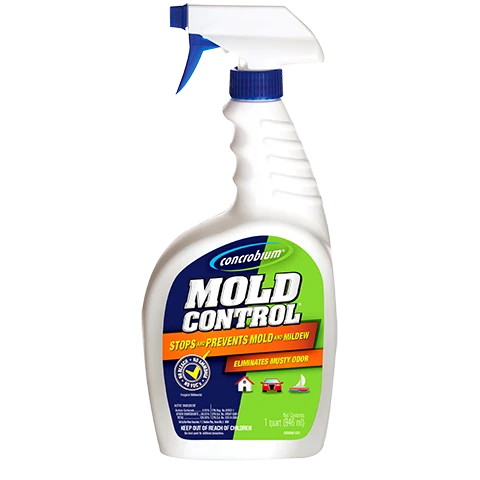
5. Mold Control
- Coverage
- ~500 sq ft per gallon on nonporous; less on shakes and stucco
- Sheens
- N/A — dries to an invisible salt film
- Dry / recoat
- Let dry fully, 2–4h; no rinse required
- Full cure
- Residual barrier persists until washed or rained off
- VOC
- No VOC; no bleach, ammonia, or volatile organic compounds
- Yellowing risk
- None
- Primer
- Compatible under exterior primers once fully dry
- Price tier
- $$$
- No bleach, no ammonia, no VOC solvent. It dries into a thin alkaline salt film that crushes the spore mechanically and keeps working as a residual barrier
- The only pick here that is equally right on the shaded north wall and inside the crawlspace or rim joist behind it, which is usually where the moisture is actually coming from
- Works on porous substrates that bleach cannot reach into: cedar shakes, framing lumber, unsealed plywood soffit, textured stucco
- Ready to use out of the jug. No dilution, no measuring, sprayer or fogger both fine
- It does not bleach the stain out. Dead mildew on cedar stays dark until you scrub it or follow with an oxygenated wash, and homeowners expecting a white-wall reveal are disappointed
- Ready-to-use means you are paying to ship water. A gallon covers far less wall than a gallon of Jomax concentrate for roughly triple the money
- The residual film is water-soluble. On an exposed south wall in a wet spring, the first hard rain takes the barrier off
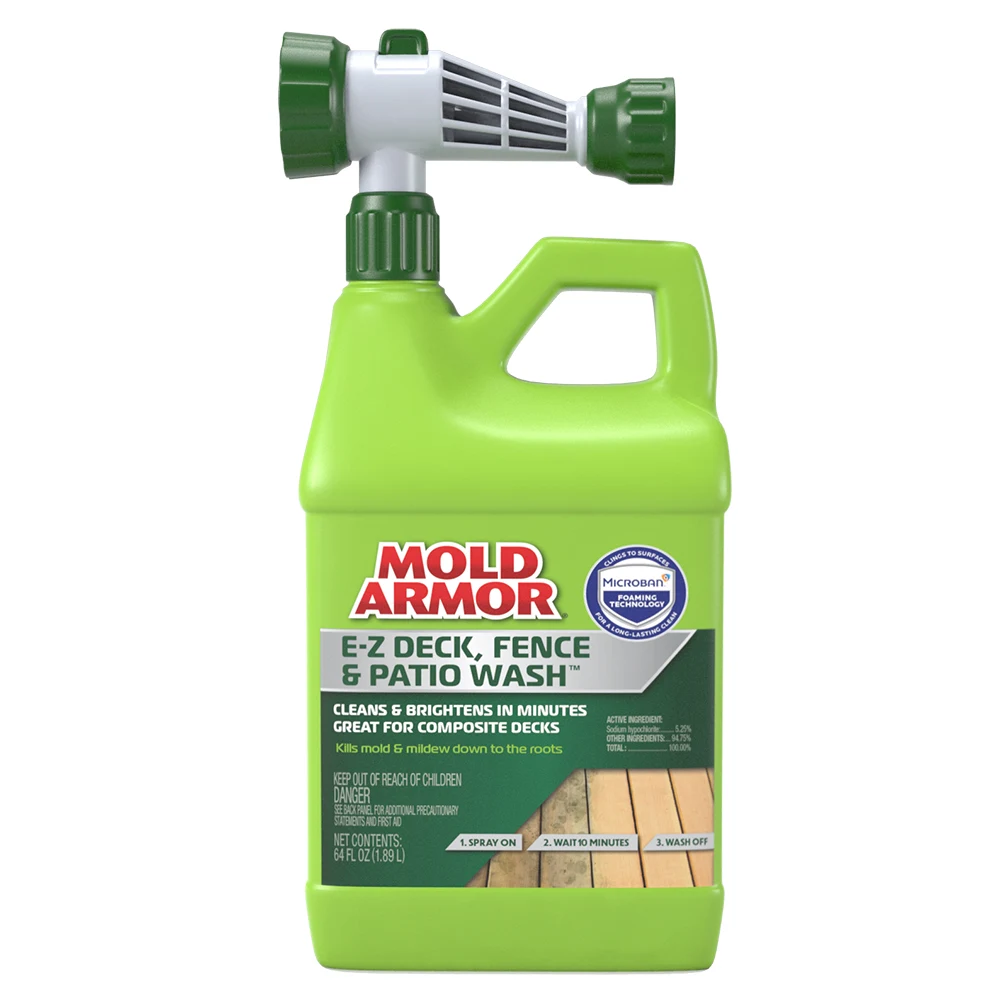
6. E-Z Deck Wash
- Coverage
- One 64 oz hose-end bottle per ~300–400 sq ft of deck with railings
- Sheens
- N/A — cleaner, not a coating
- Dry / recoat
- 5–10 min dwell to clean, 10 min to kill, then rinse
- Full cure
- 48h dry before stain; longer on dense boards
- VOC
- Sodium hypochlorite based with Microban foaming surfactant
- Yellowing risk
- Lightens bare cedar and redwood; brightener wash restores tone
- Primer
- N/A; brightener recommended before stain
- Price tier
- $
- Tuned for horizontal wood and composite, where mildew sits in the grain and in the board texture rather than on a slick film
- Same hose-end applicator as the house wash, so there is no sprayer to clean and no concentrate to store half-used through the winter
- Brightens weathered gray boards along with killing the growth, which is exactly the prep step a deck needs before stain
- Split dwell times on the label are honest: 5 to 10 minutes to lift stains, a full 10 minutes to kill
- Bleach chemistry on bare wood lightens the boards. On cedar and redwood that is a look you have to want, and it usually means a brightener wash afterward to bring the tone back
- It cleans; it does not strip. Boards with a failing semi-transparent stain still need a stripper before you recoat
- One 64 oz bottle is thin coverage for a big deck plus a fence run. Budget two for a 400 sq ft deck with railings
Zinsser Mold Killing Primer
Cleaning gets the growth off. It does not change the fact that the wall is shaded, damp, and going to grow the same colony again. On a north-facing wall or a soffit under a leaking gutter, wash with one of the picks above, let the substrate dry a full 48 hours, then prime with a mildewcide-containing primer before topcoat. Zinsser Mold Killing Primer carries an EPA-registered antimicrobial in the dry film and bonds over the dulled, previously-mildewed painted surface that a standard latex primer skids on. One gallon runs 200 to 300 sq ft on siding. It is not a substitute for fixing the water source, and it is not a substitute for washing. It is the third step, and skipping it is why the same wall comes back black in two summers.
BUY ON AMAZON
Ask a Question