Best Work Platforms and DIY Scaffolding
Six work platforms and DIY scaffolds tested across a stairwell, a 12-foot great room, and a week of trim work. Top pick: MetalTech Jobsite Series 6-Foot Baker, plus where each one falls short.

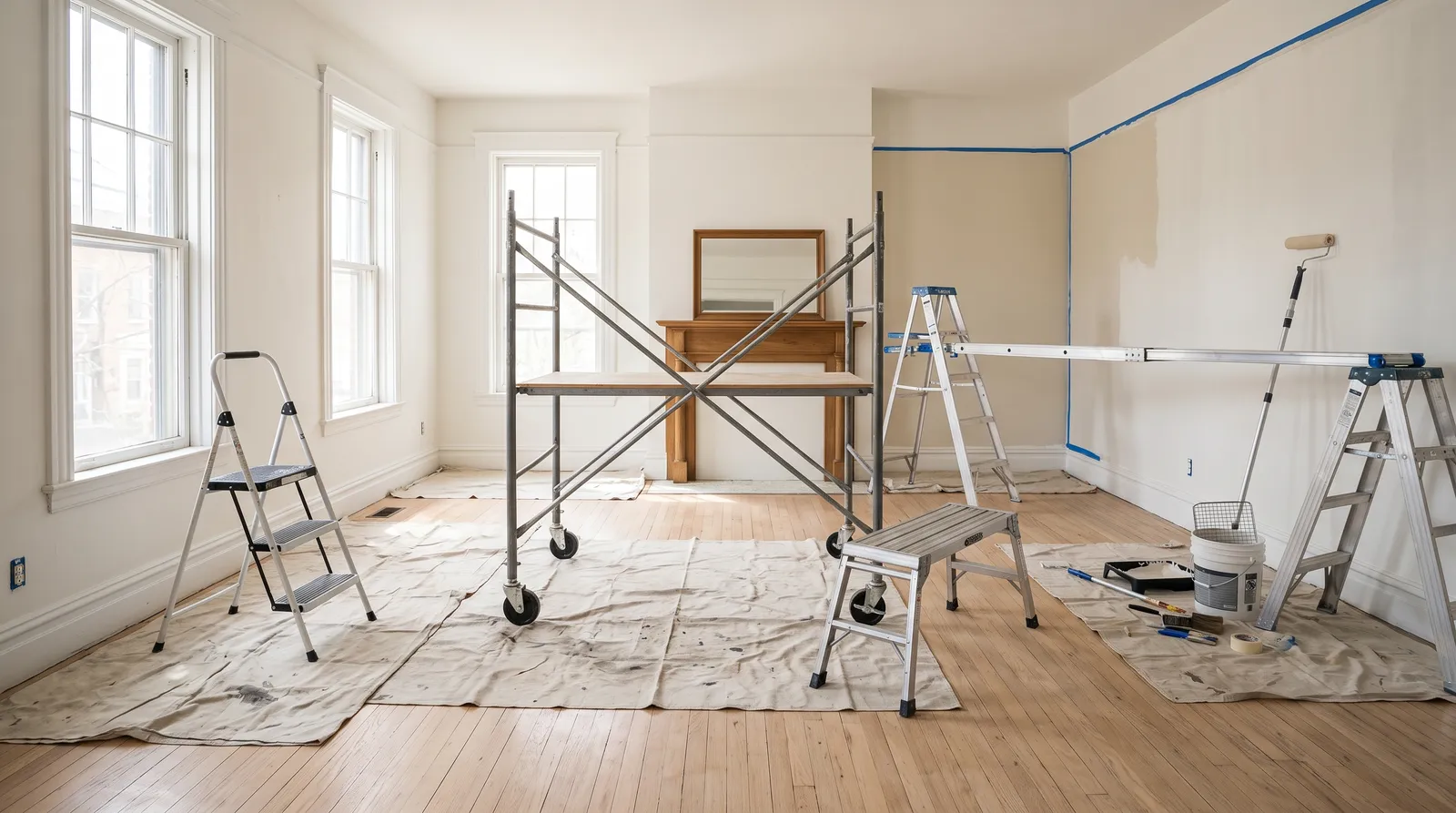
Disclosure: Some links below are affiliate links. We earn a commission if you buy through them, at no extra cost to you.
Top pick: the MetalTech Jobsite Series 6-Foot Baker, model I-CISC. About $330, a deck that pins anywhere from 27 to 73 inches in 2-inch steps, 1,100 pounds of rated capacity, and it rolls through a 30-inch interior door fully assembled. It wins on the number that decides how long an interior repaint takes, which is how many times you climb down to move something. It falls short on weight, at 110 pounds built, and on that first assembly, which ate 38 minutes of my Saturday. For one room where storage is the real constraint, the Werner PS-48 folds to a cart and costs half as much. For everyday cut-in and baseboard work, the 20-inch Werner AP-20 gets used more days of the year than any scaffold I own.
Six products in this test. The cheapest is about $70.
That one is the one most readers should buy first.
Platform, Baker, or Plank
Three different tools get called scaffolding, and picking the wrong category costs more than picking the wrong brand inside it.
A work platform is a low folding stand, 12 to 24 inches tall, with a standing surface wide enough to side-step along a wall. It replaces the bottom three rungs of a stepladder and it replaces them well. On an 8-foot ceiling, a 20-inch platform plus a pole puts your shoulders at the right height for a cut line and lets you walk 3 feet sideways without touching the floor. This is the tool that solves the most common painting problem in American houses.
A baker scaffold is a rolling steel frame, roughly 6 feet long, with an adjustable deck and casters. It is the DIY answer to ceilings between 9 and 14 feet. The deck gives you a floor to stand on, a place to set the bucket, and enough length to cut 6 feet of wall-to-ceiling line before you roll.
A plank spans two supports. It is the only answer for a stairwell, where no scaffold base sits level and no ladder wants to stand on a tread. A telescoping aluminum plank with ladder jacks or trestles at each end is the setup, not a board across two stepladder tops.
If your house has 8-foot ceilings and you are painting bedrooms, buy the platform and stop reading the scaffold section. If you have a two-story entry, you need the plank or a stacked baker, and no amount of extension pole substitutes for it. The extension pole round-up covers how far a pole actually gets you, which for cut-in is not far at all.
How I Ran This
Five weeks, three jobs, six units.
The stairwell job was a two-story entry with a 17-foot peak wall, seven gallons of Sherwin-Williams ProMar 200 eggshell. That job is where the PA208 plank and a two-high baker did the work, and where a stepladder does nothing but scare you.
The ceiling job was a 22 by 16 great room with a flat 12-foot ceiling, three coats of ceiling flat off an 18-inch frame. That is the test that separates a 73-inch deck from everything else. Rolling a 12-foot ceiling off a 6-foot stepladder means the roller is always at full arm extension and the coat goes on uneven, because your reach changes as you tire.
The trim job was eight days in a 1970s ranch with 8-foot ceilings: baseboard, casing, window stool, and a crown run in the dining room. That is where the low platforms earned their spot and the scaffolds sat in the garage.
Five scoring axes, in this order: reach math (does it put your shoulders where the work is), stability under a deliberate side-load lean at full deck height, moves-per-wall across a 16-foot run, setup and teardown on a stopwatch, and folded storage footprint against a garage wall. I checked every capacity against a real loaded weight, which for me is 185 pounds plus a 55-pound bucket plus a pole and frame, and not against the number on the sticker. Casters went over a 3/4-inch oak threshold and across sealed hardwood, then got inspected for marking.
Nothing was stacked past the manufacturer’s stated limit. Nothing was tested above its rated height.
The Six at a Glance
| Product | Type | Deck height | Standing area | Rated capacity | Weight | Price tier |
|---|---|---|---|---|---|---|
| MetalTech Jobsite 6-Foot Baker | Rolling baker scaffold | 27 to 73 in | 74.75 x 29.75 in | 1,100 lb | 110 lb | $$$ |
| Werner PS-48 | Compact rolling scaffold | 12, 24, 36 in | 41.5 x 17 in | 250 lb per plank | 44 lb | $$ |
| Werner AP-20 | Folding work platform | 20.5 in | 39.5 x 12 in | 225 lb | 15 lb | $ |
| Werner PA208 | Telescoping plank | Span 8 to 13 ft | 14 in wide | 250 lb | 40.5 lb | $$$ |
| MetalTech BuildMan 6-Foot | Heavy-duty baker | 29 to 71.5 in | 75.75 x 31 in | 1,500 lb | 165 lb | $$$$ |
| Little Giant Safety Step 3-Step | Step with handrail | Top tread ~30 in | One tread | 300 lb (Type IA) | 21 lb | $$ |
1. MetalTech Jobsite Series 6-Foot Baker, Top Pick
The Jobsite I-CISC is the scaffold most homeowners should own, and the reason is the 2-inch adjustment.
Every other height decision in painting is a compromise. A stepladder gives you fixed rungs, so you either reach up or you crouch. The Jobsite deck pins at 27, 29, 31 inches and so on to 73, which means you set it once for the wall-ceiling line in that room and never think about it again. On the 12-foot great room I set the deck at 55 inches, cut the full perimeter in two afternoons, and climbed down eleven times total across 76 linear feet of wall. From a 6-foot stepladder the same perimeter would have been forty repositions.
Capacity is honest. Rated 1,100 pounds, which in real terms is me, a helper, a 5-gallon bucket with a grid in it, and a pole rig, without doing arithmetic. That headroom changes how you work, because you stop leaving the bucket on the floor and reaching for it.
The 5-inch double-locking casters did not mark sealed white oak across five weeks, and they cleared a 3/4-inch threshold with a shove. Assembled width is 74.75 inches by 29.75 deep, which walks through a 30-inch door at an angle. I moved it between four rooms without taking a single pin out.
Weight is the price you pay. 110 pounds assembled, and getting it into a truck bed is a two-person lift or a very careful ramp. First assembly took me 38 minutes with the instruction sheet, mostly because the locking pins do not want to seat until the frames are square, and squaring them on an uneven garage floor is fiddly. Second setup after that: 9 minutes. The 29.75-inch deck depth is generous for painting and cramped if you are also hanging drywall sheets, which is what the BuildMan is for.
| Spec | Value |
|---|---|
| Deck height | 27 to 73 in, 2-inch increments |
| Assembled | 74.75 in W x 29.75 in D x 75 in H |
| Capacity | 1,100 lb |
| Weight | 110 lb |
| Stacking | Up to 3 units, about 24 ft reach |
| Approx. price | $300 to $380 |
Buy it if: you own a house with any ceiling above 9 feet and you paint more than one room a year. It pays for itself against rental in about three jobs. Skip it if: every ceiling in your house is 8 feet. You would be storing 110 pounds of steel to do a job a $70 platform does better.
2. Werner PS-48, Best Compact Rolling Platform
The PS-48 solves a different problem: the garage that has no room for a baker scaffold.
Two aluminum planks, each 46 by 8.5 inches, that pin at 12, 24, or 36 inches. Set both planks in and you get a 41.5 by 17-inch standing area, about 9 feet of working height with a pole in hand. It folds and rolls like a hand truck, and it stores on end against a wall in roughly the footprint of a bicycle. That is the whole argument, and for a lot of houses it is enough of one.
In the trim job it lived at 24 inches for a week and became the thing I stood on for casing and the thing I set the cut bucket on between walls. At the 36-inch setting on a slightly cupped garage floor it had noticeable sway under a side-load lean. Shim a foot or drop to 24 and it settles.
Read the capacity carefully, because this is the spec people misread. 500 pounds is the combined figure. The plank rating is 250 pounds each. Me plus a loaded 5-gallon bucket on the same plank is over the line, and it feels over the line before you do the math.
Buy it if: you want one rolling tool for a standard-ceiling house and storage space is the constraint. About $180 to $230. Skip it if: you have a 12-foot ceiling. The 36-inch top setting will not get you there and you will end up on tiptoe with a pole, which is how ceiling coats go blotchy.
3. Werner AP-20, Best Low Platform for Cut-In and Trim
This is the pick I would defend hardest, and it is the cheapest thing in the article.
The AP-20 is an aluminum folding platform: 39.5 inches of standing length, 12 inches deep, 20.5 inches off the floor, 15 pounds, and about $70. In an 8-foot-ceiling room, 20.5 inches of lift is the exact distance between a cut line you have to stretch for and a cut line at eye level. And the 39.5-inch length means you cut, side-step, cut, side-step, and only step down at the corner.
Across eight days of trim work I stepped off it maybe six times per wall instead of the fifteen or twenty a stepladder demands. Fatigue-wise, that is the whole game. A tired painter on day six cuts a wobblier line than the same painter on day one, and the platform is the reason day six looked like day one.
Weaknesses are real. The 225-pound rating is the lowest here, and a heavier painter with a loaded bucket is close enough to it that I would set the bucket on the floor. 12 inches of depth means your heels hang off the back edge if you turn sideways to reload a brush, and you learn to keep your feet square. No wheels, no rail. You pick it up and carry it, which at 15 pounds is a non-issue.
Buy it if: you have 8-foot or 9-foot ceilings and you paint. There is no version of this recommendation with a caveat attached. Skip it if: you need to be more than 2 feet off the floor. Then you are shopping for a scaffold, not a platform.
4. Werner PA208 Telescoping Plank, Best for Stairwells
Stairwells break every other tool in this article. The floor is not level, the base is not square, and the surface you need to reach is 17 feet above the bottom tread.
The PA208 telescopes from 8 to 13 feet, locks in 12-inch increments with positive stops so you cannot over-extend it, and gives you 14 inches of width to stand on. Fourteen inches sounds small until you have stood on a 2x10, which is 9.25 inches and feels like a balance beam once you are 8 feet up with a loaded brush. Set on ladder jacks against the stairwell walls, the PA208 turned a two-day cut-in into a morning.
The rating is 250 pounds, single occupant, light load. Do not put a 5-gallon bucket on the plank with you. Hang a cut bucket off your belt or a rail hook and keep the plank for your body weight.
The other thing to know is that a plank is not a complete system. You need ladder jacks clamped to two extension ladders, or a pair of proper trestles. Hooking it over two household stepladder tops is not a setup, it is an accident with a delay built in. And at 40.5 pounds and 8 feet collapsed, it does not go in a car and it does not go in a closet.
Buy it if: you have a two-story entry or a stairwell you will repaint more than once. About $180 to $230.
5. MetalTech BuildMan 6-Foot Drywall Baker, Best Heavy-Duty
Same category as the top pick, different customer.
The BuildMan is rated 1,500 pounds against the Jobsite’s 1,100, gives you a 31-inch-deep anti-slip deck against 29.75, and rolls on 6-inch casters that clear a threshold without the shove the 5-inch wheels need. Working heights run 29 to 71.5 inches. It stacks three high for about 24 feet.
Where it separated in testing was the ceiling job. Two of us on the deck with a compound pail, an 18-inch frame, and a pole, and the deck did not flex or talk. On the Jobsite under the same load the deck is fine and you notice it more. If you are finishing drywall before you paint, the extra deck depth and the anti-slip surface matter more than they sound like they should. The pole sander round-up covers the other half of that job.
It is 165 pounds and 75.75 inches wide, so it is less willing through a doorway than the Jobsite and a chore to load into a vehicle. For an 8-foot bedroom ceiling the extra 400 pounds of capacity buys you nothing.
Verdict: the right buy if you are finishing drywall as well as painting it, or if two people work the deck at once. Otherwise the Jobsite does the same job for less money and less back.
6. Little Giant Safety Step 3-Step, Best for Small Rooms
Bathrooms, closets, and hallways are where scaffolding logic collapses. There is no room to open a baker and no wall long enough to justify a platform.
The Safety Step is a folding aluminum step with stair-style treads and a handrail. Type IA, 300 pounds, 21 pounds of tool. The treads are the point: you walk up and down it the way you walk up stairs, instead of feeling backwards with a toe for a rung while holding a wet brush. It folds to about 5 inches and stands behind a door.
That last spec is why it gets used. A tool that lives in reach gets picked up; a tool behind the water heater does not.
Limits are obvious. The top tread on the 3-step sits around 30 inches, so a 9-foot ceiling still needs a pole. Standing area is one tread wide, which means you climb down every few feet across a long wall. The handrail is a real safety feature and also the part that catches door casing when you carry it through a house.
Buy it if: you want one step tool that lives in a closet and handles bathrooms, touch-ups, and light fixtures.
What I Left Out
- Sectional frame towers. Cheaper per foot above 12 feet and correct for exterior two-story work. Twenty minutes to break down every time you move, which kills them for interior painting. Rent, don’t buy.
- Pump jacks. Excellent for a full exterior siding repaint on a two-story wall. Wrong scale for anything a weekend painter is doing. See the exterior peeling paint fix for when that job is actually in front of you.
- Drywall stilts. Legal in most states, genuinely fast for ceilings, and a broken ankle waiting for anyone who has not used them a hundred hours. Not a DIY tool.
- Plastic multi-purpose step stools. The $25 ones at the grocery store flex under 200 pounds and have no rating you can look up. The Safety Step is a different class of object.
Height Math That Saves You a Purchase
Your reach with a brush in hand is roughly your height plus 18 inches at a comfortable working angle, not the full overhead stretch. Call it 7 feet 3 inches for a 5-foot-9 painter. That’s the number that decides everything.
8-foot and 9-foot ceilings. You reach the ceiling line flat-footed for rolling with a pole, but cut-in needs 18 to 24 inches of lift. AP-20, or the PS-48 at its 24-inch setting if you want extra standing width for casing and crown.
10 to 12-foot ceiling. Baker deck at 40 to 60 inches. This is where the Jobsite pays for itself, and where a stepladder starts producing uneven ceiling coats because your reach changes as your arms tire. Pair it with a proper ceiling roller cover, because at that height a shedding cover means a full recoat.
Two-story entry or stairwell, 14 to 20 feet. Plank on jacks, or a two-high baker with outriggers. There is no third option that is safe.
Exterior second story. Rent the frame tower. Work out your paint quantity first with the coverage and gallons calculator so you are not making a store run mid-setup.
The Safety Rules I Won’t Bend
Guardrails on any deck above 6 feet where you would fall to a hard floor. Home centers sell the rail kit for the Jobsite and BuildMan for well under $100, and it is the least glamorous money you will ever spend well.
Outriggers on any stacked baker, no exceptions. OSHA’s rule of thumb for supported scaffolds is that height should not exceed four times the smallest base dimension without outriggers or ties. A 29-inch-deep baker hits that ratio around 9 feet 8 inches, which is the second section. Buy the outrigger set with the scaffold, not after the first scare.
Lock all four casters before you step on. Every time. The failure mode is a scaffold that rolls 4 inches while you shift your weight, and the person who falls is always the person who locked three of four.
Never stand on the top cap of a stepladder to reach the last foot. That is what this entire category exists to prevent.
Check the floor. A rolling deck on a floor with a 1/2-inch slope over 6 feet leans, and you feel it at 60 inches of deck height. Shim the low caster with a wood scrap, not a folded rag.
Setup, Storage, and How Long These Last
Assembly. Do the first build of a baker on a flat garage floor, not on carpet. The frames need to sit square before the locking pins seat, and carpet fights that. Budget 40 minutes for the first one and 10 for every setup after.
Storage. Aluminum platforms fold and hang. Steel bakers do not fold, so they either live assembled in a garage bay or you pull the four pins and stand the frames against a wall, which takes about 5 minutes each way. Store the deck flat, not leaning, because plywood decks take a bow if you lean them on edge for a season.
Rust. Steel bakers rust at the caster stems and the pin holes. Wipe the frames dry after any outdoor job and hit the pin holes with a shot of light oil once a year. My eight-year-old baker has surface rust on the frames and locking pins that still slide.
Life expectancy. Aluminum platforms and planks last effectively forever unless you bend one. Steel bakers go 15 to 20 years of homeowner use. Casters are the consumable; non-marking wheels flat-spot after a few years of sitting loaded in one position, and replacements run about $15 each. Plywood decking ages worst of all, so keep a scrap drop cloth on the deck when you paint and the deck outlives you.
Mistakes I Still See
- Buying the scaffold before the platform. People shop for the impressive tool. The $70 platform gets used on ten times as many days as the $330 scaffold.
- Reading plank ratings as unit ratings. The Werner PS-48 says 500 pounds on the box. It is 250 per plank. This is the single most misread number in this category.
- Skipping outriggers on a two-high stack. The tower does not tip in one motion. It walks a little, then it walks more, then it goes.
- Painting from a leaning stepladder in a stairwell. Every year someone tries to level a stepladder on a tread with a stack of books. Use a plank on jacks or hire the stairwell out.
- Storing a plywood deck on edge. It bows over a winter and then it never sits flat in the frame again.
- Loading the deck against the rail. Buckets go in the center. A 55-pound bucket on the edge of a 29-inch deck changes the center of gravity more than most people expect.
- Working without a drop cloth under the scaffold. Casters pick up dried paint from the floor and print it across the next room. The drop cloth round-up covers which ones survive a caster rolling over them.
What I’d Buy With My Own Money
For an 8-foot-ceiling house: Werner AP-20 ($70) and a Little Giant Safety Step 3-Step ($150). About $220, both live in a closet, and between them they cover every room you own.
For a two-story house with a great room: add the MetalTech Jobsite Baker ($330) and the guardrail kit. That handles the 12-foot ceiling and the upstairs hall.
For a stairwell you will repaint again: the PA208 plank plus a pair of ladder jacks, around $300 together, or one $200 day of rental scaffold with the tower delivered. Rent it the first time. If you find yourself renting twice, buy.
Skip the plastic step stool. Buy the platform.
Ask a Question