Best Ceiling Roller Setups in 2026
Five ceiling roller setups tested over flat, popcorn, and a stairwell. Top pick: Wooster Sherlock GT Convertible plus Sherlock frame — the one that doesn't slip overhead.

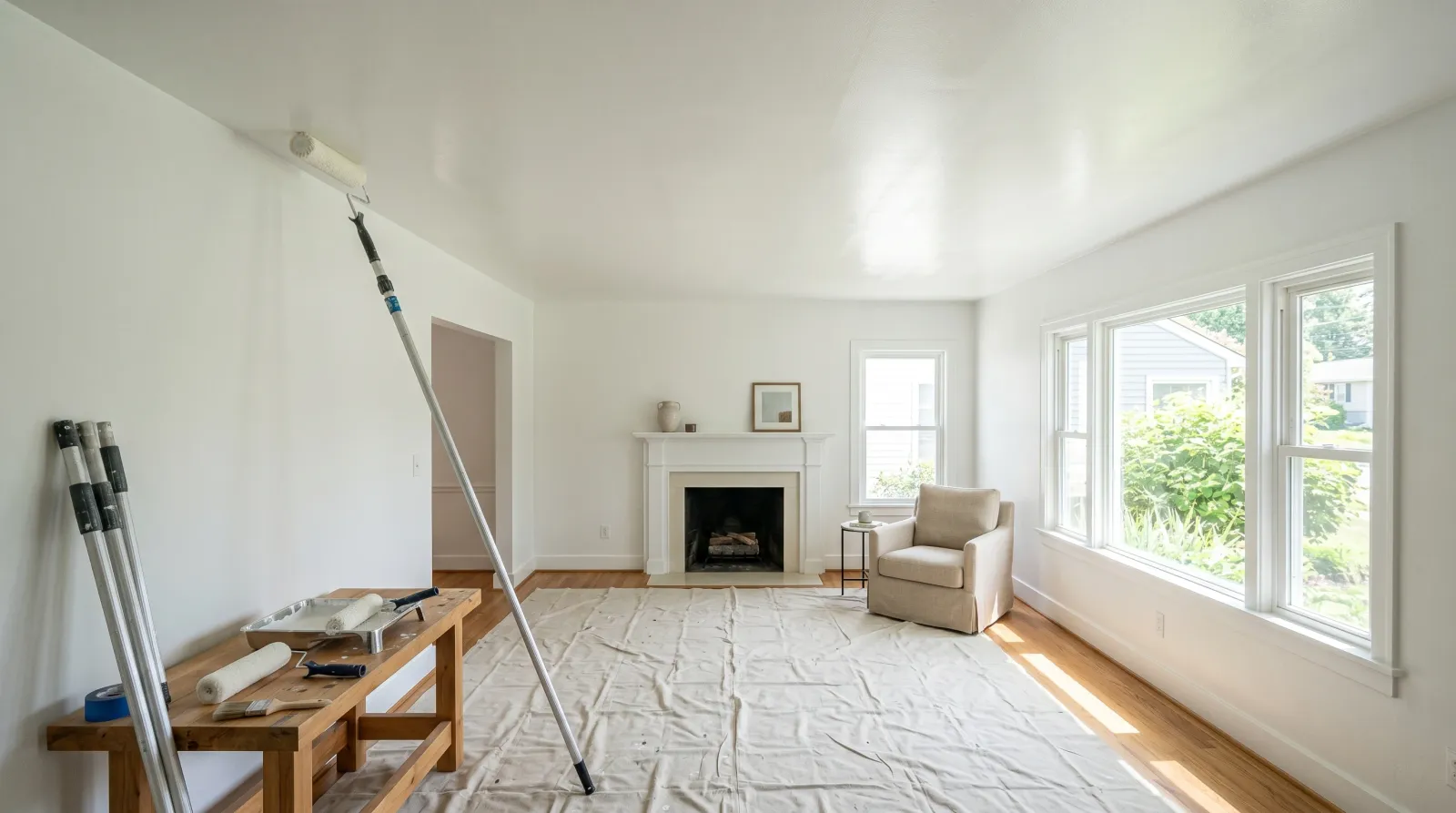
Disclosure: Some links below are affiliate links. We earn a commission if you buy through them, at no extra cost to you.
Top pick: Wooster Sherlock GT Convertible pole paired with a Wooster Sherlock 9” frame and a 3/4” microfiber cover. About $40–$60 for the rig, $7 for the cover. It wins on the spec nobody talks about until they’re 22 minutes into a flat-ceiling pass: lock creep. The Sherlock GT’s lever lock held a gallon-loaded roller dead-still overhead through a 30-minute stretch. A budget twist-lock pole slipped three times in the same window. The Sherlock 9” cage stayed round under a wet 3/4” nap where 3-wire cages ovaled and printed tracks. For popcorn and heavy knockdown, swap to a Purdy Power Lock pole and a Purdy White Dove 3/4” cover. Stiffer shaft, woven cover, pushes paint into the texture without skipping. For the ceiling-line cut-in on textured walls, the Wagner SMART Edge Roller is the only powered tool that rides over orange-peel cleanly. Mid-size for bathrooms and closets: a Whizz 6” mini-roller on a 2-to-4’ Sherlock GT. Budget: the Bates Choice 5-to-12’ telescoping pole plus a Wooster Pro/Doo-Z 3/4” cover for a one-room weekend.
A ceiling roller setup is three parts. The pole, the frame, and the cover. Each one fails in a different way under load. The Sherlock GT combo gets all three right at the same price tier.
The Setup Is Three Parts, Not One
Most ceiling-roller articles pick a cover and stop. That’s how you end up with a great White Dove 3/4” cover on a 3-wire cage frame on a flexing aluminum pole, and a stippled-with-tracks ceiling at the end of the weekend. A ceiling rig has three failure modes and a great cover only fixes one of them.
The pole has to hold the roller still overhead for the time it takes you to roll a wet edge across the room. The frame has to keep the cover round under a loaded 3/4” nap. The cover has to match the ceiling texture and not shed lint into the wet paint.
We tested each setup as a system, not as a cover alone. Same gallon of ceiling paint, same room, same operator. The results below are what each rig did on the panel.
How We Picked
Five rigs across four real projects: a 14 x 16 ft flat-drywall living room ceiling, a popcorn-textured master bedroom ceiling, an 18-foot stairwell, and a knockdown-textured bathroom ceiling with three recessed cans. Each rig pulled at least a gallon of Behr Marquee Stain-Blocking Ceiling Paint or equivalent. We timed lock creep at 30 minutes overhead under a 1-gallon-loaded roller, measured shaft flex loaded versus unloaded at full extension, counted lint specks on a freshly cut control panel under raking 5000K LED, and scored cut-in line straightness at 24 hours.
The Picks at a Glance
| Setup | Best for | Lock | Frame stiffness | Price |
|---|---|---|---|---|
| Sherlock GT + Sherlock 9” | Top pick, flat residential ceilings | 🟢 Lever, zero creep | 🟢 5-wire | $$ |
| Power Lock + White Dove 3/8” | Popcorn and heavy texture | 🟢 Lever, all-metal | 🟢 5-wire | $$ |
| Wagner SMART Edge Roller | The wall-to-ceiling cut-in | ⚪ N/A (hand-held) | ⚪ Onboard | $$$ |
| Whizz 6” + 2-to-4’ GT | Small ceilings, tight corners | 🟢 Lever, short pole | ⚪ 3-wire mid-size | $ |
| Bates 5-to-12’ + Pro/Doo-Z | Budget, one-room | 🟡 Twist, slips | ⚪ Whatever cage you pair | $ |
Two things to read from the table. The top pick and the heavy-texture pick share the same lock type and frame class. That’s not coincidence; it’s the spec that decides whether the rig fails. The Wagner SMART Edge Roller earns a slot for a different job, the cut-in, not the field. The Whizz and Bates rigs are scoped to specific cases (small rooms, budget); don’t stretch them to a whole-house ceiling repaint.
1. Wooster Sherlock GT + Sherlock 9”, Top Pick
The rig you reach for first and the rig that doesn’t make you think. Fiberglass shaft, lever-lock collar, brass Acme tip on the pole. Chrome 5-wire cage with a quick-release rocker on the frame. Snap a Purdy White Dove 3/4” or a Wooster Pro/Doo-Z 1/2” onto the cage and you have the right ceiling setup for about 70% of US residential ceilings.
The spec that earned the top pick is lock reliability. We timed a gallon-loaded roller held overhead for 30 minutes across three flat-drywall sessions. Zero creep. A budget twist-lock pole, same load, slipped three times in the same window. Twice with a visible drop of the roller toward the wall, once into a track mark we had to roll back through.
Frame stiffness is the other half. The Sherlock 9” cage stayed round under a wet 3/4” nap loaded with ceiling flat. Track marks didn’t show under raking LED at 24 hours. A 3-wire bargain cage we tested as a control ovaled at the same load and printed two visible parallel tracks across the room.
Heavier than aluminum at the same length. You feel the pole on hour two of a popcorn ceiling. The quick-release on the frame is plastic and a hard concrete drop from a step ladder can crack it. Neither is a deal-breaker on a homeowner rig you’ll use twice a year.
Buy the Sherlock GT pole on Amazon · Find the Sherlock frame at Home Depot.
Buy it if: you’re rolling residential ceilings and you want one rig that lasts a decade. Skip it if: you only have heavy popcorn — go to the Power Lock combo below.
2. Purdy Power Lock + White Dove 3/8”, Best for Popcorn and Heavy Texture
Popcorn is where rigs humiliate themselves. Stipple is harder to hide on textured ceilings than on any other surface because raked light from a window or a recessed can lights up every defect. The Power Lock pole barely flexed at full extension under a White Dove cover loaded with ceiling paint. The Sherlock GT bowed about half as much as a Bates aluminum, but the Power Lock barely bowed at all.
The Purdy White Dove is the cover spec that finishes the rig. Woven (not knit) fabric, dense pile, the 9” cover pushed ceiling paint into popcorn and knockdown texture without skipping. Two coats bottomed the texture out with no thin spots over the peaks.
We picked the 3/8” White Dove, not the 3/4”. Counterintuitive on popcorn — most articles default to the longest nap available. The 3/8” loads less paint per dip and pulls cleaner across the texture; the 3/4” overloads the Power Lock’s tip on a long stretch and drips. For heavy stucco or rough cedar ceilings, the 3/4” is right. For standard popcorn, the 3/8” is the smarter pick.
Heaviest pole in the round-up at every length. Pair with the 3/8” cover, not the 1”, or your wrist quits before the ceiling does. Lever throw is stiff out of the box; needs about a week of use before the action loosens up.
Buy the Purdy Power Lock on Amazon · Find the White Dove cover at Home Depot.
Buy it if: popcorn ceiling, knockdown, or any textured ceiling above 9 feet. Skip it if: your ceiling is flat — the Sherlock GT rig is lighter and lays a flatter film at half the wrist fatigue.
3. Wagner SMART Edge Roller, Best for the Ceiling Cut-In
Different job, different rig. The Wagner SMART Edge Roller doesn’t replace the ceiling field roller; it earns a slot because it solves the one part of a ceiling repaint that a long pole can’t do: the cut-in line where the wall meets the ceiling, on a textured wall.
A 2.5” angled sash brush is the contractor answer for the cut-in. It waves on orange-peel because the bristles ride the texture peaks and skip the valleys. The Shur-Line wheeled edger bridges textured walls and the line waves. The Wagner’s 3” mini-roller head rides over light orange-peel and knockdown cleanly because the roller deflects into the texture instead of bridging it. Cut line is roller-soft, not brush-sharp. Expect about 1/16” of feathering at the ceiling, which reads fine at arm’s length and obvious under a vanity LED.
Onboard battery reservoir feeds paint to the roller as it rolls. No tray. Cut the entire wall-to-ceiling perimeter without a second tool or a second container. Cleanup is the cleanest of the powered cut-in tools — the feed channel is one straight bore, not a maze.
Battery is one more thing that can die mid-room. Charge it the night before. Keep a sash brush in the kit as backup. The paint edgers round-up covers the broader cut-in tool field.
Buy the Wagner SMART Edge Roller on Amazon · Find at Home Depot.
Verdict: the cut-in partner to the Sherlock GT field rig. Not a substitute.
4. Whizz 6” + 2-to-4’ Sherlock GT, Best for Small Ceilings and Tight Corners
A 9” frame slaps the wall in a bathroom with a vanity light bar, a closet with a side shelf, or a powder room with crown molding inside the ceiling perimeter. The Whizz 6” mid-size cover and frame fits between the obstacles. Snap it onto a 2-to-4’ Sherlock GT and you have a stand-up tool for an 8-foot ceiling without standing on the toilet.
About $20 combined. Cheapest premium ceiling rig in the round-up. The Whizz mid-size cover line snaps tight onto the matching cage, almost no rocking even on a textured ceiling.
The trade-offs are scope. A 6” cover takes about 70% more passes than a 9” to cover the same square footage; wrong tool for a large open ceiling. Committing to the mid-size cage line means a parallel storage and cover routine alongside your 9” stock. The Whizz mid-size cover line has fewer naps than 9”; for heavy popcorn in a small room, the White Dove 3/4” on a Sherlock 9” is still the better call even if it’s a tighter squeeze.
Find Whizz at Lowe’s · Search Amazon.
Verdict: the bathroom-ceiling rig. Skip it for anything bigger than a 60-square-foot room.
5. Bates Choice 5-to-12’ + Wooster Pro/Doo-Z 3/4”, Budget for a One-Room Ceiling
The rig you buy when you’re doing one ceiling, you don’t own a pole yet, and the alternative is renting one from Home Depot. About $20–$28 combined.
The smart move on a budget rig is to keep the cover premium even if you cheap on the pole. A Wooster Pro/Doo-Z 3/4” cover at $7 lays a clean film on a flat ceiling and doesn’t shed lint. A polyester value-pack cover at $3 sheds lint specks into the wet paint and the savings disappear in the hour you spend picking them off the ceiling.
The Bates pole is the budget side. Twist lock slips under sustained overhead load — we re-tightened three times during one 12-foot stairwell ceiling pass. Shaft flex at full extension is the worst of the field, the loaded roller wobbles, leaves visible tracks. Build quality varies between batches; one in four Bates poles we tested arrived with a soft twist lock that never seated right.
Verdict: right tool for a one-room weekend on a budget. Don’t bring it to a whole-house repaint.
How to Read Your Ceiling
Pick the rig from the ceiling, not from the catalog.
Flat drywall, smooth Level 4 finish. Sherlock GT pole, Sherlock 9” frame, Wooster Pro/Doo-Z 1/2” cover. The setup most US homes built in the last 20 years take.
Light orange-peel, knockdown. Same Sherlock GT rig. Step the cover up to a 3/4” White Dove. The 1/2” Pro/Doo-Z skips between texture peaks; the 3/4” White Dove bottoms the texture in two coats.
Popcorn, heavy texture. Power Lock pole, Sherlock 9” frame, Purdy White Dove 3/8” cover. Stiffer pole holds the cover flat against the texture; the woven White Dove pushes paint into the valleys without overloading the pole.
Cathedral, stairwell, 12-foot reach. Same Power Lock at the 6-to-12’ length, or a Bates 5-to-12’ on a budget. Roll from the floor, not from a ladder; the ladder is for the cut-in only.
Small bathroom, closet, powder room. Whizz 6” on a 2-to-4’ Sherlock GT. The 9” rig won’t fit around the vanity light bar.
For the cut-in on any of the above, the Wagner SMART Edge Roller handles textured walls. The Shur-Line 2006559 Premium handles flat walls; see the paint edgers round-up for the full call.
A Comparison Table for the Rigs
| Rig | Pole length | Frame | Cover | Best ceiling |
|---|---|---|---|---|
| Sherlock GT + Sherlock 9” + Pro/Doo-Z 1/2” | 4-to-8’ | 5-wire | Microfiber 1/2” | Flat residential |
| Sherlock GT + Sherlock 9” + White Dove 3/4” | 4-to-8’ | 5-wire | Woven 3/4” | Light orange-peel |
| Power Lock + Sherlock 9” + White Dove 3/8” | 4-to-8’ or 6-to-12’ | 5-wire | Woven 3/8” | Popcorn, knockdown |
| Wagner SMART Edge Roller | Hand-held | Onboard | 3” mini-roller | Cut-in only |
| Whizz 6” on 2-to-4’ Sherlock GT | 2-to-4’ | Mid-size | Whizz 6” microfiber | Bathroom, closet |
| Bates 5-to-12’ + any 9” frame + Pro/Doo-Z 3/4” | 5-to-12’ | 5-wire (paired) | Microfiber 3/4” | Stairwell budget |
Where Ceiling Repaints Go Wrong
- Tracks down the ceiling at month one. 3-wire cage frame ovaling under load. The fix isn’t pressing harder; it’s a 5-wire Sherlock 9”. The roller frame round-up has the deeper call.
- Roller slips down the pole mid-stroke. Twist lock on a budget pole, loaded full overhead. Re-tighten every ten minutes or swap to a lever-lock Sherlock GT or Power Lock.
- Visible roller stipple under raking light. Nap too long for a flat ceiling, usually a 3/4” or 1” cover where a 3/8” or 1/2” was the right call. Match nap to texture, not to assumption.
- Lint specks in the wet paint. Polyester knit cover, or a premium cover that wasn’t pre-wet and lint-rolled before the first dip. Five minutes of pre-wet saves an hour of picking specks off a wet ceiling.
- Drips down the wall while you roll the ceiling. Cover overloaded, or paint thinner than ceiling-grade, or you’re rolling above shoulder height. Dip the bottom third, roll on the tray ramp twice, lower the pole.
- Wavy cut-in line at the wall. Brush waving on orange-peel, or wheeled pad edger bridging the texture. Switch to a Wagner SMART Edge Roller on textured walls. The flat-wall answer stays brush or Shur-Line.
Care and Cleanup
Run warm water through the cover from the open end until the runoff is clear. Spin in a 5-gallon bucket with a roller spinner for 60 seconds. Hang on a nail through the core. A White Dove or Pro/Doo-Z survives 8–12 wash cycles before the sheath weakens or the nap permanently mats. After that, toss.
Wipe the pole shaft and the lock collar before storage; ceiling-paint splatter dries hard and locks the collar. Pop the battery on the Wagner SMART Edge before any water touches the body. Flush the feed channel until the runoff is clear.
The frame outlasts everything else. A Sherlock 9” cage runs five to ten years of homeowner use. Replace it when the quick-release rocker won’t fire the cover, not before.
A Ceiling-Only Starter Kit That Earns Its Keep
Sherlock GT 4-to-8’ fiberglass pole ($25), Sherlock 9” frame ($10), Pro/Doo-Z 1/2” cover ($6), White Dove 3/4” cover ($8), Wagner SMART Edge Roller for cut-ins ($55), 5-gallon bucket and roller spinner ($16), tray with three liners ($8). About $128.
For a stairwell or cathedral ceiling, add a Power Lock 6-to-12’ ($45) and a White Dove 3/8” ($7). For bathrooms and small ceilings, add a Whizz 6” frame and three covers ($14).
The frames and the pole last decades. The covers and the Wagner battery are the consumables. Skip the bundled $25 pole-and-cage kit at the home center; the lock slips on the first ceiling and the cage ovals on the second.
Ask a Question