Best Roller Frames in 2026
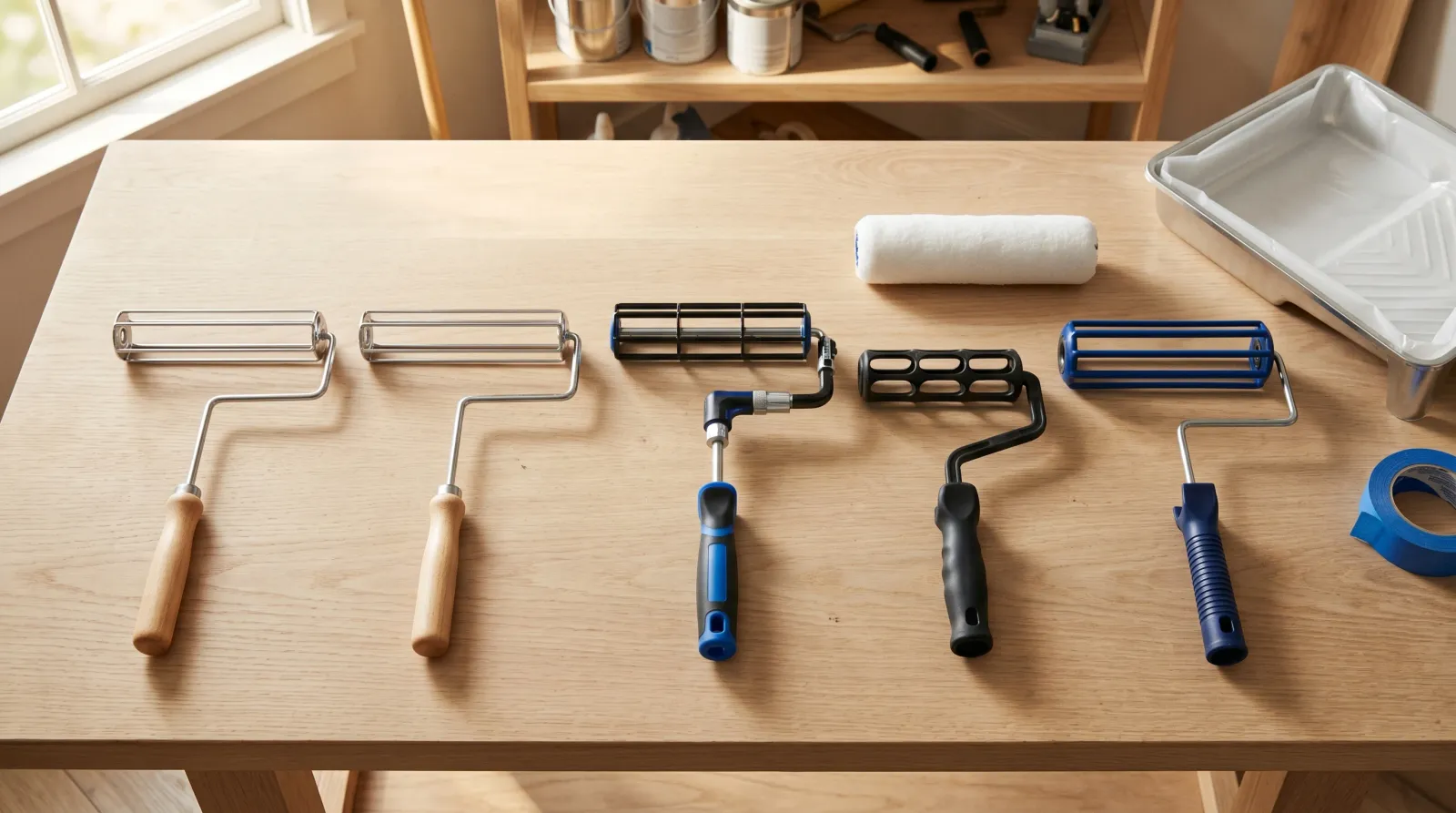
Five paint roller frames tested on walls, ceilings, and exteriors. Top pick: Wooster Sherlock 9" — the cage that holds round under a loaded 3/4" nap without rocking.

Disclosure: Some links below are affiliate links. We earn a commission if you buy through them, at no extra cost to you.
Top pick: Wooster Sherlock 9“. About $10–$13, 5-wire chrome cage, quick-release that pops the cover off at the tray edge without painting your sleeve. It wins on cage stiffness under a loaded cover and on the one-hand release, the two specs that decide whether a frame is a tool or a chore. It falls short on heavier exterior work, where the Sherlock Wide Boy’s stiffer cage and longer aluminum shaft hold a 1“ nap flatter against rough cedar. For sloped ceilings, stair runs, and any awkward angle, the Purdy Revolution Premium Adjustable swivels the cage where a fixed head can’t go. For tight rooms and small cabinets, the Whizz 7“ mid-size frame fits where a 9“ slaps the trim. The Big Ben is the Wooster pick for thick naps and exteriors when you don’t need the pro shaft.
Buy one good 9“ frame and one mid-size, and the rest of your kit moves between them. Skip the bundled $3 cage that comes with a $20 paint kit. The cage is what holds the cover round, and a wobbly cover is what leaves the parallel tracks you’ll see under the kitchen light at coat two.
The Five Frames, on Paper and in Practice
Frames look interchangeable on the rack. They aren’t. We picked five that cover the real homeowner and pro use cases and ran them through the same four jobs we ran the paint roller covers through: a living room repaint, a popcorn ceiling, twelve kitchen cabinet doors, and a cedar-sided shed exterior. The frame stays with the job; the cover gets matched to the surface.
The Sherlock, the Big Ben, and the Sherlock Wide Boy all come from Wooster; they’re not redundant. The Sherlock is the homeowner-into-prosumer 9“ with a quick-release. The Big Ben is the heavier-cage, rubber-handle version for exterior and thick-nap work. The Wide Boy is the contractor upgrade with the longer aluminum shaft and the stiffest cage of the group. The Purdy is the adjustable, which solves a problem none of the Wooster fixed frames touch. The Whizz 7“ is the mid-size answer for tight rooms; nothing in the 9“ family competes for that job.
How We Picked
Each frame ran a full project end-to-end with a matched cover from the roller-cover round-up. We measured cage oval-flex with a digital caliper at the cover ends under a loaded cover held horizontal, scored quick-release function across 30 reload cycles at the tray, and mated each frame to a Wooster Sherlock GT extension pole to confirm Acme-thread compatibility. The pick-specific finding lives in each review below — what this frame did on its panel.
Quick Comparison
| Frame | Cage | Cover size | Best for | Approx. price |
|---|---|---|---|---|
| Wooster Sherlock | 5-wire chrome, quick-release | 9“ | Top pick, interior walls and ceilings | $10–$13 |
| Purdy Revolution Adjustable | 5-wire, pivot head | 9“ | Sloped ceilings, stair runs, awkward angles | $14–$18 |
| Wooster Big Ben | Heavy-gauge chrome | 9“ | Thick naps, exteriors, longevity | $10–$14 |
| Whizz 7“ Premium | Wire cage, snap-fit | 7“ mid-size | Tight rooms, bathrooms, small cabinets | $5–$8 |
| Wooster Sherlock Wide Boy | Heavy 5-wire, aluminum shaft | 9“ | Pro upgrade, all-day jobs, exteriors | $15–$22 |
The Sherlock and the Big Ben overlap on price; they don’t overlap on use. Sherlock for interior. Big Ben when the cover is a 3/4“ or heavier and the surface is rough. Wide Boy when you’re painting more than your own house.
How to Choose a Roller Frame
Cage Stiffness Is the Spec That Matters
The cage is the round armature the cover slides onto. Under a loaded cover, a cheap 3-wire cage flexes into an oval. An oval cage puts uneven pressure on the wall, lays an uneven film, and shows up as faint parallel tracks at coat two under raking light. The fix isn’t pressing softer or buying better paint. The fix is a 5-wire cage. Every frame in this round-up except the Whizz mid-size runs five wires, and the Whizz uses a tighter cage diameter on a shorter span so the geometry holds up at 7“. The bundled cage in a $20 paint kit is a 3-wire. Replace it.
Quick-Release vs Spring Clip
A quick-release frame has a small rocker or button at the cage end; you press it, the end cap retracts, and the cover slides off without you grabbing wet paint. A spring-clip frame holds the cover in place with a small steel spring; you yank the cover off, sometimes one-handed, sometimes not.
Quick-release wins on cleanup. After a wall job, you stand over the tray, press the button, and the cover drops into the bucket. Your hand stays clean. With a spring clip, you pinch the cover off the cage and paint goes on your fingers, your sleeve, your jeans. Spring clips are cheaper and have nothing to break. For a one-cover job, fine. For a real repaint, the quick-release earns the extra $4.
Threaded Tip and Pole Compatibility
The threaded butt at the end of the handle is where an extension pole screws in. The US standard is the Acme thread. Every frame in this round-up uses it. Every standard pole in our extension pole round-up uses it. Avoid any frame with a proprietary tip; the pole you already own won’t fit, and you’ll be stuck buying a pole from the same brand at marked-up prices.
Handle Material
Hardwood handles look pretty and feel grippy when dry. They go slick when wet, which is what happens within five minutes of starting a real job. Rubber-overmold handles stay grippy in sweat and paint, survive a thinner bath without softening, and weigh about the same. The Big Ben runs a rubber overmold; the Sherlock and the Wide Boy run a lacquered hardwood. A quick paper-towel wipe between dips handles the hardwood problem; if you’d rather skip it, the Big Ben is the call.
Width: 9“ Is the Default, 7“ Is the Specialist
A 9“ cage and a 9“ cover handle most rooms in a US house. A 7“ mid-size fits where a 9“ doesn’t: between standard 16“ stud bays around switches and outlets, in bathroom water-closet corners, in closets and small cabinets. The 7“ Whizz isn’t a replacement for a 9“; it’s a second frame for a different category of room. If your house is all open rooms, skip it. If it’s chopped up, buy it.
1. Wooster Sherlock 9“, Top Pick
The Sherlock is the frame you pick up first and the frame that doesn’t make you think. 5-wire chrome cage, hardwood handle, brass Acme-threaded tip, and the quick-release rocker that fires the cover off the cage at the tray edge. We ran it through a 14 x 16 ft living room in Regal Select eggshell with a Pro/Doo-Z 1/2“ cover and got no measurable cage flex on the caliper test, no track marks at coat two under a vanity light bar, and a clean cover-off at the tray every time.
The quick-release is the small luxury that adds up. After three coats across three rooms, the difference between a quick-release Sherlock and a spring-clip cage is roughly thirty seconds saved per cover times nine covers, which is the difference between cleaning up at six and cleaning up at seven. The rocker is plastic; a hard drop on a concrete floor can crack it, but normal use is fine. We dropped one frame off a stepladder onto hardwood and it survived without a scuff.
Where the Sherlock loses is heavier exterior work. With a 1“ Purdy Marathon loaded for a cedar shed, the cage flexed about a millimeter at the end caps under horizontal hold. The Big Ben and the Wide Boy didn’t. A millimeter doesn’t sound like much, but on a long board with a 1“ nap pushing into rough wood, it’s the difference between an even film and a slight wobble.
| Spec | Value |
|---|---|
| Cage | 5-wire chrome |
| Cover size | 9“ (also sold for 12“, 14“, 18“) |
| Release | Quick-release rocker |
| Handle | Lacquered hardwood, brass Acme tip |
| Approx. price | $10–$13 |
Buy it if: you paint walls and ceilings and you’ll wash and reuse covers. Skip it if: the work is mostly exterior, where the Wide Boy is stiffer.
2. Purdy Revolution Premium Adjustable 9“, Best for Awkward Angles
The Adjustable is the frame for rooms a fixed frame fights you in. The pivot head angles up to about 75 degrees, which means the cover sits flat against a stair-rise, a soffit return, the underside of a sloped ceiling, or the back panel inside a deep closet. With a fixed Sherlock you’d torque your wrist to keep the cover flat, and the resulting pressure is uneven down the stroke. The Adjustable just rotates the cage to the surface and you keep your wrist neutral.
We measured cage flex on the pivot head and got slightly more rocking than the Sherlock at the joint when we pressed hard. Light pressure rolls clean. Heavy pressure introduces a wobble. The fix is technique: load the cover heavier and roll with less pressure. The grip is a soft overmold and is meaningfully less fatiguing than the Sherlock’s hardwood on a 45-minute ceiling session.
The friction screw that holds the pivot angle in place loosens after about two hours of use. Check it before every wall. If it slips back to neutral mid-stroke, you’ll feel the cover roll up off the surface. About $14–$18, the most expensive frame in the round-up.
Buy it if: stairs, sloped ceilings, soffits, or deep closets. Skip it if: all your walls are flat and 9 feet tall.
3. Wooster Big Ben 9“, Best for Thick Naps and Exteriors
The Big Ben is what the Sherlock would be if you doubled the cage gauge and put a rubber handle on it. We ran it through the cedar-shed exterior with a 1“ Marathon nap. The cage didn’t flex on the caliper test, the rubber-overmold handle stayed grippy through rain spray and paint splatter, and the steel threaded butt took the Sherlock GT pole at full extension without stripping.
It’s heavier on the wrist by about 30%. For interior walls in 1/2“ nap, that extra weight fatigues the wrist faster than the Sherlock does. The cage diameter is also slightly looser than the Sherlock; with a thin-nap microfiber cover, the cover rocks a touch unless the end caps grip tight. With a 3/4“ or 1“ nap, the geometry seats snug and the rocking goes away. The Big Ben is built for thick naps; pair it accordingly.
The handle is the unsung win. After three days of an exterior job, the rubber overmold looks the same as day one. A hardwood handle would be paint-stained and starting to soften at the grip.
Buy it if: exteriors, thick-nap interior ceilings, and cabinetry with heavy enamel. Skip it if: light-nap interior walls only; the Sherlock is more comfortable for that.
4. Whizz 7“ Premium Mid-Size Frame, Best for Tight Rooms
The Whizz 7“ is the frame the 9“ frames can’t replace. It fits between standard 16“-on-center studs, clears wall switches and outlets without slapping the trim, and rolls a bathroom or a coat closet in a single span without three corner restarts. We ran a Whizz 7“ with a 7“ foam cover on a kitchen cabinet box and the smaller cage tracked the door rail without overhanging the stile. A 9“ frame would have lapped onto the stile and stippled the next coat.
The trade-off is the cover line. The Whizz cage takes Whizz-line 4“, 6“, and 7“ covers; it doesn’t take a 9“ Wooster Pro/Doo-Z or a 9“ Purdy White Dove. That means a parallel cover inventory and a parallel cleanup. For homeowners with mostly small rooms, the Whizz line covers all the cases. For homeowners with one big living room and a couple of bathrooms, the Whizz becomes a specialist tool that handles 15% of the job while the Sherlock 9“ handles the other 85%.
The wire cage flexes more than the Sherlock under a wet 3/4“ nap. It’s fine on bathroom walls in a satin sheen. It’s marginal on a textured ceiling. Don’t push the 7“ Whizz into a job a 9“ Sherlock handles cleaner. Five to eight dollars at every Lowe’s in the country.
Buy it if: your house has tight rooms or you do a lot of small-cabinet enamel work. Skip it if: you live in open floor plans and the only small space is a single bathroom.
5. Wooster Sherlock Wide Boy 9“ Pro Frame, Best Pro Upgrade
The Wide Boy is the contractor version of the Sherlock. Heavy 5-wire cage, longer aluminum threaded shaft, the same quick-release rocker. Zero measurable oval-flex on the caliper test with a 1“ Marathon loaded for the cedar shed; the Sherlock flexed a millimeter, the Wide Boy held flat. On the cabinet doors with a thin-nap cover, the stiffer cage and the slightly longer shaft let us reach the back rail of a 24“ door without leaning over the workbench.
The aluminum shaft doubles as a short-reach pole frame for an 8-foot kitchen ceiling. You don’t need an extension pole on a normal kitchen; the Wide Boy’s shaft handles the height without one. The trade-off is weight: 30% heavier than the Sherlock, and the aluminum shaft transmits cold in winter and gets slick when wet because the rubber grip is only partial. A wrap of grip tape on the shaft solves it.
The Wide Boy earns its $15–$22 if you paint more than your own house. For a single-house homeowner, the Sherlock at half the price does 95% of the same work.
Verdict: the pro frame. Buy it once and it outlasts most of your covers, your tape, and your paint trays.
Frames We Tried and Dropped
- HDX 9“ bargain cage from Home Depot. 3-wire, ovals under load, leaves tracks at coat two. The bundled frame in a $20 paint kit is the same one. Skip.
- Bates Choice 9“ frame. Cheap and fine for a single job; we used it on a closet repaint with no complaints. The cage is okay, the spring clip is fine, the price is right. Cut because the Sherlock at $5 more is better at everything.
- Foam-handle generic frames. The foam grip absorbs paint and starts to crumble inside a job. A rubber overmold lasts. Don’t pay for foam.
- 18“ wall frames. Cuts time on big open walls. Useless in tight rooms with outlets, returns, and switches. Specialty; not a primary frame.
Care, Cleanup, and Longevity
A roller frame outlasts the cover by 50 to 100 cycles. Take care of it.
After every job, pop the cover off, run the cage under warm water from the open end, and rotate it under the stream until the runoff is clear. Dry the cage on a paper towel, mate it back to a clean cover spinner if you have one, and hang it by the handle. Don’t store a wet frame inside a sealed bag; the steel wires rust at the cap weld first.
Hardwood handles need a quick wipe-down with a damp cloth after every job. A wax pass once a year keeps the lacquer from cracking. Rubber-overmold handles need nothing.
The Acme-threaded tip is the failure point. Cross-thread it onto a pole once at an angle and the threads strip. Mate the pole to the frame straight, finger-tight first, then turn the pole a half-turn back. If the threads ever feel rough, stop and back off; forcing it kills the thread.
A frame lasts 5–10 years of weekend painting if you wash it after every use and don’t drop it on concrete. The Sherlock and the Big Ben in our shop are both over 4 years old and read the same as new.
Common Mistakes
- Buying the cage that comes bundled with the cover. A bundled $3 cage is a 3-wire. Replace it with a Sherlock.
- Running a thin-nap cover on the Big Ben. The loose cage diameter rocks. Pair the Big Ben with 3/4“ or 1“ naps; pair the Sherlock with 3/8“ and 1/2“.
- Cross-threading the pole. Mate finger-tight first, then turn the pole a half-turn back. Forced threads strip in one cycle.
- Switching between oil and latex on the same frame. Trace mineral spirits in the cage fish-eye into the next latex dip. Keep a second cheap frame for oil work, or scrub the cage with detergent and dry overnight between paint types.
- Storing a wet frame in a sealed bag. The cage wires rust at the welded end caps first. Hang the frame open.
- Pressing harder when you see tracks. The cause is an oval cage, not light pressure. A 5-wire frame fixes it; pressing harder doesn’t.
What the Frame Is Worth in the Kit
For a homeowner doing a couple of rooms a year: Sherlock 9“ ($12), Whizz 7“ mid-size ($6), the Wooster Sherlock GT extension pole from the extension pole round-up ($35), and a Wooster Jumbo-Koter 4-1/2“ mini frame ($8) for trim. About $60 in frames, total. They’ll last the next ten years of repaints. Add the Sherlock Wide Boy if you’re painting your second house and your sister’s.
The cover is the consumable, the paint is the consumable, the frame is not.