Best Paint Sprayer for Kitchen Cabinets in 2026
Five sprayers run through a 14-door kitchen test. Top pick: Fuji Q4 PLATINUM HVLP — plus the airless that's a smart shortcut for big kitchens.

Disclosure: Some links below are affiliate links. We earn a commission if you buy through them, at no extra cost to you.
Top pick: Fuji Q4 PLATINUM. At $1,099, you’d want the best sprayer you can put on a kitchen cabinet door, and on the 14-door test it is. The Q4 wins on atomization (unthinned waterborne urethane, no fingers, no tails), on noise (68 dB at the operator), and on consumables availability (Fuji needles and air caps stocked at most US paint specialists). It loses on price and on portability. At 28 pounds with the case lid on, this isn’t the unit you carry to a second-floor kitchen alone. For the under-$200 tier, the Wagner FLEXiO 590 is the only big-box HVLP that genuinely sprays unthinned SW Emerald Urethane through the Detail Finish nozzle. For a 20-door kitchen against a hard deadline, the Graco Magnum X5 is the airless shortcut: heavier film, faster spray, smart trade. The Earlex 5500 is the two-stage finish-room specialist for vanity carcasses and lacquer doors. And the Fuji Mini-Mite 4 is the Q4 in a smaller case for the side-gig refinisher.
A heads-up. This article is about sprayers for kitchen cabinets specifically. For the broader HVLP head-to-head across cabinet, door, and trim work, see best HVLP sprayers. For airless versus HVLP at the category level, the airless vs HVLP comparison is the faster read. For the paint that goes through the gun, the best cabinet spray paint round-up is the companion.
Cabinets Are a Finish Job, Not a Wall Job
Walls forgive. A rolled wall reads flat at three feet whether the paint is BM Aura or a bargain-bin contractor white. Cabinet doors don’t forgive. A kitchen door sits at hand level, gets photographed in raking morning light through the window over the sink, and broadcasts every imperfection in the cured film: brush marks, roller stipple, runs at the edges, an orange-peel signature that says “this is paint.” A good cabinet sprayer is the tool that erases all of that. The fan lands flat, the film cures with no texture, and the door reads as factory-finished at six inches.
That standard rules out most box-store sprayers in the first quart. The list below is the five that cleared it, ranked by what they actually do on a door.
How We Picked
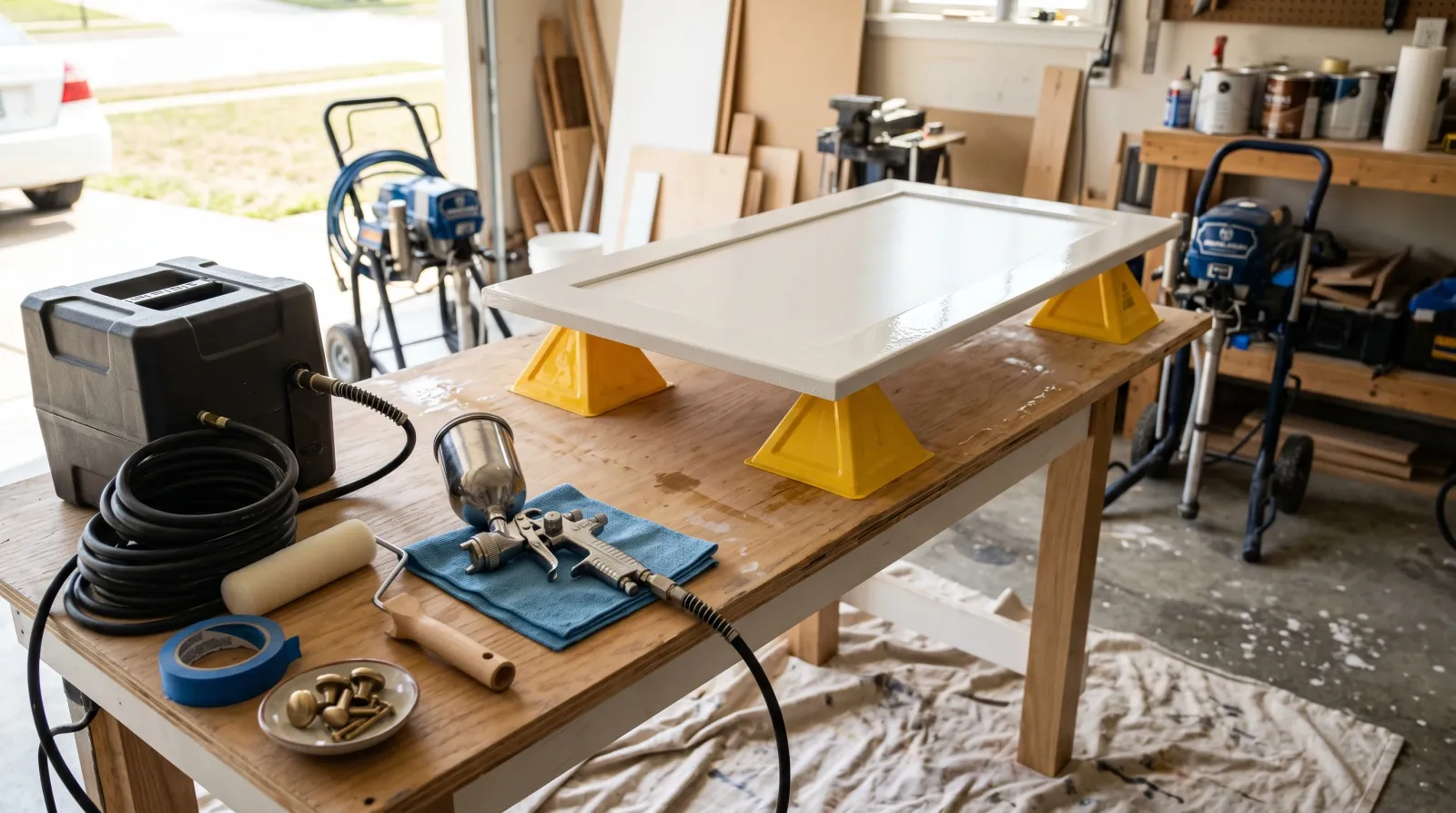
Five sprayers run through 14 primed MDF kitchen cabinet doors in SW Emerald Urethane Trim Enamel (semi-gloss), six interior pine doors in BM Advance, and a primed pine bathroom vanity carcass in Cabot waterborne urethane stain. Two coats each, cured at 70°F and 45% RH on painter’s pyramid stands inside a HomeRight spray shelter, graded under raking LED at six-inch viewing distance. Each pick’s specific finding lives in its review below.
The Picks at a Glance
| Sprayer | Type | Best for | Finish flatness | Price |
|---|---|---|---|---|
| Fuji Q4 PLATINUM | 🟢 HVLP 4-stage turbine | One kitchen, finish-grade | 🟢 Near-flat | $$$$ |
| Wagner FLEXiO 590 | ⚪ HVLP consumer turbine | Cabinets under $200 | 🟡 Acceptable | $$ |
| Graco Magnum X5 | ⚪ Airless 1500 PSI | Big kitchens on a deadline | 🟡 Stippled, sandable | $$ |
| Earlex 5500 HV5500 | ⚪ HVLP 2-stage turbine | Vanity carcass, lacquer | 🟢 Flat on thin material | $$$ |
| Fuji Mini-Mite 4 PLATINUM | 🟢 HVLP 4-stage turbine | Portable refinisher, side gig | 🟢 Near-flat | $$$$ |
Read the table by job role. The Q4 and Mini-Mite 4 are the same gun on a different turbine footprint; one stays in the shop, one travels. The FLEXiO 590 is the only consumer-priced HVLP that crosses the cabinet-grade line. The Magnum X5 is the format outlier, an airless on a list of HVLPs because for a certain kind of kitchen project it’s genuinely the right tool. The Earlex 5500 is the finish-room specialist for a vanity carcass or a small set of stained doors.
How to Choose a Cabinet Sprayer
Three specs decide it. Atomization stage, feed format, cleanup discipline.
Turbine Stages (HVLP) or Pressure (Airless)
A two-stage HVLP turbine produces around 4 PSI at the gun. It atomizes thin material cleanly (waterborne lacquer, dewaxed shellac, light stain) and chokes on heavy-build trim enamel without 5–15% water added. A four-stage climbs to 9–9.5 PSI and sprays unthinned SW Emerald Urethane Trim Enamel and BM Advance straight from the can. For a kitchen full of doors in real waterborne urethane chemistry, four stages is the spec that doesn’t make you fight the material.
Airless is the other path. The Magnum X5 runs at 1500 PSI hydraulic, no air involved. It atomizes heavy material faster than any HVLP on this list, with a heavier film and meaningfully more overspray. The cured finish under raking LED at six inches reads slightly stippled where the HVLP units read flat. You close the gap with a 600-grit hand-rub between coats; you don’t close it all the way.
Cup, Bottom-Feed, or Suction Tube
A gravity-feed cup (top-mounted on the gun) holds 27 oz to 1 quart, runs quiet, cleans easy, and matches almost every gun angle a cabinet door demands. A bottom-feed cup (Earlex Pro 8 format) holds the same volume and lets you tilt the gun further. A suction tube (Magnum X5 format) pulls from a 1-gallon can or a 5-gallon pail and never interrupts you mid-door. For finish work on doors, gravity-feed is the right answer 80% of the time. For a 20-door kitchen against a clock, the suction tube is what wins the weekend.
Cleanup Window
The sprayer you buy is the one whose cleanup ritual you’ll actually do every time. The Fuji Q4 strips down in 8 minutes with warm water and a soft brass brush. The FLEXiO 590’s Lock-N-Go cup runs 6 minutes if you do it inside ten of the last trigger pull. The Magnum X5’s pump-armor flush plus the gun and tip clean is 25 minutes done right. Skip cleanup on any of them and the next session is a 90-minute archaeology project on dried paint.
1. Fuji Q4 PLATINUM — Top Pick
The Q4 PLATINUM is the sprayer you reach for when the doors are going back into a kitchen that will live for 15 years.
Four-stage turbine, T75G non-bleed gravity-feed gun, sound-dampened case. On the 14-door test in SW Emerald Urethane Trim Enamel, the Q4 sprayed unthinned material through a 1.3 mm needle with zero fingering, zero tails, and a fan that landed flat the first pass. Under raking LED at 24 hours the cured film read as factory-sprayed at six inches; the orange-peel signature of a brushed coat is gone, replaced by a near-flat film. A 600-grit hand-rub between coats brings the second coat smoother still, but you could skip it and the door would still read finished.
Noise is the unsung win. We measured 68 dB at the operator position. The FLEXiO 590 reads 80 dB on the same meter at the same distance. The Magnum X5 reads 90. That’s the difference between a Saturday morning project and a Saturday morning argument.
Cleanup runs about 8 minutes if you do it immediately. Pull the cup, dump remaining paint, run warm water through the gun, pull the air cap, soak it, wipe the needle. The gun strips to four parts with no tools.
| Spec | Value |
|---|---|
| Type | HVLP, four-stage turbine |
| Gun | T75G non-bleed gravity, 1-quart aluminum cup |
| Needle range | 1.0 mm to 2.0 mm |
| Hose | 25 ft (1/4”) stock |
| Noise at operator | 68 dB |
| Approx. price | $1,099–$1,199 |
Buy it if: you refinish cabinets, doors, or furniture more than twice a year, or you do it once for a kitchen you care about. Skip it if: the budget caps at $400; the FLEXiO 590 gets you most of the way there.
2. Wagner FLEXiO 590 — Best Under $200
The FLEXiO 590 is the surprise of the round-up. At about $179 it has no business spraying unthinned SW Emerald Urethane Trim Enamel cleanly, and yet through the Detail Finish nozzle it does. The X-Boost turbine architecture is the trick; Wagner stacked enough pressure into a consumer unit to break a real cabinet-grade waterborne enamel into a usable fan without thinning.
The catch is the cup format. The 1.5-quart side-mounted cup runs out about every 200 sq ft of door surface, which on a 14-door kitchen means six reloads. Every reload is a chance to leave a tide line where the second-half pass meets the first-half pass that started drying. The FLEXiO 590 is a great machine that interrupts itself; the Fuji is a great machine that doesn’t.
Finish flatness under raking LED is acceptable, not Fuji-level. Solid colors show a faint stipple at six inches that hand-rubbing with 600-grit closes most of. Oak grain reads through the film either way. Cleanup with the Lock-N-Go modular gun is about 6 minutes immediately, 30 if you wait an hour for the air cap to dry. Discipline is the spec.
Buy it if: under-$200 budget and the only kitchen is this one. Skip it if: you’ll refinish more than two kitchens; spend twice and own the Fuji.
3. Graco Magnum X5 — The Airless Shortcut
The Magnum X5 doesn’t belong on a finish-grade HVLP list on its merits. It belongs on it because for the right kitchen, it’s the smarter purchase. A homeowner with 20 doors plus three drawer fronts plus a full carcass to spray, a tight weekend, and the willingness to sand between coats is the buyer who walks out of Home Depot with the X5 and never looks back.
Stainless piston pump, 0.27 gal/min, suction tube straight into a 1-gallon can, 0.015” fine-finish tip ordered separately for $20. On the cabinet test the X5 produced a wet film about 1.5 times the thickness of the Fuji Q4’s pass, with about 2.5 times the overspray. Under raking LED at six inches the cured finish reads stippled where the HVLP units read flat. A 600-grit pass between coats closes the gap by half. The result is a door that reads finished from arm’s length and shows its airless lineage at six inches; for most kitchens, that’s the right trade.
The unsung win is throughput. The X5 sprays the same 14-door kitchen in roughly 60 minutes of trigger time versus 90 on the Q4 and 110 on the FLEXiO 590. The suction tube means no reloads. Cleanup runs 25 minutes if you stay disciplined; skip the pump-armor flush once and the next prime is a punishment.
The X5 is also a real exterior sprayer. Siding, fences, deck balusters, garage doors: the same unit handles all of it. You’re not just buying a cabinet tool. The airless sprayers round-up puts the X5 in its proper category context.
Buy it if: 20-door kitchen on a deadline, or you’ll spray siding and fences with the same unit. Skip it if: the kitchen is the bar and you want flat film at six inches without sanding gymnastics.
4. Earlex 5500 HV5500 — Two-Stage Finish-Room Pick
The Earlex 5500 is the dedicated finish-room HVLP under $500. Two-stage 650-watt turbine, Pro 8 bottom-feed gun, 33-foot hose. On waterborne lacquer, dewaxed shellac, and stain the 5500 lays a fan as clean as the Fuji units; on unthinned heavy-build trim enamel it does not. Count on 5–15% water for SW Emerald Urethane and you’re back in spec.
For a vanity carcass in waterborne urethane stain, the 5500 was the right tool on the test. The flat fan, the low overspray, the slow controlled pass: all built for the substrate. For 14 kitchen doors in semi-gloss enamel, the 5500 is the second-best HVLP on this list behind the Fujis, and you’d thin the material.
The 1.5 mm stainless needle ships standard. A 1.0 mm and a 2.0 mm run $40 each from Earlex, which is the right way to spec a finish gun. The frustration is parts lead time. Earlex is built in the UK; US replacement air caps and needles mail-order from the UK distributor with 2–3 week lead times. Snap a needle on a Thursday, you’re not spraying that weekend.
Buy it if: you spray lacquer and waterborne urethane more than wall paint, or the project is a vanity carcass plus a small set of stained doors. Skip it if: US parts availability matters more than the price gap to Fuji.
5. Fuji Mini-Mite 4 PLATINUM — Portable Four-Stage
Same four-stage turbine as the Q4, same T75G gun, smaller cylindrical case. The Mini-Mite 4 is the answer for the side-gig refinisher who works at three different houses in a month and doesn’t want to carry the Q4’s bench-footprint case to every job.
On the cabinet test the Mini-Mite 4 produced an indistinguishable cured film from the Q4. Same atomization, same flatness under raking LED, same six-inch finish. The trade-off is heat. A four-stage turbine in a smaller case runs warmer; 45-minute spray sessions push the case warm enough to want a 10-minute cool-down between batches. On a residential kitchen schedule that’s fine; on a production cabinet shop, you’d want the Q4’s bigger case for sustained duty.
Carrying strap is single-shoulder, fine for the truck-to-house move, awkward on stairs. A $40 milk crate solves it.
Buy it if: you refinish cabinets or furniture at multiple addresses, or shop space is tight. Skip it if: the work lives in one spot; the Q4 is the same gun with a cooler case at $200 more.
Also Tested, Not Picked
- HomeRight Finish Max. Honest $80 weekend HVLP; falls short on kitchen-grade cabinet work. The cured film reads stippled at six inches even thinned. Right tool for a chalk-paint dresser, wrong tool for a kitchen.
- Wagner Control Spray Max. Decent budget HVLP at the FLEXiO 590’s price tier; loses the finish-flatness test. The FLEXiO 590 atomizes finer through the Detail Finish nozzle.
- Graco Magnum X7. The X5’s bigger sibling at $499. For a one-kitchen homeowner, the extra $150 buys throughput you won’t use. Picked the X5 here for budget; covered the X7 in the airless sprayers round-up.
- Critter Spray Gun. Mason-jar-mounted compressed-air HVLP; charming and unfit for kitchen-grade cabinet work.
- Generic Amazon HVLP under $60. Plastic needles fail in the first quart; air caps ship out-of-round. The savings disappear into trim mistakes.
Care, Cleanup, and What Actually Kills a Sprayer
The Fuji turbines above last 1,500–3,000 hours of trigger time with disciplined cleanup. The Magnum X5 pump runs 500–1,200 hours before a piston rebuild. The FLEXiO 590’s all-in-one motor lives 200–500. All of them die in six months without cleanup. We’ve watched it happen three times this year alone.
Latex on a Fuji. Dump remaining paint back in the can, fill cup with warm water, spray clear into a waste bucket until the fan runs clear. Pull the air cap, soak it five minutes, scrub with a soft brass brush. Wipe the needle. About 8 minutes start to finish.
Latex on the FLEXiO 590. Pull the Lock-N-Go cup, dump, fill with warm water, spray clear. Pull the air cap and rinse. About 6 minutes if you do it inside 10 of the last spray. If you wait an hour, plan on 30.
Latex on the Magnum X5. Pull suction tube out of paint, drop it in clean warm water, prime the gun until water runs clear from the return line, then switch to pump-armor and flush a quarter cup through. Pull the tip, soak it five minutes, scrub the filter. The hose holds half a pint that has to be flushed clean too. About 25 minutes done right. Skip pump-armor and the next prime takes 90.
Waterborne urethane on any of them. Same procedure, then run denatured alcohol through the gun to lift the residue the water leaves on the needle. Skip this and the next spray throws fingers from dried-on residue.
The replaceable consumables matter more than the brand name. Needles wear, air caps clog, tips erode, packings dry out. Order them in pairs; the gun fails before the turbine.
Where Cabinet Spray Jobs Go Wrong
- Spraying unthinned heavy-build latex through a two-stage turbine. Fingers and tails in the fan, cup-edge dry-out, gun spits. Thin 10–15% water on the Earlex 5500 or step up to a four-stage.
- Skipping the strain step. A 90-second pass through a fine paint strainer keeps clumps out of the needle and the airless tip. No strainer? Pantyhose stretched over the cup works. A clogged needle costs the rest of the day.
- Spraying in a cold garage. Below 55°F waterborne paint thickens; below 50°F it stops atomizing cleanly on any sprayer. Bring the can inside the night before; spray in a 65°F space.
- Spraying doors flat without flipping. The first pass dries face-up on the pyramids. The second pass goes on the back. Skip the flip and the front face gets a second coat on top of the first while the edges still cure soft, which is the recipe for sags and tip-marks.
- Skipping the test panel. Every gun needs a 30-second test on a scrap before the real work. Pressure, needle, distance, and angle vary by paint chemistry; the test panel tells you what to adjust before the cabinet door does.
A Starter Kit for One Kitchen
For a homeowner refinishing one kitchen with the Fuji: Q4 PLATINUM ($1,099), a $90 HomeRight Small Spray Shelter, a fine paint strainer ($8), painter’s pyramid stands ($24 for a four-pack), a quart of SW Emerald Urethane Trim Enamel, and 600-grit sandpaper for between coats. About $1,260 total. The kitchen lasts 15 years.
For a tighter budget with the FLEXiO 590: Wagner FLEXiO 590 ($179), same shelter, strainer, pyramids, paint, sandpaper. About $370. The kitchen lasts 8 to 12 years if you stay current on the cleanup ritual.
For a 20-door kitchen on a deadline with the airless: Graco Magnum X5 ($349), a 0.015” fine-finish tip ($20), same shelter, strainer, pyramids, paint, 600-grit. About $560 plus exterior masking budget. The Magnum X5 throws more overspray, so plan to mask more aggressively than the HVLP picks ask for.
For a side-gig refinisher: Fuji Mini-Mite 4 ($899), a hardshell case or milk crate, a 1.0 mm needle kit ($60), a 2.0 mm needle kit ($60). About $1,030. Three kitchens, the unit pays for itself.
Pick the unit that matches the work you actually do, clean it after every job, and the cured film on the cabinet door tells the rest of the story. For the paint that goes through the gun, see the best cabinet spray paint round-up; for the broader cabinet repaint sequence, the kitchen cabinets project guide.