Best HEPA Shop Vacs for Sanding Dust
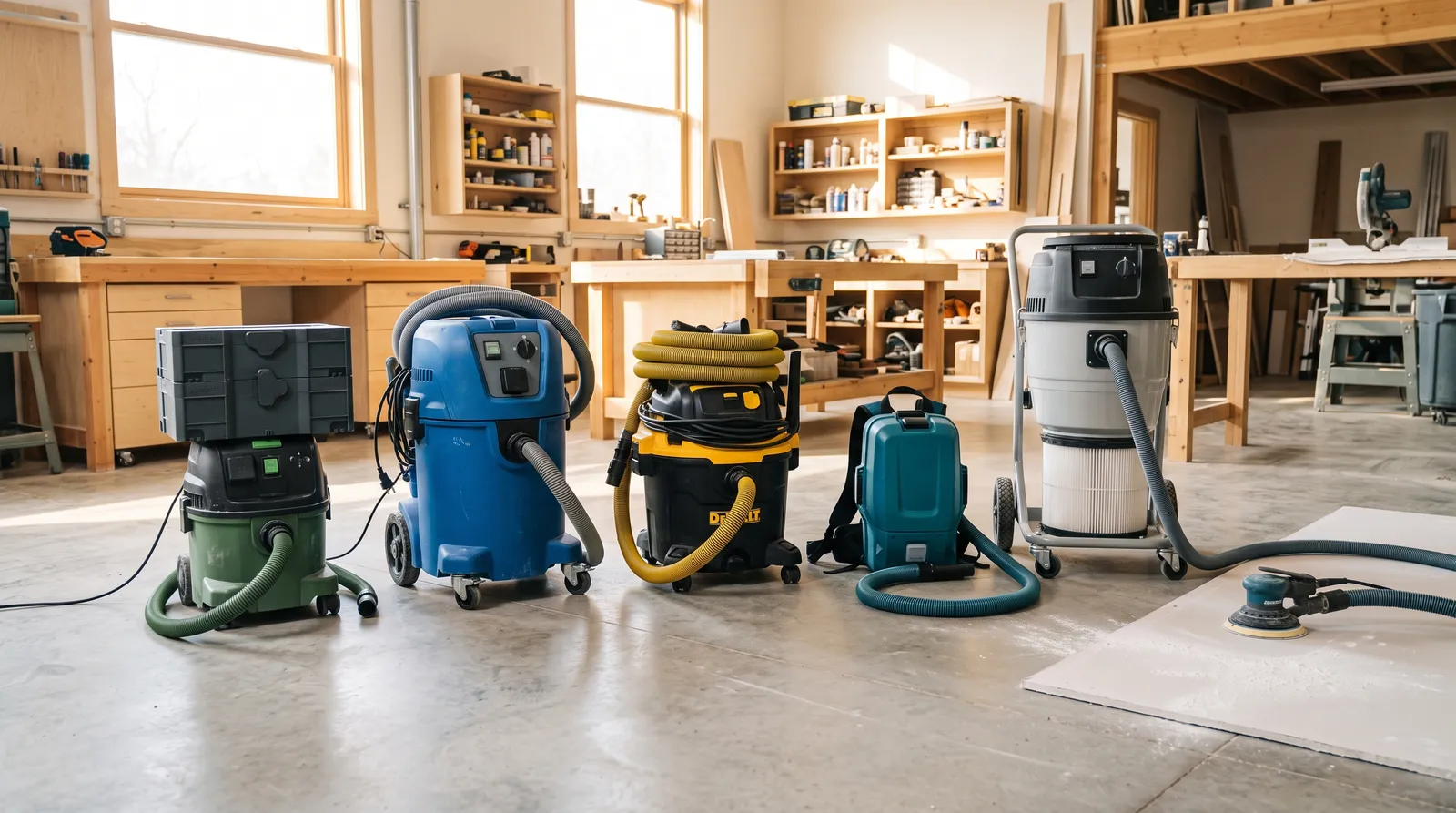
Five HEPA vacuums tested on drywall mud, old paint, and cabinet sanding. Top pick: Festool CT 26 EI HEPA, plus a Bosch that costs half as much and where each one falls short.

Disclosure: Some links below are affiliate links. We earn a commission if you buy through them, at no extra cost to you.
Top pick: the Festool CT 26 EI HEPA. Roughly $850 by the time it’s on your floor, 6.9 gallons, a certified HEPA main filter, and five levels of variable suction that let you dial the pull down until your sander stops sticking to the wall. It wins on control and on filtration you can trust. It falls short on price and on tank capacity. If $850 for a vacuum makes you laugh, the Bosch VAC090AH does most of the same work for about half. For jobsite abuse and the lightest corded body here, the DEWALT DWV010. For a set of cabinet doors with no cord in the way, the Makita XCV11Z. For a whole-house skim coat where you’re changing bags all day, the 14-gallon Bosch VAC140AH.
All five capture 99.97 percent of particles at 0.3 microns and larger.
Your shop vac does not, and that’s the entire reason this page exists.
HEPA, HEPA-Type, and the Vac Already in Your Garage
The filter aisle at any home center sells a “HEPA material filter” that drops into a standard wet/dry vac for about $30. It is not the same thing as a HEPA vacuum, and the wording is doing careful legal work.
HEPA is a media standard. It says the filter medium captures 99.97 percent of particles at 0.3 microns. It says nothing about the machine the medium sits in. A $90 shop vac has four or five paths dust can take that never touch the filter: the tank gasket, the lid latches, the hose cuff where it presses into the tank inlet, and the motor housing itself. Pull hard enough on fine gypsum dust and it finds all of them.
A certified HEPA extractor is sealed and tested as a whole system. The lid clamps against a real gasket. The bag self-seals when you pull it. The exhaust is downstream of the media instead of leaking around it. That’s the difference you’re paying for, and it’s why a room sanded with a real extractor stops being hazy the moment you switch the machine off.
I’ve watched a shop vac with a fresh HEPA-material filter fog a bedroom in four minutes. Same room, same mud, same sander, the Bosch VAC090AH left a black tarp ten feet away almost clean at the end of six hours.
What Drywall Dust Actually Does to a Vacuum
Joint compound sands into something closer to flour than sawdust. That changes the problem in three ways.
It blinds a pleated filter fast. Fine gypsum doesn’t sit on the pleats, it packs into them, and a filter that started at full airflow can be down noticeably inside an hour of continuous sanding. This is the reason automatic filter cleaning exists, and it’s the single most useful feature on any extractor under $600.
It settles in the hose. Sawdust travels. Drywall dust drops out of the airstream any time velocity falls, which is why a long hose on a weak vac quietly builds a sleeve of packed mud dust along the bottom of the line until suction dies. Water lift, measured in inches of static lift, is the spec that fights this. CFM is what marketing prints.
And it gets everywhere the machine isn’t sealed. Old paint sanding is worse, because pre-1978 paint chips and dust are a health issue rather than a housekeeping one. If you’re prepping a 1962 hallway, the vac is safety equipment. Match it with a P100 and the right prep sequence from the repaired drywall guide before you start.
How I Ran This Test
Three jobs, eight weeks, same hose length and same fleece bag type wherever the machine allowed it.
The skim coat. A 14 by 16 foot bedroom, full skim, sanded out with a 5-inch random-orbit sander and a pole sander. About six hours of near-continuous dust per machine. This is the volume test and the filter-blinding test.
The lead-era hallway. A 1962 corridor with four layers of paint on jamb and casing, sanded and scraped under lead-safe procedure with every bag sealed on removal. This is the containment test.
The cabinet job. Twenty-two doors stripped and re-sanded on a bench. Low volume, high precision, and the test where suction control matters more than power.
I tracked four things. How fast suction faded between filter cleanings, judged by lifting the hose off a sealed surface and by how hard the sander became to push. Whether visible dust escaped at the tank gasket and the lid seam. How each machine behaved when the sander pad sealed flat against smooth drywall. And how much dust settled on a black tarp laid ten feet from the work by the end of each session.
Filters got weighed dry before and after each job. That number tells you which machines are loading their media and which are shedding dust into the tank and out the exhaust.
The Festool won the cabinet job outright, on suction control. The two Bosch machines won the skim coat on filter pulse. The DEWALT won the stairs, because it weighs 21 pounds and the others don’t.
The Five, Side by Side
| Brand / Model | Tank | Airflow | Filter cleaning | Best for | Price tier |
|---|---|---|---|---|---|
| Festool CT 26 EI HEPA | 6.9 gal | 138 CFM, 5-level variable | Manual | Cabinets, trim, fine sanding | $$$$ |
| Bosch VAC090AH | 9 gal | 150 CFM, 97.3 in. lift | Auto, every 15 sec | Drywall, general prep | $$$ |
| DEWALT DWV010 | 8 gal | 150 CFM | Auto, every 30 sec | Jobsite, stairs, RRP work | $$$ |
| Makita XCV11Z | 2 gal | 57 CFM, 27 in. lift | Manual clean system | Cabinets, ladders, cordless | $$ |
| Bosch VAC140AH | 14.5 gal | 150 CFM, 97.3 in. lift | Auto, every 15 sec | Whole-house drywall | $$$ |
1. Festool CT 26 EI HEPA, Top Pick
The CT 26 is the extractor everyone else gets compared to, and the reason isn’t the filter. Every machine here has a good filter. The reason is the suction dial.
Set a random-orbit sander to full extraction on a flat, freshly skimmed wall and the pad seals to the surface. The sander stops orbiting freely, the motor bogs, your wrist takes the load, and the finish comes out with fine swirl marks you’ll see the moment primer goes on. Every fixed-suction extractor here does this. The CT 26 has five suction levels, and somewhere around level two the sander floats and cuts the way it’s supposed to. On the 22-door cabinet job that difference showed up on the doors, not just in my forearm.
The rest of the machine is built to match. The antistatic hose has a smooth outer skin, so it slides over a door casing instead of catching and dragging dust across a surface you just cleaned. The onboard outlet triggers the vac from a corded tool. Festool cordless sanders start it over Bluetooth. The self-sealing bag closes as you pull it out, which is what makes emptying a HEPA vac actually contain anything.
What it doesn’t do is clean its own filter. There’s no automatic pulse, so on a six-hour skim-coat session you feel the suction taper and you stop to knock the filter out by hand. The 6.9-gallon tank is small for that kind of work. And the price is the price: about $850 with the hose, plus Festool-priced bags and HEPA filters afterward.
| Spec | Value |
|---|---|
| Container | 6.9 gallons |
| Max airflow | 138 CFM |
| Suction control | Five levels, variable |
| Filtration | HEPA main filter, self-sealing bag |
| Tool start | Corded outlet plus Bluetooth for Festool cordless |
| Approx. price | $800–$900 |
Buy it if: you sand for a living, or you’re doing fine finish work where a sander sticking to the surface costs you a coat. The suction dial is the whole argument. Skip it if: your job is high-volume drywall. Buy a Bosch, put the savings into a better sander.
2. Bosch VAC090AH, Best Value in Certified HEPA
Different problem, different machine. The VAC090AH is what I’d hand almost every reader of this page.
It’s certified HEPA at 99.97 percent of particles 0.3 microns and larger, same rating as the Festool. It moves 150 CFM with 97.3 inches of static water lift, which is enough to pull mud dust through 15 feet of hose without letting it settle in the line. And it cleans its own filter every 15 seconds, automatically, which is the feature that decides a long sanding day.
On the skim-coat job I ran the Bosch for six hours straight and the suction at the end felt like the suction at the start. That’s the filter pulse doing its job. The Festool, same room, same mud, wanted a manual filter knock after about ninety minutes.
The Power Broker dial is the other quiet win. It splits available amperage between the vac and whatever’s plugged into its outlet, so a 15-amp sander and a vacuum on the same 20-amp bedroom circuit don’t trip the breaker every twenty minutes. Anyone who has sanded in a 1960s house knows that specific frustration.
Where it loses: no variable suction. It pulls hard, always, and a light sander will glue itself to flat drywall. The workaround is a bleeder valve in the hose or a strip of tape across the port. It weighs 28 pounds with a wide stance, and it does not want to come up a staircase. And the 15-second filter pulse is loud enough that you hear it over the sander, forever.
Buy it if: you want certified HEPA and all-day suction at roughly half the Festool money. This is the value pick and it isn’t close. Skip it if: most of your sanding is finish work on cabinets or trim, where the fixed suction fights you.
3. DEWALT DWV010, Best for Jobsite Abuse
Twenty-one pounds. That’s the pitch, and after two flights of stairs it’s a good one.
The DWV010 is the lightest corded extractor in this group by a wide margin, and it’s the one I reached for on the 1962 hallway because that job meant moving the machine constantly. Automatic filter cleaning pulses every 30 seconds instead of every 15, which is noticeably quieter than the Bosch and still held suction fine on paint dust, though on heavy gypsum it fades a little faster.
The box is the whole kit: two HEPA filters, a fleece bag, and a 15-foot antistatic hose. Nothing to buy on day one. With the DWV9330 filter set it’s EPA RRP compliant, which is the paperwork you need on any pre-1978 house. If you’re not sure what you’re dealing with, test before you sand and read the peeling exterior paint fix if the failure is on siding rather than trim.
The 8-gallon number is optimistic. The filter chamber eats into it and usable capacity is closer to six. The latches are the weak point, mine got stiff after a few months of dust in the hinge, and the hose goes rigid in a cold garage and fights you in a tight stairwell.
Verdict: the extractor for people who carry their tools. Lightest body, full kit in the box, RRP-ready.
4. Makita XCV11Z, Best Cordless
Two gallons, 10.1 pounds, no cord, and real HEPA filtration rather than a HEPA-style filter. That combination doesn’t exist anywhere else at this price.
The XCV11Z was the machine that made the cabinet job pleasant. Fifty-seven CFM and 27 inches of water lift is modest on paper, and in practice it’s exactly right for a 5-inch random-orbit sander on a door face. It doesn’t seal the pad to the surface the way the big corded machines do. It goes up a ladder with you on the optional shoulder strap, which matters if you’re sanding a stair rail or crown. One 5.0Ah battery runs about an hour, which covered a full set of doors with a swap at lunch.
The tank is two gallons. On drywall dust you’ll empty it before lunch and again before you go home. It’s tool-only, so budget for a battery and charger if you’re not on Makita 18V already. And there’s no outlet to trigger it from a corded tool, so you start and stop it by hand.
Buy it if: your sanding is cabinets, trim, furniture, and patch cleanup, and you’re tired of dragging a cord. Around $200 tool-only.
5. Bosch VAC140AH, Best for Whole-House Drywall
Same engine as the VAC090AH, bigger stomach. Fourteen and a half gallons, 150 CFM, 97.3 inches of water lift, the same 15-second filter pulse.
The case for it is bag changes. On a full-house skim coat, a 9-gallon machine sends you to the truck three times for every one trip with this one, and each trip costs ten minutes and a bag. The wide wheelbase also stays upright when a stiff hose pulls sideways, which the tall narrow extractors do not.
It weighs 38 pounds and it will not fit through a standard attic hatch. For anything smaller than a whole-house job it’s a lot of vacuum to push around.
Verdict: buy it if you’re a drywall or plaster contractor. Skip it if you’re a homeowner, no matter how good the sale is.
Vacs I Looked At and Passed On
- Ridgid 14-gallon NXT with a HEPA-material filter. The vac is fine and the filter is real HEPA media. The system isn’t sealed or tested as a HEPA unit, and on the skim-coat test I could see dust at the lid seam. Good shop vac, wrong tool for sanding.
- Milwaukee M18 FUEL 9-gallon wet/dry vac. Excellent cordless machine with a high-efficiency filter, not a HEPA filter. If Milwaukee ships a HEPA version it moves straight onto this list.
- Fein Turbo II. 151 CFM and 98 inches of water lift, and the build quality is genuinely first-rate. It ships as a standard-filter machine in the US, so the HEPA question depends on which filter you order. Confirm before you buy.
- Festool CT MIDI I. Same suction control as the CT 26 in a smaller body. Cut only because the tank is too small for the drywall work most readers come here for.
- Any $90 shop vac plus a $30 HEPA filter. This is the setup most people actually own, and it’s the one I’d argue with. See the first section.
Picking One: The Specs That Decide It
Certified HEPA vs a HEPA Filter
Read the phrasing on the box. “HEPA filter” describes media. “HEPA vacuum,” with a system-level claim and usually an RRP or OSHA reference, describes a sealed machine. For sanding dust, only the second one does what you want.
Water Lift Beats CFM
CFM is the number on the front of the box. Static water lift is the number that carries flour-fine gypsum through 15 feet of 1-1/4-inch hose without letting it settle. The Bosch machines publish 97.3 inches. The Makita publishes 27, which is honest and appropriate for a 2-gallon cordless. A vac with big CFM and weak lift will clog its own hose on a skim coat.
Automatic Filter Cleaning
Under $600, this is the feature I’d prioritize over everything except HEPA certification itself. Fine gypsum packs into pleats within the hour. A machine that pulses its filter holds suction all day; one that doesn’t sends you to knock the filter out by hand every ninety minutes, in a room full of the dust you’re trying to control.
Hose Diameter and the Cuff
Most sander dust ports want a 1-1/4-inch hose with a tapered cuff. A 2-1/2-inch shop-vac hose does not fit, and the step-down adapter is exactly where the leak lives. Check the fit against your actual sander before you buy, especially if you’re running an older tool. The orbital sander round-up covers which ports match which hoses.
Bags Are Not Optional
Run a self-sealing fleece bag for sanding dust. Bagless HEPA captures the dust and then hands it back to you at the dumpster. Bags also protect the pleated main filter, which on these machines runs $50 to $120 to replace. A $6 bag that extends filter life by several jobs is the cheapest thing you’ll buy for this vacuum.
The Running Cost Nobody Budgets
Extractors are not a one-time purchase, and the sticker price hides about a third of what you’ll spend.
Fleece bags run roughly $4 to $8 each, and on serious drywall work you’ll use one to two per room. HEPA main filters run $50 to $120 depending on brand, and even with bags in use they’re consumables. Plan on one filter change a year with regular use, more if you’re sanding plaster or concrete.
Hoses wear. The antistatic ones split at the cuff first, usually where they’ve been stepped on. A replacement Festool or Bosch hose is $80 to $140, which is a genuinely annoying number for a piece of tubing.
Over three years of steady use, budget half the machine’s price again in consumables. That math is part of why the Bosch VAC090AH beats the Festool for most people: the filters and bags cost less too.
Mistakes I Keep Seeing
- Running the extractor with no bag to save $6. You capture everything, then release it into the driveway when you dump the tank. The bag is the containment step, not an accessory.
- Full suction on flat drywall. The pad seals, the sander stalls, and the finish takes swirl marks. Dial the suction down, or tape a bleeder gap into the port on a fixed-suction vac.
- Using a 2-1/2-inch shop-vac hose with an adapter. Every adapter joint leaks fine dust at exactly nose height. Get the right hose diameter for your sander.
- Skipping the respirator because the vac is HEPA. Extraction at the tool captures most of the dust, not all of it, and sanding old paint puts what escapes right at your face. Wear a P100. The respirator round-up covers which ones seal on which face shapes.
- Sanding before the mud is fully dry. Wet compound gums the paper, loads the hose, and packs the filter with a paste no pulse system can clear. Give it the time the bucket says.
- Buying the 14-gallon because it was on sale. Thirty-eight pounds is a decision you make once and regret on every staircase.
What I’d Buy, by Job
One room a year, and mostly patch-and-paint work: skip the purchase. Rent an extractor from a tool yard for about $50 a day, spend the money on a better sander and a real respirator, and read the primer explainer before you skim anything, because most of the sanding people do is fixing a primer decision they made too fast.
Regular homeowner projects and a room or two a year of real drywall: Bosch VAC090AH. Certified HEPA, automatic filter cleaning, all-day suction, roughly half the Festool.
Cabinets, furniture, trim, and fine finish work: Festool CT 26 EI HEPA. The suction dial pays for itself in surfaces you don’t have to re-sand.
Cabinets on a budget, or anything up a ladder: Makita XCV11Z, around $200 if you already own Makita batteries.
Drywall or plaster for a living: Bosch VAC140AH, and buy bags by the case.
If you’re standing in the aisle with $500 and no strong preference, take the Bosch VAC090AH and a box of fleece bags. It’s the least regrettable purchase on this page.
Ask a Question