The Complete Deck Refinishing Kit
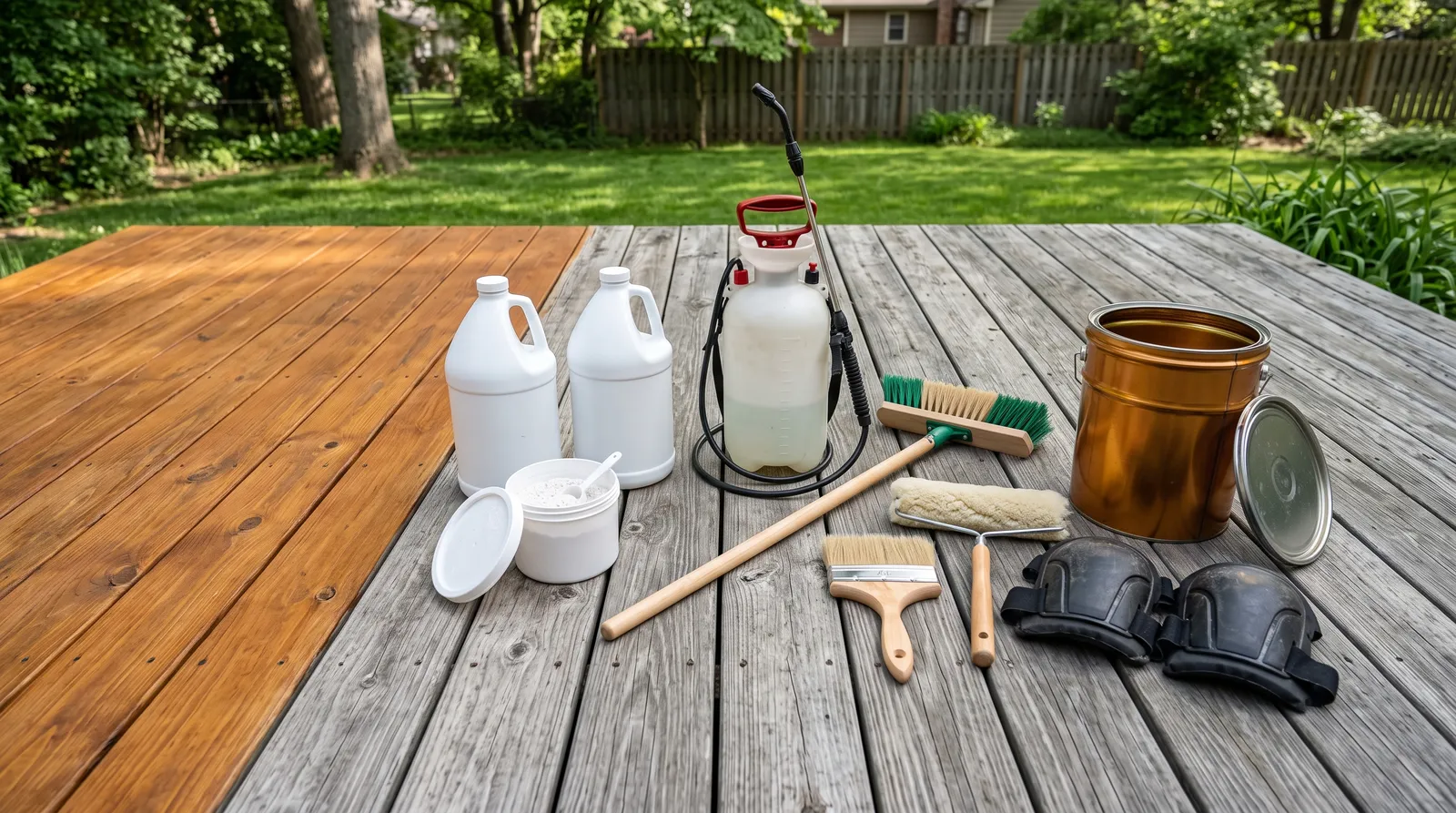
The nine deck refinishing supplies I actually buy before a strip-and-stain weekend. Top pick: Ready Seal Natural Cedar, plus the cleaner, brightener, sprayer, and applicators that earn their spot.

Disclosure: Some links below are affiliate links. We earn a commission if you buy through them, at no extra cost to you.
Top pick for the stain: Ready Seal in Natural Cedar. About $190 for the 5-gallon pail, no primer, no wet-edge panic, no lap marks, and it goes on wood that is still faintly damp. It wins on forgiveness, which is the spec that matters most when a first-timer is 40 boards into a hot Saturday. It falls short on cure, since the color does not settle for roughly 14 days, and on service life, since a horizontal oil finish wants a maintenance coat every 2-3 years. Everything else on this list exists to prepare the wood for it or to move it out of the pail.
Nine items. About $270 for a 300-square-foot deck, stain included.
That is the whole point of this page. A deck refinish is not one purchase, it is a chain, and the weakest link decides how the finish looks in September. I have watched people spend $200 on premium stain and put it over wood they rinsed with a hose. It blotched. They blamed the stain.
Why the Prep Products Cost You More Than the Stain Does
The stain is the part people research. Our deck stain round-up covers that choice in depth. The prep is the part that decides the outcome.
Weathered deck boards are not just dirty. The top layer of a gray deck is chemically damaged wood, a shallow crust of degraded lignin and dead fiber that has no structural bond to the board underneath. Stain applied over it soaks into a layer that is already coming off. Six months later the finish flakes and the homeowner concludes the stain failed. The stain did what it was told.
Cleaner removes that layer. Brightener resets the pH so the fresh wood underneath accepts the finish evenly. Both steps cost about $40 combined, and skipping either one is how a $250 project becomes a $250 project you do twice.
The cheapest possible version of this kit is a jug of bleach and a garden hose. Do not do that. Chlorine bleach breaks down lignin, which is the glue holding wood fibers together, and it leaves the surface fuzzy and weak while doing very little to actual mildew below the surface. It looks like it worked. Two seasons later you have a deck that sheds fibers under a bare hand.
How I Ran the Test
Two decks, one Michigan season, April through July 2026.
Deck one was a 320 sq ft pressure-treated southern yellow pine deck built in 2019, never sealed, fully weathered to gray, with 40 linear feet of railing and 96 balusters. That baluster count matters; it is where applicator choice stops being a preference and starts being an hour of your life.
Deck two was a 180 sq ft western red cedar deck carrying a failing three-year-old semi-transparent coat, mostly shaded, with the black tannin streaking around fasteners that cedar always gives you.
Both decks were split into sections so cleaner and brightener combinations ran against each other on the same wood, in the same weather, on the same day. Cleaners were graded on gray lift after one 15-minute dwell and scrub, on fiber damage judged by dragging a bare palm across the dried board, and on how much of the lawn died. Brighteners were graded on color shift photographed against a fixed reference card at the same hour on the same overcast day, then on stain uptake evenness two weeks after the finish coat.
Stains went down by pad on the open field and by brush on the railings, timed per 100 sq ft, then graded at 30, 60, and 90 days for color hold, water beading, and lap-mark visibility. The pine deck’s south-facing half carried Ready Seal and DEFY Extreme side by side for the UV comparison.
The knee pads were tested the honest way. I wore them for two full weekends and wrote down when the straps started sliding.
The Shopping List
| Item | What it does | Price tier |
|---|---|---|
| DEFY Wood Cleaner | Lifts gray, kills mildew, opens the grain | $ |
| DEFY Wood Brightener | Neutralizes the cleaner, evens stain uptake | $ |
| Libman #547 Floor Scrubber | Agitates the cleaner so it actually works | $ |
| Chapin 20000 pump sprayer | Puts cleaner and brightener down evenly | $ |
| Ready Seal Natural Cedar | The finish, top pick | $$ |
| DEFY Extreme | The finish, full-sun alternative | $$$ |
| Wooster Bravo Stainer 4.75-inch | Railings, balusters, board edges | $$ |
| Wooster wool applicator, 10-inch | Open deck boards, fast | $ |
| NoCry KneeGuard Professional | Your knees, on 96 balusters | $$ |
Two of those are alternatives to each other, not additions. Buy one stain, not both.
1. DEFY Wood Cleaner, Step One
Sodium percarbonate, sold as a powder, mixed in the sprayer tank. It is oxygen bleach chemistry rather than chlorine, which is the whole reason it belongs in this kit. It lifts the gray crust and kills mildew without attacking the lignin that holds the board together.
On the pine deck I mixed one tank at label strength, sprayed a 10x10 section, let it sit 15 minutes while it foamed, then scrubbed with the Libman. The gray came off as gray water. The board underneath was the color of fresh lumber with an orange cast to it, which is normal and is exactly what the brightener fixes in the next step.
Two things will make this product look like it failed. Letting it dry on the board before you scrub, which happens fast in direct sun and leaves a streak you have to redo. And skipping the scrub entirely, which is the version most people do. The chemical loosens the crust. Mechanical agitation removes it. Spray-and-rinse gets you maybe 40 percent of the result.
One 2.25 lb tub covered both test decks with powder left over. Call it under $15 of cleaner per deck.
Buy it if: your deck is gray, or spotted with black mildew, or both. Skip it if: the existing finish is a solid stain or paint that is peeling, which is a stripper job and a different product. Start with our peeling exterior paint fix instead.
2. DEFY Wood Brightener, Step Two
This is the step nobody photographs and everybody should.
Oxalic acid, mixed and sprayed on after the cleaner has been rinsed and the deck has drained. Ten minutes of dwell, rinse again, done. There is no scrubbing. The whole thing adds about twenty minutes to the day.
What it does is chemistry you can see. Freshly cleaned pressure-treated pine comes out of the cleaning step with an orange-brown cast and a slightly alkaline surface. The acid neutralizes the pH, drops the orange back toward a natural tan, and dissolves the black iron tannin stains that bloom around screws and joist hangers on cedar. On the shaded cedar deck, the streaks around every fastener were gone in one application.
The real payoff shows up two weeks after staining. The brightened test section took Ready Seal evenly, board to board. The section I cleaned but did not brighten took it in patches, darker where the alkalinity had been highest, and by day 30 the difference was obvious from the kitchen window.
Buy it if: you used a cleaner. Those two purchases are one purchase.
3. Libman #547 Floor Scrubber
A flat-headed stiff-bristle scrubber with a threaded socket for a pole. About $18.
The flat head is the spec. Most cheap deck brushes have a slightly curved bristle profile, which means at any given moment about a third of the bristles are in the air. The 547 keeps the whole face on the board. On checked, splintery pressure-treated pine the stiff fibers get down into the grain cracks where the gray sits deepest.
Thread it onto a painter’s extension pole and you scrub standing up, which turns a miserable job into a merely tedious one. Any pole from our extension poles round-up fits.
It is narrower than a dedicated 24-inch deck brush, so a 500 sq ft deck is a real workout. And the bristles splay after two or three full decks. At $18 that is fine; it retires to the garage floor.
4. Chapin 20000 SureSpray, 1 Gallon
Under $20, and the reason your cleaner goes on evenly instead of in puddles.
You can apply deck cleaner with a watering can. It will be uneven, you will use twice the chemical, and the strong spots will lighten the wood more than the weak spots. The Chapin’s adjustable nozzle gives you a fan wide enough to cover a board in one pass and tight enough not to mist your hostas.
The funnel-top tank matters more than it sounds like it should. Powdered cleaner goes straight in with water, gets shaken, and sprays. No mixing bucket, no funnel, no measuring cup you then have to explain to somebody.
Seals are the compatibility question with any sprayer. The poly tank and Viton seals handle percarbonate and oxalic acid without complaint; after a full season of both, mine still holds pressure. What it does not handle is oil-based stain. The wand gasket swells and the sprayer is done. Spraying deck stain is a bad idea anyway on a windy day next to a house, and back-brushing is required regardless, which erases the speed advantage.
One gallon means refilling on anything over 300 sq ft. If you do this yearly, the battery-powered Chapins are worth the jump.
5. Ready Seal Natural Cedar, Top Pick
Ready Seal is the stain I hand people who have never done this before, and it is the one I would use on my own deck.
It is a penetrating oil. No primer, no film, no wet-line drama. You pour it into a tray, run the wool pad down a board, and the material self-levels as it soaks in. Overlaps disappear. Stops and starts disappear. On the pine deck I deliberately stopped mid-board twice, walked away for ten minutes, and came back. Neither stop is visible today.
It also goes on damp wood. That single property saved the cedar deck job when a Thursday-night rain would otherwise have pushed everything to the following weekend.
Coverage on weathered pressure-treated pine ran closer to 130 sq ft per gallon than the label suggests, which is normal for thirsty first-time wood. The 320 sq ft pine deck plus railings took just under three gallons.
Two honest cons. The color takes about 14 days to reach its final tone, so the deck you look at Sunday evening is darker and blotchier than the one you get in two weeks. People panic at hour six. Do not. And it is an oil on a horizontal surface, which means a maintenance coat every 2-3 years. The maintenance coat is easy, a wash and a recoat with no stripping, because there is no film to fail. Compare that to a solid stain that needs a full strip at year five and the math looks different.
Third thing, and it is a safety item rather than a con: the rags and pads self-heat as the oil cures. Bucket of water or flat on concrete. Never balled in a bag.
Buy it if: this is your first deck, or your deck is shaded, or you value not having to be perfect. Skip it if: the deck bakes in full southern sun all day and you want three years of color hold instead of two.
6. DEFY Extreme, the Full-Sun Alternative
Different chemistry, different buyer.
DEFY Extreme is waterborne, carrying zinc nano-particle UV blockers that work the way sunscreen works. On the south-facing half of the pine deck it held color visibly better than the oil at the 90-day mark, and that gap is the reason to buy it. If your deck is in direct sun from mid-morning to evening, UV is the thing killing your finish, not water.
Cleanup is a hose. No mineral spirits, no solvent smell drifting into a bedroom window, no self-heating rags. On a second-story deck outside a nursery, that is the deciding factor.
The trade-off is that it is unforgiving. It wants a wet edge maintained board to board, it wants genuinely dry wood underneath, and it shows every stop where the oil hides them. Work in full-board runs, two people if the deck is wide, and do not start at noon on an 85-degree day.
Pricing is $59.99 a gallon and $269.99 for the 5-gallon pail, above the oil options.
Buy it if: full sun, low odor requirement, and you are comfortable keeping a wet edge.
7. Wooster Bravo Stainer, 4.75-Inch
96 balusters. That number is why this brush is on the list.
The Bravo Stainer holds more stain per dip than any brush this size has a right to. On oil, that means you can run a full 12-foot board edge or four balusters before reloading, and the reload trip is where deck jobs bleed time. Natural bristle also moves penetrating oil into the grain rather than skating it across the top, which shows up as deeper color in the checks and cracks.
Wooster makes it in 2.75, 4, 4.75, and 5.5 inch widths. The 4.75 is the sweet spot for deck work: wide enough for board faces near a wall where the pad cannot reach, narrow enough to control on a baluster.
Buy the right bristle. Natural bristle in waterborne stain goes limp and useless within minutes, so if you chose DEFY Extreme, get the natural-and-polyester blend version. And clean it in mineral spirits the same day; oil stain left overnight in a natural bristle brush sets like cement.
8. Wooster Wool Floor Applicator, 10-Inch
The speed item. About $15, threads onto the same extension pole as the scrub brush.
Wool pad on open deck boards covers two to three times faster than the brush, and it lays penetrating oil down flat enough that overlaps blend without back-brushing on most boards. On the pine deck the 10-inch pad did the entire open field in under an hour.
It cannot touch railings, balusters, or the gaps between boards. It is half a system, and the Bravo Stainer is the other half.
One quirk worth knowing: the pad loads heavy and drips on its first pass off the tray. Start on a board you will walk over later, not the one by the back door.
9. NoCry KneeGuard Professional
The item people cut from the cart and regret at hour three.
Deck work is knee work. A weathered pressure-treated board is a field of splinters and proud screw heads, and folded towels stop being padding after about fifteen minutes. The KneeGuard uses a gel core behind a hard outer cap, so pressure spreads and sharp things do not reach you.
The two-strap design above and below the calf is the reason they stay put. Single-strap pads rotate off the knee and end up on the shin, which is why most people conclude knee pads do not work.
The hard shell will scuff a freshly stained board if you kneel back into a wet section, so plan your route and work toward the exit. And they are warm. On a 90-degree afternoon you will notice.
What I Left Off the List
A pressure washer. Rented, misused, it fuzzes softwood permanently and leaves wand stripes that telegraph through every future coat. A hose and the Libman got both decks clean. If you have 800 sq ft and want the speed, read our pressure washer prep guide first and use a 40-degree tip.
A sander. Deck sanding is for splintered boards and railings you actually touch, not for the field. If yours needs it, that is a job for an orbital and 60-80 grit, covered in the sandpaper guide.
Chlorine bleach and generic “deck wash.” Bleach degrades lignin and leaves fuzzy weak fiber. It also does not brighten. Percarbonate plus oxalic acid is the pairing that works.
Painter’s tape. You do not mask a deck. Stain on siding wipes off wet, and if you are spraying near a house you already made a different mistake.
Plastic sheeting for the shrubs. I tried it and it traps heat and cooks the plants underneath. Wet the beds down before you start, wet them again after, and the runoff dilutes. A canvas drop cloth over anything precious works better than plastic, for the reasons in our drop cloth round-up.
Sizing the Kit to Your Deck
Under 200 sq ft, shaded. Cleaner, brightener, scrub brush, sprayer, 2 gallons of Ready Seal, the wool pad, one Bravo Stainer. Roughly $190. Skip the knee pads only if you have no railings.
300-400 sq ft with railings. The full nine-item list, 3 gallons of stain, about $270. This is the standard suburban deck and the standard kit.
Over 500 sq ft. Buy the 5-gallon stain pail, add a second scrub brush, add a helper. The per-gallon savings on the pail covers both applicators. Consider renting the pressure washer at this size.
Cedar or redwood, any size. Same kit, and the brightener step gets more important, not less. Tannin streaking around fasteners is a cedar signature and oxalic acid is what removes it.
The Order of Operations
Wet the deck and the surrounding plants. Spray cleaner, 15-minute dwell, do not let it dry. Scrub with the grain. Rinse hard. Spray brightener, 10 minutes, rinse. Walk away for 48 hours.
Come back, sprinkle water on a board. If it beads, wait another day. If it soaks in within ten seconds, stain. Work out your gallons first with the coverage and gallons math so you are not driving to the store mid-job.
Railings and balusters first with the brush, working top down so drips land on unfinished wood. Then the field boards with the wool pad, full board runs, starting at the far corner and finishing at the stairs. Do not paint yourself into the middle of the deck. People do.
Then leave it alone for two weeks before deciding how it looks. The step-by-step version of that sequence lives in our deck staining project guide, and the broader substrate rules are in the exterior wood guide.
Mistakes That Cost People a Weekend
- Staining wood that is not dry. The surface dries in hours, the board takes two days. Sprinkle test, every time.
- Skipping the brightener. Invisible on day one, obvious on day thirty, and by then the fix is a full strip.
- Bleach instead of percarbonate. Weakens the wood, does not brighten, gives you fuzzy boards you cannot fix.
- Buying stain for the chip color. Deck stain color is 70 percent the wood underneath. Test on an actual board from your deck, in your light, and wait the full two weeks before judging.
- One coat on brand-new pressure-treated lumber. New PT is wet from the treatment plant and will not accept much of anything. Let it weather three to six months, clean it, then stain.
- Rolling stain on with a paint roller. Too much material, too fast, and it puddles in the grain and stays tacky for a week. Wool pad or brush.
- Balling up the oily rags. They heat as they cure. Bucket of water, or flat on concrete.
If your deck is gray, shaded, and you have never done this: DEFY Wood Cleaner, DEFY Wood Brightener, the Libman, the Chapin, three gallons of Ready Seal Natural Cedar, the wool pad, the 4.75-inch Bravo Stainer, and the knee pads. Two weekends, about $270, and you will not touch it again for three years.
Ask a Question