How to Paint a Nursery — Safe Picks and Order
First-timer plan for painting a nursery before baby: zero-VOC paint, low-fume primer, ventilation that actually works, and a 7-day cure window.

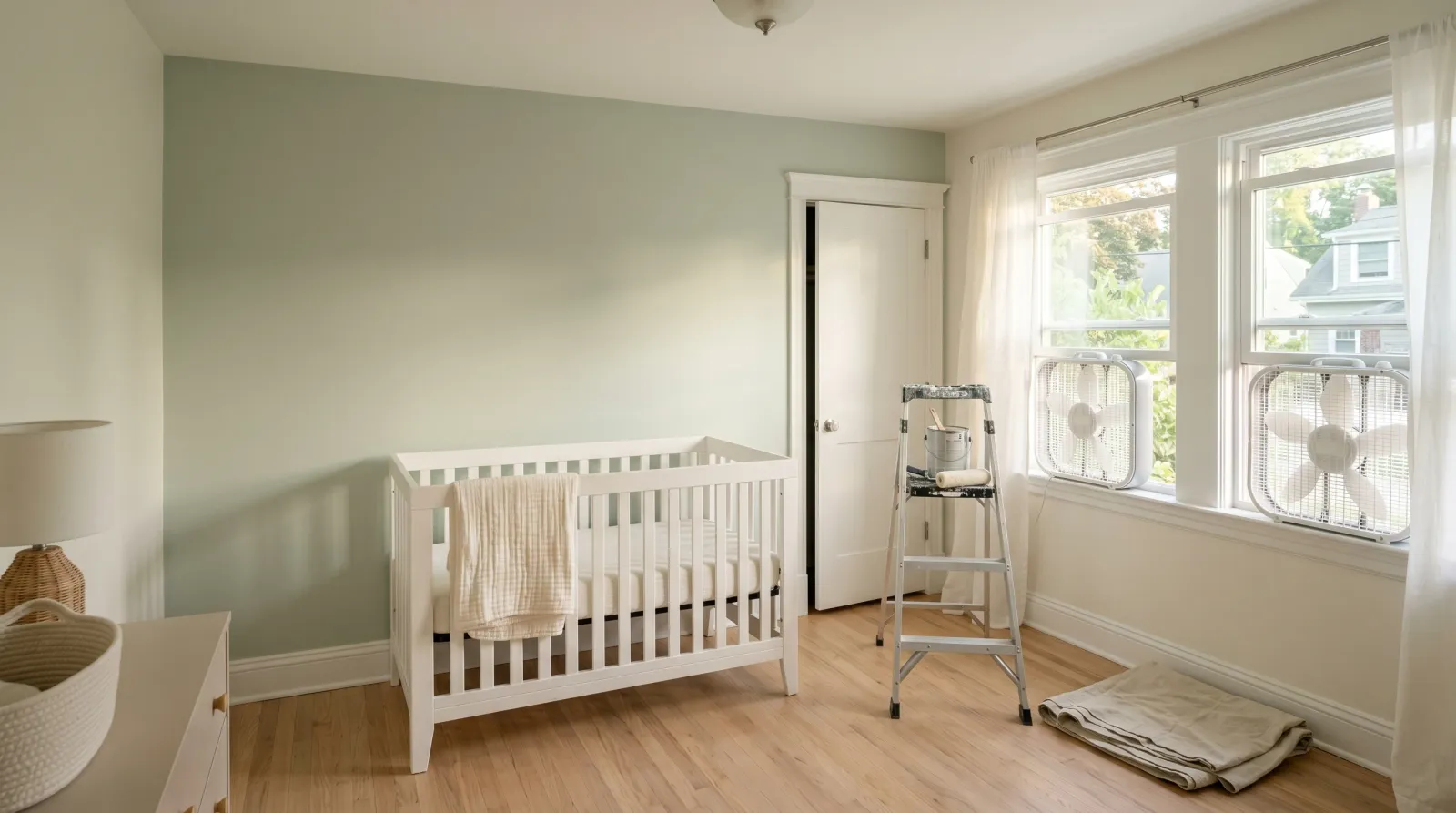
Okay, so you’ve got a nursery to paint and a deadline that doesn’t move. The room itself is the easy part — small, square, usually empty already. The hard part is the calendar. Paint goes up in a weekend. The air takes about a week to feel right. Plan backwards from there and you’ll be fine.
Don’t worry. This is one of the friendlier first-time paint projects in the house.
What You’ll Get
A 10×10 nursery (the standard “second bedroom” size) freshly painted in a low-fume, zero-VOC color, fully cured and aired out, ready for the crib to go in before baby arrives.
Honest Take on Timing
The painting itself is short. The cure window is the real schedule.
| Stage | Active time |
|---|---|
| Friday night prep | 1–1.5 hrs |
| Saturday morning (spackle, sand, spot-prime) | 1–1.5 hrs |
| Saturday afternoon (first coat) | 2–3 hrs |
| Sunday morning (second coat) | 1.5–2 hrs |
| Sunday afternoon (tape pull, cleanup) | 30 min |
| Mon–Sun (room sits empty, fans running) | passive |
6–8 active hours over a weekend, plus a full week of airing out with the door closed and fans on before furniture goes in. That’s the part most first-timers underestimate. If your due date is in three weeks, paint this weekend. If it’s in eight, even better — earlier is always safer.
Cost: $140–260 if you don’t already own brushes and rollers. The zero-VOC paint runs $65–95 a gallon (more than standard wall paint, worth it here), primer $20, tape and drops $20, brushes and rollers $30–60, miscellaneous another $20.
Why You Want Zero-VOC for This Room
VOCs (volatile organic compounds, the solvents in regular paint that make it smell) are what off-gas for days after a normal repaint. They’re irritating to anyone and they’re a real concern for tiny lungs. Zero-VOC formulas swap those solvents for water-based carriers that flash off cleaner and faster. See our explainer on VOCs if you want the chemistry.
Three lines are the consensus picks for nursery walls:
- Benjamin Moore Aura — the premium pick. Zero VOC, near-zero smell, covers in two coats almost every time. About $90 a gallon.
- Clare — direct-to-consumer, comes pre-tinted in the can, ships to your door. Genuinely odorless during application. About $65 a gallon.
- ECOS Paints — the most stripped-down formula on the market. No biocides, no ammonia, no formaldehyde. About $80 a gallon.
Skip the budget zero-VOC labels at the big-box store; “zero-VOC” on the base can still mean the tinted gallon has a few grams per liter once the colorant is added. The three above use low- or zero-VOC colorant systems on the lighter pastels, which is what you want.
For the full round-up of nursery-appropriate picks, see the best zero-VOC paints and the best no-VOC paint brands lists.
A Note on Color
Pale colors. I know that sounds boring, but the depth of color you can pick affects the VOC load — deep saturated reds, navies, and forest greens need a heavy dose of colorant at the store, and the colorant carries VOCs even when the base doesn’t. Soft whites, warm off-whites, pale sage, dusty pink, light cornflower blue — those are the safest tints. If you want a feature wall in a deeper color, do it on a single wall, not the whole room, and bump the cure window from one week to two.
What You’ll Need
Paint. One gallon of zero-VOC eggshell or matte in your color. A 10×10 room with 8-foot ceilings is right at the edge of one gallon for two coats; if you have an accent wall in a second color, grab a quart of the accent.
Primer. Benjamin Moore Fresh Start 046 (the low-VOC bonding primer) in one quart, for spot-priming only. Don’t prime the whole room unless you’re going dramatically lighter or covering a dark wall.
Tools. A 2” angled sash brush (Wooster Silver Tip or Purdy XL), a 9” roller frame with two 3/8” microfiber sleeves, a roller tray with liners, Frog Tape Multi-Surface, a canvas drop for the floor, plastic drops for the closet door and any furniture you can’t move out, lightweight spackle and a putty knife, a 220-grit sanding sponge, and two box fans. Cross-ventilation matters more than any single tool on this list.
For drywall prep detail — patching, sanding, sealing fresh patches — see the drywall guide. I’m keeping this guide on the weekend flow.
The Weekend Flow
Friday Evening: Prep (1–1.5 Hours)
Empty the room. If furniture has to stay, push it to the center and tarp it. Take off switch plates and outlet covers and bag the screws in a labeled ziplock. You think you’ll remember which screw came from where. You won’t.
Patch old nail holes and anchor holes with lightweight spackle. It dries in about an hour and sands easy. If a hole is bigger than a dime, two thin coats with a sand in between is better than one fat coat.
Tape off along the ceiling line, the baseboard top, the window and door casings, and any closet trim. Press the tape edge firm with a fingernail — a loose tape edge bleeds and you’ll see the bleed after coat two.
Drop cloths down. Two box fans, one in each window if the room has two, facing opposite directions so air moves through. If there’s only one window, one fan in the window pointing out and prop the door open. Never paint a nursery with the door closed.
Saturday Morning: Spot-Prime (1–1.5 Hours)
Sand the spackled patches flush with the 220-grit sponge. Wipe with a barely-damp microfiber to pull the dust.
Brush Fresh Start 046 over every patched spot, and over any whole wall that used to be a darker color. Dries in 30 minutes, ready for finish paint in an hour. The smell on this primer is mild but present; keep the fans cranking.
You don’t need to wash the walls unless they’re visibly grimy. Nurseries usually start as guest rooms or storage; just wipe any obvious dust off the baseboards.
Saturday Afternoon: First Coat (2–3 Hours)
Cut in first. Start at the ceiling line, work down to the baseboard, then around the door, window, and closet. A 2” angled brush, loaded about a third of the bristle length. If a cut isn’t perfectly crisp, leave it; the second coat fixes it.
Roll the flats. 9” roller in a “W” pattern, then back-roll the section before moving on. Zero-VOC paints lay down smoother than the older formulas; you don’t have to muscle them.
Most zero-VOC walls flash off in 2 hours and recoat in 4. Read the can — Aura’s window is shorter, ECOS is a bit longer. While you wait, peel any tape on a cut that’s clearly clean and dry to the touch.
Watch out for the closet. The closet ceiling is the most common spot to miss. Get the box fan to push air through the closet door for at least 15 minutes after you finish the inside.
Sunday Morning: Second Coat (1.5–2 Hours)
Look at the walls under a real light — not the overhead in the room, but a clamp light or daylight from the window. You’ll see holidays (spots where the first coat went too thin). The second coat covers them.
Cut in, then roll, same order as Saturday. Goes faster because you’re not figuring out cuts. This is the satisfying coat.
Once the second coat is firm to the touch but not bone dry (30–60 minutes), pull the tape at a 45° angle, slowly. If a corner pulls paint with it, dab the spot with a small brush from the can.
Sunday Afternoon: Cleanup (30 Minutes)
Roll up the drop cloths, wash brushes and rollers in the sink (zero-VOC paints clean with water), bag the trash, and leave the box fans running. Close the door. Stay out of the room for the week.
Common Mistakes
- Painting too close to the due date. Two weeks out is the latest comfortable window. One week is squeaky. Same-week paint and baby-arrives-tomorrow is asking for an off-gas headache.
- Buying “low-VOC” instead of “zero-VOC” without checking the tinted number. The label on the base can isn’t the gallon on your wall. Ask the store to print the VOC level on the tinted gallon receipt.
- Skipping the cross-flow. One fan blowing in is half the job. You need air in and air out, or you’re just stirring the room.
- Sleeping in the room before it’s cured. A week with the door closed and fans on, even if it doesn’t smell anymore. The nose adapts; the air doesn’t change because your nose did.
- Priming the whole room “to be safe.” Extra primer means extra coats of off-gassing. Spot-prime only.
Cure Schedule
| Time after final coat | What’s safe |
|---|---|
| 4 hours | Touch dry, tape pulled |
| 24 hours | Room can be entered briefly, fans still running |
| 7 days | Furniture in, baby in (with fans during the day for another week if you want) |
| 30 days | Full chemical cure, scrubbable |
Maintenance
Zero-VOC paint in a nursery holds up well — the room doesn’t get the scuffing a kitchen or hallway does. Expect a touch-up here and there in the first couple of years (a banged crib, a thrown spoon), and a full repaint somewhere around year five or six when the room becomes a toddler room and the color wants to change anyway.
Keep a sealed pint of leftover paint for touch-ups, labeled with the date and the room. Gallon cans rust at the rim within a year if you leave them in the basement.
Ask a Question