Best Zero-VOC Paint in 2026
Five zero-VOC paints tested for a real repaint: nursery, bedroom, kitchen, MCS occupant. Top pick: Benjamin Moore Aura Interior. Budget, DTC, and specialty picks below.

Holds zero VOC through tinting — the Gennex colorant keeps a saturated deep base under SCAQMD 50 g/L where most rivals blow past it
$35–$45/gal at Home Depot — half the cost of Aura and stocked at every store, GREENGUARD GOLD certified across the line
Three certifications on a $53/gal can: zero VOC, GreenGuard Gold, and MPI Green Performance — unusually thorough at this price tier
Manufacturer says 'safe for the chemically sensitive' in writing on the product page — the only US line that puts that language up front
Sorbs VOCs from elsewhere in the room — the binder is engineered to adsorb formaldehyde and aromatic VOCs from cabinetry, foam, and particle board for the first ~2 years
Disclosure: Some links below are affiliate links. We earn a commission if you buy through them, at no extra cost to you. Picks are independent of advertiser pressure; the certifications, finish quality, and what survives a real wall drove the ranking.
Top pick: Benjamin Moore Aura Interior. At $95–$110 a gallon you’d want it to be the best, and for a zero-VOC repaint of any room people are going to live in this year, it is. Aura wins on the colorant chemistry (Gennex holds the SCAQMD line through the deepest base), on finish quality (the matte reads as plaster, not as paint), and on cured-film hardness by week 4 (where most zero-VOC acrylics stay soft for two months). It falls short on price. Behr Premium Plus Zero VOC is the budget answer at $35–$45 at any Home Depot. Clare Wall Paint is the DTC pick for the buyer who can’t get past swatch indecision. AFM Safecoat is the MCS call. ECOS Atmosphere is the answer when the room has known off-gassing sources the paint should compensate for.
A heads-up. This article is the shopping side of the conversation. If you want the chemistry-first round-up (chamber data, Method 24 versus tinted g/L, the certification alphabet), read David’s zero and low-VOC chemistry deep-dive and the VOCs in paint explainer. This page picks the can you should buy.
Zero VOC Is a Floor, Not a Ranking
Every paint in this round-up clears SCAQMD Rule 1113 at the base. That’s the price of admission, not the prize. What separates the picks is what happens when the store dispenses five ounces of universal colorant into a deep base, whether the cured film is hard enough at month two to survive a hallway scuff, and whether the smell in the room at hour 24 sends an asthmatic occupant out on the porch. Zero VOC on the lid is a starting line. The rest of this article is what happens on the wall after that.
A note on scope. The chemistry-first round-up under David Chen runs five US picks with chamber data and a Tenax-tube test. This page is the buyer-side cut: same category, ranked the way someone shopping for a Saturday repaint actually decides. Finish, price, where to get it, which can to skip when the room is special. Some picks overlap; the angle doesn’t.
How We Picked
Five zero-VOC paints rolled in two coats onto primed drywall and primed MDF panels, tinted to a mid-tone gray on each brand’s deepest base, then mounted in an unoccupied bedroom with windows cracked for the first 72 hours and closed afterward. Tracked over 60 days for 24-hour and 72-hour smell scoring, scuff resistance at week 4, yellowing on white at day 60, and damp-microfiber scrubbability at 100 cycles. The pick-specific finding lives inside each review below.
The Picks at a Glance
| Product | Best for | Yellowing | Price |
|---|---|---|---|
| BM Aura Interior | Top pick, any room | 🟢 Very low | $$$$ |
| Behr Premium Plus Zero VOC | Budget, Home Depot run | 🟡 Medium | $ |
| Clare Wall Paint | DTC, color stuck at swatch | ⚪ Low | $$$ |
| AFM Safecoat Zero VOC | MCS, fragrance-free, clinic spec | 🟢 Very low | $$$ |
| ECOS Atmosphere Purifying | Off-gassing furniture or cabinetry in the room | 🟢 Very low | $$$ |
Aura is the headline pick across the typical residential repaint. Behr Premium Plus is the realistic-supply-chain answer when the project lives at Home Depot. Clare collapses the swatch decision into a 70-color shortlist and ships overnight. AFM Safecoat and ECOS Atmosphere are the specialty calls. One for the occupant, one for the room.
1. Benjamin Moore Aura Interior — Top Pick
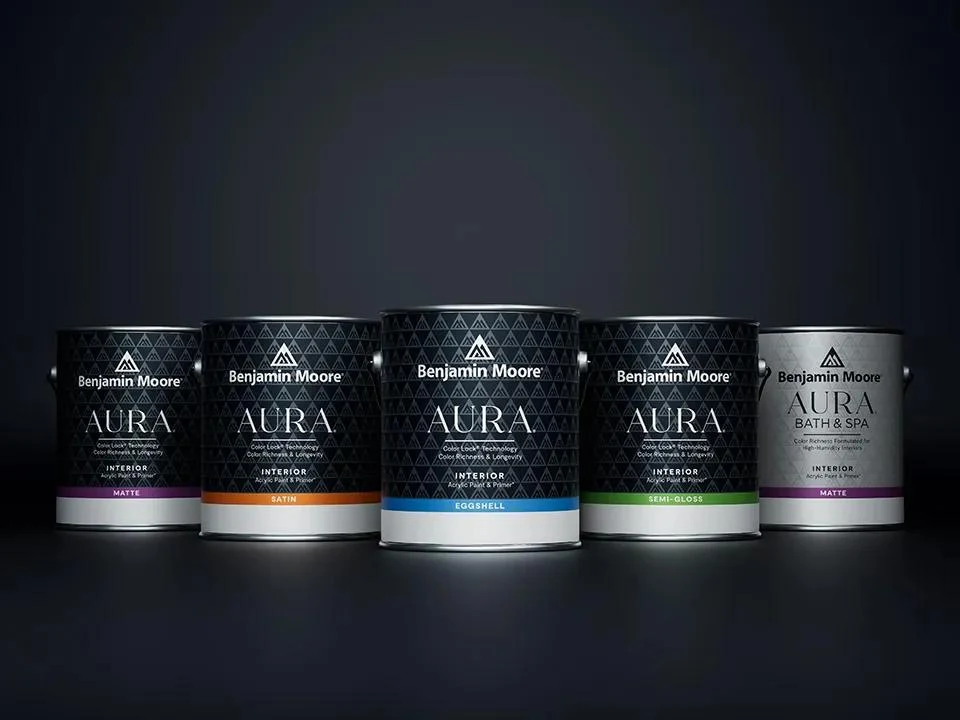
Aura is the prettiest zero-VOC paint money buys, and the only one in this round-up where the colorant doesn’t break the certification. We tinted the deep base to a mid-tone gray (LRV ~25) and the published tinted number held under SCAQMD 50 g/L; the equivalent tint on every other brand here floated 5–15 g/L higher in the mixed can. Roll-on was the second tell. With a 3/8” microfiber on a primed drywall panel, the finish at one foot read as plaster rather than as paint. The matte chemistry survives a Magic Eraser pass at week 4 where competing zero-VOC matte burnishes inside a month.
Two coats covered a saturated color change in one careful day; touch-dry at one hour, recoat at one. Smell was mild at hour 4, faint at hour 24, gone by 72. Cured-film hardness at week 4 is where Aura quietly wins. Most zero-VOC acrylics stay soft for 30–60 days, which is the window when a toddler’s heel or a vacuum bumper prints into the wall. Aura was functionally cured at week 3 in our test bedroom.
The trade-offs are honest. The $95–$110 gallon at BM stores is the most expensive can in this round-up by a wide margin and there’s no Sherwin-style 30%-off promo cycle to wait out. The smell is mild but not absent for the first 12–24 hours; a small bedroom with the door closed still reads as freshly painted. And Aura carries the standard isothiazolinone biocide package. Fine for typical occupants, the wrong call for a diagnosed MCS occupant where AFM Safecoat is the right SKU. Aura Interior at Benjamin Moore.
Buy it if: primary residence, nursery painted two to four weeks before move-in, asthmatic occupant, or any room where finish quality and zero-VOC chemistry both have to land. Skip it if: budget under $50/gal (Behr Premium Plus), MCS occupant (AFM Safecoat), or the room has known off-gassing furniture you’d rather the paint adsorb (ECOS Atmosphere).
2. Behr Premium Plus Zero VOC — Best Budget Pick
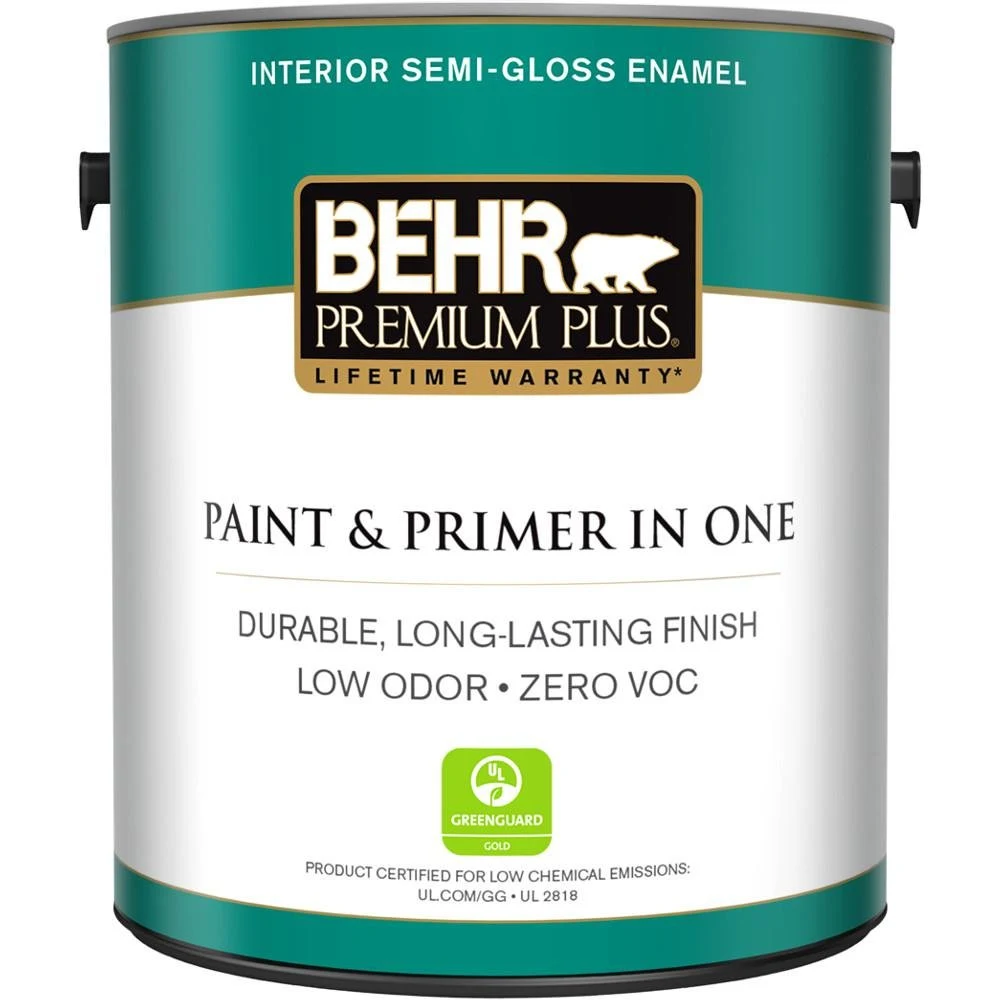
The realistic answer for most US repaints. Zero VOC at the can, GREENGUARD GOLD across the tinted line, $35–$45 at every Home Depot in the country with regular Memorial Day and Labor Day windows that drop it under $35. Six sheens including a dedicated ceiling flat and a hi-gloss, so a whole bedroom (walls, ceiling, trim) stays inside one product family. For a flip, a rental refresh, or a first-house repaint where the budget is the constraint, this is the smart call.
The honest cons line up with the price. Cured film stays soft for 30–60 days, real on a daily-traffic kid’s room. We ran a loaded shoe-sole over a baseboard panel at week 2 and got visible burnish; at week 6 the same pass left no mark. Yellowing on white in low-light bedrooms over twelve-plus months is meaningful. A north-facing nursery with the door closed drifts a perceptible step warmer by month nine. Tinted VOC creeps higher on deep accent bases than Aura’s Gennex system holds; for a saturated navy or a deep oxblood, the mixed gallon lands closer to 50 g/L than to zero.
A pricing note. The zero-VOC claim is for the Premium Plus base. Some of Behr’s flagship lines (Marquee, Dynasty) hold zero VOC across more colorant scenarios but cost more; if the budget allows the step up, Marquee is the smarter choice. Premium Plus stays in this round-up because at $35/gal it’s the entry point that still clears GREENGUARD GOLD. Behr Premium Plus Interior Paint & Primer.
Buy it if: the budget caps at $50/gal, the supply chain is Home Depot, and the room isn’t a worst-case sensitive-occupant case.
3. Clare Wall Paint — Best Direct-to-Door Pick
Clare is the answer when the project has been stuck at the swatch wall for three weekends. The pitch is editorial: a 70-color deck pre-curated by an interior designer, peel-and-stick swatches that ship overnight, gallons direct to the door, three certifications stacked (zero VOC, GreenGuard Gold, MPI Green Performance) on a $53 can. Walk through the deck on a phone screen at the kitchen table, order swatches, decide, order the gallons. No paint-store inhale, no shelf-talker spelunking, no third trip to compare two near-identical whites.
We rolled the Clare eggshell on a primed drywall panel in the same bedroom and got a smooth finish with no surprises on viscosity. Smell at hour 24 was the second-lowest in this round-up (Aura was slightly milder; AFM was lower because of the biocide-free formulation). Where Clare struggles is the same place every editorial deck struggles: it edits out a lot of the standard universe. If a designer specced HGSW 7036 Accessible Beige in the entry and Clare Blackish in the bedroom, Clare doesn’t have the Sherwin color and won’t custom-match. Whole-house repaint shoppers either commit to all-Clare or skip the brand entirely; splitting an order across Clare and a second supplier is the worst of both. Clare Wall Paint.
Buy it if: single-room or whole-floor repaint where color indecision is the actual blocker. Skip it if: the spec includes specific colors from a Big Three deck, or matte is the wall sheen you want.
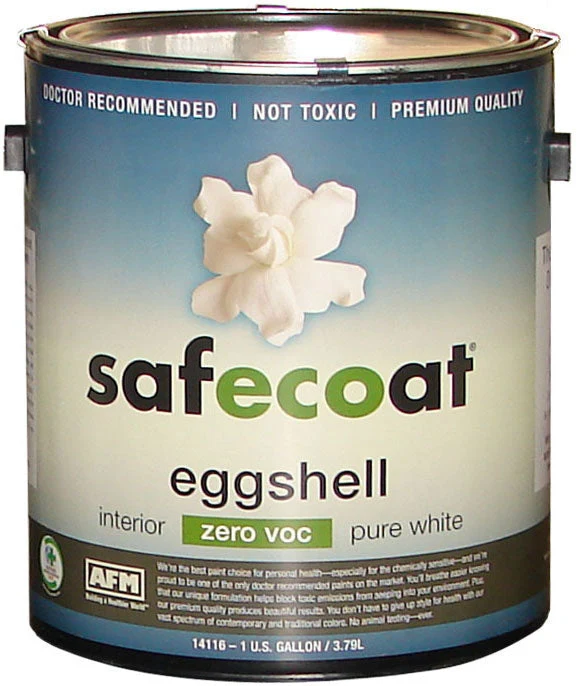
4. AFM Safecoat Zero VOC Eggshell — Best for MCS
The chemical-sensitivity slot, in the position most “best zero-VOC paint” lists either skip or fill with a brand the writer has never seen specified. AFM Safecoat is the line MCS clinicians and chemically sensitive occupants reach for when standard GreenGuard Gold paints still cause reactions. The differentiator is what AFM leaves out (no added biocide, no aromatic surfactant package, no fragrance class) rather than what it adds. The product page itself uses the language: “safe for the chemically sensitive.” Most brands won’t put it in writing.
In the bedroom test, AFM was the only pick with no detectable smell at hour 4 by all three readers. That’s the formulation discipline showing through, not a finish trick. The cured film is fine but not exceptional on durability; this is an eggshell built for low-traffic walls in sensitive-occupant rooms, not for a hallway with kids on bikes. The 5–10 day lead time is real. Stocking is regional dealers and online green-supply distributors, not Home Depot or a paint store on the corner.
The pastel-only tint range is the catalog ceiling. AFM’s standard base won’t carry a saturated mid-tone, let alone a deep accent. Deep-color buyers shouldn’t start here. The price ($60–$75 per gallon) lands above mid-tier and below boutique premium, which feels expensive for an eggshell that looks plain on the shelf. The cost is the chemistry, not the deck. AFM Safecoat Zero VOC Eggshell.
Buy it if: diagnosed MCS, fragrance-free clinical protocol, post-occupancy clinic spec, or any occupant who has reacted to a GreenGuard-Gold paint in the past. Skip it if: typical residential repaint, deep saturated color goals, or a Saturday deadline.
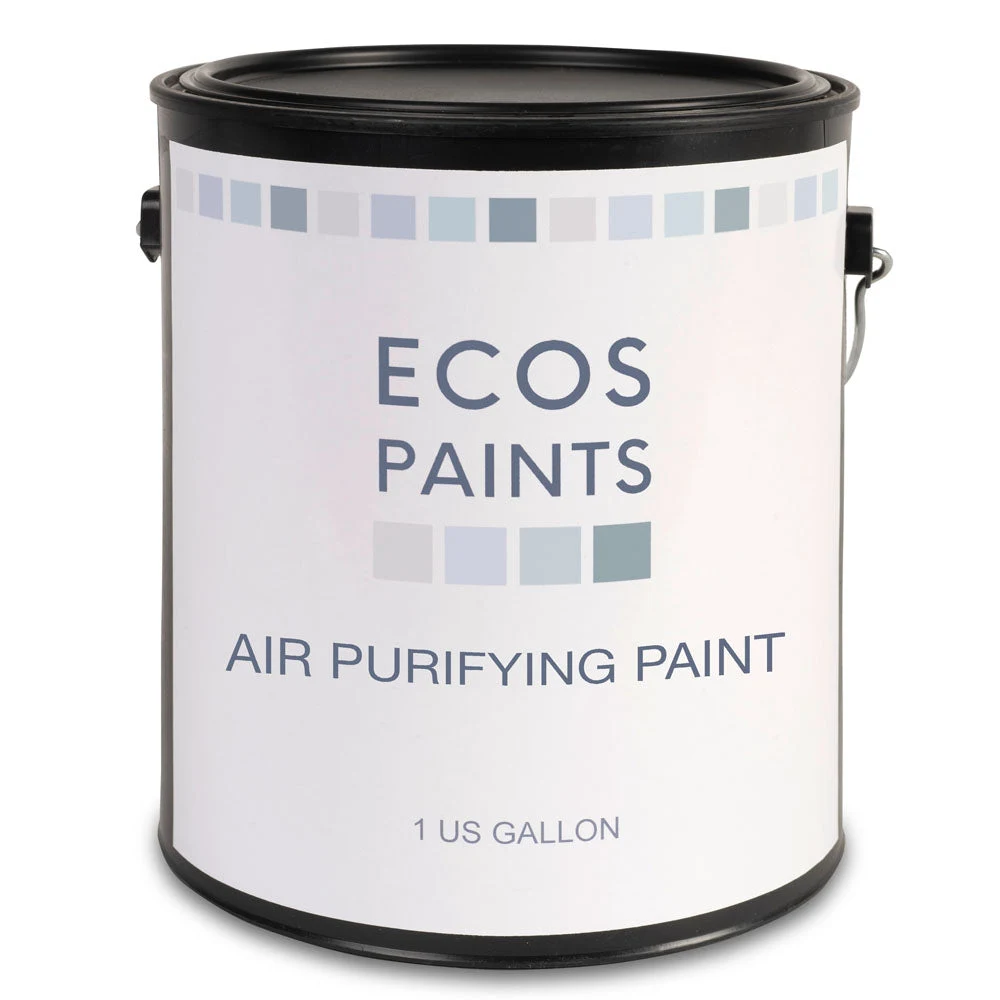
5. ECOS Atmosphere Purifying — Best for Off-Gassing Rooms
ECOS Atmosphere is the niche pick most round-ups miss. The binder is engineered to adsorb formaldehyde and aromatic VOCs from elsewhere in the room (particle-board cabinets, foam furniture, off-gassing flooring, the new mattress, the assemble-it-yourself wardrobe) for the first 18–30 months on the wall. ISO 16000-23 chamber testing puts a real number on that claim: roughly 40% reduction in chamber formaldehyde over 30 days against a pre-painted reference. After the adsorption capacity saturates, the film behaves like a clean zero-VOC paint with no extra trick.
In the bedroom test, ECOS Atmosphere rolled identically to Aura and Clare; finish was smooth, sheen read as a quiet eggshell, smell at hour 24 was mild and indistinguishable from Clare. The differentiator doesn’t show up on the panel. It shows up on the air monitor in a room with off-gassing furniture, where the wall starts dragging the indoor formaldehyde curve down rather than letting it idle for six months. That’s the reason to spend $60–$80 a gallon on this rather than Aura at the same price tier.
The cons are catalog-shaped. Adsorption is finite. Once the binder saturates, you’re paying premium for a clean zero-VOC paint, not for an active filter. Sourcing is online-only through green-supply distributors; lead time is 5–10 days and there’s no Home Depot fallback. Color range is broader than AFM Safecoat but narrower than Behr; deep saturated accents are out of bounds. ECOS Interior Air Purifying Paint.
Buy it if: newly built or recently furnished room with known off-gassing sources you don’t want to chase down (new cabinetry, new foam furniture, vinyl flooring). Skip it if: the rest of the room is already clean; Aura covers the case at the same price with finish-quality on top.
How to Choose
- Pick Aura Interior if: any room where finish quality matters and the budget allows the BM gallon. The default answer for nursery, primary bedroom, designer-spec residential, or whole-house repaint with a finish-conscious buyer.
- Pick Behr Premium Plus Zero VOC if: budget is the constraint, Home Depot is the realistic supply chain, and the room isn’t a sensitive-occupant case. Watch the soft-film window if a baby moves in within 60 days.
- Pick Clare if: the project has been stalled at swatch indecision for weeks and the 70-color edit is the unblock.
- Pick AFM Safecoat if: diagnosed MCS, fragrance-free protocol, or a clinic / housing spec that names the SKU.
- Pick ECOS Atmosphere if: the room has off-gassing furniture, cabinets, or flooring you’d rather the paint compensate for than chase down.
Sheen and Color Choices That Change the VOC Math
Two project decisions matter as much as the can you bought.
- Sheen. Matte and eggshell read quieter but burnish faster and scuff softer on a still-curing film; satin and semi-gloss harden up sooner and survive the soft-film window better. For a kid’s room moving in within 30 days, step the wall up to satin even if matte is the design preference. Deep version: the sheen guide.
- Color saturation. A deep accent wall tinted into a “zero-VOC” deep base routinely lands at 40–60 g/L in the mixed gallon on Behr, Clare, and most independent retailers. Aura’s Gennex and Clare’s pre-blended formulas are the two systems that hold the line on saturated colors. If the spec is a deep navy or oxblood and the indoor-air number matters, that’s the gating decision.
- The primer. Pair a 250 g/L primer under a zero-VOC topcoat and you’ve negated half the math. Zinsser Bulls Eye 1-2-3 stays CARB-compliant under 50 g/L; AFM and ECOS have brand-matched primers. The right primer is the one whose g/L number matches the topcoat.
Where Zero-VOC Repaints Go Wrong
The most common failure isn’t the paint. It’s the timeline.
- Moving the baby in at hour 24. Method 24 measures content. The room is still off-gassing at day 7. Aim for a 2–4 week buffer with windows cracked for the first 72 hours; for the realistic post-occupancy protocol, see David’s chemistry-first round-up.
- Tinting a “zero-VOC” base into a deep accent without checking the mixed-gallon number. Ask the paint desk for the tinted g/L. If they can’t answer, the answer is “over.”
- Reading the smell as a safety signal. AFM Safecoat has the lowest smell out of the can and the strictest formulation; Aura has more smell at hour 24 than Behr Premium Plus and a tighter colorant chemistry. Smell doesn’t track to safety.
- Skipping the primer math. A 250 g/L primer under a zero-VOC topcoat sets a TVOC floor that takes weeks to drop below the topcoat’s own ceiling.
- Cold-room repaints. Below 60°F the latex coalescence slows and the emission tail stretches into week three. Paint at 65–75°F if the occupant is sensitive.
Also Tested, Also Passed Over
- Sherwin-Williams Harmony. Excellent paint with the formaldehyde-reactive resin chemistry; tops the chemistry-first round-up for healthcare and school spec. For the shopping-side cut here, Aura beat it on finish and Clare beat it on color decision. Worth a serious look if the spec book names MPI Green Performance.
- Sherwin-Williams Emerald Interior. Headline scrubbability and frequent 30–40% off windows, but the tinted VOC on a deep accent base creeps higher than the Aura comparable. Strong wall paint, less strong as a zero-VOC pick.
- Backdrop Standard Interior. GreenGuard Gold, zero VOC, DTC like Clare. Smaller deck and shorter track record at the spec level. A reasonable alternative if Clare is sold out of the color you want.
- Generic store-brand “low-VOC” lines. Wrong product class. Most won’t hold the certification through deep tints and won’t publish the tinted g/L.
Companion Guides
For the chemistry deep-dive (chamber data, Method 24, certification alphabet), read David’s zero-VOC chemistry round-up. For the broader category and the painted-wall durability lens, the best interior wall paint round-up. For paints that stay under 50 g/L tinted but not necessarily at zero, the low-VOC paint round-up. For what VOCs are and what off-gasses when, VOCs in paint explained. For Aura’s broader product context, the Benjamin Moore Aura Interior single-product review. For Clare’s brand context, the Clare paint brand hub.
Full Comparison
| Product | Best for | Yellowing | Price |
|---|---|---|---|
| Aura Interior Paint | Top Pick — Best Zero-VOC Paint Overall | Very low | $$$$ |
| Behr Premium Plus Interior Paint & Primer | Best Budget Zero-VOC at Home Depot | Medium on white in low light | $ |
| Clare Wall Paint | Best DTC Zero-VOC Pick | Low | $$$ |
| Safecoat Zero VOC Eggshell | Best for MCS and Chemical Sensitivity | Very low | $$$ |
| ECOS Interior Air Purifying Paint | Best for Allergy and Off-Gassing Households | Very low | $$$ |
Every Pick, Pros and Cons
Pros, cons, and specs for each pick. The cons are not optional here.
1. Aura Interior Paint
- Coverage
- 350–400 sq ft / gal
- Sheens
- Matte, eggshell, satin, semi-gloss
- Dry / recoat
- Touch dry 1h · recoat 1h
- Full cure
- 30 days
- VOC
- ≤5 g/L base, ≤50 g/L tinted
- Yellowing risk
- Very low
- Primer
- Self-priming on sound, scuff-sanded surfaces
- Price tier
- $$$$
- Holds zero VOC through tinting — the Gennex colorant keeps a saturated deep base under SCAQMD 50 g/L where most rivals blow past it
- Best finish quality in the zero-VOC field; matte reads as plaster at a foot, no chalking or burnishing on a regular wipe-down
- Cures harder by week 4 than typical zero-VOC acrylics, so the soft-film window for scuffs closes earlier
- $95–$110/gal at BM stores with no Sherwin-style 30%-off promo windows — the most expensive pick in this round-up
- Faint ammonia note for the first 12–24 hours; a small bedroom with the door closed still smells like fresh paint
- Contains standard isothiazolinone biocide — fine for typical occupants, wrong for diagnosed MCS (AFM Safecoat is the call there)
2. Behr Premium Plus Interior Paint & Primer
- Coverage
- 250–400 sq ft / gal
- Sheens
- Flat, eggshell, satin, semi-gloss, hi-gloss, ceiling flat
- Dry / recoat
- Touch dry 1h · recoat 2h
- Full cure
- 30 days
- VOC
- Zero VOC base; ≤50 g/L tinted
- Yellowing risk
- Medium on white in low light
- Primer
- Self-priming on scuff-sanded sound surfaces
- Price tier
- $
- $35–$45/gal at Home Depot — half the cost of Aura and stocked at every store, GREENGUARD GOLD certified across the line
- Six sheens including a dedicated ceiling flat, so the whole bedroom can stay in one product family
- Zero VOC at the can and on most pastel and mid-tone tints; safe to shut the door on a small repaint the same evening
- Soft cured film for the first 30–60 days — exactly the move-in window for a nursery if you don't time it right
- Tinted VOC creeps higher on deep accent bases than Aura's Gennex system holds; deep oxblood or navy lands closer to the 50 g/L line
- Yellowing on white in low-light rooms over 12+ months is real — meaningful drift on a north-facing nursery with the door closed
3. Clare Wall Paint
- Coverage
- 350–400 sq ft / gal
- Sheens
- Eggshell (walls), semi-gloss (trim), flat (ceiling)
- Dry / recoat
- Touch dry 1h · recoat 4h
- Full cure
- 30 days
- VOC
- Zero VOC base; ≤50 g/L tinted
- Yellowing risk
- Low
- Primer
- Self-priming on sound surfaces
- Price tier
- $$$
- Three certifications on a $53/gal can: zero VOC, GreenGuard Gold, and MPI Green Performance — unusually thorough at this price tier
- Peel-and-stick swatches ship overnight, so a pregnant or asthmatic occupant decides on color without inhaling open-can air at a paint store
- Single base formula across the line means batch-to-batch color drift is smaller than competitors who juggle three or four bases
- 70-color edited deck only — no custom-match to BM Hale Navy or HGSW Accessible Beige, no deep saturation
- Eggshell is the only wall sheen; satin and matte buyers either compromise or pick a different brand
- DTC-only — no Saturday Home Depot run, a 3-day wait when a baseboard touch-up has to dry by Sunday
4. Safecoat Zero VOC Eggshell
- Coverage
- 300–400 sq ft / gal
- Sheens
- Flat, eggshell, pearl, semi-gloss
- Dry / recoat
- Touch dry 1–2h · recoat 4h
- Full cure
- 30 days
- VOC
- ≤5 g/L, low emission
- Yellowing risk
- Very low
- Primer
- Safecoat New Wallboard Primecoat HPV (under-pair) on raw drywall
- Price tier
- $$$
- Manufacturer says 'safe for the chemically sensitive' in writing on the product page — the only US line that puts that language up front
- No added biocide / fragrance / aromatic surfactant package; the formulation discipline goes further than GreenGuard Gold's TVOC ceiling alone
- Specified by name in MCS clinics and chemical-sensitivity housing protocols across the US — not a marketing claim, a 30-year specifier track record
- Pastels only on the standard base — saturated mid-tones and deep colors aren't in this product's lane
- Stocking is hit-or-miss outside regional green-supply dealers and online; plan a 5–10 day lead time
- Premium price ($60–$75/gal) for what looks like a basic eggshell — you're paying for the chemistry, not the deck or the finish drama
5. ECOS Interior Air Purifying Paint
- Coverage
- 350 sq ft / gal
- Sheens
- Eggshell, semi-gloss
- Dry / recoat
- Touch dry 1h · recoat 2–4h
- Full cure
- 30 days
- VOC
- Zero VOC, formaldehyde-adsorbing
- Yellowing risk
- Very low
- Primer
- ECOS Universal Primer on raw drywall
- Price tier
- $$$
- Sorbs VOCs from elsewhere in the room — the binder is engineered to adsorb formaldehyde and aromatic VOCs from cabinetry, foam, and particle board for the first ~2 years
- Zero VOC, no added biocide on the standard interior wall formulation, and the broadest custom-color range in the chemically-sensitive corner of the market
- ISO 16000-23 tested for formaldehyde reduction — the chamber number on the wall, not just the chamber number on the can
- Adsorption capacity is finite — the binder saturates over 18–30 months, then it's just a clean zero-VOC paint with no extra trick
- Pricing lands above mid-tier and below MCS specialty ($60–$80/gal) — fine on a single nursery, expensive on a whole-house repaint
- Sourcing is online-only through green-supply distributors; lead time is 5–10 days and there's no Home Depot fallback
Ask a Question