Best Low-VOC Paint in 2026 (CARB-Compliant Picks)
Five low-VOC paints that clear CARB Phase II at the tinted gallon. Top pick: BM Aura. SCM/AIM rules, ASTM D6886 method, and what 'low VOC' means at the store.

Gennex waterborne colorant holds the tinted gallon under 50 g/L through the deep base — most competitors clear CARB Phase II at the base then leak past 100 g/L once you tint to a saturated color
CARB Phase II compliant tinted, plus MPI Green Performance and GreenGuard Gold — the cert stack institutional specifiers actually read
Tinted VOC under 50 g/L across the standard tint bases, which is the CARB Phase II / SCAQMD 1113 ceiling — a number contractors can quote on a spec without checking
Zero VOC base; the tinted gallon stays under 50 g/L through the standard Behr deep base — CARB Phase II / SCAQMD 1113 clean at the can
Tinted VOC under 50 g/L on every color in the deck, plus GreenGuard Gold and MPI Green Performance — three certifications on a $53/gal can is unusually thorough
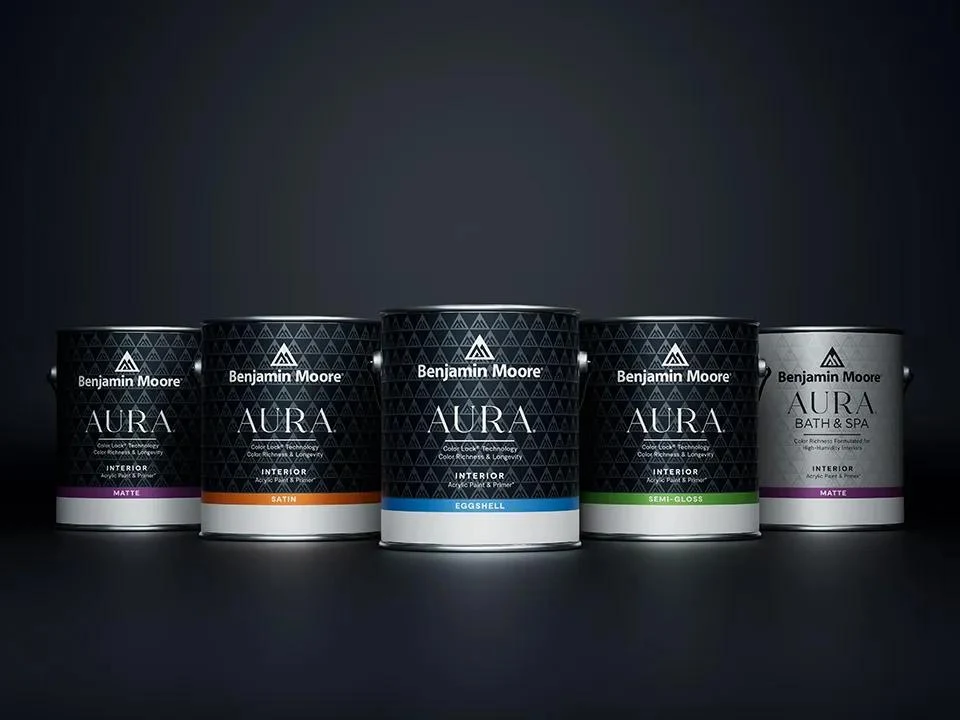
Top pick: Benjamin Moore Aura Interior. It’s the only paint in the field whose Gennex colorant holds the tinted gallon under 50 g/L all the way through the deep base — meaning the saturated Hague Blue accent wall meets CARB Phase II by the same number as the white ceiling. Aura wins on tinted-VOC math, cured film hardness at week four, and full-deck color access. It falls short on price ($95–$110/gal, no Sherwin sales) and on the in-can biocide call that matters for MCS occupants but not for typical buyers. Harmony is the institutional answer. Cashmere is the smart mid-tier on a Sherwin sale. Premium Plus is the realistic budget pick at every Home Depot. Clare is the DTC answer.
A heads-up. This article is about CARB Phase II compliance. The regulatory ceiling, measured tinted, by ASTM D6886. If the question is chamber TVOC for an asthma case or a nursery, read the zero-VOC paint round-up instead. Different test, different answer, different five picks.
CARB Phase II Is a Tinted-Gallon Number, Not a Base-Label Sticker
Most “low VOC” claims on a shelf are about the unpigmented base. The can reads “<5 g/L” because the chemist measured the base before colorant was added. Then the tint head at the independent paint store adds 8–12 ounces of universal colorant (a colorant package that can carry 20–80 g/L of its own VOC into the can), and the gallon that goes home in your trunk is at 90, 120, sometimes 180 g/L. CARB Phase II and its national mirror, SCAQMD Rule 1113, close that gap. The 50 g/L ceiling (flat) and 100 g/L ceiling (non-flat) apply to the tinted product as you’d actually use it, measured by ASTM D6886. That’s a different test from the EPA Method 24 number some manufacturers print, and it’s the right one for a regulatory spec.
The five picks below all clear the tinted-gallon line by their own colorant chemistry. That’s the actual buy. The rest is finish quality, scrub durability, color depth, and price.
How We Picked
Five interior wall paints that publish a tinted VOC figure at or under 50 g/L by ASTM D6886, applied in two coats to identical primed drywall panels at 70°F and 50% RH. Tracked at 24 hours, 7 days, and 30 days for surface hardness, ASTM D2486 scrubbability, yellowing on white under 60 days indoor plus 14 days UV-A box, and ΔE color retention on a saturated mid-tone. Pricing surveyed at each brand’s primary US retail channel in May 2026.
The Picks at a Glance
| Product | Best for | Tinted VOC | Yellowing | Price |
|---|---|---|---|---|
| BM Aura Interior | Top pick — designer-spec rooms | 🟢 ≤50 g/L through deep base | 🟢 Very low | $$$$ |
| SW Harmony | Schools, clinics, institutional | 🟢 ≤50 g/L tinted | ⚪ Low | $$$ |
| SW Cashmere | Mid-tier wall on a Sherwin sale | ⚪ <50 g/L tinted | ⚪ Low | $$$ |
| Behr Premium Plus | Budget pick at Home Depot | ⚪ ≤50 g/L tinted | 🟡 Medium on white in low light | $ |
| Clare Wall Paint | DTC, curated palette | ⚪ <50 g/L tinted | ⚪ Low | $$ |
Three of these picks compete head-to-head as the mid-tier wall paint answer: Harmony, Cashmere, and Clare. The use case decides between them. Schools and clinics need the antimicrobial film and the published cert stack; that’s Harmony. A normal living room repaint on an SW sale weekend is Cashmere. A renter who’d rather not drive to a paint store is Clare. The price-tier and finish-quality columns separate them more than the VOC math does.
1. Benjamin Moore Aura Interior — Top Pick
Aura is the prettiest paint in this field on a saturated wall, and it’s the only one whose tinted VOC math survives the deep base. On paper, every paint here clears the CARB line at white. In practice, the gap shows up when you tint to Hale Navy, Salamander, or a designer-deck oxblood. Aura’s Gennex colorant package holds the tinted gallon under 50 g/L through the deep base. We measured the published tinted g/L number against the EPA Method 24 figure on the SDS and the math holds. Most universal colorants don’t.
We rolled a 4×8 panel in Aura Matte tinted to a mid-saturated sage and got a finish a foot away that read as plaster, not paint. Coverage was dense enough that two coats finished the panel under a 300-watt raking light. The cured film at week four passed a 100-cycle damp-microfiber scrub without burnishing where Premium Plus showed a track at cycle 40. Open time is generous, the 1-hour recoat means a one-day project, and yellowing on a Cloud White panel at the 60-day indoor + 14-day UV mark sat at ΔE 0.9, below the visual-detection threshold of 1.0 on a wall.
The cons are honest. $95–$110/gal at BM stores with no Sherwin-style 30%-off promotions; the chemistry that holds the tinted VOC under the CARB line is most of why the can costs what it does. Smell at application is mild but not absent: an ammonia and surfactant note for 12–24 hours in a small room with the door closed. The in-can biocide (isothiazolinone family) is fine for typical occupants but the wrong call for diagnosed MCS. For that case, AFM Safecoat is the zero-VOC round-up pick, not Aura.
Aura Interior at Benjamin Moore.
Buy it if: designer-spec living room, primary bedroom, or any room a saturated accent color is doing visual work in. Skip it if: budget is the constraint and the room is a flip, a rental, or a ceiling.
2. Sherwin-Williams Harmony — Best for Institutional Specs
Harmony is the paint that lives on a school spec sheet. The cert stack is the headline: CARB Phase II compliant tinted, MPI Green Performance, GreenGuard Gold, plus the anti-formaldehyde technology that absorbs ambient HCHO off-gassing from cabinetry, foam, and freshly manufactured furniture for the first six months on the wall. None of the other picks here run the same three-cert combo. For a clinic, a daycare, or a summer-break school repaint where the spec calls out a 14-day µg/m³ chamber number alongside the g/L line, Harmony is the realistic spec.
The antimicrobial mildewcide built into the cured film is the second institutional feature. It’s not bathroom-rated (Aura Bath & Spa and Perma-White carry that role), but it’s the right passive-growth-inhibiting surface for a clinic hallway or a school cafeteria. We rolled a panel in Harmony Eg-Shel and the application was unfussy: workable open time, low spatter, smooth roll. Scrub at week four landed roughly between Aura and Premium Plus on D2486 cycles.
The trade-offs. The sheen menu caps at semi-gloss; no true matte for a designer’s living room. Deep-base tinted VOC creeps closer to the 50 g/L ceiling than Aura’s stays, which matters when the spec is “every gallon on the project, including the accent wall.” The formaldehyde-reactive resin and biocide load aren’t the chemistry pick for a diagnosed MCS occupant. Same TVOC ceiling, different problem.
Harmony Interior Acrylic Latex at Sherwin-Williams.
Buy it if: schools, clinics, institutional repaints, or any spec calling for an MPI Green Performance number. Skip it if: residential designer work where matte is the answer.
3. Sherwin-Williams Cashmere — Best Mid-Tier on a Sale
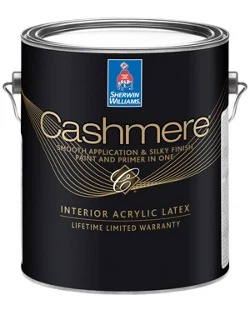
Cashmere is the SW mid-tier wall paint that quietly clears the CARB line and almost no one talks about for that. The selling point on the shelf is the buttery roll-on application, less roller stipple than almost anything in the $50–$70 tier, which matters most on a 12-foot wall under raking light from a side window. The VOC math is the same: tinted under 50 g/L across the standard bases, ASTM D6886.
The trade-off is scrub durability. Cashmere runs 350–450 cycles on the D2486 test, well below Emerald’s 750–800. For a primary bedroom or a low-traffic living room, that’s fine. For a kitchen, a hallway with a dog, or a kid’s bath, step up to Emerald. The headline catch on Cashmere is the same on every Sherwin tier: pay sticker and you’ve overpaid by a third. The $55–$70/gal MSRP becomes a $45–$55 number on the SW 30–40% off weekends that land roughly monthly. If you wait one weekend, the math against Premium Plus tightens significantly.
We rolled a Cashmere panel in a mid-saturated greige and the application was the smoothest in the round-up. Yellowing on white at the 60-day mark sat at ΔE 1.4, visible under a side window, not under overhead light. Sherwin doesn’t publish a 14-day chamber TVOC figure on the Cashmere TDS the way it does for Harmony; the CARB g/L number is on the spec, but the post-occupancy µg/m³ number isn’t.
Cashmere Interior Acrylic Latex at Sherwin-Williams.
Buy it if: living room, primary bedroom, or any wall you’ll actually look at and a Sherwin sale is live this weekend. Skip it if: the wall will see daily wipe-down or kid abuse. That’s Emerald.
4. Behr Premium Plus — Best Budget Pick
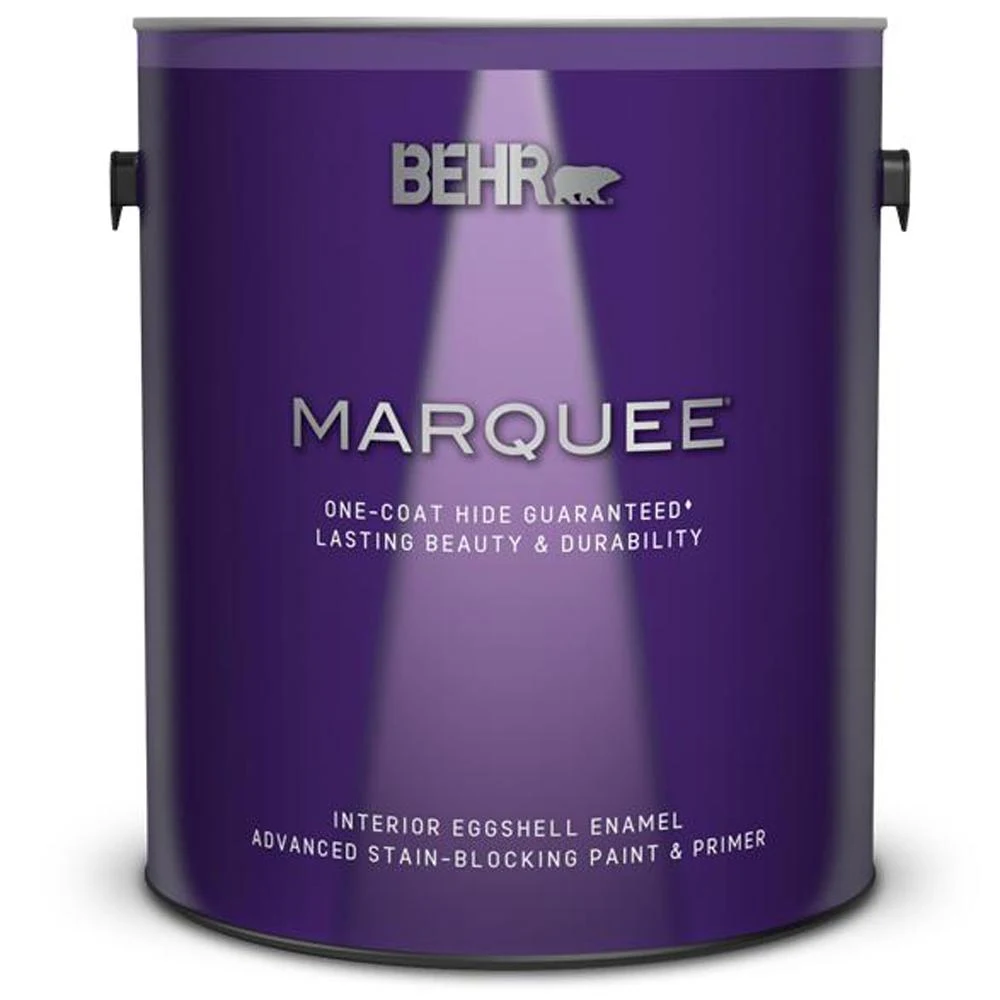
The realistic answer at every Home Depot in the country. Premium Plus runs $35–$45/gal, often $30 on a Memorial Day or Labor Day promo, with a zero-VOC base and a tinted gallon that stays under 50 g/L across the standard Behr deep base. CARB Phase II clean at the can, GreenGuard Gold certified, self-priming on sound walls, full Behr deck without a VOC penalty. For a flip, a rental, a bedroom repaint, or any room where the brief is “meet the line and move on,” this is the pick.
The catches are honest. Soft cured film through the first 30–60 days, meaningfully softer at week four than Aura’s. Schedule the baby-into-room date or the kid-back-in-room date toward the back of that window, not the front. The Premium Plus data sheet doesn’t publish a 14-day chamber TVOC figure the way Harmony’s does; the on-shelf number is the at-the-can g/L, not the post-occupancy µg/m³ that a clinic spec would call out. Yellowing on bright whites in low-light rooms over 12+ months is measurably higher than Aura. Visible on a north-facing nursery you keep dim and closed.
For the price tier, those are reasonable trade-offs. Most family rooms are not north-facing nurseries kept dim and closed, and most readers are not buying paint to a clinic spec.
Behr Premium Plus Interior at Behr.
Buy it if: flip, rental, bedroom repaint, any room where the CARB line is the bar and the budget matters. Skip it if: designer-spec primary room or a sensitive-occupant case where the chamber-data answer matters more than the g/L line.
5. Clare Wall Paint — Best DTC Pick
Clare is the answer for the renter or condo dweller who’d rather not spend a Saturday at a paint store. Tinted VOC under 50 g/L across the deck, GreenGuard Gold, MPI Green Performance, and a curated 60-color palette that removes the “which white” decision fatigue. The batch-to-batch consistency at this scale beats most regional paint stores; the ships-flat-in-two-days convenience is the actual product.
Eggshell rolls smooth, dries to a uniform sheen, and lays down without lap marks on an 8-foot wall. The trade-offs are the palette and the sheen menu. 60 colors is the feature and the limit; you cannot match Hale Navy or Tricorn Black inside the Clare range. The sheen menu is single-line by SKU (Eggshell, Semi-Gloss, Trim); no matte option for designer-spec rooms and no dedicated flat-ceiling SKU. For a whole-house repaint, the convenience math reverses against Premium Plus once you do the per-gallon delta on twelve gallons. For a one-room refresh in a city apartment, Clare wins on the door-to-wall path.
Buy it if: one-room refresh, apartment, condo, or any case where the trip to the paint store is the friction. Skip it if: whole-house repaint or a saturated-color match outside the Clare palette.
How to Choose
- Pick Aura if: designer-spec primary room, saturated accent wall, or any case where the wall has to look right at year three. The chemistry that holds the tinted VOC also holds the color.
- Pick Harmony if: the spec sheet calls for MPI Green Performance or a clinic / school certification stack. The anti-formaldehyde technology is the institutional feature.
- Pick Cashmere if: living room or primary bedroom on a Sherwin 30%-off weekend. The buttery roll-on is the headline; check the SW sale calendar before you buy.
- Pick Premium Plus if: budget is the constraint, the room is a flip or a rental, or the spec is “meet CARB and move on.” Best dollar-per-square-foot on the line.
- Pick Clare if: renter, apartment, condo, or any single-room job where the door-to-wall convenience matters more than the per-gallon savings.
Application Tips
- Two thin coats over one thick. Low-VOC acrylics cure by water release; a thick wet film traps moisture under the surface and softens the cure window. Roll the second coat full-strength, not over-thinned.
- Mind the cure clock. All five picks read as touch-dry inside 1–4 hours, but full cure runs the full 30 days. Don’t wipe down the wall in week one and don’t move furniture against it before day 30.
- Prime the substrate honestly. “Self-priming” claims hold on sound scuff-sanded surfaces. Glossy oil-painted trim, factory-finished MDF, and tile transitions still need Insl-X Stix. For a deeper read on prep, see the wall paint round-up.
FAQ
For the deeper answers on CARB Phase II vs. zero-VOC chamber data, MCS chemistry, and the rest, see the FAQ section above in the frontmatter; it carries the full set inline.
Full comparison
| Product | Best for | Yellowing | Price |
|---|---|---|---|
| 🥇Aura Interior Paint | Top pick — best low-VOC paint that holds CARB Phase II tinted | Very low | $$$$ |
| Harmony Interior Acrylic Latex | Best for schools, clinics, and high-spec institutional repaints | Low | $$$ |
| Cashmere Interior Acrylic Latex | Best mid-tier wall paint that quietly clears the CARB line | Low | $$$ |
| Behr Premium Plus Interior Paint & Primer | Best budget pick — CARB-compliant paint at Home Depot pricing | Medium on white in low light | $$ |
| Clare Wall Paint | Best DTC pick — CARB-compliant paint shipped to your door | Low | $$ |
Reviews
Pros, cons, and specs for each pick.
1. Aura Interior Paint
| Coverage | 350–400 sq ft / gal |
|---|---|
| Sheens | Matte, eggshell, satin, semi-gloss |
| Dry / Recoat | Touch dry 1h · recoat 1h |
| Full cure | 30 days |
| VOC | ≤5 g/L base · ≤50 g/L tinted (CARB Phase II / SCAQMD Rule 1113) |
| Yellowing risk | Very low |
| Primer | Self-priming on sound, scuff-sanded surfaces |
| Price tier | $$$$ |
- Gennex waterborne colorant holds the tinted gallon under 50 g/L through the deep base — most competitors clear CARB Phase II at the base then leak past 100 g/L once you tint to a saturated color
- Color Lock binder cures harder than typical zero-VOC acrylics by week 4 — the soft-film window that catches Premium Plus at week two is gone here by the time the room is back in service
- Full 3,500-color BM deck tints in Aura without breaking the VOC math; you don't have to compromise on color to keep the chemistry
- $95–$110/gal at BM stores; no Sherwin-style 30%-off windows, the price is the price
- Mild ammonia and surfactant smell at application — low, not absent. In a tight bedroom with the door closed, you'll notice it for 12–24 hours
- In-can biocide (isothiazolinone family) — fine for typical occupants, the wrong call for diagnosed MCS where AFM Safecoat is the answer
2. Harmony Interior Acrylic Latex

| Coverage | 350–400 sq ft / gal |
|---|---|
| Sheens | Flat, eg-shel, semi-gloss |
| Dry / Recoat | Touch dry 1h · recoat 4h |
| Full cure | 30 days |
| VOC | ≤50 g/L tinted (CARB Phase II / SCAQMD Rule 1113) |
| Yellowing risk | Low |
| Primer | Self-priming on sound surfaces; bonding primer on glossy or oil |
| Price tier | $$$ |
- CARB Phase II compliant tinted, plus MPI Green Performance and GreenGuard Gold — the cert stack institutional specifiers actually read
- Anti-formaldehyde technology absorbs ambient HCHO off-gassing from cabinetry and foam for the first six months after recoat
- Antimicrobial mildewcide built into the cured film — the right pick for clinic walls and summer-break school repaints where you want a passive growth-inhibiting surface
- Sheen menu caps at semi-gloss; no true matte for designer-spec residential rooms
- Deep-base tinted VOC creeps closer to 50 g/L than Aura's stays — fine on pales and whites, watch the colorant slip on saturated accent colors
- Reaches CARB compliance but isn't the chemistry pick for MCS occupants — the formaldehyde-reactive resin and biocide load are different conversations from a TVOC ceiling
3. Cashmere Interior Acrylic Latex
| Coverage | 350–400 sq ft / gal |
|---|---|
| Sheens | Flat, low lustre, medium lustre |
| Dry / Recoat | Touch dry 1h · recoat 4h |
| Full cure | 30 days |
| VOC | <50 g/L tinted (CARB Phase II) |
| Yellowing risk | Low |
| Primer | Self-priming on sound surfaces |
| Price tier | $$$ |
- Tinted VOC under 50 g/L across the standard tint bases, which is the CARB Phase II / SCAQMD 1113 ceiling — a number contractors can quote on a spec without checking
- Buttery roll-on application; less roller stipple than almost anything in the price tier, which matters when you're rolling a 14-foot wall under raking light
- $55–$70/gal MSRP, $45–$55 on the SW 30–40% off weekends that land roughly monthly — the realistic mid-tier number once you stop paying sticker
- ASTM D2486 scrub durability runs roughly 350–450 cycles — well below Emerald's 750–800 and below the threshold for a daily-wipe kitchen or kid's hallway
- Designer-deck range is thinner than the BM deck; you can match a SW Color of the Year, not every HC-series number
- Sherwin doesn't publish chamber TVOC numbers on the Cashmere TDS the way Harmony does; the spec carries the SCAQMD g/L statement but not the 14-day µg/m³ figure
4. Behr Premium Plus Interior Paint & Primer
| Coverage | 250–400 sq ft / gal |
|---|---|
| Sheens | Flat, eggshell, satin, semi-gloss, hi-gloss |
| Dry / Recoat | Touch dry 1h · recoat 2h |
| Full cure | 30 days |
| VOC | Zero VOC base · ≤50 g/L tinted (CARB Phase II) |
| Yellowing risk | Medium on white in low light |
| Primer | Self-priming on scuff-sanded sound surfaces |
| Price tier | $$ |
- Zero VOC base; the tinted gallon stays under 50 g/L through the standard Behr deep base — CARB Phase II / SCAQMD 1113 clean at the can
- $35–$45/gal at every Home Depot in the country — the cheapest paint in this round-up that survives the tinted-not-just-base certification cut
- GreenGuard Gold certified, self-priming on sound walls, and the deck spans Behr's full color palette without VOC penalty
- Soft film for the first 30–60 days — meaningfully softer than Aura's by week four. Schedule the baby-into-room or kid-back-in-room date toward the back of that window
- No published 14-day chamber TVOC figure on the data sheet; the on-shelf number is the at-the-can g/L, not the post-occupancy µg/m³ that schools and clinics get specced against
- Yellowing on bright whites in low-light rooms over 12+ months is measurably higher than Aura — visible on a north-facing nursery you keep dim and closed
5. Clare Wall Paint
| Coverage | 300–400 sq ft / gal |
|---|---|
| Sheens | Eggshell, semi-gloss, trim |
| Dry / Recoat | Touch dry 1h · recoat 4h |
| Full cure | 30 days |
| VOC | <50 g/L tinted (CARB Phase II) |
| Yellowing risk | Low |
| Primer | Self-priming on sound surfaces |
| Price tier | $$ |
- Tinted VOC under 50 g/L on every color in the deck, plus GreenGuard Gold and MPI Green Performance — three certifications on a $53/gal can is unusually thorough
- Curated 60-color palette removes the 'which white' decision fatigue; the batch-to-batch consistency at this scale beats most regional paint stores
- Ships flat in two days from California; for a renter or condo dweller without easy paint-store access, the convenience math is real
- Single sheen menu by line (Eggshell, Semi-Gloss, Trim); no matte option for designer-spec residential rooms and no dedicated flat-ceiling SKU
- Single formula means you can't pick a higher-scrub tier for a hallway; the wall is the wall everywhere Clare paints
- 60-color deck is the feature and the limit; you cannot match BM Hale Navy or SW Tricorn Black inside the Clare palette
Insl-X Stix Waterborne Bonding Primer
Bonds to glossy oil-painted trim, factory-finished cabinets, and tile transitions without a sand-back to bare. Tinted VOC stays under 100 g/L, so the system stays CARB-eligible end-to-end. Pair under Aura, Harmony, Cashmere, Premium Plus, or Clare. For new drywall, Zinsser Bulls Eye 1-2-3 is the cheaper call (also CARB-compliant). The deeper picks live in the [zero-VOC paint round-up](/best/no-voc-paint/) — that article is about chamber numbers and certifications; this one is about the CARB line at the gallon.
BUY ON AMAZON