How to Paint Fascia and Soffit Without Coming Back in Two Years
Pro playbook for painting fascia and soffit: identify wood vs aluminum vs vinyl, scrape and prime peelers, cut tight to gutters and siding, two coats, ladder reach plan.

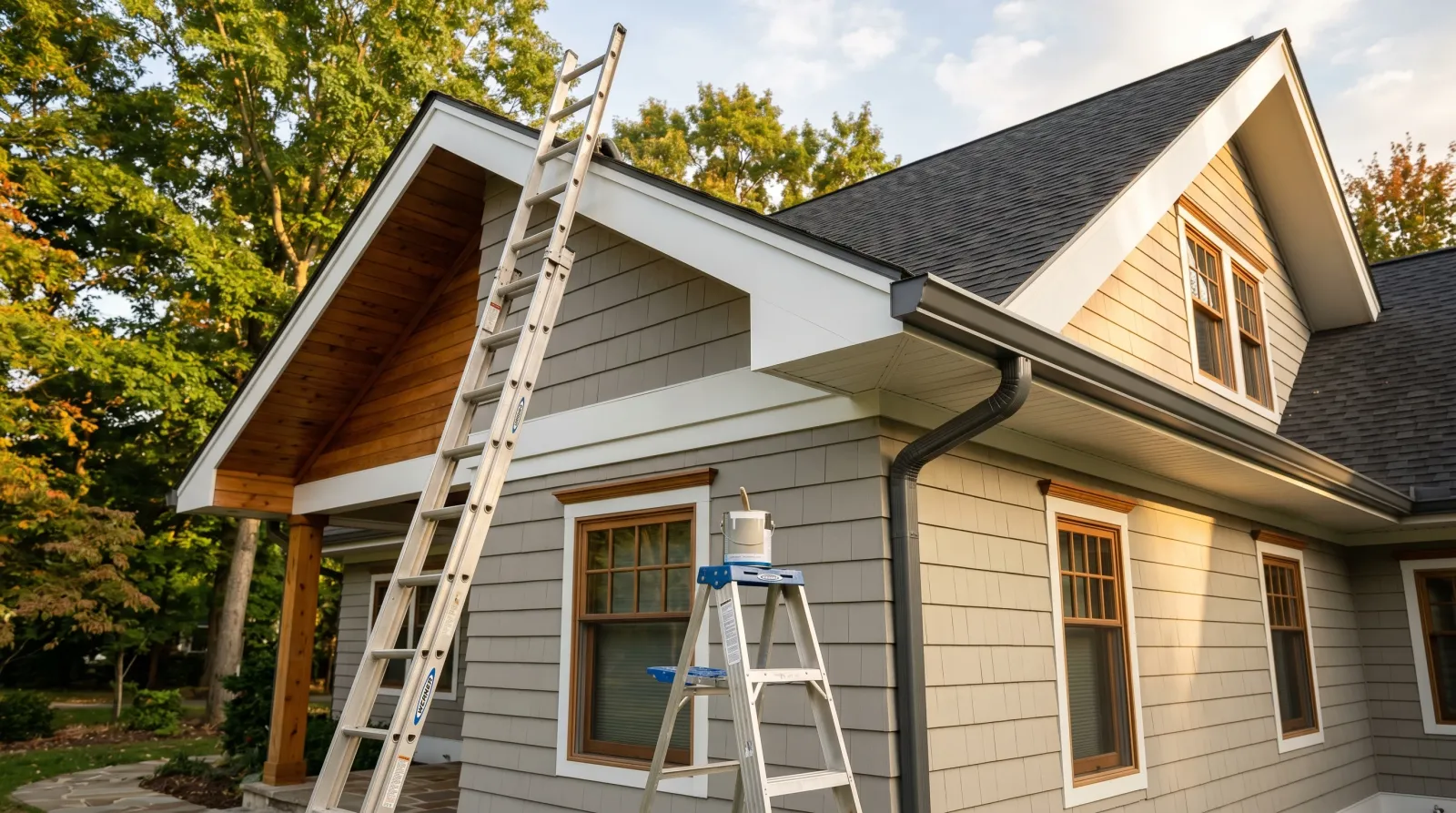
Fascia and soffit are the longest-lasting paint job on the house. They’re also the first place a careless repaint shows.
Most people skip the eaves on a body repaint because they’re hard to reach. Two years later the body still looks fine and the fascia is peeling in horizontal strips behind every gutter elbow. Here’s the order I work them in.
What You’ll Get
Crisp white fascia and soffit running clean around the full eave of a 1,800–2,400 sq ft house, ready for eight to fifteen years depending on substrate. Two to three working days single-story, four to six on a two-story. Materials run $180–$420.
Honest Take on Time and Difficulty
Medium project. Not technically hard. Hard because you’re on a ladder for every minute of it.
The brushwork is straightforward once you’ve cut a window trim. What slows you down is reach. Every 8 to 12 feet of eave you’re climbing down, moving the ladder, climbing back up, finding the cut line again.
| Day | Work | Hours |
|---|---|---|
| 1 | Pressure-wash eaves, flush gutters | 2–3 |
| 2 | Dry-down (no work) | 0 |
| 2 | Scrape, sand, repair rot, caulk | 4–6 |
| 3 | Spot-prime, mask gutter, first coat | 5–7 |
| 4 | Second coat fascia and soffit | 4–6 |
| 5 | Touch-ups, pull masking, walk-around | 1–2 |
Two-story doubles the ladder time. Sixty bucks a day for a 5-foot rolling scaffold under the gable buys back a full day of ladder wrestling.
Step 1: Identify What You’re Painting
Three substrates show up under the eave. Each one wants a different prep.
Wood fascia, wood soffit. The original spec on most pre-1990 houses. Pine, cedar, or fir. Holds paint well when primed, rots fast where water sits. Most prep, best finish.
Aluminum fascia wrap and aluminum soffit. Factory-painted aluminum coil wrapped over the original wood fascia in the 80s and 90s as a “maintenance-free” upgrade. The aluminum is fine. What’s behind it is sometimes 30 years of wet rotting wood. Tap the wrap with a knuckle every few feet. If it sounds hollow or flexes, the wood underneath is gone and a repaint won’t fix that.
Vinyl soffit, vinyl fascia. Modern construction default since 2000. Snap-together panels, vented soffit, J-channel at every wall. Takes paint with a bonding primer and a vinyl-safe acrylic. Won’t take a darker color than the original without warping in summer sun.
Tap the eave with a knuckle before you write a shopping list. Wood is dull. Aluminum rings metallic. Vinyl sounds hollow.
Step 2: Wash and Flush
Pressure-wash the eaves at 1,500 PSI with a 40-degree fan tip. Work top to bottom, hold the tip 12 inches off the surface. Aim down and outward. Never shoot water up into the soffit vents or behind the fascia. Trapped water takes weeks to dry and any paint over wet wood blisters within a season.
Flush the gutters while you’re up there. Leaves and grit dam up at the downspouts and dump water back across the fascia every storm. A clogged gutter is the single biggest reason fascia paint fails on the south corner of the house.
Mix a percarbonate cleaner for any mildew on the shaded north side. Brush it in, dwell 10 minutes, rinse. Then walk away for 48 hours of dry weather. Three days if shaded or it rained recently.
Watch out for: spraying water up into ridge vents or behind the fascia drip edge. Trapped water rots the rafter tails and you won’t see it for three years.
Step 3: Scrape, Sand, Repair Rot
This is the hour that makes or breaks the job.
Walk every eave with a 5-in-1 and a carbide scraper. Anywhere paint is loose on wood fascia, scrape until you hit sound paint that won’t lift with a fingernail. Feather the edge with 80-grit, knock it flat with 120. The transition has to be smooth or it telegraphs through both finish coats.
Probe every fascia corner and soffit-to-wall joint with a screwdriver, especially where the gutter dumps water. Soft wood is rotted wood. Cut out the bad section, replace with the same dimension pine or cedar, prime all six sides before you nail it up. Bare end grain is how rot gets back into a new patch inside two years.
Pull failed caulk out of the fascia-to-soffit joint. Re-caulk with paintable acrylic latex. Tool the bead with a wet finger. Never silicone. Paint won’t take to it.
On aluminum, scuff with a 220-grit sponge. You’re just breaking the gloss so primer bites. On vinyl, no sanding. Clean with TSP substitute, rinse, dry.
Watch out for: knots and cedar tannin left exposed on wood fascia. Both bleed through acrylic within months. Spot-prime with Cover-Stain or BIN Advanced. Brush it on, not sprayed.
Step 4: Spot-Prime and Mask
Spot-prime every bare-wood patch, every replacement board, every knot, every visible nail head. Cover-Stain (oil-based) for general bare wood and rust bleed. BIN Advanced (shellac) for cedar tannin. A quart covers more spot work than you’d think.
On aluminum, prime chalky or bare spots with INSL-X Stix or Zinsser Bulls Eye 1-2-3. Both bond without sanding to bare metal. On vinyl, prime the whole soffit with Stix if the surface is faded; skip it if the vinyl is still factory-clean.
Mask the gutter face with 1.5-inch blue tape along the top edge. Drop cloths along the foundation and over any shrubs. Mask the soffit vents from the inside.
Watch out for: painting over soffit vents. A clogged vent traps moisture in the attic and rot starts under the roof deck where you’ll never see it.
Step 5: First Coat, Cut Tight
Brush, don’t spray. Aluminum and vinyl soffit can take a sprayer if you mask aggressively, but wood fascia gets brushed every time. Spray on fascia means overspray on the gutter face and a finish that sits on the surface instead of getting worked in.
Cut the fascia first with a 2.5-inch angled sash. Load the brush, drag the bristles tight to the gutter tape, pull a clean line. Work in long strokes along the grain. Feather the wet edge into the next section before it sets. Don’t stop in the middle of a fascia run. Lap marks on white trim show the second the morning sun hits them.
Soffit next. Brush the soffit edges and vent perimeters with the same sash, then load a 4-inch foam roller or a mini roller with 3/8-inch nap for the wide flats. Roll across the panels, not along them. Across reads cleaner from below.
Cut tight to the siding at the frieze board. The line where the soffit meets the wall is the second most visible cut on the whole eave. The fascia-to-gutter line is first. Both get one slow pass with a fresh brush, not a hurried smear.
Watch out for: a roller too thick on the soffit. A 3/4-inch nap drips onto your head and the siding below. 3/8-inch nap or a foam mini.
Step 6: Second Coat
Wait the can’s recoat window, usually 4 hours for an acrylic semi-gloss in dry conditions. Second coat goes on the same way: cut the fascia, brush the soffit edges, roll the flats.
The white deepens. Spots that looked thin disappear. One coat looks fine the day you paint it. Two coats looks fine for a decade.
Don’t skip the second coat on the back of the house because nobody sees it. The north-facing fascia holds moisture longest and a thin single coat will be the first to chalk and lift.
Pull the gutter tape the same day, before the film bridges the edge.
Common Mistakes That Ruin the Job
- Painting over rotted fascia behind the gutter corner. Year two the whole corner section peels in sheets. Probe before you paint.
- One coat on fascia to save time. Always two coats. White over white reads thin and chalks early on the south face.
- Spraying wood fascia. Overspray on the gutter, drift onto the siding, finish sits on top instead of bonding in. Brush every time.
- Painting over soffit vents. Clogs the attic ventilation and the roof deck rots from inside.
- Skipping the bonding primer on aluminum or vinyl. Acrylic alone won’t bite. First scrape from a ladder leg pulls a strip off.
- Dark color on vinyl soffit. Warps the panel inside one summer. Stay inside the vinyl-safe palette.
- Pulling tape after the film cures. Lifts a strip with the tape. Pull same day.
Ladder and Scaffold Reach Plan
Single-story eaves at 8–10 feet, an 8-foot stepladder gets you most of the run. Switch to a 16-foot extension for any gable end above the porch.
Two-story is where planning matters. A 28-foot extension with a standoff bracket reaches the second-story fascia on a standard 18-foot eave height. The standoff is the part most DIYers skip. It holds the ladder 12 inches off the wall so the rail rests against the siding, not the aluminum gutter.
For any second-story gable that runs more than 20 feet of fascia, rent a 5-foot rolling scaffold. Sixty to eighty bucks a day. Set it once, work a 10-foot section without climbing, move it, work the next 10. Two hours of scaffold work replaces a full day of ladder repositions.
Watch out for: leaning a ladder against an aluminum gutter without a standoff. Gutter dents, paint chips, now you’ve got a repair before the repaint is dry.
Cure Schedule
| After final coat | What’s safe |
|---|---|
| 4 hours | Touch dry, no rain |
| 24 hours | Light rain fine, light dew OK |
| 7 days | Normal weather, hose down for cobwebs |
| 30 days | Full cure, scrub as needed |
Don’t pressure-wash a fresh fascia for the first month. The film is still hardening and high-pressure water lifts it off.
Maintenance and the Next Repaint
Wood fascia holds eight to twelve years in a four-season climate with the gutters kept clean. Aluminum wrap holds twelve to fifteen. Vinyl soffit basically forever if you don’t repaint it darker.
Walk the eaves every spring with binoculars from the ground. Look for peeling along the south-facing gutter corner, chalking on the west elevation (wipe a clean rag, it’ll pick up color), soffit panels separating or bowing, and rust streaks below gutter spikes.
Clean the gutters twice a year, spring and late fall. A clog ages fascia paint faster than anything else on the house. Five minutes per downspout buys two years of finish life.
When the south corner starts showing wear, spot-repair that one corner before you repaint the whole house. Wash, scrape, prime, two coats. Two hours of work.
Cost Breakdown: 1,800–2,400 Sq Ft Single-Story
| Item | Cost |
|---|---|
| Acrylic semi-gloss trim paint (2–3 gal) | $130–$210 |
| Stain-blocking primer (1 qt) | $25–$35 |
| Bonding primer for aluminum/vinyl (1 qt) | $25–$35 |
| Paintable acrylic caulk (3–4 tubes) | $18 |
| Scrapers, sanding sponges, 5-in-1 | $30 |
| Sash brush, foam roller, mini roller | $35 |
| Drop cloths, blue tape, vent covers | $40 |
| Pressure washer rental (half day) | $25 |
| Total | $328–$428 |
Two-story adds $80–$150 in scaffold rental and a gallon of paint. A pro quote on the same eaves runs $1,200–$2,800.
Two coats. Brush the fascia, scuff and prime the metal and vinyl, never paint over rotted wood behind a gutter.
Ask a Question