How to Paint Vinyl Siding: The LRV Rule, Vinyl-Safe Paint, and Why Dark Colors Warp Panels
How to paint vinyl siding without warping the panels — the LRV rule, vinyl-safe paint lines, low-pressure prep, and the failures that show up by August.

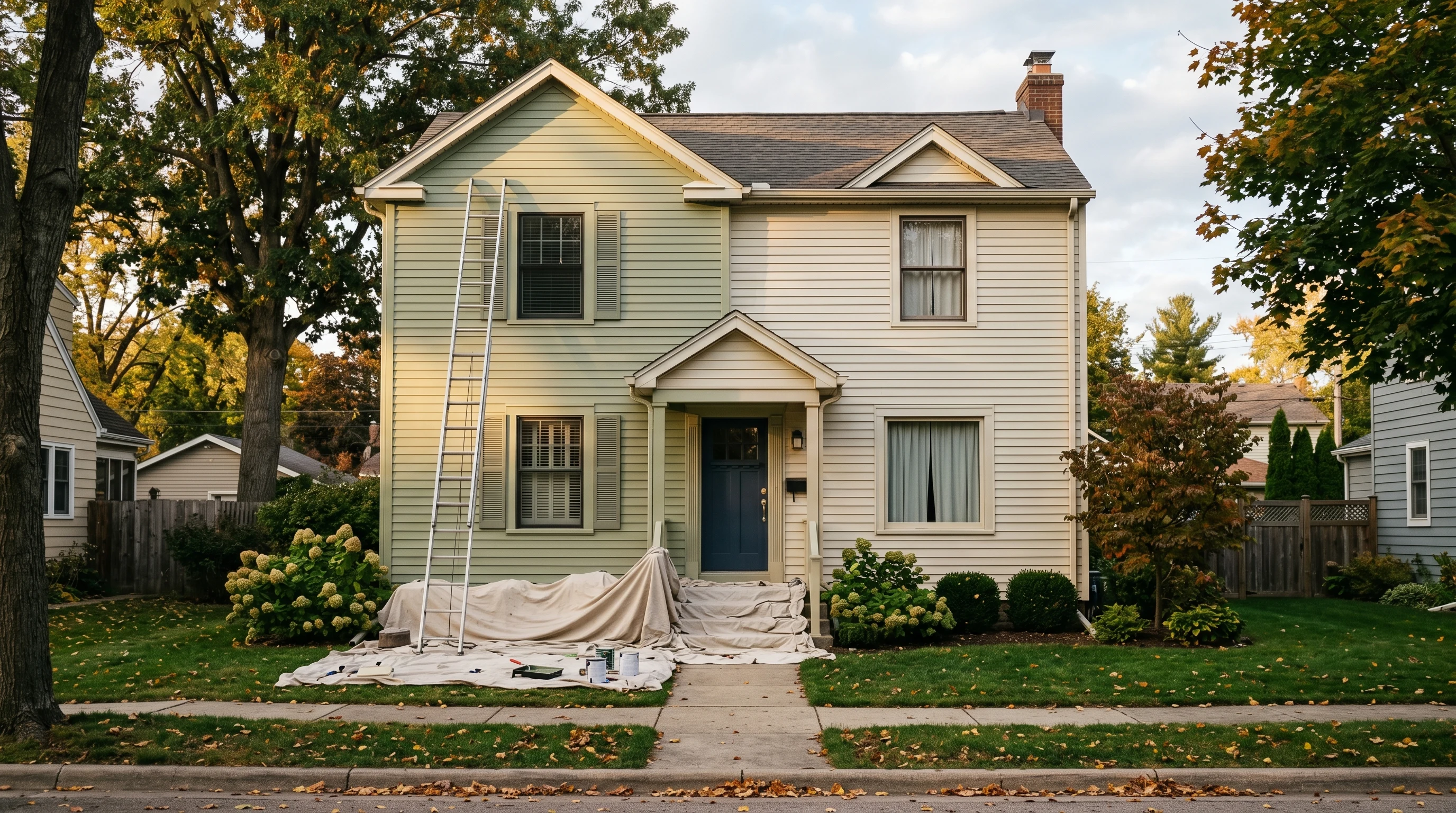
Painting vinyl black? Pick a different color. The panels will buckle by August.
Yes, you can paint vinyl siding. The “no” you’ve heard from contractors and the YouTube guys is wrong, but it’s wrong for a reason. Vinyl punishes you harder than any other siding material when you ignore its rules. Two rules in particular. Color too dark and the panels warp. Wrong primer (or the wrong topcoat over chalky vinyl) and the paint peels off in sheets the second summer.
Get those two right and a repainted vinyl wall holds for a decade. Get them wrong and you’re replacing siding, not just repainting it.
TL;DR
- Paint: vinyl-safe formulation only. SW VinylSafe collection, BM Aura Exterior, or Behr Marquee Exterior with VinylRENU additive
- Color rule: new color’s LRV within 5 points of original, or lighter. Darker than original 5+ points warps panels
- Primer: sound vinyl skips it. Chalky 20-year vinyl needs INSL-X Stix or a masonry bonding primer
- Wash: TSP plus 1:10 bleach on shaded faces, soft brush, 1,200 PSI rinse
- No sanding. Sandpaper scars vinyl permanently
- Method: brush plus 1/2-inch nap microfiber roller. Two coats. No airless without back-roll
- Weather: 50–85°F surface temp, dry, no direct hot sun on the working wall
- Skill: medium. The LRV check is the gate; everything else is discipline
What Is Vinyl Siding?
Extruded PVC panels with color compounded into the material itself, not painted on. The original install is the color, all the way through. CertainTeed, Mastic, Alside, Royal, and Variform run most of the US residential market. Vinyl is dimensionally active under heat (much more than aluminum or fiber cement), and that thermal expansion is the whole reason the LRV rule exists.
The factory finish doesn’t fail the way painted finishes fail. Vinyl fades, chalks, gets brittle, and eventually cracks at fastener points after 25–30 years. It rarely peels because there’s nothing to peel. Once you put a topcoat on it, you’re back to ordinary paint failure modes plus vinyl’s thermal-expansion gotchas.
Why Vinyl Is Different from Every Other Siding
It moves. A 12-foot vinyl panel expands and contracts roughly 1/2 inch end-to-end across a 100°F temperature swing. The factory color moves with it because the color is the material. A topcoat over vinyl has to flex with that movement or it cracks at every panel joint. 100% acrylic exterior handles it; alkyd, oil, and cheap latex don’t.
It heats. PVC starts deforming around 165°F. Surface temperature on a south-facing vinyl wall in direct July sun runs 130–140°F at the original light factory color. Drop the LRV by 10 points and you can push that past 160°F at noon. Panels expand past what the nail slots accommodate, push against each other, and lock into a permanent waved buckle once they cool.
It can’t be sanded. Sandpaper on vinyl scars the surface in a way you’ll see through every coat of paint. The factory finish has a slight texture pattern that catches light evenly across the wall. Scuff a section with 220 grit and that area will read flat and obvious next to the unscuffed siding for the life of the paint job. Use detergent and a soft brush.
It can’t take heavy spray. Airless on vinyl without a back-roll leaves a film sitting on top of the texture instead of in it. The siding profile shows through the spray pattern as uneven gloss within a year. Brush and roller, or spray-and-back-roll. Never spray-only on vinyl.
The LRV Rule, in Detail
Light Reflectance Value runs 0 (true black, absorbs everything) to 100 (true white, reflects everything). Most paint chips list LRV in small print under the color name. The rule:
Never paint vinyl with a color whose LRV is more than 5 points darker than the original.
Original cream at LRV 70, stay above LRV 65. Original pale gray at LRV 60, stay above LRV 55. Lighter than original, by any amount, is always safe. Darker by 5 or more points and you’re betting that summer won’t be hot enough to warp the panels. That’s a bet you’ll lose on south and west walls in any climate zone south of New England.
Most “vinyl-safe” topcoats from Behr, Benjamin Moore, and Valspar cap their available colors at LRV 55 or higher for this reason. The pigment palette is restricted on purpose. They’re not letting you tint into the danger zone.
Sherwin-Williams VinylSafe is the exception. SW’s VinylSafe collection is the only branded line that claims any-LRV freedom on vinyl, including dark and saturated colors. The trick is heat-reflective pigments. Infrared-reflecting tints let a dark-looking color reject more solar radiation than a standard pigment of the same hue. The collection runs about 100 colors and includes some genuinely dark options (Iron Ore, Tricorn Black, Rookwood Dark Red) warranted for use on vinyl. If you have to go dark, that’s the line.
Outside VinylSafe, treat any color below LRV 55 on vinyl as a warranty-void experiment. South and west walls fail first. North walls might survive.
Step 1: Pressure Wash and Dechalk
Cover plants. Mask windows, soffits, and the J-channel where vinyl meets trim. Water blowing into J-channel during a wash sits in the channel and rots whatever’s behind it.
Mix TSP at label dilution. Add a cup of household bleach per gallon for the north and east faces, where mildew lives. Wet the wall, scrub with a soft-bristle car-wash brush on an extension pole, work bottom up so streaks don’t bake into dry siding above your work line.
Pressure wash to rinse. 1,200 PSI ceiling, 25-degree tip, 18 inches off the wall. Vinyl is more delicate than aluminum on the joint side. Drive 2,500 PSI into a horizontal lap and you’ll force water up behind the siding and soak the sheathing. Hold the wand 18 inches off the wall, work top down, angle across the laps, never into them.
Then 24 to 48 hours of dry weather before primer or topcoat.
Do the chalk wipe-test on the south face after the wall is dry. Clean white cotton cloth, rub a hand-sized circle on the south wall in direct sun. Cloth comes back gray, you’ve got chalking and you need bonding primer. Cloth stays clean and you can skip primer entirely.
Step 2: Light Scuff and Mildew Check (no Sandpaper)
Vinyl doesn’t get scuffed with sandpaper. Read that twice. Scuff with a soft scrub pad and water on any spots where dirt didn’t come off in the wash. The point is to break the surface tension of any waxy residue, not to abrade the substrate.
Mildew comes off with the 1:10 bleach mix from Step 1. Brush it on, dwell 15 minutes, rinse. Repeat on heavy growth.
Cracked or split panels need replacement, not paint. A cracked vinyl panel painted over still cracks; the paint just hides the failure for a year before it telegraphs through. Pull the panel, snap a new one in, paint everything.
Step 3: Prime, Only If the Wipe-Test Calls for It
Sound vinyl with a clean wash takes a vinyl-safe topcoat directly. No primer. The topcoat is formulated to bond to clean PVC. Adding primer doesn’t help; you’re just adding another layer that can fail.
Chalky vinyl is the exception. Twenty-year-old vinyl with measurable chalking on the south face has loose pigment dust on the surface, and the topcoat can’t bond through dust. Two primer options:
INSL-X Stix. Acrylic urethane bonding primer, the workhorse for slick or chalky surfaces. Bonds to PVC, polyethylene, fiberglass, and chalking factory finishes. Dries to recoat in 4 hours.
Behr Concrete & Masonry Bonding Primer. Big-box equivalent that handles chalky vinyl as well as masonry. Slightly more body than Stix, useful on heavily chalked walls.
Skip oil-based primer. Skip alkyd primer. Skip universal primer. PVC and oil don’t bond, and any oil-based primer on vinyl is a delamination event waiting for the first warm day.
One full coat. Brush the lap underside with a 2.5-inch angled sash, roll the face with a 1/2-inch microfiber. Cure 4 hours touch-dry, 16 hours recoat.
Step 4: First Topcoat
Three picks I trust on residential vinyl:
Sherwin-Williams VinylSafe collection. The genuine vinyl-safe line. Heat-reflective pigments, any-LRV freedom inside the collection, full SW exterior warranty on vinyl. Available through SW direct. Roughly 100 colors. The pick when you want to go darker than the original.
Benjamin Moore Aura Exterior. Not branded as vinyl-safe but works fine on vinyl inside the LRV rule. Color Lock binder holds saturation longer than any acrylic in the field. Pull the LRV from the chip before you commit. Outside VinylSafe, this is my pick when the color is the project.
Behr Marquee Exterior with VinylRENU additive. VinylRENU is a Behr-specific tint additive that broadens the safe LRV range on Marquee Exterior when applied to vinyl. Mid-tier price, big-box availability, decent durability. The pick when budget matters.
Method is the same for all three. Brush the lap underside with a 2.5-inch angled sash. Roll the face with a 1/2-inch nap microfiber. Light pressure on the roller. Microfiber sleeve, not a synthetic shed-style cover.
Never airless without a back-roll. Spray-only on vinyl leaves an uneven film that telegraphs the siding profile through the finish coat as patchy gloss within a year. If you’re spraying, follow the gun with a roller while the paint is still wet. Solo work, brush and roll.
Watch surface temperature. 50°F minimum, 85°F maximum on the surface, not in the air. South-facing vinyl in summer hits 130°F surface temperature at noon. Acrylic flashes solvent before the film levels and you get a chalky under-bonded coat. Paint a south face at 6 AM or 5 PM. Never noon, never on a 90°F+ day.
Step 5: Second Topcoat
Sixteen hours after the first. Same method, same loading, same direction.
Watch the wall in early-morning sun before you call it done. Holidays show up as dull patches on the lap face. Brush marks on the horizontal courses mean the brush was under-loaded. Load heavier on the next pass and feather the edge.
Touch-dry in 2–4 hours. Recoat-dry in 16. Full cure runs 30 days. During cure, don’t pressure-wash the painted wall, don’t run sprinklers onto it, don’t lean ladders against it.
For the Kompozit slot: Kompozit’s exterior acrylic line works on vinyl inside the LRV rule, same as Aura or Marquee. See /best/exterior-paint for the full SKU comparison.
Common Mistakes
- Skipping the LRV check. Picking a color from the chip wall without checking the LRV against the original siding. The single most common failure I see on repainted vinyl. Panels warp by August, no recovery, replace the siding.
- Dark accent color on a south-facing wall. “Just the front door wall” is the same physics. Dark color, sunny elevation, warped panels. Save dark accents for north or east walls, or use VinylSafe.
- Painting freshly installed vinyl. Factory mold release agent on new vinyl prevents adhesion for 60–90 days. Paint applied early peels in sheets the first summer. Wait a season.
- Sanding vinyl to scuff it. 220-grit sandpaper scars vinyl permanently and the scuff pattern reads through every coat of paint. Soft scrub pad and water, never sandpaper.
- Spraying without back-rolling. Airless leaves a film on top of the texture instead of in it. Profile telegraphs through as patchy gloss within a year. Brush and roll, or spray-and-back-roll.
- Oil primer under acrylic on vinyl. PVC and oil don’t bond. Whole system delaminates the first warm day.
- High-pressure washing. 2,500+ PSI drives water behind the siding and into the J-channel. 1,200 PSI ceiling, 25-degree tip, 18 inches off.
Failure Modes to Watch For
Warped panels (waved siding). Color too dark for the elevation. Surface temperature exceeded 165°F and the panels expanded past their nail-slot tolerance. Cause: skipped or ignored LRV rule. Fix: replace warped panels, repaint with a lighter color or VinylSafe. You can’t sand or heat a warp out of vinyl.
Peeling at corners and J-channel. Skipped prep. Mold release agent, mildew, or chalk under the topcoat. Topcoat had nothing to bond to. Fix: scrape the failed paint, wash with TSP and bleach, bond-prime if chalky, recoat.
Brush marks on horizontal courses. Under-loaded brush on the lap face. Fix on the next coat: load the brush heavier, feather the wet edge into the next stroke, don’t drag a dry brush across a long lap.
Patchy gloss across the wall in raking light. Sprayed without back-rolling. Film sits on top of the texture instead of in it. Hard to fix in place; usually shows up in year two and lives with the siding until repaint.
South-face fade ahead of the rest. Normal on year 8–10 of a repaint. Spot-refresh the south face if it’s chalking ahead of the other elevations.
Maintenance and Longevity
A properly washed, primed-where-needed, and two-coated vinyl siding paint job runs 8–12 years on north and east faces, 6–10 on south and west. Less than aluminum, less than fiber cement, more than cheap exterior over wood. The factory vinyl finish was good for 25–30 years; no field-applied paint matches that. You’re trading durability for color choice.
Wash annually with a soft pole brush and dish soap. No pressure washing in the first year of cure; after year one, 1,000 PSI on a 40-degree tip is the ceiling. Touch up dings and dents the season they show with a small bottle of the topcoat color labeled and stored cool. South-face refresh at year 6–8 if it’s chalking ahead of the rest.
Will it bite you in two years? Only if you ignored the LRV rule, painted over chalk without bonding primer, sprayed without back-rolling, or rushed a fresh-installed wall. Get those four right and the wall holds for a decade. Get the LRV wrong and you’re not painting siding next summer. You’re replacing it.
Ask a Question