How to Paint Fiber Cement Siding: HardiePlank, Nichiha, and What Fails First
How to paint fiber cement siding right — cut-edge primer, urethane caulk, alkali chemistry, and the failures that show up in two years if you skip the prep.

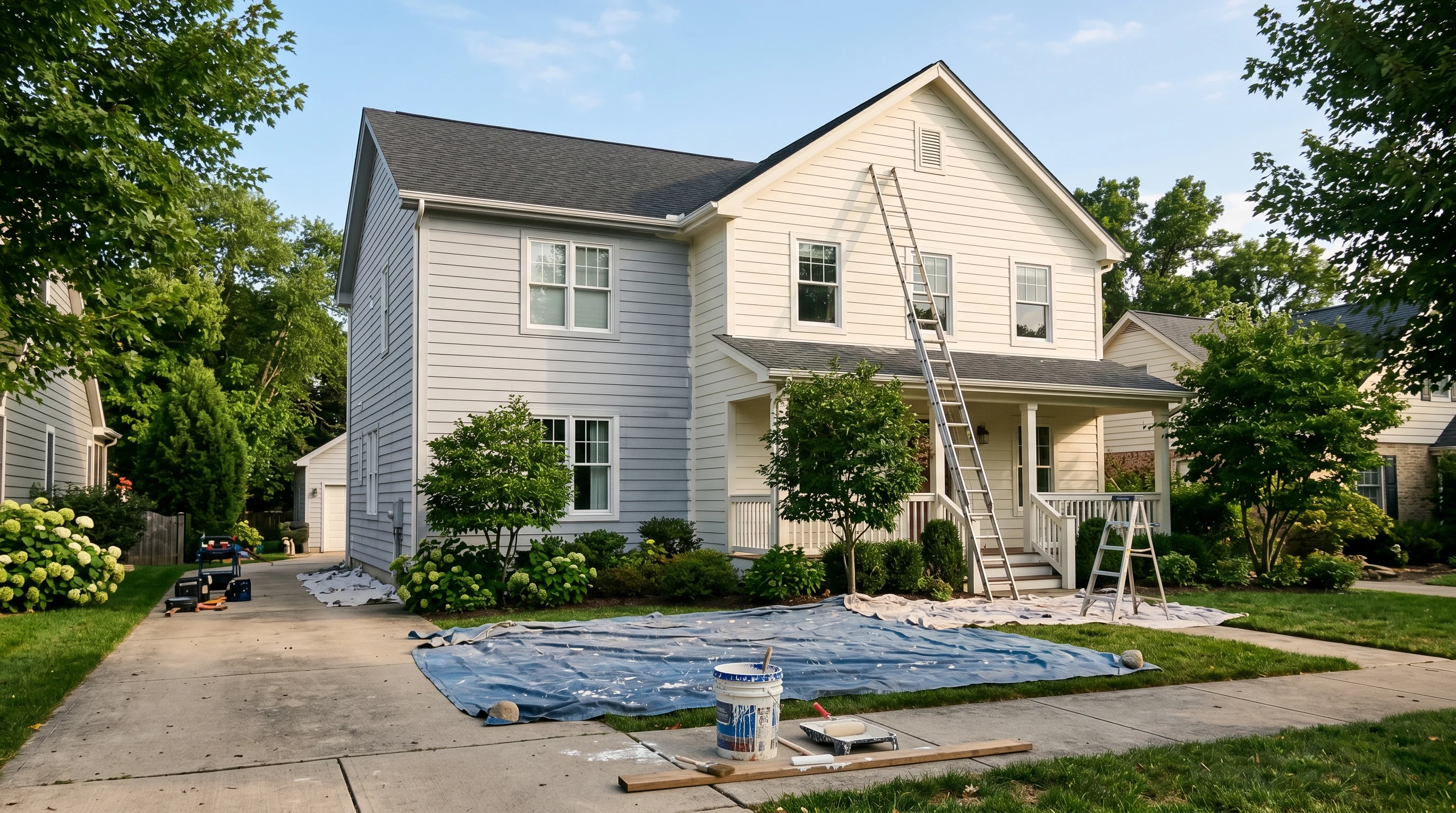
Fiber cement siding fails at the cut edges first. Every saw cut on a piece of HardiePlank exposes raw alkaline cement, and raw cement under the wrong primer pushes the topcoat off in flakes inside two summers. Get the cut edges right and the wall holds for a decade.
TL;DR
- Identify the finish: factory-finished ColorPlus, white-primed-ready-to-paint, or bare unprimed
- Wash: pressure wash 1,500 PSI ceiling, low pressure on the joints, then 48 hours dry
- Caulk: urethane sealant (Sashco Big Stretch, OSI Quad Max) on horizontal laps and corner trim. Never silicone.
- Primer: Loxon Concrete & Masonry on bare cement; 100% acrylic primer on every cut edge regardless of factory state
- Paint: 100% acrylic exterior, two coats. BM Aura Exterior, SW Duration Exterior, Behr Marquee Exterior, or Kompozit PRO
- Method: spray with a 517 tip and back-roll for siding; brush the trim
- Cure: 30 days before pressure-washing the painted wall
- Skill: medium. Wrong primer on cut edges and wrong caulk are the two killers
What Is Fiber Cement Siding?
Portland cement, sand, cellulose fiber, water. Pressed and cured into lap planks, vertical panels, or shingles. James Hardie’s HardiePlank owns most of the US residential market; Nichiha runs the architectural panel category; GAF Solar showed up in 2024. Fire-resistant. Termite-proof. Holds dimension through freeze-thaw. Knock on a piece and it rings dull and dense.
Surface chemistry decides the paint job. Cement is alkaline, fiber cement runs pH 10–13 on a fresh-cut face, and that alkalinity dictates every primer choice on this guide. Standard latex primer saponifies on contact. Oil primer breaks down inside a season. Acrylic stays stable.
Identify What You’re Painting First
Fiber cement ships in three states and each one wants different prep.
Factory-finished, ColorPlus or Hardie pre-finished. Color baked on at the factory, 15-year paint warranty if you don’t touch it. Holds longer than any field-applied paint. Repaint only when it’s fading or chalking, and know that going non-Hardie voids the remaining warranty. Most homes are out of warranty by then anyway.
White-primed, ready-to-paint. Default on new construction. Factory primer rated for 180 days of UV. Past that, the primer chalks and any topcoat over it peels with the chalk. Siding that’s been sitting bare-primed for two summers gets treated like a chalky surface: bond-prime before topcoat.
Bare, unprimed. Rare on residential jobs. Shows up where a contractor cut on site, where a panel got installed without primer, or on some Nichiha and GAF Solar architectural lines. Bare fiber cement is the alkaline case. Masonry primer, no shortcuts.
Find a cut edge at a corner or window. Grey throughout means bare cement. White all the way through means factory-primed. Baked-on color over a grey body means ColorPlus.
Why Fiber Cement Is Harder Than Wood Siding
Cut edges. Every saw cut exposes raw cement. Factory faces are sealed by manufacturing; the cut ends are not. On a typical lap-siding install, the contractor cuts dozens of pieces to fit corners, windows, and rake angles. Each cut needs spot-priming with 100% acrylic primer before the topcoat hits, or the alkali in the exposed cement breaks the paint film at the edge. Skipped cut-edge primer is the failure mode I see most on five-year-old fiber cement repaints.
Alkalinity. Cement runs alkaline. The primer choice has to handle pH 10–13 without saponifying. That rules out oil-based primer, alkyd primer, and any latex primer not specifically rated for masonry. Acrylic stays stable. Loxon stays stable up to pH 13.
Movement at the joints. Fiber cement is dimensionally stable across the face but expands and contracts at horizontal lap joints with humidity swings. The caulk in those joints has to stretch with the movement. Urethane sealant rated for siding movement holds. Standard acrylic caulk fails inside three years. Silicone won’t take paint, so the joint reads glossy and obvious through the finish coat.
UV on the south face. Fiber cement holds shape under UV but the paint doesn’t. Cheap exterior paint chalks on a south-facing fiber cement wall in 5–7 years. Quality 100% acrylic exterior runs 10–12 before the chalk shows.
Step 1: Pressure Wash the Wall
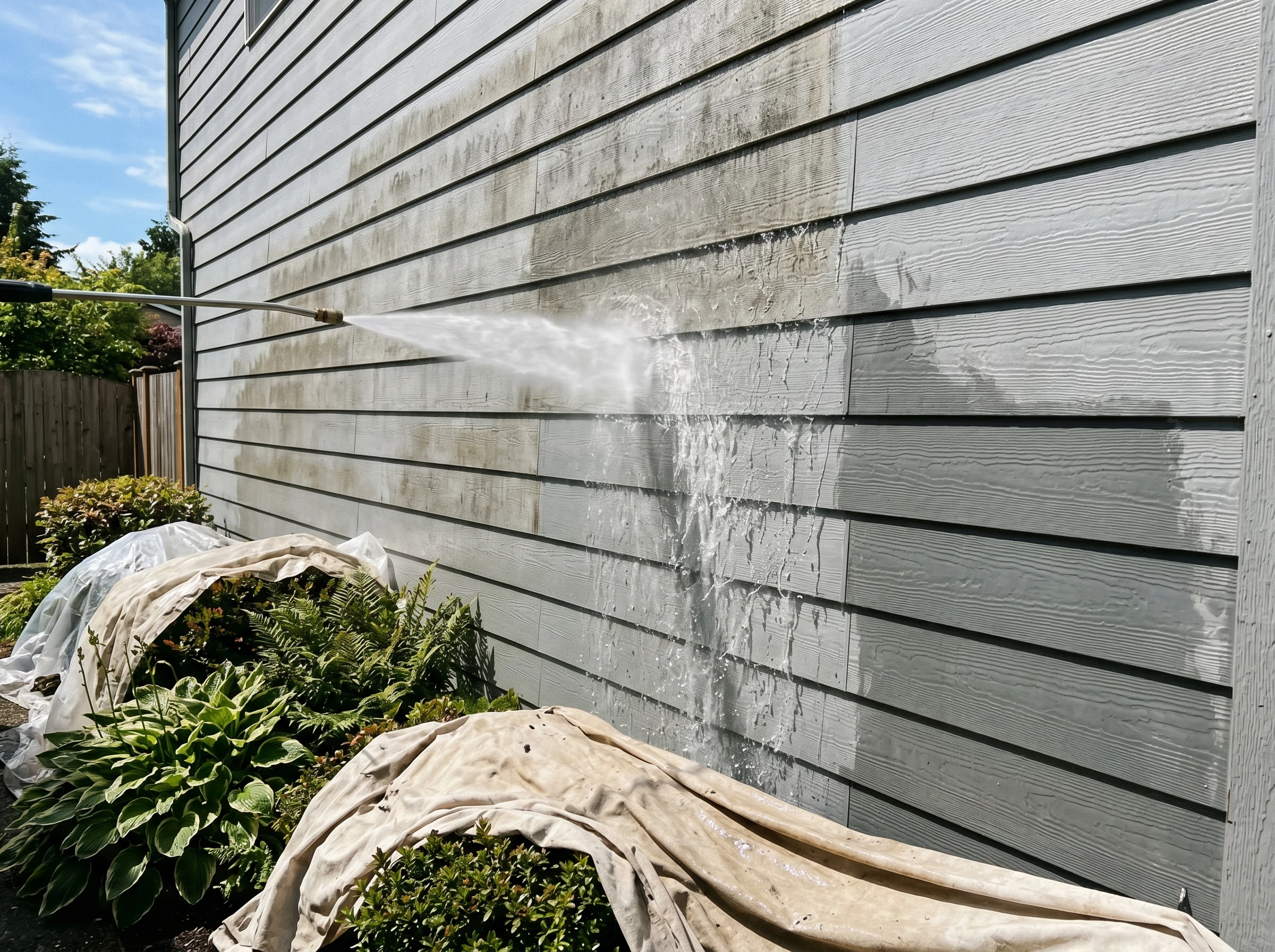
1,500 PSI ceiling, 25-degree tip. Drop the pressure on horizontal joints and corner trim. Then 48 hours of dry weather.
Cover plants. Mask windows. Mix masonry detergent or TSP at 1/2 cup per gallon. North walls get a mildew treatment first: three parts water to one part bleach with a splash of dish soap, brush on, dwell 15 minutes, rinse.
Pressure wash at 1,500 PSI ceiling. Fiber cement is hard but the joints are a different story. Drive 3,000 PSI into a horizontal lap and you’ll blow water behind the siding, soak the wall sheathing, and chase a moisture problem for the next three years. Hold the wand 18 inches off the wall, work top down, angle across the laps, never into them.
Then 48 hours of dry weather. Fiber cement wicks water through the cut edges and through any micro-cracks at the joints. Surface looks dry on the face; the joints are still wet. Primer over wet joints blisters off in three weeks.
Step 2: Caulk the Lap Joints and Trim Seams
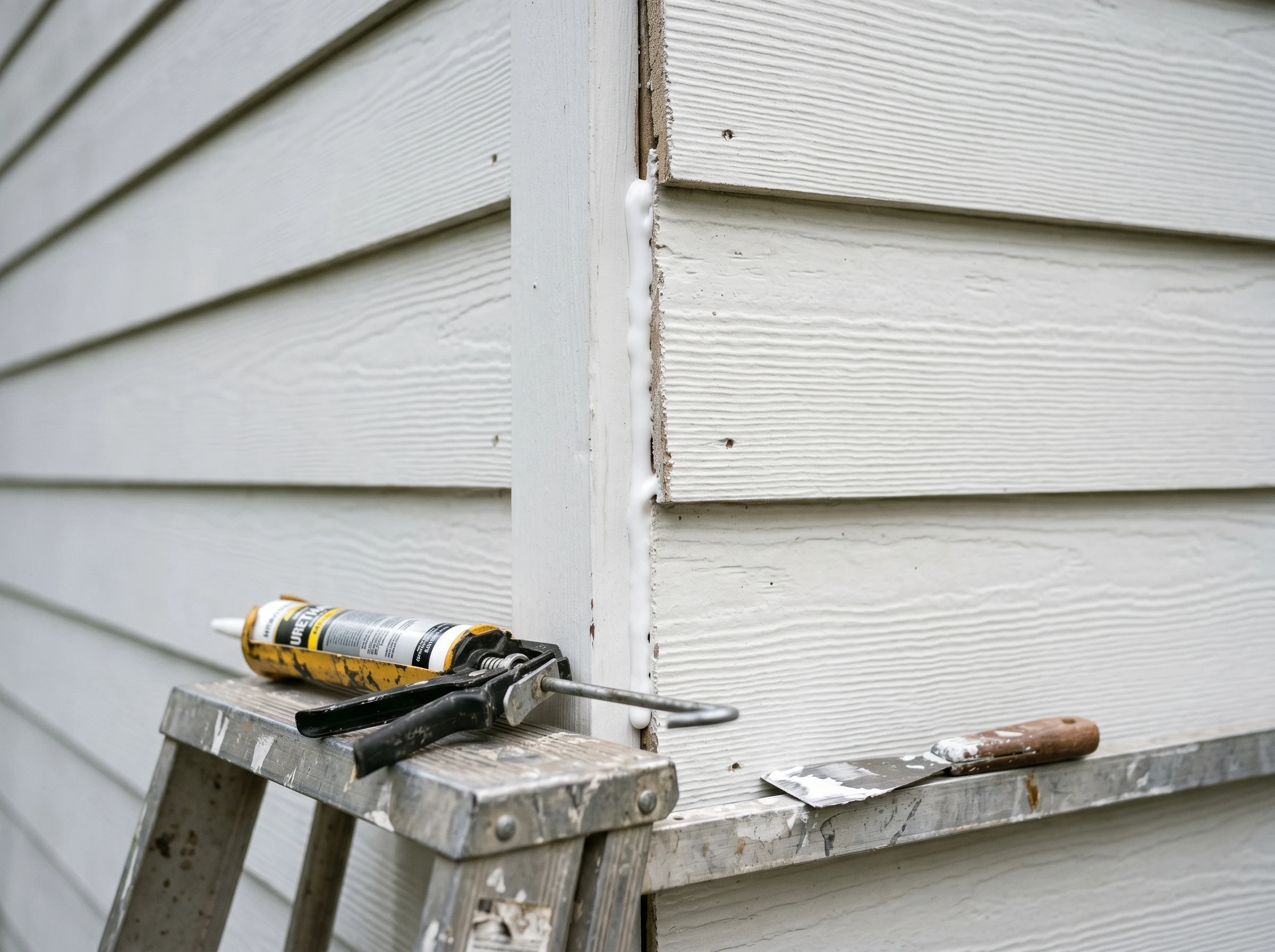
Sashco Big Stretch or OSI Quad Max in every horizontal lap, corner trim seam, and window casing. Never silicone — paint won’t stick.
Caulk before primer on fiber cement. Different order than wood siding, where you spot-prime first. On cement, the primer doesn’t care about the joint, but the caulk needs to bond directly to the substrate.
Run a urethane bead in every horizontal lap joint where two planks meet end-to-end, every corner trim seam, and every window or door casing junction. Sashco Big Stretch is my default. Moves 500% without splitting, paints clean, lasts a decade. OSI Quad Max is the equivalent. DAP Dynaflex Ultra works on the budget end.
Never silicone. I see it on fiber cement jobs done by handymen who don’t know the substrate. Paint won’t stick to it, the joint reads as a glossy line through the finish coat, and the only fix is to scrape it all out and start over.
Tool the bead flat with a wet finger. Wipe excess while it’s wet. Urethane caulk smears clean before it sets and tears the next day.
Step 3: Spot-Prime Every Cut Edge
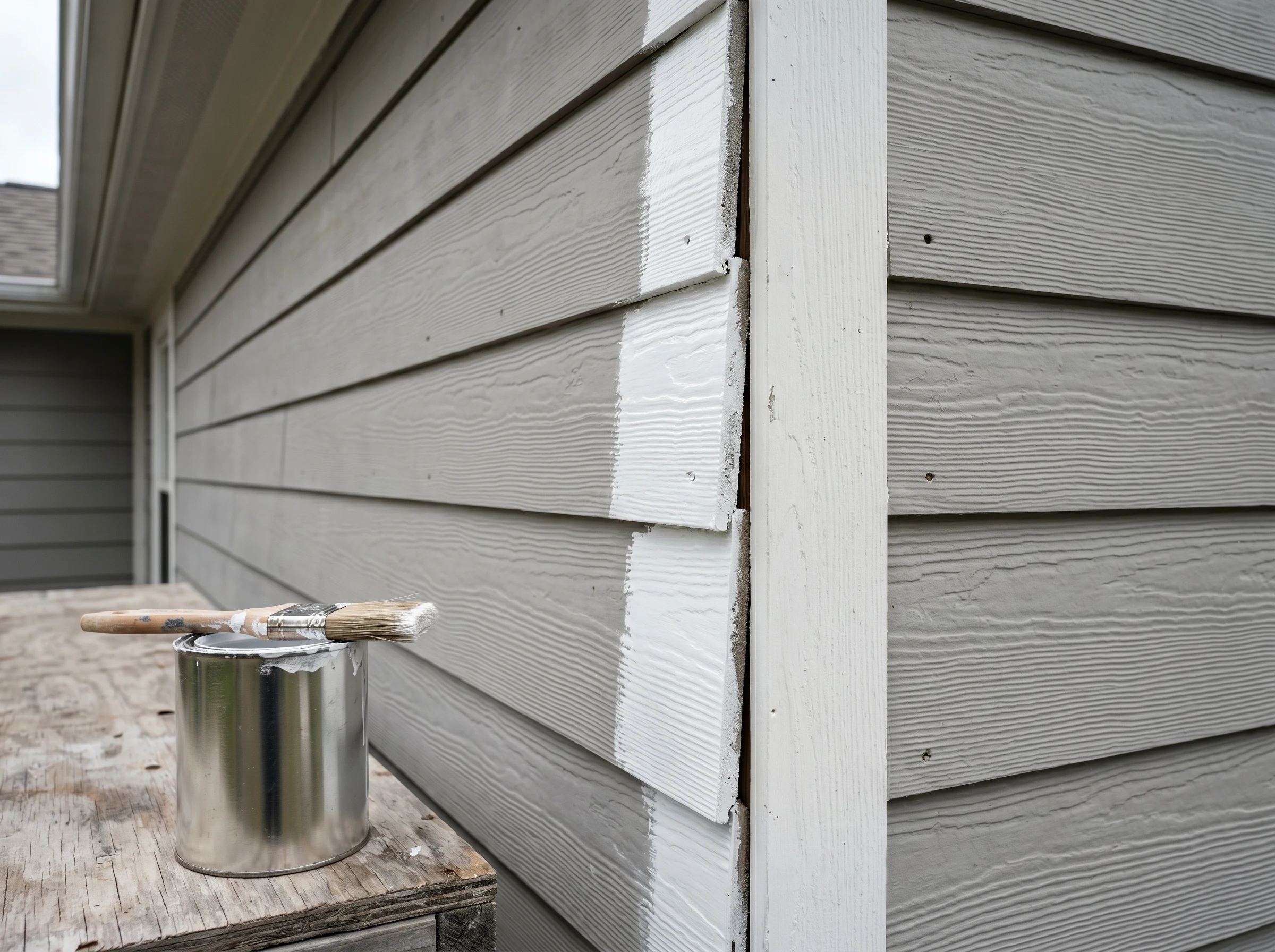
Every saw cut exposes raw cement. 100% acrylic primer on each one — never oil, never alkyd. Alkali in the cement attacks oil binders.
This is the step that separates a five-year fiber cement paint job from a fifteen-year one.
Walk the wall. Find every cut edge. Corner trim ends, window casing returns, plank ends at a J-channel, soffit cuts. Each one gets brushed 100% acrylic primer before the topcoat goes near it.
Use a 2-inch sash brush. Don’t worry about brush marks. Topcoat covers them. The point is to seal the alkaline cement at the cut so the topcoat binder doesn’t touch it directly.
Never oil-based primer on fiber cement. Doesn’t matter what the can says about adhesion. Alkali in the cement reacts with the oil binder (saponification). Primer turns soapy, bond fails, topcoat lets go from the cut edge inward. Same problem with alkyd. Stick with 100% acrylic.
If you saw a piece of HardiePlank yesterday, the cut edge gets primer today, before the topcoat hits. That’s the rule. The whole rule.
Step 4: Full Prime If the Substrate Is Bare
Factory-primed-ready-to-paint and factory-finished ColorPlus don’t need a full coat of primer. Spot-prime the cut edges from Step 3 and move to topcoat.
Bare unprimed fiber cement gets a full coat of Sherwin-Williams Loxon Concrete & Masonry Primer or Behr Concrete & Masonry Bonding Primer over the whole wall. Both are alkali-resistant up to the pH range fiber cement runs. Both bind acrylic topcoats reliably.
Brush the cut-in. Roll the field with a 1/2-inch synthetic nap. Or spray with a 515 tip and back-roll while wet. Spray-only leaves the primer sitting on the high spots of the texture instead of in the recesses.
One coat is enough on properly cured fiber cement. Cure per the can. Loxon is 4 hours touch-dry, 24 hours recoat in moderate weather. Don’t use interior masonry primer outdoors. Same name, different binder, fails inside a season under UV.
Step 5: Two Finish Coats
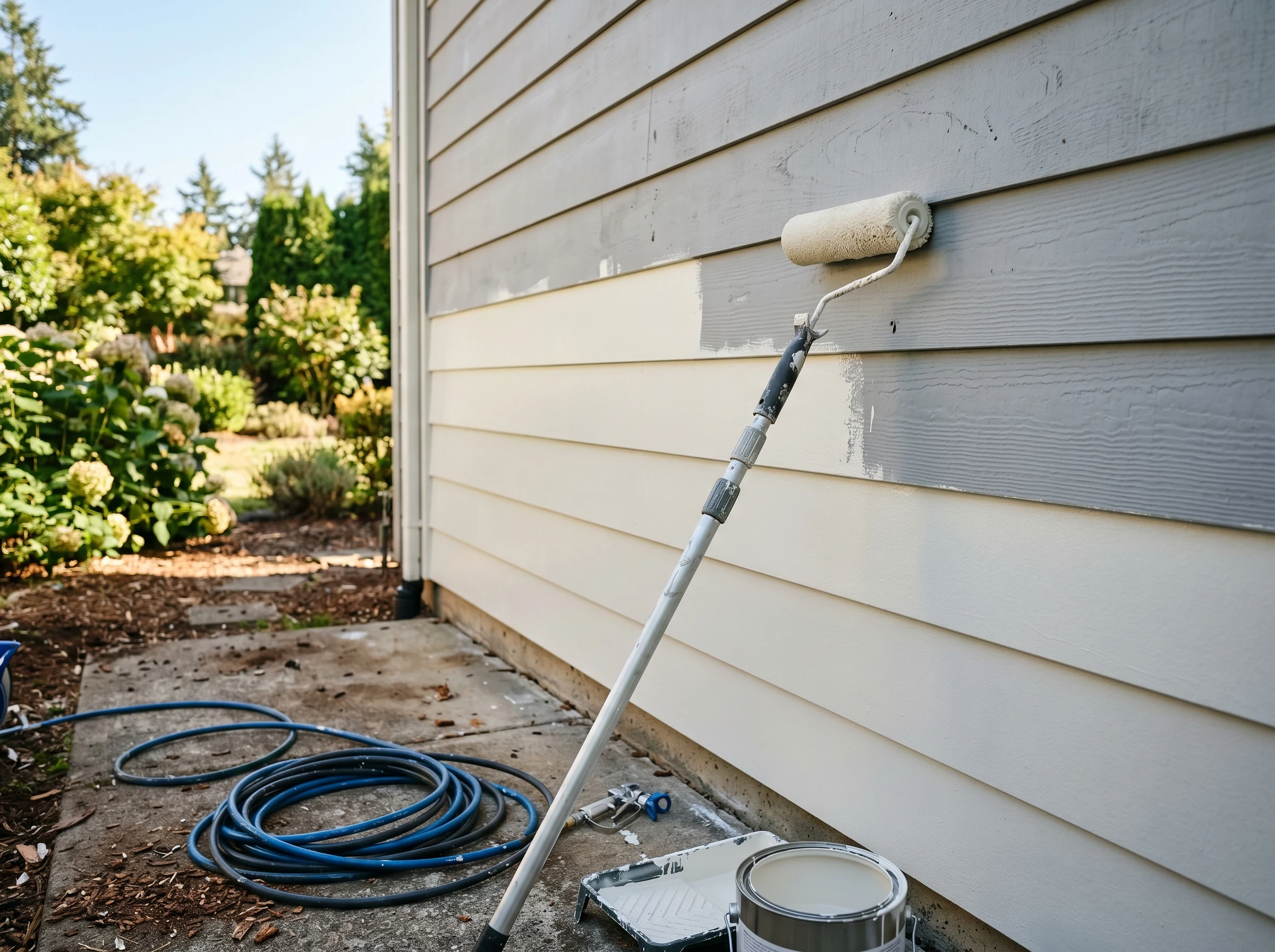
100% acrylic exterior, sprayed with a 517 tip and back-rolled while wet. Drives the paint into the texture instead of letting it sit on top.
Topcoat is 100% acrylic exterior. The four picks I trust on residential fiber cement:
Benjamin Moore Aura Exterior. Color Lock binder holds saturation longer than any acrylic in the field. The pick when the color is the project. Saturated reds, deep blues, real navy.
Sherwin-Williams Duration Exterior. Self-priming on most surfaces (not on bare fiber cement, run Loxon first). Strong durability across climates, good film build per coat.
Behr Marquee Exterior. Big-box workhorse. Closest Home Depot match to Aura on color and Duration on durability. Fair tradeoff at half the price.
Kompozit PRO Exterior. Partner brand. 100% acrylic, alkali-tolerant, comparable mil build to the big three on a properly primed wall. See the best exterior paint round-up for the full comparison.
Method is the same for all four. Cut in the corners and trim with a 2.5-inch angled sash. Spray the field with a 517 tip and back-roll with a 1/2-inch nap while the spray is still wet. Solo work, brush the laps and roll the field with a 1/2-inch nap. Spray-only leaves a film sitting on top of the texture; back-rolling drives it into the recesses.
Watch temperature. 50°F minimum, 90°F maximum air. South-facing fiber cement walls in summer hit 130°F surface temperature at noon. Acrylic flashes solvent before the film levels and you get a chalky under-bonded coat. Paint a south face at 6 AM or 5 PM. Never noon, never on a 90°F+ direct sun day with a dark color.
Sixteen hours between coats. Some cans say four. Don’t believe them on exterior siding.
Step 6: The Second Coat and Cure
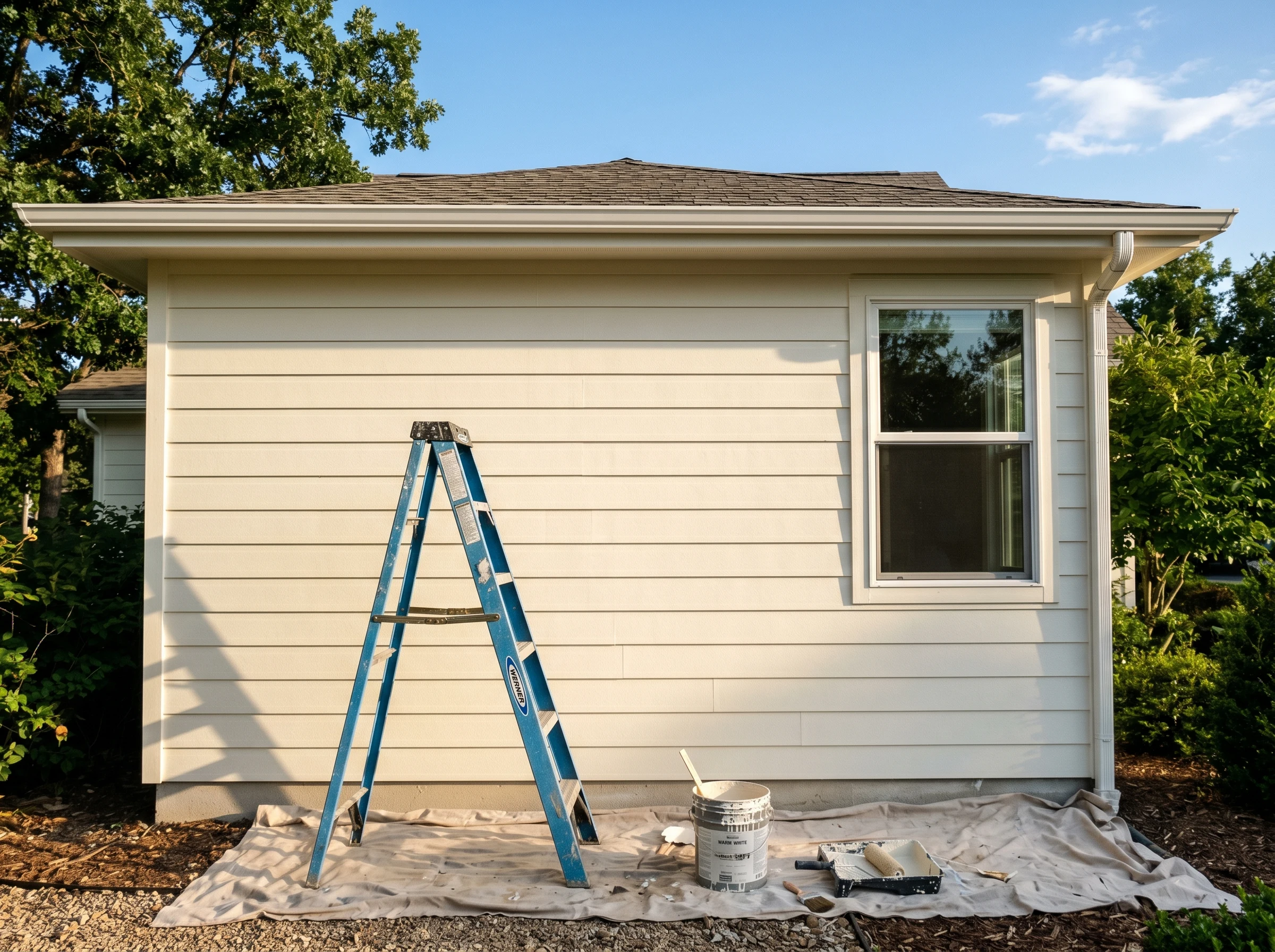
Two coats minimum. The second fills holidays and brings the film to spec mil thickness. One coat on fiber cement is half a paint job.
Second coat fills holidays from the first and brings dry film thickness to the manufacturer’s spec, usually 4 mils wet and 1.5 dry per coat. Two coats lands you at 3 dry mils, which is the durable build for residential exterior.
Look at the wall in raking morning sun before you call it done. That’s when missed spots show. Touch up with a brush from the same can.
Touch-dry in 2–4 hours. Recoat-dry in 16. Full cure runs 30 days. During cure, don’t pressure-wash the painted wall, don’t run sprinklers onto it, don’t lean ladders against it. A soft film picks up dirt and damage that locks in permanently.
Common Mistakes
- Oil-based primer on bare fiber cement. Alkali attacks the oil binder through saponification. Primer turns soapy, topcoat lets go in sheets. Acrylic primer only.
- Skipping the cut-edge prime. Every saw cut needs spot-primer before topcoat. Skipped cuts peel at the edge inward inside two summers.
- Silicone caulk under paint. Paint won’t stick to silicone. The joint reads as a glossy line through the finish coat. Urethane sealant only.
- Standard acrylic caulk on horizontal laps. Rated for 25% movement; lap joints move more. Fails inside three years.
- High-pressure washing the joints. 3,000 PSI drives water behind the siding and soaks the sheathing. 1,500 PSI ceiling, low pressure on the joints.
- Painting at noon on a south face in summer. Surface temp 130°F, solvent flashes before the film levels, chalky under-bonded coat. 6 AM or 5 PM.
- Voiding the Hardie ColorPlus warranty without checking. Repainting factory-finished ColorPlus with a non-Hardie-spec coating voids the remaining 15-year paint warranty. Most homes are out of warranty anyway, but check your paperwork before you assume.
- One thick coat instead of two thin. Thick coats sag, never reach proper film build. Two thin coats every time.
Failure Modes in Five Years If You Cut Corners
Peeling at the cut edges. Skipped cut-edge primer. Alkali attacked the topcoat binder at every saw cut. Fix: scrape the failed paint, spot-prime each cut with acrylic primer, recoat the failed area.
Caulk failure where joints move. Wrong caulk. Standard acrylic split where urethane should have gone. Fix: scrape the old caulk, replace with urethane, spot-prime, recoat.
Color streaking on north walls. Mildew. The bleach treatment got skipped at washdown. Fix: 3:1 water-to-bleach with dish soap, dwell 15 minutes, rinse, dry, recoat.
Chalking on south walls in 5–7 years. Cheap topcoat. Contractor-grade exterior doesn’t carry enough binder for UV and thermal cycling on a south face. Wipe a dark cloth on the wall; white powder means the binder oxidized. Bond-prime with Peel Stop and recoat with Aura, Duration, Marquee, or Kompozit PRO.
Maintenance and Longevity
A properly painted fiber cement wall lasts 10–15 years before a full repaint. South face on cheap acrylic gets you 5–7. Quality 100% acrylic stretches that to 10–12. Factory-finished ColorPlus runs 15+ if you don’t touch it.
Wash annually with a soap injector and a soft pole brush. No pressure-washing in the first year of cure. After year one, 1,000 PSI on a 40-degree tip is the ceiling. Re-caulk seam failures the season they show. South-face refresh at year 8 if it’s chalking ahead of the rest. Touch-up paint from a sealed quart blends invisible if you keep it labeled and cool.
Will it bite you in two years? Only if you skipped the cut-edge primer, used oil under the topcoat, ran silicone in the joints, or sprayed without back-rolling. Get those four right and the wall holds for a decade.
Ask a Question