What Is Resin in Paint?
Resin is the polymer that fuses into the dried film and holds everything else there. Acrylic, alkyd, urethane, epoxy — the resin decides what the paint actually does.

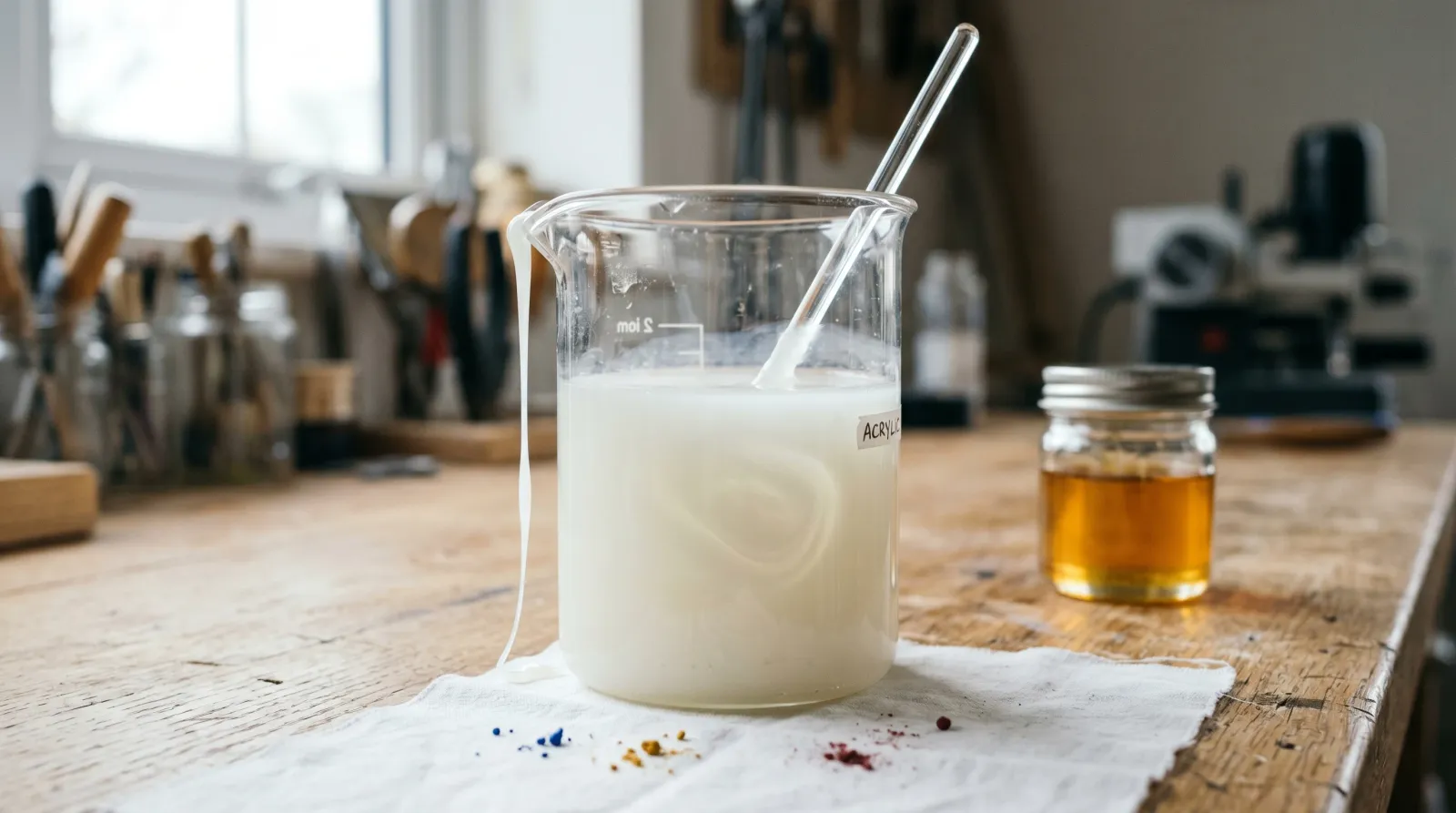
Walk through any paint aisle and you’ll see the same word printed on the premium cans and missing from the cheap ones: resin. “100% acrylic resin.” “Alkyd-urethane resin.” “Modified epoxy resin.” The budget cans on the bottom shelf just say “acrylic latex” with no qualifier, or “interior wall paint” with nothing chemical on the front at all. That asymmetry is on purpose. The resin is the most expensive ingredient in the gallon, and the brands that spent on it want you to know.
Resin is another word for binder. It’s the polymer that holds the pigment together and sticks the film to the wall once the water (or solvent) evaporates. The reason for that is the resin is the only part of the formula that’s still there in year three. Pigment provides color and opacity. Water or mineral spirits is just the carrier that gets everything onto the surface and then leaves. What stays — what you scrub, what flexes through humidity swings, what the UV beats on for a decade — is a thin film of resin with pigment particles locked inside it. The resin is the paint, in any sense that matters six months after the job.
How Much of the Can Is Actually Resin
Less than most people guess. A typical exterior acrylic house paint carries 15–30% acrylic emulsion by weight, and that emulsion is itself only 40–50% solids — the rest is water. Run the arithmetic and the actual polymer is somewhere around 8 to 15% of the wet gallon. Pigment runs 20–40% by weight, additives (thickeners, surfactants, coalescents, biocides) take 5–15%, and water makes up the balance.
Those small percentages are why the resin drives the price. Acrylic polymer costs several times what titanium dioxide costs per pound, and many times what water costs. Shifting a formula from 100% acrylic to a vinyl-acrylic blend saves a few dollars a gallon at the plant — and gives away most of the film’s flexibility and washability.
The number to look at on a data sheet is volume solids: what fraction of the wet paint stays behind as dry film. A flat interior acrylic runs about 50% volume solids; a gloss acrylic lands closer to 44%. Higher volume solids means a thicker dry film per coat, which is the whole point of mil thickness — a standard interior coat is roughly 4 mils wet drying to about 1.5 mils dry. Split those solids between resin and pigment and you get the pigment volume concentration, which is where cheap paint gives itself away: past about 45% PVC there is no longer enough resin to fully wrap every pigment particle, and the film chalks under a damp finger.
The Resin Families You’ll Actually See
There are maybe a dozen resin chemistries in commercial paint. Six of them cover almost everything sold for houses.
Acrylic resin. Polymerized acrylate esters (methyl methacrylate, butyl acrylate, and friends) dispersed in water. Hard, flexible, UV-stable, bonds well to a wide range of substrates. Every premium interior and every honest exterior line is built on this resin. When you see “100% acrylic” on the label, it means the polymer fraction is all acrylic with no PVA mixed in. That’s the spec to look for on anything that gets washed, hit by sun, or moves with humidity. The full breakdown is in the 100% acrylic explainer.
Vinyl-acrylic. A blend of acrylic resin with polyvinyl acetate (PVA), usually 30–70% acrylic. Cheaper to make, softer film, fine on bedroom walls and low-traffic interiors. Wrong for bathrooms, exteriors, and trim — the PVA fraction embrittles under sun and softens under repeated washing.
Alkyd resin. The traditional oil-based polymer, built from a polyester backbone modified with drying oils. Cures by oxidation rather than coalescence — oxygen bonds the chains together over a week. Self-levels beautifully on trim, dries to a hard glossy film, yellows on whites under low light. Modern waterborne alkyds (Benjamin Moore Advance, Sherwin-Williams ProClassic, PPG Break-Through) carry alkyd resin in a water emulsion and dodge most of the yellowing and the VOCs; the waterborne vs traditional alkyd comparison sets out what you give up and what you keep.
Urethane resin. Built from polyols cross-linked with isocyanates. Harder than acrylic, more abrasion-resistant, survives daily scrubbing. Sherwin-Williams Emerald Urethane, Benjamin Moore Command, and Behr Urethane Alkyd Enamel all sit here. Trim, doors, vanity cabinets, banisters — anywhere the film takes daily contact. Where the line between the two families actually falls is covered in urethane vs acrylic.
Epoxy resin. Two-part, chemically cross-linked through an amine hardener. The hardest resin available at room-temperature cure. Garage floors, pool decks, industrial concrete, tub-and-tile kits. Aggressive smell while curing, almost indestructible after — which is why nearly every serious garage floor coating is epoxy-based.
PVA resin (polyvinyl acetate). The cheapest waterborne resin. Soft film, decent adhesion to drywall, poor washability. Lives on contractor flat ceiling paint and bargain interior wall paint. Honest paint for a ceiling that won’t be touched, wrong for anywhere else.
| Resin | How it cures | Full cure | Belongs on |
|---|---|---|---|
| PVA | Coalescence | 14–30 days | Ceilings, closets, low-traffic walls |
| Vinyl-acrylic | Coalescence | 14–30 days | Bedroom and hallway walls |
| 100% acrylic | Coalescence | 14–30 days | Exteriors, kitchens, baths, most trim |
| Alkyd | Oxidation | 7–14 days | Trim, doors, enamel work, metal |
| Urethane | Cross-linking | 24–72 hours, hardening for days | Cabinets, doors, banisters, floors |
| Epoxy | Two-part cross-linking | 24–72 hours, 7 days to service | Concrete, garage floors, tubs and tile |
Polymer Chemistry, the Short Version
Every one of these resins is a long chain of repeating monomer units bonded into a polymer. The behavior of the cured film comes down to three properties of that chain: how rigid the backbone is, how easily the chains entangle and lock together, and whether the chains cross-link to each other or just sit packed side by side.
Acrylic chains are moderately flexible, pack tightly, and form physical bonds at coalescence — strong enough for a decade outdoors, soft enough to stretch through a humidity cycle without cracking. Alkyd chains cure chemically as oxygen builds bridges between the drying oils, which is why an alkyd film keeps getting harder for a week after it feels dry. Epoxies and two-part urethanes cross-link aggressively through a hardener — every chain bonded to its neighbors in three dimensions — which is why a fully cured epoxy is more like a sheet of plastic than a paint film. The head-to-head on the two most common families is in alkyd vs acrylic.
That difference in cure chemistry is the reason a waterborne acrylic is washable in a few days but doesn’t hit peak scrub-resistance until week three — the chains are packed but still settling, and scrub testing on a properly aged acrylic film runs past 500 cycles where a soft PVA film burnishes in a couple of dozen wipes. The same logic explains why epoxy is sold in two cans you mix on the jobsite: keep the resin and the hardener apart, and the chemistry waits for you. Mix them, and the clock starts. The difference between a film that feels dry and a film that is finished is worth understanding on its own — see curing vs drying.
The Temperature Number on the Can Is a Resin Number
Every waterborne can prints a minimum application temperature, usually 50°F, sometimes 35–40°F on a cold-weather line. That number isn’t caution. It’s the resin’s minimum film formation temperature (MFFT), measured under ASTM D2354, and it’s close to the polymer’s glass transition temperature — the point where the chains become mobile enough to deform and interdiffuse.
Above MFFT, the resin spheres in the wet paint soften, squash together, and knit into a continuous film. Below it, the particles stay hard, never fuse, and you get a powdery layer that looks painted and wipes off. This is not a partial failure that gets better in July; the film that formed below MFFT is the film you have. Formulators lower the effective MFFT with coalescing solvents, which is exactly what cold-weather exterior paints do and part of why they carry a higher VOC number. The full mechanism is in film formation, and the practical version is in painting in cold weather.
Why “100% Acrylic” Is the Spec to Look For
Most homeowners will never need to think about urethane, alkyd, or epoxy resins — those are trim, cabinet, and floor categories where the can clearly tells you what it’s for. The decision that actually shows up in every paint aisle is whether the wall paint in your hand is 100% acrylic or a vinyl-acrylic blend.
The front of the can won’t tell you. “Acrylic latex” is legal to print on either. Flip the can or pull the TDS off the manufacturer’s site and look for the vehicle or composition line. “100% acrylic resin” or “all-acrylic latex” means no PVA. “Vinyl-acrylic copolymer” or “acrylic-vinyl latex” means it’s a blend. A line that just says “acrylic” with no qualifier is hedging — assume it’s a blend. If the words latex and acrylic still blur together, latex vs acrylic paint untangles them.
For a bathroom, a kitchen, anything exterior, or trim that closes against another piece of wood, buy the can that says 100% acrylic. The premium pays for a resin that stays elastic through ten years of seasonal cycling and holds adhesion on chalky or glossy substrates. For a bedroom ceiling or a closet wall, the blend is honest paint and you’ll never know the difference. Match the resin to the abuse the surface will actually take.
So What Does This Mean When You’re Buying Paint?
Reduce the whole chemistry lesson to one question at the shelf: what is going to happen to this surface, and which resin survives it?
- Water, steam, and scrubbing — bathroom walls, kitchen walls, laundry. 100% acrylic, eggshell or satin. The blend softens under repeated detergent.
- Sun and seasonal movement — siding, fascia, fences, stucco. 100% acrylic, no exceptions. The resin has to stretch through a 100-degree annual temperature swing without cracking, and PVA embrittles under UV.
- Hands, knocks, and daily contact — doors, trim, cabinets, banisters. Urethane, urethane-modified acrylic, or a waterborne alkyd. These are all harder resins than wall paint, and trim paint round-ups sort by exactly that property.
- Traffic and chemicals on concrete — garage floors, basement slabs, shop floors. Two-part epoxy. Nothing single-component holds up to hot tire pickup.
- Nothing at all — ceilings, closets, rental turnovers. PVA or vinyl-acrylic. Paying for acrylic resin on a surface no one touches is money you can’t recover.
Two more practical consequences fall out of the chemistry. First, resin type sets the recoat and cure windows, so a two-part epoxy that needs its second coat inside a stated window is not negotiable the way a second coat of latex is. Second, resin governs what will stick to what — an alkyd film oxidizes into a hard, slick surface that waterborne acrylic slides off of, which is why painting over old oil trim needs a bonding primer rather than optimism.
The Natural Resins Still in Service
Not every resin came out of a petrochemical plant. Shellac is a natural resin secreted by the lac insect, dissolved in denatured alcohol, and it is still the most reliable stain blocker sold — nothing synthetic seals knot bleed or smoke odor as completely, which is why shellac primer survives in a market that replaced almost everything else. Rosin, distilled from pine oleoresin, still shows up in varnishes. Linseed and tung oil are the drying oils inside every alkyd, so even the “synthetic” oil-based resin has a plant-derived backbone. Casein, the milk protein binder, is the resin in true milk paint. If low-petrochemical formulas matter to you, the natural and eco paint round-up sorts those by what the binder actually is rather than by what the marketing says.
The practical takeaway is the same at every price point: read the composition line, not the front label. The resin is the only ingredient that will still be on your wall a decade from now, and it is the one thing the cheap can quietly leaves out.
Ask a Question