What Is Alkyd Paint?
Alkyd paint uses a synthetic polyester-and-oil resin that cures into a hard, glassy film. Here's the chemistry and why it became the cabinet and trim default.

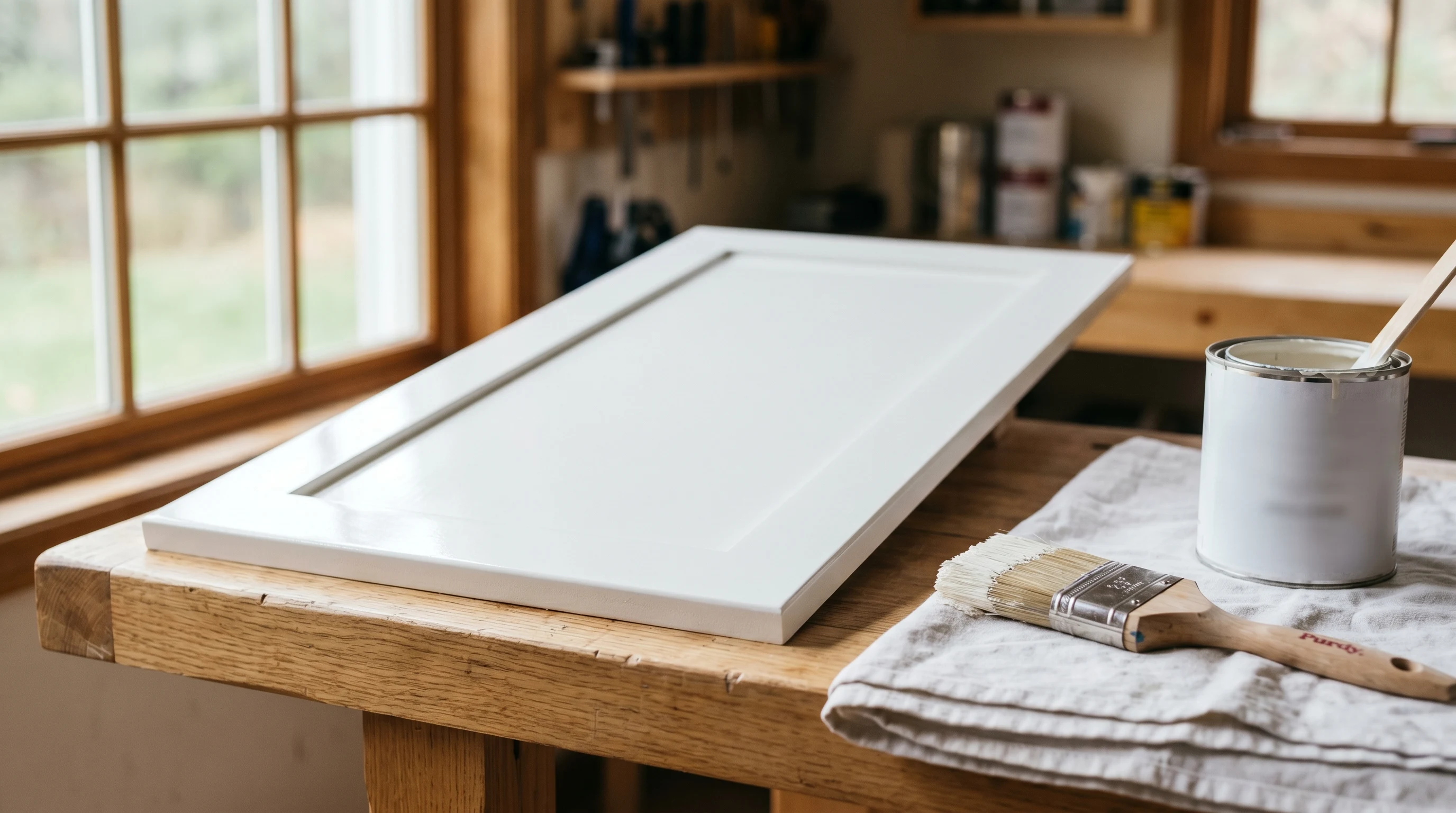
Open a freshly painted cabinet door at week two and run your thumbnail across the edge. If the finish dents, it’s latex. If it clicks like a piano key, it’s alkyd. The difference is the resin. Alkyd paint uses a synthetic polyester binder, chemically modified with vegetable oil, that cures by oxygen-driven cross-linking into a hard, glassy film. Touch-dry in 1 to 8 hours, recoat in 6 to 24, full cure in 14 to 30 days. At the end of that window the film is harder, smoother, and more abrasion-resistant than any acrylic latex on the market.
That hardness is why alkyd paint became the cabinet, trim, and door default in American houses for most of the twentieth century, and why even with the rise of waterborne acrylics it never quite left.
What Alkyd Resin Actually Is
The word “alkyd” is a compressed splice of “alcohol” and “acid.” The resin is a polyester (a chain built from a polyol like glycerol or pentaerythritol reacted with a dibasic acid, usually phthalic anhydride) that’s been chemically modified with a long-chain fatty acid from vegetable oil. Soybean, safflower, and linseed oils are the common ones. The oil tail dangles off the polyester backbone and gives the resin two properties that pure polyester can’t deliver alone, solubility in mineral spirits and the ability to cure in air.
That second property is the key one. An alkyd film doesn’t dry by evaporation the way latex does. It dries in two stages. First the solvent (mineral spirits, or water in the case of a hybrid) leaves. Then oxygen from the air attacks the double bonds in the oil tails and stitches them together into a three-dimensional cross-linked network. That second stage is what people mean by “cure.” The film keeps getting harder for weeks. A two-day-old alkyd surface is workable. A three-week-old alkyd surface is bulletproof.
Why It Self-Levels and Why That Matters on Trim
Latex paint thickens fast as the water flashes off. Brush marks set before they have time to smooth. Alkyd paint stays open for fifteen or twenty minutes after the brush leaves the surface. Capillary forces pull the wet film flat while it sits, erasing brush strokes and leaving a glassy surface that looks sprayed even when it was brushed by hand.
That self-leveling behavior is what made alkyd the cabinet and trim paint. A panel door has flat fields and recessed panels that a roller can’t reach, so you brush them. With a quality latex you can see every brush stroke six months later in the right light. With an alkyd you see a mirror. The professional cabinet finishers I trained with would brush a kitchen with traditional oil enamel through the 1990s precisely because the customer couldn’t tell it wasn’t sprayed.
Traditional Solvent-Borne vs. Waterborne Alkyd Hybrid
The cabinet world split in two starting around 2008. Benjamin Moore Advance shipped in 2009 as the first commercially successful waterborne alkyd, followed by Sherwin-Williams ProClassic Waterborne and a wave of imitators. Both families use alkyd resin and cure the same way — oxygen cross-linking the oil tails — but the carrier is water, not mineral spirits.
| Traditional Alkyd | Waterborne Alkyd Hybrid | |
|---|---|---|
| Carrier | Mineral spirits | Water |
| VOC | 380–550 g/L | 50–250 g/L |
| Yellowing | Noticeable in low light | Minimal, even on whites |
| Self-leveling | Excellent | Very good |
| Final film hardness | Highest | High (close, not equal) |
| Cleanup | Solvent | Soap and water |
The traditional solvent-borne can still wins on absolute hardness and leveling, especially on a horizontal surface like a stair tread. The waterborne hybrid wins on yellowing, smell, cleanup, and being legal to sell in California and a dozen other states where VOC limits killed the traditional formula. For a kitchen cabinet repaint in 2026, waterborne alkyd is the answer ninety percent of the time. The remaining ten percent is high-traffic floor work and shop-applied factory finishes where the smell isn’t a problem.
Where Alkyd Still Earns Its Keep
Use alkyd for cabinets, doors, jambs, baseboards, crown, banisters, stair treads, and built-in shelving. Anywhere a finger or a shoe or a vacuum cleaner is going to repeatedly hit the surface. The hard cure resists abrasion, scuff, and chemical attack from cleaning products in a way that even a top-shelf acrylic doesn’t quite match.
Skip alkyd on bedroom walls and living-room ceilings. Walls don’t need that hardness and the cure time slows the project down for no reward. Skip it on exterior siding too. Alkyd embrittles under UV after a few years and starts cracking, which is why every premium exterior on the market is 100% acrylic. Match the binder to the abuse the surface will take.
Common Mistakes With Alkyd Paint
A few patterns show up over and over in the cabinet repaints people regret.
Reinstalling hardware at day three. The film is touch-dry but nowhere near cured. Hinges screwed back on too early leave permanent compression rings in the finish. Wait a full two weeks before any hardware goes back on, longer if the room is cold.
Recoating waterborne alkyd like it’s latex. A second coat at the two-hour mark on Advance or ProClassic Waterborne lifts the first coat into ropes. The first coat has skinned over but the cross-linking hasn’t started. Read the can — the recoat window is usually 16 hours, not 4.
Brushing it like latex. Alkyd self-levels if you let it. Going back over a tacky stroke at minute eight to “fix” a brush mark drags the skin and leaves a worse one. Lay the paint down, tip it off once, walk away.
For the deep version, see the oil-vs-water comparison and the kitchen cabinet round-up for SKU picks.