What Is Urethane Paint?
Urethane paint cures through a chemical reaction, not evaporation, into a film hard enough for fleet trucks and kitchen cabinets. Here's the chemistry, the label words, and the numbers on the can.

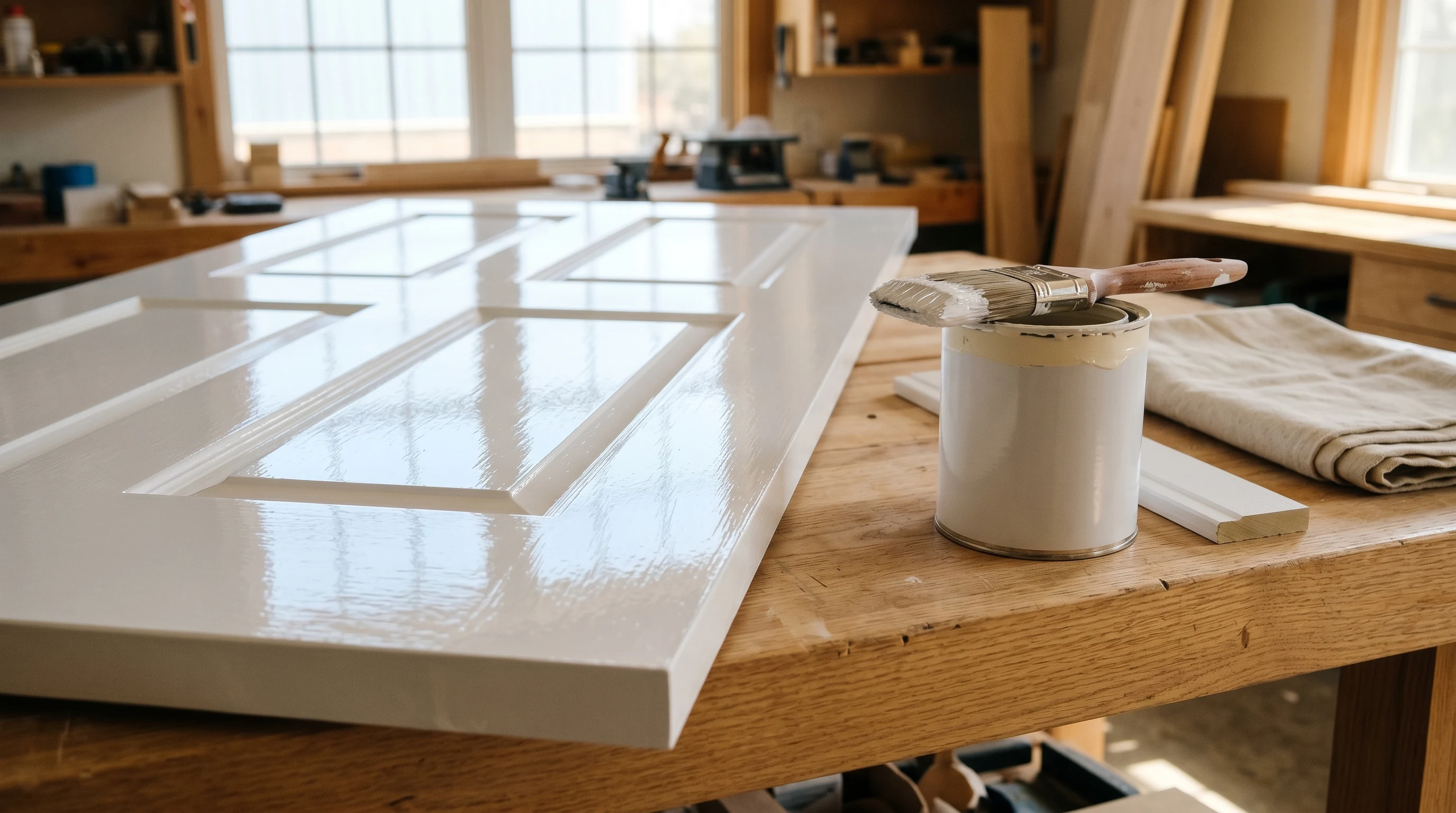
Drop a steel ball bearing onto a cured urethane trim panel and it bounces. Drop the same bearing onto a top-shelf acrylic latex of the same thickness and it leaves a small dent. The difference is one bond type in the binder. Urethane paint uses a resin built around the urethane linkage, formed when an isocyanate group reacts with a hydroxyl group, and that bond cures into a film harder, denser, and more chemical-resistant than anything an evaporating acrylic can produce. Touch-dry in 1 to 4 hours depending on chemistry, recoat in 4 to 12, full cure in 5 to 30 days.
That hardness is why urethane paint runs the cabinet shop, the trim package on a custom build, and the side panel of every box truck on the highway.
What a Urethane Bond Actually Is
The word “urethane” describes a chemical group, not a finished product. It’s the bridge that forms when an isocyanate group (-N=C=O) reacts with a hydroxyl group (-OH). The reaction stitches two molecules together and releases nothing — no water, no solvent, no byproduct. That is unusual. Most film-forming reactions in paint release something as they cure, and that something has to leave the film, which is why most paints shrink and stress as they dry.
A urethane bond also happens to be one of the strongest bonds you can build into a polymer at room temperature. It’s stiff but slightly flexible, which is why polyurethane shows up in everything from skateboard wheels to spandex. In a paint film that combination reads as hardness without brittleness. The cured surface resists abrasion, doesn’t crack when the substrate moves, and shrugs off household chemicals that strip a less cross-linked finish.
The Three Urethane Families You’ll Actually Buy
Urethane paint isn’t one product. It’s three distinct chemistries that share the urethane bond and almost nothing else about how you use them.
| Waterborne Urethane-Acrylic Hybrid | Single-Component Polyurethane | Two-Part (2K) Isocyanate Urethane | |
|---|---|---|---|
| Examples | SW Emerald Urethane Trim Enamel, INSL-X Cabinet Coat, PPG Break-Through! | Oil-modified urethane varnish, spar urethane, floor poly | Awlgrip, automotive refinish, fleet enamel |
| Carrier | Water | Mineral spirits | Mineral spirits or strong solvent |
| Cure mechanism | Coalescence + urethane cross-link | Moisture pulled from the air | Isocyanate + polyol mix |
| VOC | 50–250 g/L | 350–550 g/L | 250–700 g/L |
| Pencil hardness | roughly 2H–4H | 3H–5H | up to 9H |
| Pot life | None (open can) | None (open can) | 2–4 hours after mixing |
| Dry to touch | 1–2 hours | 2–4 hours | 1–2 hours |
| Full cure | 14–30 days | ~7 days | 5–7 days |
| Where it’s used | Cabinets, trim, doors | Floors, wood, exterior | Fleet, marine, automotive |
| Who applies it | Homeowner or pro | Pro or experienced DIY | Industrial sprayer only |
The waterborne hybrid is what Sherwin-Williams Emerald Urethane Trim Enamel actually is, and it’s the category that grew the most over the last decade. The acrylic backbone gives you brushability, low VOC, and soap-and-water cleanup. The urethane segments grafted onto that backbone give you the cabinet-grade hardness that pure acrylic can’t reach. You sacrifice maybe ten percent of the absolute durability a true 2K urethane would deliver, and in exchange you get a paint a homeowner can buy and brush.
The single-component polyurethane is the old-school spar varnish family, modernized. It cures by pulling moisture out of the air to react with the isocyanate already in the can. It’s the right choice for an interior wood floor, a stair tread, or an exterior door that needs more film than a hybrid can build — and if you’re buying the clear version for a deck rail or a boat trim, read what spar urethane is first, because the flexible spar formulas cure softer on purpose.
The 2K isocyanate system is the industrial endpoint. You mix Part A (the polyol) with Part B (the isocyanate) in a measured ratio, spray within the pot life, and the film cures into something close to glass. This is what’s on the side of a UPS truck and the deck of a sport-fishing boat. The catch is the isocyanate itself — free isocyanate vapor is a respiratory sensitizer, and even one bad exposure can leave a sprayer unable to work around the chemistry again. Body shops use supplied-air respirators, not cartridge masks. This is not a homeowner product.
Why It Cures Harder Than Acrylic
A standard acrylic latex film forms by coalescence. Water evaporates, the dispersed acrylic spheres pack together, and as they sit they slowly fuse into a continuous film. The bonds holding that film together are weak intermolecular forces — van der Waals attractions between polymer chains. The chains can slide past each other under load, which is why a fingernail dents acrylic at week six.
A urethane film cross-links chemically. The polymer chains aren’t just lying next to each other, they’re bonded to each other through the urethane group. To deform the film you have to break covalent bonds, not just nudge chains apart. That’s the bouncing-ball-bearing test. It’s also why a urethane trim package on a beadboard wainscot survives a kid’s bicycle handlebar on the way to the garage, and an acrylic one wears a permanent gouge.
There’s a lab number behind that story. The pencil hardness test drags graphite of a known grade across a cured film at 45 degrees and records the softest pencil that cuts in. A pure acrylic latex enamel typically lands around 2H to 3H. A waterborne urethane-acrylic hybrid moves up to roughly 4H, and a catalyzed 2K polyurethane can reach 9H — the top of the scale. One or two steps on that scale doesn’t sound like much, but hardness rises steeply, and the same jump shows up in block resistance, which is the property that decides whether a painted door sticks to its stopped jamb on a humid August night.
What This Means When You’re Buying Paint
Here is where the chemistry meets the shelf. Very few cans say “urethane paint” outright. What you’ll read instead is one of four label phrases, and they don’t mean the same thing:
- Urethane alkyd — an alkyd resin with urethane segments built into it. Hard and fast-curing, but it still oxidizes like an alkyd, so it will drift amber in a dark closet.
- Acrylic urethane or urethane-modified acrylic — the waterborne hybrid described above. Best all-round pick for interior trim, doors, and cabinets.
- Waterborne alkyd — not a urethane at all, though it sits on the same shelf and brushes the same way. Benjamin Moore Advance is the well-known one, and it is genuinely good; it just cures by oxidation rather than urethane cross-linking, and it lays down thinner, at 3.6 wet mils to 1.3 dry.
- Polyurethane on a clear can — a topcoat, not a color coat. It goes over stain or paint, not instead of it. If you’re deciding between that and the acrylic version, polyurethane vs polycrylic covers where each one belongs.
Expect to pay roughly double a good wall paint per gallon, and expect less coverage. A waterborne urethane trim enamel runs about 30 to 32 percent volume solids and is rated at 350 to 400 square feet per gallon at 4 wet mils. Wall paint is often 35 to 40 percent solids and covers 400 or more. The mil thickness math matters more than it does on a wall, because urethane’s durability claims assume you actually built the film — two coats landing near 2.6 dry mils. One thin coat brushed out to save paint gives you a urethane price and an acrylic-grade result.
The other thing to budget is time, not money. A urethane hybrid is touch-dry fast and hard slowly. Reinstalling cabinet doors at day three, before the film has finished cross-linking, is the most common way a good job goes wrong — the bumpers print into the still-soft finish and leave permanent circles. If that sounds familiar, dry time vs cure time has the full schedule.
Where Urethane Earns Its Keep
Use urethane on cabinets, interior doors, trim, jambs, banisters, stair treads, built-in shelving, and any other interior surface that takes repeated impact, abrasion, or cleaning-product exposure. The waterborne hybrid is the right choice ninety percent of the time. Step up to a single-component polyurethane for floors and stair treads where the film needs to take shoe traffic. Step up to a 2K system only when you’re spraying a fleet vehicle, a boat, or a piece of factory-finished casework — and only with the respirator gear to do it safely.
Skip urethane on bedroom walls and living-room ceilings. It cures slower than acrylic and costs roughly double per gallon, and walls don’t need any of what urethane delivers. The reason for that is straightforward: a wall takes occasional wiping, not the per-day abrasion a cabinet rail or a door jamb sees, and a good acrylic wall paint already clears the scrub-resistance bar for that duty. Match the binder to the abuse the surface will take. That’s the whole principle — and it’s the same principle behind cabinet paint vs wall paint.
Three Ways People Ruin a Urethane Job
Overworking the wet film. Urethane hybrids self-level for ten to fifteen minutes. Brushing back into a section that has started to set tears the leveling film and locks in stroke marks that would have flowed out on their own. Lay it on, tip it off once, walk away.
Missing the recoat window. Every urethane has a period during which the next coat chemically bonds to the last. Miss it and the second coat is only sticking mechanically. Two-part and solvent urethanes are the strictest here — past about 18 hours you have to scuff-sand between coats or the layers can delaminate later.
Painting cold. Cross-linking is a chemical reaction, and reaction rates fall off fast below about 50°F. A urethane applied in an unheated garage in November may feel dry and still be soft weeks later, because the film never got warm enough to finish the reaction it started.
For SKU picks, see the kitchen cabinet round-up and the interior trim round-up. For a head-to-head on which resin belongs on your trim, read urethane vs acrylic enamel.
Ask a Question