How to Paint Over Smoke Damage
Painting after fire takes more than fresh paint. TSP-PF wash, two coats of BIN shellac primer to seal soot and odor, then two coats of topcoat. Here's the sequence.

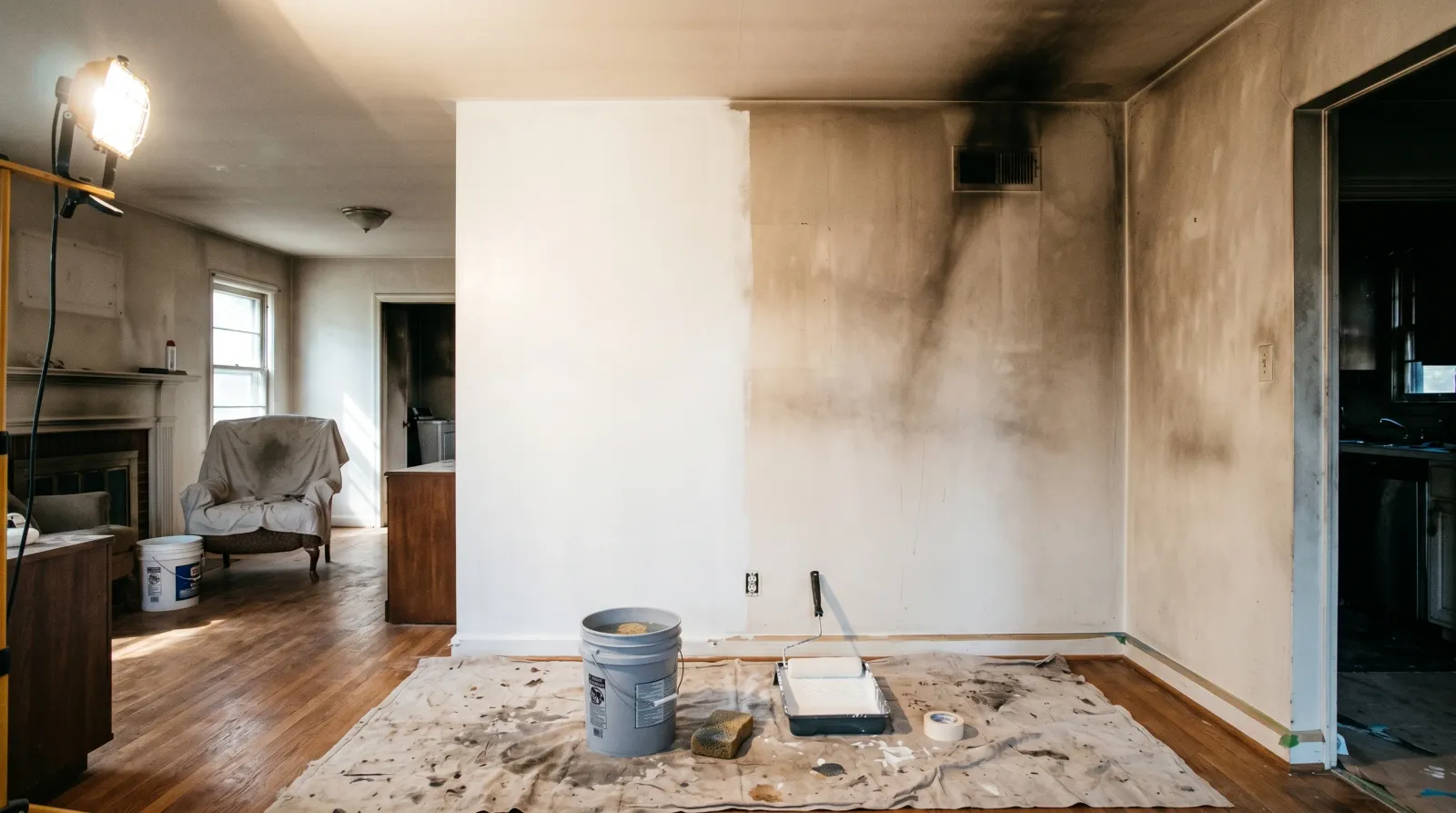
A grease fire on the stove, an electrical short in a wall, a candle left burning on a shelf. The flames are out, the firefighters are gone, and the whole back half of the house wears a grey-brown film and a smell that hits you the second you open the door. That’s smoke damage. Painting after fire is the visible end of the job, but it’s not where you start.
Painting over soot with latex is the most common mistake on this job, and it fails fast. The brown bleeds back through the white. The smell creeps out through the dry film for months. This page is the sequence that actually holds.
Does This Match What You’re Seeing?
Fire residue looks like a few different things depending on what burned. Get the diagnosis right or the fix is wrong.
- Grey-brown film across whole walls and ceilings, worst at the top of the wall and crowning around vents and door frames. Wipes off onto a dry chemical sponge in dark streaks. That’s standard wood-and-paper soot from a typical structure fire. The fix on this page works.
- Black greasy film concentrated above the stove or fireplace, sticky to the touch. Protein and grease residue from a kitchen burn or unvented combustion. Same fix, but the wash step is harder and the odor load is higher. See the kitchen grease seal page for the prewash.
- Yellow-amber film with no particulate, mostly even across walls. Not fire residue. That’s nicotine. See how to block nicotine stains.
- Dark plastic-smelling residue with a chemical edge, sometimes oily. Plastics or synthetic burn. Stop. Call a restoration contractor. The toxicology is past a DIY paint job.
Wipe a damp microfiber across the wall. If it comes back grey or brown and gritty, you have soot. If the smell is woodsmoke and char rather than chemical, you’re in DIY range. Move on.
How Serious Is This
That depends on what burned and how much of it. Cosmetic smoke from a contained kitchen flare, no structural damage, no plastics in the burn — same-weekend fix for the visible part of the job, plus a week of airing out for the smell. Single room, two coats of primer, two coats of finish.
Whole-house smoke from a real structure fire is a different conversation. The drywall and insulation behind the paint hold the smell too, and no primer reaches through three layers. That’s a tear-out job, not a paint job. If smoke ran through the HVAC ducts, those need professional cleaning before primer hits the walls. If anything plastic or synthetic burned, get a certified restoration estimate first.
One more thing. Pre-1978 homes often hide lead paint under the soot. Test for lead before you touch a sander. EPA RRP rules apply.
Why Soot Bleeds Through Latex
Smoke residue is a fine carbon particulate carrying burnt-organic compounds and condensed combustion byproducts. The particles are sticky and chemically active when wetted. Roll a water-based primer over them and the water mobilizes the soluble fraction, the carbon hitches a ride into the wet film as the water evaporates, and the stain comes back to the surface as the film cures.
Odor works the same way. The smell of fire isn’t airborne particulate alone; it’s bound to the residue and to the porous substrate underneath. Latex paint forms a permeable film once dry. Odor molecules pass through it the way water vapor passes through a breathable wall coating. The room still smells like a fire a month later.
Alkyd primer helps with the visible stain but loses to odor. The mineral-spirit carrier doesn’t dissolve carbon as aggressively as water does, so the brown bleeds less. The cured alkyd film is still semi-permeable to volatile organics, though. The smell finds its way through.
Shellac is the answer because of what it’s mixed with and how it cures. Worth a quick word from David.
A Note From David Chen on Why Shellac Is the Odor Barrier
Smoke residue is two problems in one coating. The visible half is carbon and burnt-organic deposit sitting on the substrate. The invisible half is a swarm of volatile organic compounds (aldehydes, phenols, polycyclic aromatics) adsorbed onto every porous surface in the room. A paint film has to seal both.
Shellac is suited to this. The natural resin dissolved in denatured alcohol cures into a tight, glassy, low-permeability film. Carbon particles can’t physically migrate through it. Volatile organics can’t pass through it at any practical rate either, because the same density that blocks particle migration blocks small-molecule diffusion.
Two coats matters because of statistics. One coat of any primer has microscopic pinholes, places where the film flowed thin around substrate texture or where a bubble collapsed and left a void. A second coat lands those defects on top of intact film from coat one. The combined barrier is dramatically less permeable than either coat alone.
That’s why fire restoration specs call for shellac at two coats. The chemistry seals the stain on coat one. The redundancy seals the odor on coat two.
Back to Mark.
The Fix
Step 1. Dry Soot Removal, Then TSP-PF Wash
Don’t wet the soot before you can. Dry-wipe first with a chemical dry sponge (vulcanized rubber, sold as a soot sponge at any paint store). Work top to bottom, long strokes, rotate to a clean face when the sponge loads up. This lifts the bulk of the loose particulate without smearing it into the paint.
Then the wet wash. Mix TSP-PF (the phosphate-free version) at label strength in warm water, sponge on top to bottom, three-foot sections, let it sit thirty seconds, wipe with a clean cloth before it dries. Change the rinse water often. It’ll turn black inside ten minutes. Then a second pass with clean water to lift the residue.
Let the walls dry overnight before priming. Twelve hours minimum at 65°F. Wear gloves, eye protection, and an N95 minimum — soot is a respiratory irritant and you don’t want it in your sinuses for a week. Never mix TSP or any household cleaner with bleach, ammonia, vinegar, or hydrogen peroxide. Those combinations produce toxic gas, and you do not need a second indoor air problem on top of the first.
Step 2. Two Coats of BIN Shellac Primer
Zinsser B-I-N is the white-label can. Shake it hard, pour into a clean tray, roll it on with a 3/8 inch nap microfiber. Cut in with a synthetic brush, then roll while the cut-in is still wet. Don’t stop in the middle of a wall. Lap marks set fast in shellac and they show through any topcoat.
Touch-dry in 15 minutes, recoat in 45 at 70°F. Apply two coats. Not one. Two. The first coat seals the visual stain. The second coat is the odor barrier. Without it, smoke smell finds the pinholes and leaks through to the topcoat. This is the step where homeowners try to save a can of primer and end up redoing the room a year later. Don’t skimp on the BIN coverage.
Ventilate hard. Cross-flow if you can get it, an organic-vapor respirator if you can’t. The alcohol fumes are sharp until the film flashes. Kids and pets out of the building for the day, not just the room.
Step 3. Two Coats of Topcoat
Once both coats of BIN are dry, standard interior latex goes on top. Two coats, four hours between, your chosen sheen by room. Eggshell on walls, flat on ceilings, semi-gloss on trim if the trim got hit by smoke too.
Cut in the corners first, roll while the cut-in is still wet, lay off in long vertical strokes. The shellac has locked the soot and the smell. The topcoat is just color and finish now. Same rules as any repaint.
Recommended Product
Zinsser B-I-N Shellac-Base Primer. Two coats is the fire-restoration spec. One gallon covers about 350 square feet at one coat, so a typical bedroom takes a gallon for both coats. Buy two cans if you’re doing more than one room. Don’t substitute.
Find it on Amazon · Zinsser brand review
Prevention
You can’t really prevent smoke damage from a fire that already happened. What you can do is finish the job once so you’re not back here.
Replace porous soft goods that took heavy smoke: carpet, padding, drapes, upholstered furniture, mattresses. Have the HVAC ducts professionally cleaned before you run the system again. Those ducts are a soot reservoir that re-coats the freshly painted walls every time the blower kicks on. Change the furnace filter and run a HEPA air purifier for a couple of weeks.
For the next stove fire, smoke alarms in every sleeping area and a Class K extinguisher in the kitchen. Cheap insurance.
When to Call a Pro
- Whole-house structural fire, or smoke that ran through the HVAC ductwork to rooms that didn’t burn. Restoration contractor, not a paint job.
- Any fire involving plastics, electronics, or wiring. The residue chemistry includes compounds you don’t want to handle without proper PPE and containment.
- Pre-1978 home where the existing paint is chipping or chalking under the soot. Lead test first. Do not dry-sand. EPA RRP rules apply.
- Smoke smell that persists after two coats of BIN and two coats of finish. Means the contamination went through the drywall into the studs and insulation. That’s tear-out territory.
- Anyone in the household with asthma, COPD, or chemical sensitivity. The cleanup phase puts particulate in the air no matter how careful you are.
Ask a Question